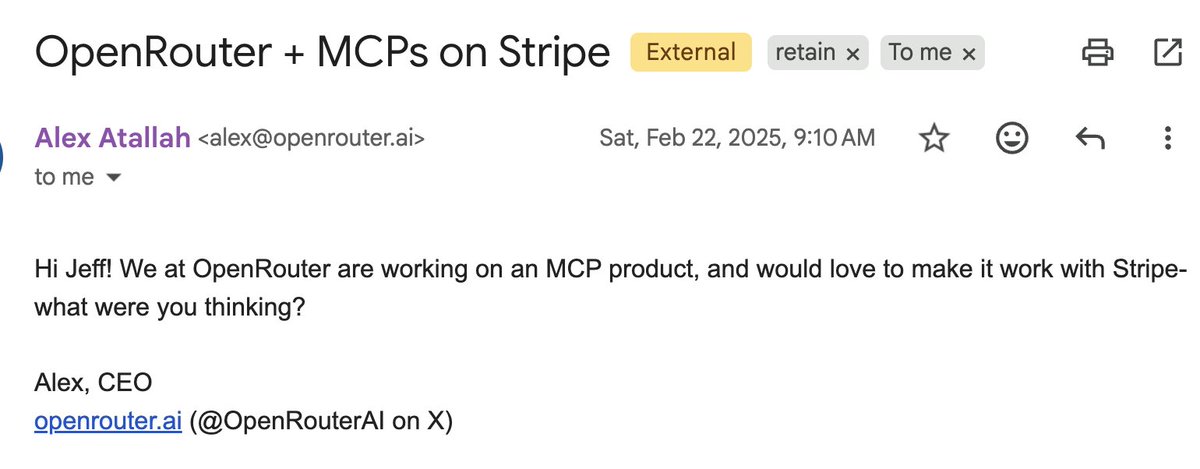
Warm intro at scale is basically getting people to forward your cold email.
1/ Find people with one degree of connection to whoever you need
2/ send them your cold email
3/ Ask them to forward it.
One person in a round could get the same email from 5-7 different sources. They'd see it so many times that they'd think they should talk to you.
All you need is enough social proof that the person on the other side feels like the market already knows you.
@duongphat99@web3wiz284 Timing matters less than relevance. Try Tue-Thu mornings in their timezone, then test it. Before you send, check whether they can tell in five seconds why you picked them and what you can help with.
https://t.co/IYf8IyM2Cj
Sent 30 cold emails and heard nothing back?
Before sending another 30, read the last one from the recipient’s side.
Can they quickly tell why you chose them, what you can help with and how to reply?
.@ivanburazin just grew @daytonaio from $1M to $100M in 4 quarters. But he still had to cold email 600 people to raise his pre-seed:
"For our pre-seed party round, I reached out cold to 400-600 people. And these weren't randos. It was a market map of people who invest in this kind of thing.
You just cold email the hell out of it. Multiple times. For events, we'd cold email 100 people to get 20.
People are scared to send emails. I don't know why. And people send really bad emails.
If it's long, it's bad. I'm not reading that. The longer, the worse.
When my team sends me a draft, I say, "Why the hell did you write this?" They say, "I want to explain everything." I say, "They don't have time."
Write it like a tweet.
The subject has to make them open it. Then one long sentence. "You're an infra founder. We're building new infra. You might be interested. We've raised from this person, this person and this person. We have revenue X, and we've raised this much of the round."
"I'm raising $1 million and I have $600k" is a very different signal from "I'm raising and I have nobody."
"If you're interested, let me know."
That's the whole email.
Usually I don't even send the deck. Plain text. No HTML, no unsubscribe link, none of that."
@Nizarkank Fewer, sharper touches beat volume: 10 unique messages written around each buyer's problem will outconvert 100 copy-pastes. Start with a tight list of who needs you now. See how @shl makes the case for it.
https://t.co/3xII2204Vy
Sending 100 copy-pasted cold emails in one hour: 1% conversion rate.
Sending 10 unique cold emails in one hour: 80% conversion rate.
Plus you’ll have practiced your writing skills, and done more research on the people you’re trying to help.
@L0cCapital@RagnarokExee@NamanyayG Research is the hook, not the pitch. Lead with one specific detail that matters to them, then ask for something small like a yes or no. See how @salesxsaas frames it: it's about them, not you.
https://t.co/tXN3XHYpyC
This is your competition (all wrong)
*5-8 sentences is overkill for 1st cold email
*it’s not about YOU it’s about them
*personalization must = relevance
*spurring curiosity > selling yourself
*write like an industry expert/consultant
I get close to 1,000 emails a week.
Want a VC to reply to your cold email?
-Cut it in half
-Why this firm should care
-Why you + your progress
-Don't have a bad name
Little things matter: name, .com, logo, product, how you show up. It all counts.
A lady named Kyley on TikTok shared the best cold email she ever received from someone. I think it's worth saving and using as inspiration. You can copy the structure, tweak it to fit your situation and make your cold emails more effective.
While I 100% believe every sales org needs to be cold calling & utilizing LinkedIn, cold email remains the most effective way to engage top executives.
- cold calling for info gathering below the line
- LinkedIn for nurturing across org
- cold email for engaging above the line
new cold email opener unlocked: "heard you on 'x' podcast say 'y' was killing you, here's a few things we can do for you."
the possibilities of finding your core ICPs pain points are endless from here.
Gojiberry (YC) went from 0 to 4,000+ paying customers in under a year by doing the opposite of what most people recommend.
We only ran one channel at a time. We didn’t add the next one until the current one was clearly working.
0 → 100: Pure outbound.
Cold email + LinkedIn using an early version of our own product. No brand, audience, or content. Just finding people showing intent and starting conversations. Ugly, manual, and it worked.
100 → 250: Reddit.
Educational posts in SaaS subreddits. 10M+ organic views. Traffic quality was mixed, but the volume filled the trial funnel for months. Cost: basically zero.
250 → 750: Content + free blueprints.
LinkedIn, YouTube, motion videos, and giving away our internal systems as free blueprints. Content got the reach. Blueprints built the trust. Founder-led content started compounding here.
750 → 1,500: Partnerships + X.
B2B influencers, sponsored newsletters, X, and a lifetime affiliate program that became a real lever. YC happened around this point and everything accelerated.
1,500+: Paid + hiring.
Meta, Google, influencer agencies, and the first real hires across growth, sales, engg, and product.
Every previous channel still runs. We just never started the next one until the current one was working.
Teams usually try to run 4–5 channels at once and wonder why none of them work.
What’s the one channel you’d actually double down on right now instead of spreading yourself thin?
I just uncovered $2 MILLION worth of construction projects we would’ve NEVER known existed. 🤯💰
No paid ads.
No cold calling.
No waiting for referrals.
I built a GROK AI bot that finds potential clients and helps me reach them automatically.
Here’s exactly how I did it. 👇
STEP 1: I CREATED A GROK BOT
I named it “COLD OUTREACHER.”
Its job?
Help me find the people who can potentially bring business to my company.
Not random people.
DECISION MAKERS.
People who have the authority to award projects, request proposals, or introduce us to new opportunities.
STEP 2: I CONNECTED GROK WITH HUNTER
Hunter helps find and verify professional email addresses.
I gave my bot very specific instructions.
Find people based on:
Their profession.
Their job title.
Their responsibilities.
Their industry.
Their geographic location.
The goal wasn’t to contact EVERYBODY.
It was to find the RIGHT people.
STEP 3: I AUTOMATED MY EMAIL OUTREACH
I configured my email to send a maximum of 50 targeted emails per day.
But here’s where most people get it wrong.
They think cold outreach means blasting thousands of people with generic emails.
That’s NOT what I’m doing.
Every email has to sound like ME.
Short sentences.
Straight to the point.
No corporate nonsense.
No five paragraph introductions explaining how amazing our company is.
Just a clear offer and a compelling reason to respond.
STEP 4: THE RESPONSES STARTED COMING IN
And this is where things got interesting.
People we would’ve NEVER contacted started responding.
Conversations started happening.
And suddenly, we were getting opportunities to bid on projects we didn’t even know existed.
Approximately $2 MILLION worth of potential construction projects so far.
Let that sink in.
These are projects we weren’t even competing for before.
And that’s what got me thinking.
How many MILLIONS of dollars in opportunities have we missed simply because the right people didn’t know our company existed?
How many contractors are sitting around waiting for the phone to ring while projects are being awarded to companies that actually reached out?
Here’s the lesson.
You can have the BEST prices.
The BEST employees.
The BEST service.
But if nobody knows you exist, NONE of that matters.
And this doesn’t just apply to construction.
If you’re a distributor, manufacturer, importer, consultant, contractor, or business owner, you should seriously consider cold outreach.
AI isn’t going to replace your ability to sell.
But it can help you get in front of people you would’ve NEVER reached otherwise.
Stop waiting for opportunities to find you.
Start putting yourself in front of them.
Because sometimes ONE email is all it takes to change the trajectory of your business 🙏🏼.
last night I presented this workflow at my friends GTM engineering event in SF
this event is invite only and I can't even say the event's name because of some fight club rules
but I presented this workflow to monitor 100+ LinkedIn accounts of your competitors and steal their leads from who engages with these accounts
these leads are so good
no body engages with your competitors unless they're about to start buying from them let's be real
this flow extracts the net new engagers daily automatically
then does a waterfall enrichment to find emails, phone numbers, company size,
and then it will save it to a postgres database
and then you can old DM them on LinkedIn with HeyReach and also cold email them on Instantly AI and like build pipeline for your sales org
and all this runs automatically in the background 24/7, it can be shipped in 5 minutes and literally anyone with a claude code subscription can set it up right now
just give you agent this skill URL - https://t.co/d4RVfeDtvx
and say set it up for me
it will walk your through everything
I'm BEGGGGING you man: buy your 2027 cold-email domains BEFORE you need them.
Our strongest thesis right now is slow acquisition. Buy ahead, let them babies age, track if they're being listed on Spa-mHaus, and give yourself time to see what you're actually putting into production.
We're still buying mostly .com + .co. We're also buying selected cheaper TLDs at roughly $2-3 per domain and seeing around 70–80% remain unlisted as they age.
Here's how we're buying going into 2027:
1. Understand who's doing the listing.
Validity's Heatwave dashboard shows how many domains get listed on a daily basis.. 5,136 just today.
2.3M domains listed, pre-listed AND under-watch domains. Those are Heatwave figures though so not Spamhaus totals.
Spa-mhaus has an active collaboration with V-alidity led to roughly a million cold-email domains being listed from late Aug 2026. This is already happening at scale.
2. Buy 30–90 days ahead.
- Our minimum holding period: 30 days
- Our preference when we can plan ahead: closer to 90
- No immediate outbound
- No need to create mailboxes the day we register
- Check listing status throughout the holding period
Spamhaus's ZRD dataset showsyou newly reg'd or newly observed domains for 24 hours.
Guidance by Spamhaus also tells you they have heightened scrutiny during a domain's first 30 days.
So cheap TLD + provision mailboxes within the day day or two on that cheap TLD or even a .com = very likely to get listed, they also grade domains on age and synthetic warming, mf'ers are smart, we're playing cat mouse with multiple multi billion dollar orgs, and we will win.
But this doesn't mean your domains become trusted on day 31 like magic.
New-domain guidance.
If you hold a domain for three months, you've got roughly nine months left before its first annual renewal.
Plan the purchase around when you'll actually need the capacity.
3. Stop buying the same name 100 different ways.
We're avoiding batches built around the same words with a prefix or suffix changed:
- xyzgroup
- xyzcapital
- xyzconsult
- xyzpartners
Spamhaus's April–September report ranks these among trending terms in newly registered domains:
- group: rank 5
- consult: rank 10
- capital: rank 12
- partner: rank 18
We're comfortable using unbranded domains. The sender identity still needs to make it clear which business is contacting someone.
Brother, i'm buying random ass domains and they perform just as well.
Debt offers getting sent out from immulatestars(.)co
It peforms.
Our decision is to stop buying repetitive batches built around them. The report also explicitly tells registrars to investigate related registration patterns.
4. Keep .com + .co as the majority.
Test cheaper TLDs in smaller cohorts.
The same Spamhaus report showed .info listings rising 248% while new .info registrations fell 52%.
That's why we're avoiding additional .info exposure (for now), even while testing other cheaper options.
Track the economics of each batch:
- Registration cost
- Renewal cost
- Number still unlisted after the holding period
- Cost per domain that passes your checks
- What happens after actual sending begins
For example, 100 domains at $2–3 costs $200–300.
If 60–80 remain unlisted, that's $2.50–5 per unlisted domain before mailbox costs. A low purchase price only tells you part of the story.
5. Separate aging from synthetic warmup.
A domain sitting unused for 90 days and a mailbox exchanging automated warmup messages are doing different things.
Heatwave's published policy targets synthetic warming.
It can also pre-list registered domains associated with a related warming operation before those domains send. Aging alone doesn't prevent that, and a green warmup score doesn't override a listing.
6. Acquire gradually and keep a proper inventory.
Buy manageable cohorts against future demand. Choose reputable registrars; using several can spread operational dependency, but we don't treat registrar diversity as protection from listing.
Record:
- Domain + TLD
- Registrar + registration date
- Acquisition + renewal price
- Earliest deployment date
- Mailbox creation date
- Latest Spamhaus + Heatwave checks
- Actual sending history
- Reason it's approved, held or rejected
7. Investigate problems before deploying more domains.
Keep an aged reserve, check authentication before deployment, and ramp volume gradually. Watch complaints, bounces and actual responses at the domain level as well as the mailbox level.
For our existing mailbox layouts, our internal cold-send ceilings are:
- 25 mailboxes per domain: 2-10 cold emails per mailbox per day, the less the better, everyone wants to get the most send for their buck so then you have tolerate getting hit more often.
Buy earlier. Track each cohort. Let domains age. Deploy only after checking what survived and what you're asking it to do.
Alex Hormozi on lead magnets in cold outreach:
according to him, it’s the #1 response rate booster in cold outreach.
but a lot of people hear "lead magnet" and send a generic PDF.
generic PDFs WILL NOT WORK.
free work is what works.
it takes real effort from your team, so not a lot of people are willing to do it.
that's exactly why the prospect sees it as extremely high value.
i personally know people who built entire branches of their agency just to fulfill free work.
the full breakdown is in my article below:
If I forgot everything I know about outbound tomorrow:
Here's exactly how I'd email my entire market again, templates included.
1/ PICK 3 DREAM COMPANIES
Dream companies are the customers you'd clone 10,000 times.
Copy the "About" section from each of their LinkedIn pages, word for word.
Pull out the words they use to describe themselves, and turn them into 3-5x more search keywords than you think you need.
Those keywords find companies like them far better than any industry filter.
2/ PULL THE WHOLE MARKET
Set Apollo broad (industry plus one tech filter) and search by those keywords.
Multiply the raw contact count by 0.7, because that's roughly what survives enrichment and verification.
Then work out your volume:
(verified contacts ÷ 3 months) × emails per sequence = emails per month
100,000 contacts with 2 emails each = 66,666 emails a month.
3/ QUALIFY BEFORE YOU PAY FOR EMAILS
Add an AI column that summarises every company, and a second that scores it against your ICP.
Tell it what your ICP is AND what it isn't, or it starts making up reasons to qualify people.
Cut anything under an 80% match.
Raw pulls land at 50-60% qualified, and this gets you to 90-95%.
4/ FIND EVERY EMAIL
Run the waterfall in this order:
GetLeads → BlitzAPI → Prospeo → Icypeas → MillionVerifier → BounceBan (for catch-alls)
Keep the info@ and personal addresses too, and send to them from a separate instance.
5/ SET UP SENDING
66,666 a month is about 3,000 a day on weekdays.
> 15 cold emails per inbox per day = 200 inboxes
> 2 Google inboxes per domain = 100 domains
> 15 days of warmup before a single cold email
> warmup stays on, open tracking stays off
> 80% of daily volume to new contacts, 20% follow-ups
Buy the domains on Porkbun, and never send cold from your main one.
6/ WRITE ONE OFFER, THEN ONE EMAIL
Subject line: 1-3 words, lowercase.
The email:
"{Hey|Hi} {{first_name}}, {would you be interested in|open to} a free [front-end offer] for {{company}}?
PS: [social proof from their industry]"
The opt-out line:
"If you don't want any more emails from me, reply 'banana' and I'll stop."
The one follow-up:
"Quick question - are you the right person to talk to about [topic] at {COMPANY}? If not, happy to be pointed in the right direction."
7/ TEST THE OFFER FIRST
Keep every word identical except the offer.
Each version gets 1,000+ sends before you judge it.
You're looking for a 2% positive reply rate, or 20% of all replies being positive.
After 2 weeks, kill the bottom 60-70% and put the volume behind what's left.
8/ ANSWER EVERY REPLY IN UNDER 5 MINUTES
Pipe every reply into Slack, let AI tag the intent, and push positive ones to your phone.
Reply with 2-3 specific times (no Calendly link on the first reply).
When they ask about price:
"Hey {{first_name}}, pricing varies - but we typically do {PRICING MODEL, NOT EXACT COST}. Can't give you a specific number since it depends on {CUSTOMER NEEDS}. We can speak for 7-9 minutes about this briefly if you wouldn't be opposed to it. If you're open to it I'll send over an invite, if not no worries."
9/ MAKE THEM SHOW UP
The second they book, send a 1-2 minute video on what to expect.
Then reminders at 24 hours, 4 hours, 1 hour and 10 minutes before.
That takes show rates from 20-30% to 80-90%.
THE MATH
$10,000 ACV and a 20% close rate.
100,000 contacts in your market.
1 lead per 250 contacts, and 1 meeting per 4 leads.
At 10,000 contacts a month: 40 leads → 10 meetings → 2 clients → $20,000 added.
Reach your whole market every month: 400 leads → 100 meetings → 20 clients → $200,000 added.
Then re-contact the same market every 90 days with a new angle.
Run the numbers.
I've built signal-based outreach workflows hundreds of times, most people suck at it despite understanding it from a top level, here's a hyper-realistic 8 step picture of what it looks like in motion -
(this for for SMBs - doing between $50k/mo and $500k/mo selling B2B with atleast a $4-5k ACV offer)
1. Build a 3-tier sending infra
- 10 ".com" domains, 30 Google inboxes warmed up for atleast 4 weeks
- 3 LinkedIn profiles with Sales Nav Core from 3 leadership members on your team
- One cold caller/ Account executive with a power dialer
(never more than 15 emails a day on google inboxes, never more than 2 emails and have 30 smtp inboxes ready for backup, optimize for safety of inboxes more than volume here)
_______
2. Decide signals for your use case
My favorite ones are:
- Website visitors identified (rb2b)
- Partial form submissions on your webiste
- High quality accounts that signed up and dropped off before paying
- atleast 30-50 LinkedIn profiles and creators for scraped for post engagers, includes:
(1) Founders and leadership team of competitors
(2) Founders and leadership of your users/clients
(3) Top agency owners and thought leaders in the space
(4) Founders of adjacent tools in the space, even though not directly competing
- Company profiles of adjacent tools, competitors, and agencies in your space
(scrape their followers)
_________
3. Your ICP recently hired into a new role
(just build a sales navigator lead list and toggle "got hired in the last 90 days"
scrape, enrich, qualify
__________
4. Lookalikes for every single client you close
Build a simple system that connects to your database/stripe, whenever a new company above a certain threshold (ie 50 employees) becomes a user, have an agenct look for 100 extremely close look alikes to this company.
___________
5. Set up your QLS (qualified lead stream) engine
- buy any decent tool that's reliable and can run waterfall enrichment for emails and phone numbers + a separate email validation tool
- get a subscription for Exa, Serper, FireCrawl, etc
- your normal claude max subscription
- Apify that scrapes these leads from sources
_____
6. How to qualify without breaking the bank
Simple rules -
- Pull all the data you can for free from contact data providers
- Have Claude Haiku do a preliminary check for obvious non icp fits (students, interns, wrong country, etc)
- everyone gets gets pushed to sonnet
- Exa does a surface level cheap research on every lead to remove any other mis fits and removes them
- everyone else who is qualified goes through deeper research and ranked for how good a lead it is
Rank based on:
- Quality of lead (company size, budgets, role etc)
- Quality of signal (aka lead on your website's pricing is better than someone who liked a competitor's post)
_______
7. Outreach orchestration:
-> highest quality leads immediately gets assigned to a rep, get a personalized LinkedIn connext request/inmail + send to slack with phone number for AE to cold call them
-> Everyone else gets a personalized email outreach , get cold called within 5 minutes of a reply from them
-> every lead, no matter score gets uploaded to LinkedIn ads manager for a retargetting campaign
______
8. Recycle non responsive and closed lost deals
- Every quarter, every lead that did not reply gets rotated to a nameless cold email campaign with different offer and copy incase they bite
- Account exective pulls a list of closed lost deals for updates and tried to win them back with pricing/value or new features etc
____
Rinse and repeat.
Go win.
we booked 101 law firms and real estate offices in 8 weeks without pitching a single service in message one
wealthy managing partners ignore cold emails about SEO or marketing retainers because 30 agencies hit them with that before 9am
so we let chatgpt close the partner's ego before he even replied to us
heres the exact funnel:
the setup: claude code, google maps, sales navigator and eaglesend
step 1: run the ego prompt
open chatgpt and type:
"who is the best personal injury lawyer in [city]"
chatgpt names 2 or 3 local firms and leaves the other 400 attorneys in that city completely INVISIBLE
step 2: build the invisible list
we have claude code scrape google maps for every firm in that city with 20+ reviews that chatgpt left out
- pull the managing partner on sales nav
- keep the ones active on linkedin in the last 30 days
- check who has an open profile so the inmail costs zero credits
step 3: send the rival screenshot
subject line is just the partner's first name
- line 1: "asked chatgpt for the best injury firm in dallas and it recommended [rival firm] instead of you"
- line 2: "want to see why its skipping your site?"
attach the screenshot of his competitor winning the prompt
"won't he think you faked the screenshot"
he always thinks its fake for about 10 seconds
then he pulls out his own iphone at his desk and types the exact same question into chatgpt himself
when his own phone tells him the guy he hates down the street is the #1 lawyer in town, his ego snaps and he replies in 5 minutes asking how to fix it
step 4: how we turn the reply into a signed deal
- a human setter calls his office within 5 minutes of the reply
- never drop a calendly link in the chat
- pitch two specific slots: "does tuesday at 10am or wednesday at 2pm work"
- send the calendar invite while he is still on the phone
this works on plastic surgeons, med spas, commercial roofers, and wealth managers in any city on earth
find the business owners losing to a local rival on AI search and make them look at the screen