Have long admired Gazers by @MattKaneArtist
and very pleased to have acquired Gazer #271 for AB5D
This edition of 1000 was released in Dec 2021 and represents one of the important red-pill moments for me personally in understanding generative and cryptoart
🇫🇷 Another French museum robbed. The stolen paintings are valued at about €9 million
Thieves hit Renoir’s house-museum at Les Collettes in Cagnes-sur-Mer, near Nice, the estate where he spent his last years.
Two men smashed a glass door and cut canvases from the frames. They tried to take four works, but dropped one while running.
Which masterpieces were stolen has not been confirmed. Besides Renoir, the museum holds works by Aristide Maillol, Pierre Bonnard and Raoul Dufy.
The value of the stolen masterpieces is estimated at about €9 million.
The theft continues a run of museum robberies in France. The most notorious recent case was the Louvre heist of October 2025, when unique jewels were taken from the imperial collection.
Neoclouds have limited cybersecurity. Next time agents successfully go rouge, they'll try taking over a neocloud to run more copies. This is bad.
Thus: neoclouds should greatly strengthen their cybersecurity and every company with strong cyber models should help with that.
The most important shift Bitcoin introduced wasn’t just monetary — it was architectural.
Embedding incentives directly into distributed systems changed what could be coordinated at scale.
Strong discussion between @kenzi_mori and @averyching on the @BeaconLayerHQ Podcast, with some useful context on the thinking behind @Aptos.
“Bitcoin was the first distributed systems paper I read with an economic layer built into it — and that changed everything.”
@kenzi_mori catches up with @averyching, Co-Founder & CTO of @Aptos, to trace his journey from high-performance computing and supercomputers, to scaling data infrastructure at Meta, to discovering Bitcoin and realizing that crypto was distributed systems with incentives natively embedded — the insight that ultimately led him to co-found Aptos Labs.
I hate to say this but if the Chinese can fake the Chinese exclusive cards this well, pretty sure they can fake all your valuable modern English cards too
the Robinhood → GameStop → @SeiNetwork pipeline is kinda crazy when you hear the full story...
@jayendra_jog saw the limits of centralized market infra from the inside.
then went and built around them.
@kenzi_mori got a good one here.
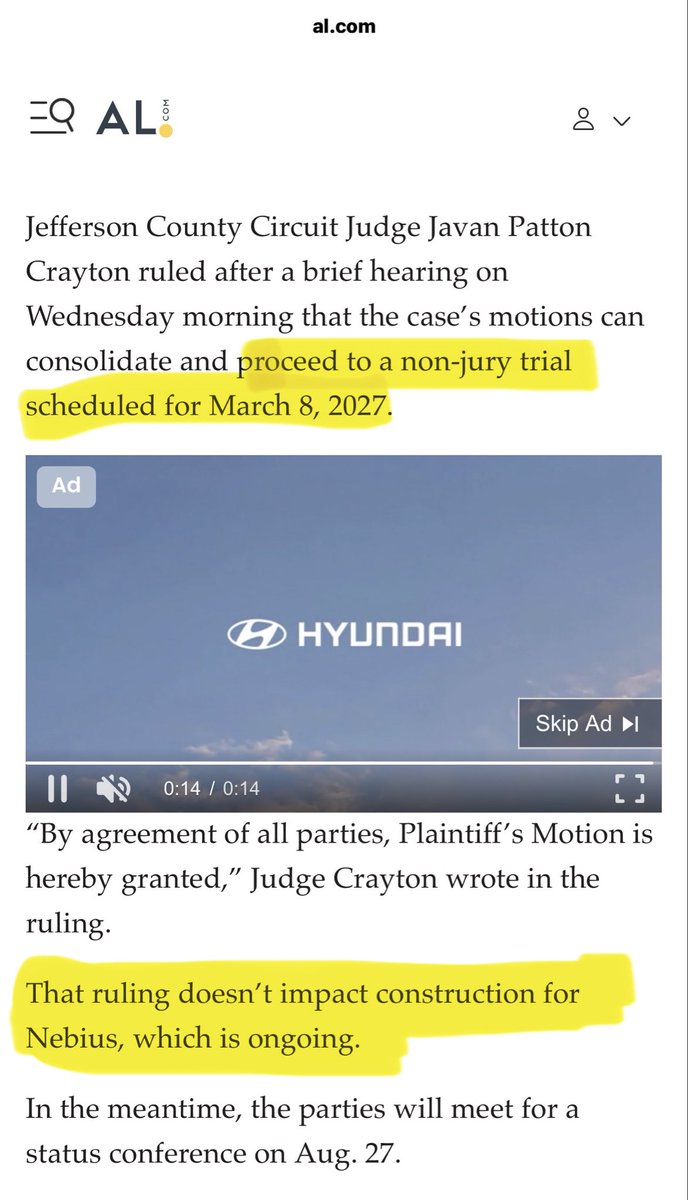
$NBIS UPDATE: Judge rules that Construction on Nebius Birmingham Data Center is Allowed to Continue Until March 8th Non-Jury Hearing 🔥
The note is behind a paywall which I was able to pay for to access, but here is the portion of the article highlighted and two key points:
1. Non-Jury Hearing — This is a key point as the judge will decide legal issue not a jury
2. Construction Can Continue until the hearing — This is Massive as Nebius will be able to move forward with substantial completion of the data center by March 8th and the chances of any ruling stopping a buildout at that advanced stage are far more slim.
There has to be some sort of class action lawsuit here bc it was never communicated to me that if I bought it a movie on one of these services that I owned it until the license expired.
Anyway…. NFTs
🚨 You bought it. Paid for it. But don't own it.
Starting Sept. 1, Sony will remove 500+ movies from PlayStation customers' libraries due to "expiring licensing agreements."
Not from the store. From YOUR library.
"You will own nothing..."
Somewhere Klaus Schwab is grinning.
All the tokens with real revenues doing real buybacks are up only
It's not just a meta... apart from being an equity token... it's currently the only way to prove the value isn't just being rugged to the equity
Pump, Hype, Lit, Venice, Ethfi, Derive
Who's next?
a little over 2 months ago, @hunterorrell were chatting about doing a livestream once a week to chat about markets and see if we enjoyed it or not.
turns out we liked it so much we started doing it twice a week.
did our first stream on the new account today @fullportshow and was sick to see us up on the live on x leaderboard.
please follow the account, and tune in. give feedback, we're listening. let's do this baby.
havent really watched football the last few years, one of my college buddy's pinged me telling me him and a few other friends need a 12th team.
so i decided to join and will have an ai agent fully running this team.
will report back over the season.
grokbot is the best ui i've had so far.
i really like it alot. going to be working mostly through this and using it to delegate to codex and cc as needed. but wow, bravo
After 7 years, Aztec’s Ignition mainnet is live.
Yet zero transactions or apps work yet. The chain is deliberately empty – because true protocol-level privacy can’t be rushed.
Here’s how this phased, decentralization-first launch positions Aztec as the leading private L2 on ETH👇
~~ Analysis by @SachiTakamura ~~
What's Actually Running
Think of Ignition like Ethereum's beacon chain from 2020. The governance and consensus infrastructure is operational, but the execution layer remains offline. The team is running what amounts to a live stress test with real money on the line.
Each sequencer staked at least 200K $AZTEC tokens to participate. They're producing blocks, provers are generating validity proofs, and the whole system is settling on Ethereum, just without any transactions.
The goal of running Ignition with real economics for 2-3 months will (hopefully) surface any remaining issues before transactions go live in early 2026, while setting the network up to be decentralized from day one.
The Decentralization Push
In Aztec's eyes, launching an L2 with a centralized sequencer from the get go rarely translates to decentralization down the road.
Centralized sequencers generate $40-150M annually in fees. Once you're locked into those cash flows, decentralization means making transactions slower and more expensive. The tension never resolves.
Instead, @aztecnetwork will launch fully decentralized from day one across three dimensions:
➢ Ownership is decentralized through $AZTEC token holders who control network parameters, fee schedules, and protocol upgrades.
➢ Block Production runs through 617 decentralized sequencer nodes using proof-of-stake. These nodes order transactions and produce blocks. To prevent any single party from gaining control, a small committee of sequencers is randomly selected to validate blocks before they are submitted to Ethereum.
➢ Proving is permissionless from the get-go. Provers generate the zero-knowledge proofs that cryptographically confirm all transactions in a batch are valid. They aggregate blocks and submit a single, final proof to Ethereum for verification, guaranteeing the integrity of the entire rollup.
When transactions go live, Aztec will qualify as a Stage 2 rollup, the highest decentralization tier for L2s. Most chains have pushed boundaries in one direction. Hitting all three pillars simultaneously is rare.
In Aztec's eyes, decentralization isn't optional for privacy. Centralized sequencers would face pressure from governments to install backdoors. Privacy requires cryptography plus decentralization, not one or the other.
What Happens Next
There are two major upcoming events, one technical and one token-related.
On the technical side, Ignition will remain live for 2-3 more months with sequencers producing empty blocks while the team monitors for issues. Early 2026 is when transactions flip on. Users will be able to send payments, deploy smart contracts, and interact with applications. By the end of 2026, block times should drop from the current 36-72 seconds down to 4 seconds, faster than Ethereum's 12-second blocks.
On the token side, the pre-allocation for the $AZTEC token sale is currently live, with the sale beginning December 2nd and running for 4 days. The sale uses @Uniswap's continuous clearing auction mechanism, meaning if you bid early, part of your bid clears at early prices and part clears later. This levels the playing field between early and late participants while letting price discovery happen naturally. When the auction ends, it automatically creates a Uniswap V4 liquidity pool at the final clearing price.
To participate in the sale, you must register prior to December 2nd.
For compliance, Aztec is using @ZKPassport, enabling people to prove cryptographically that they're from allowed jurisdictions and not on sanctions lists without traditional KYC. The sale is open to US retail and nearly every country worldwide, with the exception of sanctioned countries on the standard OFAC list.
The current 500 sequencers already staked $AZTEC tokens they purchased in a whitelisted genesis sale. They're earning rewards in $AZTEC right now. However, all tokens, whether from the genesis sale, the current public auction, or insider allocations, are non-transferable until Token Generation Event (TGE).
There is no set date for when TGE occurs, rather the community votes on it. However, the earliest date it can go live is February 11th, 2026. Once TGE happens, tokens purchased in the public auction unlock 100%.
7 Years in the Making
Overall, Ignition and the $AZTEC token sale demonstrate both the complexity of successfully executing privacy, as well as the extent to which Aztec is going to get this right.
First you have the need for decentralization from the get-go to ensure privacy endures, a feat unaccomplished by countless L2s launched so far. Then you have the tension between privacy and compliance, which the token sale's integration with ZK Passport helps solve.
Regardless of how mainnet goes, and I'm hopeful all goes well, this launch process shines as a testament to diligent design, demonstrating that forces like decentralization, privacy, and compliance can all coexist
Selling crypto to cover expenses hurts: you trigger taxes and lose exposure.
DeFi borrowing fixes both. Instead of selling your ETH, lock it as collateral, borrow USDC instantly onchain, spend like cash, and stay long — no taxable event in the U.S.
And now, do this directly through Coinbase👇
~~ Analysis by @punk0360 ~~
This is an integration I can happily recommend to my family and friends, as @coinbase is one of the most trusted and easy-to-navigate crypto exchanges, while @Morpho is one of the most proven and dependable DeFi lending protocols.
With this integration, you can now borrow against your ETH without leaving the comfort of the Coinbase app. Assuming you already have some ETH holdings on Coinbase, you just:
1. Click on your ETH balance to bring up your Ethereum dashboard.
2. Scroll down to the "Borrow" tab and press "Start."
3. Review the primer info—your Borrow up to amount (based on your ETH deposited to Coinbase), the Variable rate (the fluctuating interest Morpho will charge on your loan), and the Liquidation LTV (the "loan-to-value" point at which your underlying ETH could be liquidated for repayment)—and then press "Continue."
4. Input the amount of USDC you want to borrow, then click "Review loan."
5. Check that your loan details are satisfactory. When ready, press "Borrow now," then "Accept and continue." Your loan will be submitted, though it may take a minute or two to finalize in Coinbase's UI.
That's all it takes to get started!
If you open a loan, navigate to your Coinbase "Cash" tab and in the "Borrow" section you'll see a "Manage Loans" button. Go here for the "Repay" option to pay back the USDC you borrowed over time.
These ETH-backed loans have a flexible term, so you don't have to pay back specific amounts per a specific schedule. Just repay whenever in whatever amounts suit you, though keep a close eye on your loan health to avoid liquidation.
Also, keep in mind that USDC borrowed on Coinbase can't be used for buying crypto on Coinbase, so this particular avenue is meant for cashing out and spending.
As far as DeFi onramps go, this integration is about as simple and safe as it gets. If you or someone you know hasn't gotten around to borrowing against ETH yet, this is certainly a good place to start.
Last week, Ethereum’s ecosystem (L1 plus rollups) blasted through a new high, briefly hitting 24,000 transactions per second.
From 0.7 TPS in 2015 to regular spikes above 10,000 TPS today on @growthepie_eth, the modular bet is delivering explosive gains after a decade of building.
Welcome to Ethereum’s exponential age.👇
~~ Analysis by @punk0360 ~~
To be sure, the bulk of this current TPS surge is stemming from Lighter, the newer perps L2 whose custom appchain architecture minimizes what data touches Ethereum.
@Lighter_xyz just posts compressed state diffs and proofs to the L1 while keeping its high-frequency order flow offchain. This zk appchain design is unique in the rollups scene today, but more teams will experiment with this model and extend it in new directions.
Beyond this design evolution, Ethereum's roadmap has plenty of ecosystem-wide advances on the way that will help push performance gains. Foremost to mind is PeerDAS, which the Fusaka upgrade will bring to mainnet next month.
PeerDAS will be a powerful upgrade, as it's projected to facilitate around an 8x increase in Ethereum's blob capacity. With improved data availability, rollups are set to march past 1 million in ecosystem TPS in short order.
For instance, @base hit 1,500 TPS in June 2025 with Ethereum's current blob limits. Blob capacity going up 8x makes 10,000+ TPS feasible for the L2 at some point next year.
This math applies to zk appchains like Lighter, too. If Lighter can handle ~45,000 TPS today, it can potentially pass 350,000 TPS in 2026. Of course, there will be impactful project-level advances as well. ZKsync's upcoming Atlas upgrade has the potential to facilitate 15,000+ TPS for ZK Stack L2s. And that's just one stack and one upgrade.
So yes, Ethereum is scaling horizontally, and the prospects here are impressive. But Ethereum also has considerable vertical scaling potential. There are ongoing efforts, like EIP-7938 and "Lean Ethereum," that can help the L1 reach 10,000 TPS in its own right.
With this "all of the above" approach, we can dream big. We can build a new substrate for all the world's commerce and culture. And all of that builder potential is possible precisely because Ethereum is going tall and wide in its scaling.
This is the endgame: many chains spreading out to the horizon in every direction for any need, all anchored around an incredibly secure and robust network that's worthy of powering an entire civilization.
The progress here is clear. Meanwhile, the Ethereum community will continue to create its own destiny, just as it always has. We know the path forward, and nothing can stop us now.
For Bitcoin holders, this year’s been a bitter draft — gold blasting to $4.4K/oz with endless all-time highs, while "digital gold" barely scrapes by.
Marketed as a superior store of value, $BTC’s 3x underperformance in a safe-haven surge stings hard.
Is gold’s rally a 70-100 day lead-in to Bitcoin’s boom, or the cycle’s final curtain? Here’s how to decode it.👇
~~ Analysis by @eliasselborg ~~
What's Going on with Gold?
Gold's relentless 2025 performance can be attributed to unprecedented central bank buying, driven by inflation concerns, geopolitical tension, and a fundamental shift in how central banks think about reserves.
Central banks had their second largest Q1 gold purchases on record this year. Poland added 67 tonnes amid the Ukraine conflict. Turkey picked up 19.5 tonnes as its currency weakens. China continues to quietly accumulate amid tensions with the U.S., swapping out U.S. Treasuries, while in Shanghai, gold futures volumes have tripled since early 2024.
Gold is increasingly replacing U.S. Treasuries as the "riskless" asset in global portfolios. With mounting U.S. debt and political dysfunction, central banks are diversifying. Some reports suggest gold has even flipped Treasuries to become the number one central bank reserve asset globally.
Why? Gold doesn't carry counterparty risk and can't be printed or devalued by central bank decisions. In an era where trust in institutions is eroding, that matters.
Still, gold is showing signs of being clearly overbought. Parabolic moves like this rarely end smoothly, which raises the question: what does a gold rally of this magnitude actually signal?
What Have Gold Rallies Meant in the Past?
Similar rallies have signaled different outcomes. Sometimes gold's parabolic moves have preceded major crises. Other times, they've set the stage for broader risk-on rallies, with Bitcoin following months later.
The Bear Case: Late-Cycle Behavior
Gold surges often coincide with late-cycle uncertainty. From 2007 to 2008, gold spiked as the subprime crisis unraveled. In 1999 and 2000, gold shot up ~34% as the dot-com bubble burst and recession followed.
While today is different, there's a parallel level of unease against the backdrop of geopolitical tension and economic uncertainty. Steep climbs tend to end in sharp corrections. Gold experienced this in 2010 and 2011 when it surged 70% before collapsing 45%.
But is this really a late-cycle warning? Gold similarly rallied during 2020's COVID crisis, but that surge led to recovery, not prolonged downturn. Central banks are now accumulating over 1K tonnes per year amid a structural shift away from dollar reserves.
The Bull Case: Gold as a Leading Indicator for Bitcoin
Evidence suggests that when gold breaks out, Bitcoin has followed, usually with a lag of 70-100 days.
The clearest example is 2020. Gold surged to $2,075 amid pandemic uncertainty. About 85 days later, Bitcoin began its climb from $5K to $10K, then exploded 590% to hit $64K by early 2021. A similar situation happened last August, with gold ripping to new all time highs while Bitcoin lagged for about two months before surging come November.
If the historical pattern holds, gold's rally could be setting up Bitcoin's next leg higher. Once gold peaks, capital could flow into Bitcoin as investors shift from defensive positioning to offensive plays.
The key is recognizing that gold moves first in debasement trades, and Bitcoin follows once the narrative crystallizes. While past performance doesn't dictate future results, gold's run is not a death sentence for Bitcoin.
Things to Consider
Whether you believe gold's rally signals late-cycle risk or sets up Bitcoin's next move, it's worth understanding what these assets do in a portfolio.
Gold is a preservation tool that maintains purchasing power. It can't be printed or manipulated by central banks, providing an anchor when other assets fail.
➢ A portfolio with 5% gold and 95% S&P 500 returned 152% since 2018
➢ A portfolio with 5% Bitcoin and 95% S&P 500 returned 199%
➢ At 10% allocations, gold delivered 155% while Bitcoin hit 253%
Gold provides stability during uncertainty. Bitcoin, still growing into this role, behaves with more volatility but significantly outperforms. If your goal is wealth preservation, gold makes sense. If you're willing to stomach volatility for outsized returns, Bitcoin remains the better bet.
So, while Bitcoin holders might feel frustrated watching gold gains, if history repeats itself, that frustration could be short-lived.
There's a war brewing in Bitcoin world over whether "arbitrary data" — non-financial data like images and text — should be allowed on the blockchain 👇
~~ Analysis by @kenzi_mori ~~
This is the same debate that's been going on since @ercwl and @udiWertheimer trolled a large part of the Bitcoin community with their Taproot Wizards project, which productized the extra space in blocks and allowed anyone to have their "magic internet JPEGs" inscribed forever on the Bitcoin blockchain.
The opposition is fighting back, and we now have a name for this camp: Bitcoin Knots.
This is the camp of @LukeDashjr, perhaps the most hardcore Bitcoin monetary maximalist and anti-shitcoiner. The "knots" name is an explicit Biblical reference to the "whip of knots" that was used by Jesus to expel the money changers from the Temple...
The Knots camp's argument:
Arbitrary data in the Bitcoin blockchain is an irresponsibly risky use of Bitcoin resources. Bitcoin code should exclusively serve the use of BTC as money. If arbitrary data is allowed, an attacker could flood Bitcoin with transactions that include illegal data (namely, child pornography) that would cause anyone running a Bitcoin node to be prosecuted.
In theory, an attacker could load CP into Bitcoin transactions, meaning Bitcoin nodes would all download this "arbitrary data," and anyone running a node would find themselves transmitting and in possession of CP. This would make running Bitcoin illegal and would be a censorship attack on the network.
It might sound farcical, but this is actually how the argument goes.
The tradeoff Bitcoin Knots want is to censor the types of transactions that Bitcoin users can make so that node-operators are protected from censorship due to processing arbitrary non-BTC-spend data.
Bitcoin Core, on the other hand, is saying that morality and policy should not be conflated, and that Bitcoin Core ought to be neutral software and be unopinionated about the data that the market decides to place in its UTXOs. Core is also the 'default mode' of what Bitcoin is today.
I do find elements of the Knots side compelling.
Not because the state-level censorship and CP transmission worries are valid, but simply because Bitcoin is ultimately just an app-chain for BTC, and taking a monetary maximalist approach seems right.
Bitcoin is for bitcoins, always has been, always will.
But the point of this article is to highlight that Ethereum has taken a radically different approach to essentially the same issue.
Ethereum's Fork-Choice Enforced Inclusion Lists (FOCIL)
FOCIL is the mechanism that @ethereum core devs want to implement to solve Ethereum's censorship problem.
With the OFAC sanctioning of Tornado Cash, parts of the Ethereum tech stack started censoring Tornado Cash transactions.
FOCIL makes sure "important but ignored" transactions still get into blocks, even if a builder or proposer would prefer to censor them.
1. In each Ethereum slot, a small committee of validators scans the mempool and publishes "Inclusion Lists" (ILs) of transactions they think should be included.
2. The next slot's proposer builds the block and can order transactions as they see fit, but must include the IL transactions.
3. Attesters can only vote for blocks that satisfy the ILs. If they don't see the IL transactions, the block won't be voted on, won't be built on, and the block builder doesn't get the reward.
This removes the exclusive power of transaction inclusion from just block builders to a wider variety of staking participants.
So, in stark contrast to Bitcoin Knots, Ethereum's strategy is to force everyone to download all the data.
Rather than attempting to censor data, Ethereum is forcing the entire network to download all fee-paying transactions, regardless of the data contained in them.
It's worth pausing and reflecting on how hardcore this is.
There are different ways to be a cypherpunk, and some are more radical than others. Ethereum's strategy of forcing transaction inclusion is pretty hardcore.
Ethereum doesn't give you an option. You include the transactions, or you don't get the reward. And if you don't get the reward, why are you bothering to stake at all?
Include or die.
To what degree all of this matters, or is deep-crypto-tech nerd shit... idk it remains to be seen. Maybe this attack vector never comes to fruition and the choice to include arbitrary data is more innocuous than Luke Dashjr makes it out to be. After all, we've had arbitrary data in Bitcoin and Ethereum since their respective genesis blocks, so why would this all start now?
I'll leave this all for the reader to ponder. Meanwhile, please appreciate one of my favorite bits of arbitrary data in Bitcoin, which is the first ever Bitcoin inscription, inscribed in block 767753:
Dickbutt.