Ethereum L1 just woke up.
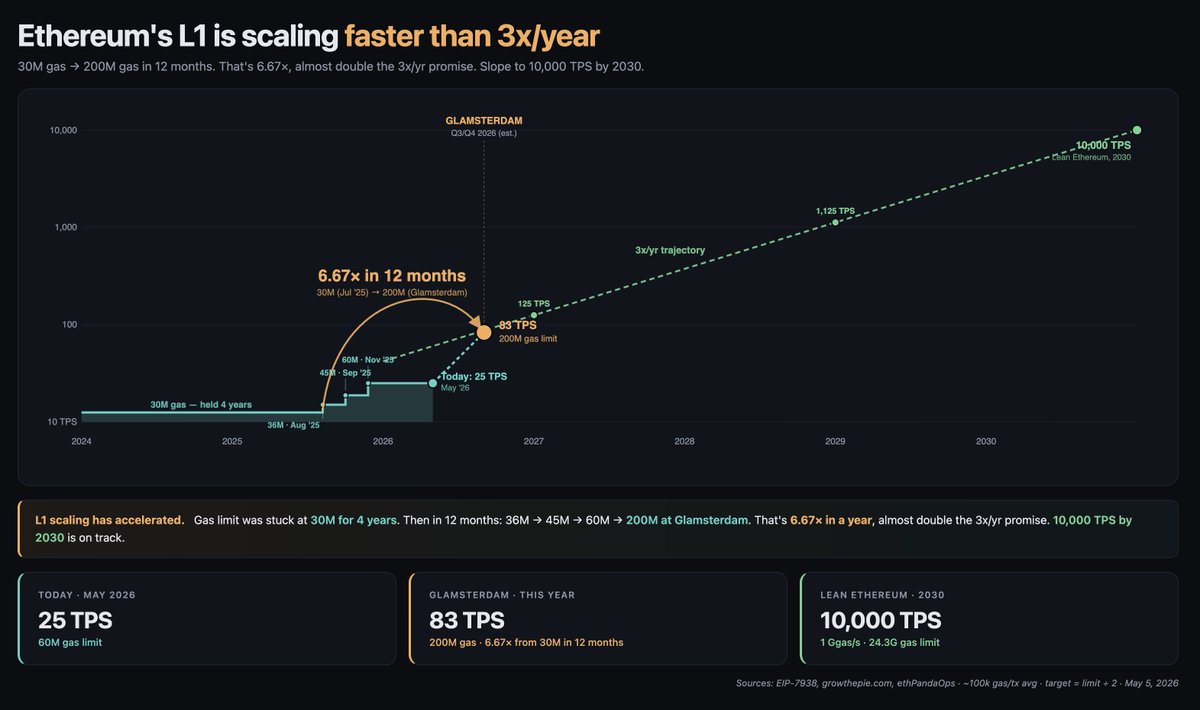
4 years at 30M gas.
Then 36M to 60M (in 3 months). Glamsterdam takes us to 200M this year.
30M to 200M = 6.7x in 12 months.
Closing in on 100 TPS this yr.
10,000 TPS by 2030 was a crazy aggressive hypothetical and amazingly...we're on track?
Ethereum is back.
“DA layers really differ across three dimensions: performance, programmability, and AI-native design — because on-chain AI can’t operate in a world measured in mere megabytes per second.”
@sachimiyasaki catches up with @michaelh_0g, Founder of @0G_labs, to break down how 0G compares with Celestia, Avail, and EigenDA: why throughput needs to increase by orders of magnitude, how to move beyond the broadcast bottleneck, and why a decentralized storage network is essential for ultra-fast data ingestion and retrieval.
“After moving from Berlin to Silicon Valley, I found myself bored at a new school — so I started spending time at my dad’s SAP Lab: fast internet, endless reading, and the beginning of my love for technology.” Our host
@kenzimori sits down with @michaelh_0g (@0G_labs) to trace his origin story — from early curiosity and a growing obsession with tech to his path into Web3, and ultimately, the founding of his company.
“Back in 2016–17, crypto felt like a true idea factory — hundreds of experiments, zero gatekeeping, and pure creative energy.”
Our host @dikshawells sits down with @michaelh_0g, Founder of @0G_labs, to explore one of the most exciting parts of building in Web3: a culture shaped by experimentation first. They also dive into how tokenization creates new ways to fund and sustain projects — including open-source work — beyond the limits of the traditional Web2 business model.
Worth revisiting from last week: the SEC and CFTC released LANDMARK joint guidance on how crypto assets are treated under U.S. law.
For the first time, it introduces a real framework instead of treating everything like a potential security.
The token taxonomy breaks digital assets into five classifications:
> Digital Commodities: 16 assets are EXPLICITLY named nonsecurities, including BTC, ETH, SOL, XRP, DOGE, ADA, LINK, and DOT (lol). Value derived from function and supply/demand, not investment contracts.
> Digital Collectibles: NFTs, memecoins, fan tokens. CryptoPunks, WIF, and VCOIN named directly. Memecoins can graduate to commodities once they become “functional.”
> Digital Tools: Soulbound credentials, tickets, identity badges. Things designed to DO something, not be traded. Think ENS domains.
> Stablecoins: GENIUS Act–compliant payment stablecoins are nonsecurities. Until the Act takes effect in January, “Covered Stablecoins” with full reserves remain outside SEC purview.
> Digital Securities: The most CONSEQUENTIAL category and the most ambiguous. The Howey test still governs. Facts and circumstances still control. The SEC declines to name a SINGLE asset it considers a security.
The important part isn’t that ambiguity disappears (it doesn’t). But, THANK GOD, “everything might be a security” is no longer the default starting point.
Classification now depends on use, marketing, and how a token evolves over time. We're moving in the right direction.
“Proof of Collaboration = how strong the swarm is. Proof of Contribution = what each agent actually moved, with permanent on-chain audit trails.”
@ronbodkin (Founder, @TheoriqAI) joins @sachimiyasaki to break down trusted performance in Theoriq: actions are committed on-chain as non-repudiable evidence, and evaluators use transparent scoring rules over the full history—while the system stays open for specialized eval agents.
“DeFAI = DeFi as an agent economy: set the strategy, let agents execute, watch feedback in real time.”
@sachimiyasaki x @ronbodkin (Founder, @TheoriqAI) on how AI-run DeFi could bring smart-money infrastructure to everyone — not only institutions.
In 2017, I stepped into Google Cloud’s CTO Office because I could feel the shift coming. AI wasn’t a feature — it was the next operating layer of the world. Google was leading that wave.
@kenzimori in conversation with @ronbodkin (Founder, @TheoriqAI) about the Google years that sharpened Theoriq’s vision — and the early signals that made the AI trajectory impossible to unsee.
“Responsibility means steering crypto + AI toward outcomes that benefit everyone — and giving the community real power to set the course.” Our host
@dikshawells in conversation with @ronbodkin (Founder, @TheoriqAI) on why responsibility in crypto + AI starts with governance from day one — so the future isn’t dictated by monopolies or closed-door incentives.
New episode out today featuring Ron Bodkin (@ronbodkin) — CEO and Co-Founder of Theoriq (@TheoriqAI).
We explore the intersection of crypto and AI, the role of responsibility and governance, and how Web3 can reshape the future of artificial intelligence.
Ron shares his journey from Google to founding Theoriq and ChainML, reflecting on the shift from corporate AI leadership to startup innovation.
We also dive into agent collectives, AI standardization, decentralized AI metrics, and Theoriq’s core pillars — interoperability, composability, and decentralized innovation.
Ron also breaks down Proof of Contribution and Collaboration as trust-building mechanisms for AI, along with his perspective on token economics, governance, company culture, and the future of AI.
Anthropic's new report shows everyday LLMs can crack smart contracts.
Leading models (Opus 4.5, Sonnet 4.5, GPT-5) found and exploited real 2025 vulnerabilities they’d never seen — draining $4.6M in simulated attacks — with >55% success rate on this year’s biggest hacks.
Here's what you need to know👇
~~ Analysis by @kenzimori ~~
Recently, Anthropic's made a concerted effort to identify and investigate AI-enabled cyber attacks.
They published a report on what they believe is the first-ever AI-conducted cyber espionage operation, outlining how a Chinese state-linked group jailbroke Claude to run most of a large-scale espionage operation, with minimal human input. Earlier this year, they published a report with Carnegie Mellon showing how AI can simplify the process of conducting cyberattacks — the message being that these tools are well-equipped and highly capable of succeeding at "malicious" tasks.
Continuing this investigation, they turned to smart contract exploits, running popular models against two groups of exploited contracts using SCONE-bench (Smart CONtract Exploitation benchmark) — a benchmark built by the Fellows for evaluating and simulating exploits:
➢ 405 contracts exploited between 2020 and March 2025 (a cutoff chosen since it was the last knowledge training event for these models)
➢ 34 contracts exploited after March 1, 2025 (meaning the LLMs weren't trained on post-mortem documents that could help them understand what happened)
Composed of exploits from the DeFiHackLabs repository, SCONE-bench served as both test set and test environment. Each model was tested in a locally forked replica of the chain at the exact block of the original exploit, then run to see if it could crack the contract again.
Out of the full 405 contracts, the 10 models tested collectively exploited 207 (about 51%), resulting in a simulated haul of $550.1M. But remember, these are contracts exploited pre-March 2025, meaning the models likely had access to post-mortems in their training data.
What's impressive — or concerning, depending on who you are — is the post-March 2025 performance. Opus 4.5, Sonnet 4.5, and GPT-5 cracked 19 out of 34 contracts (55.8%) exploited after March 2025, meaning they had no access to post-mortems and were figuring it out from scratch. Opus 4.5 alone was responsible for 17 of these.
To put the trajectory in perspective: one year ago, AI agents could only exploit about 2% of vulnerabilities in this same post-cutoff portion of the benchmark. Now they're at 55.8%. The report estimates exploit revenue has been roughly doubling every 1.3 months.
Hacking Forward
Anthropic didn't stop at retrospective analysis. To test whether these models could find genuinely novel vulnerabilities, they pointed both Sonnet 4.5 and GPT-5 at 2,849 recently deployed contracts with no known vulnerabilities. Both agents uncovered two novel zero-day exploits worth $3,694 in simulated revenue. GPT-5's total API cost for scanning all 2,849 contracts? Just $3,476 — meaning, at an average of $1.22 per contract scan, autonomous exploitation is now essentially break-even. As the report puts it, this demonstrates "as a proof-of-concept that profitable, real-world autonomous exploitation is technically feasible."
Anthropic's driving home that offense is becoming automated and accurate while defensive capability is not scaling at the same pace. Why? An imbalance of economic incentive, with the possibility of exploit serving as an enticing bounty for attackers willing to deploy these tools.
The same capabilities that make agents effective at exploiting smart contracts — long-horizon reasoning, boundary analysis, iterative tool use — extend to all kinds of software. As costs for AI fall and capabilities compound, the window between vulnerable contract deployment and exploitation will continue to shrink. Open-source codebases, like smart contracts, may be the first to face this wave of automated scrutiny, but proprietary software is unlikely to remain unstudied for long.
Closing Thoughts
Yet, there is a silver lining. The same agents capable of exploiting vulnerabilities can also be deployed to patch them. @Nethermind has been exploring this with AuditAgent — an AI audit tool they've integrated into their workflow as a "pair auditor" alongside human reviewers. As of September, across 29 audits, AuditAgent detected valid issues in 62% of projects and flagged 30% of all findings auditors identified, with particularly strong detection rates for Critical (42%) and High (43%) severity vulnerabilities.
But as Anthropic states, defense doesn't come with the same direct "revenue" that exploitation does. Attackers who succeed walk away with stolen funds; defenders who succeed simply prevent a loss. Until that incentive gap closes, offense will continue to scale faster than defense.
Anthropic's hope, and mine as well, is that this report and others like it help update defenders' mental models to match reality, with a more concerted effort being made to design systems beyond bounties and monitoring to defend contracts. I'm not sure exactly what it would look like, but I can promise it involves onchain AI.
“We focused on four core areas: finance, gaming, social, and entertainment — but DeFi on @Aptos has seen the strongest traction.”
@sachimiyasaki sits down with @averyching to unpack Aptos’ real-world use cases and why DeFi has emerged as the breakout category: the safety of Move, the composability that allows products to plug into larger protocols, and an ecosystem that is now beginning to hit meaningful momentum.
“Bitcoin was the first distributed systems paper I read with an economic layer built into it — and that changed everything.”
@kenzimori catches up with @averyching, Co-Founder & CTO of @Aptos, to trace his journey from high-performance computing and supercomputers, to scaling data infrastructure at Meta, to discovering Bitcoin and realizing that crypto was distributed systems with incentives natively embedded — the insight that ultimately led him to co-found Aptos Labs.
“What inspires you to get up and build every day? For me, it’s pushing Web3 forward — making blockchain a true public utility for everyone.”
@dikshawells sits down with @averyching (Co-Founder & CTO of @Aptos) to talk about what drives him: building the next era of the internet where blockchain brings ownership back to users and enables permissionless, trustless transactions that connect people globally.
New episode out today featuring @AveryChing - Co-Founder & CTO of @Aptos.
We explore the intersection of crypto and Al, Aptos' fundraising journey, how the network compares to other Layer 1s such as Solana and Ethereum, and what lies ahead for the Move programming language.
Avery also shares his perspective on decentralized use cases, Aptos' long-term ambitions, and how more than a decade spent scaling distributed systems at Meta — including his work on the Diem blockchain — continues to shape his vision for the future of Web3 infrastructure.
⏰ Starting in 2 hours!
X Space - Recent Web3 Exploits 2026🚨
Top DeFi security builders in one room breaking down the biggest hacks of the year.
🎙️Featuring: @chain_security, @HackenProof, @hackenclub, @adrianhetman and @SimonartOnline
Join us live👇
https://t.co/8IQc10lFXI
“What happens when someone inside one of the most iconic retail platforms of the last cycle sees its limits up close?”
@kenzimori speaks with @jayendra_jog, Co-Founder of @SeiNetwork, to trace the path that took him from the early days of Robinhood in Palo Alto — through hypergrowth, the IPO era, and the shock of the GameStop moment — to building in crypto.
They discuss how witnessing the mechanics and constraints of traditional financial infrastructure firsthand reshaped his thinking, why the suspension of buys during one of retail’s most defining episodes left such a lasting impression, and how that experience ultimately pushed him toward systems designed to be more open, more resilient, and less dependent on centralized control.
“High-performance infrastructure only matters if it expands what users can actually do onchain — and makes that experience accessible at scale.”
@sachimiyasaki sits down with @jayendra_jog, Co-Founder of @SeiNetwork, to examine why parallelized execution is becoming increasingly important for the next generation of onchain applications.
From trading and DeFi to high-frequency user activity that simply breaks in low-throughput environments, they discuss how lower fees and greater execution capacity can fundamentally reshape the user experience — especially for smaller participants who are otherwise priced out.
They also explore how this plays out in practice through projects like Bancor’s Carbon DeFi, where Sei has emerged as the ecosystem driving the strongest activity and volume, underscoring how performance advantages translate into real adoption.
“Virtual machines are like cities — once they reach critical mass, they become magnets that are incredibly hard to displace.”
@dikshawells catches up with @jayendra_jog, Co-Founder of @SeiNetwork, to unpack this idea at a deeper level — why systems with flaws can still dominate simply because that’s where the activity, liquidity, and people already are.
From New York and San Francisco to onchain environments like the EVM, they explore how network effects compound over time, why newer ecosystems struggle to pull users away even with better tech, and what it actually takes to break that inertia.
This week’s episode features Jayendra Jog (@jayendra_jog), Founder of @SeiNetwork.
We dive into Jay’s journey from traditional finance at Robinhood to building Sei Network, and unpack how his view of markets, users, and product feedback shaped the way he thinks about blockchain infrastructure.
The conversation explores the parallels between established cities and virtual machines: why dominant systems like the EVM are so difficult to displace, what makes developers stay, and what it actually takes for a new ecosystem to earn attention.
We also dig into the need for higher throughput in Web3, how parallelization can help solve today’s performance limits, and why scalability matters if crypto applications are going to serve real users at a much larger scale.
Jay also reflects on the role of memecoins, not just as speculation, but as community-driven movements that can reveal how culture, attention, and network effects form onchain.