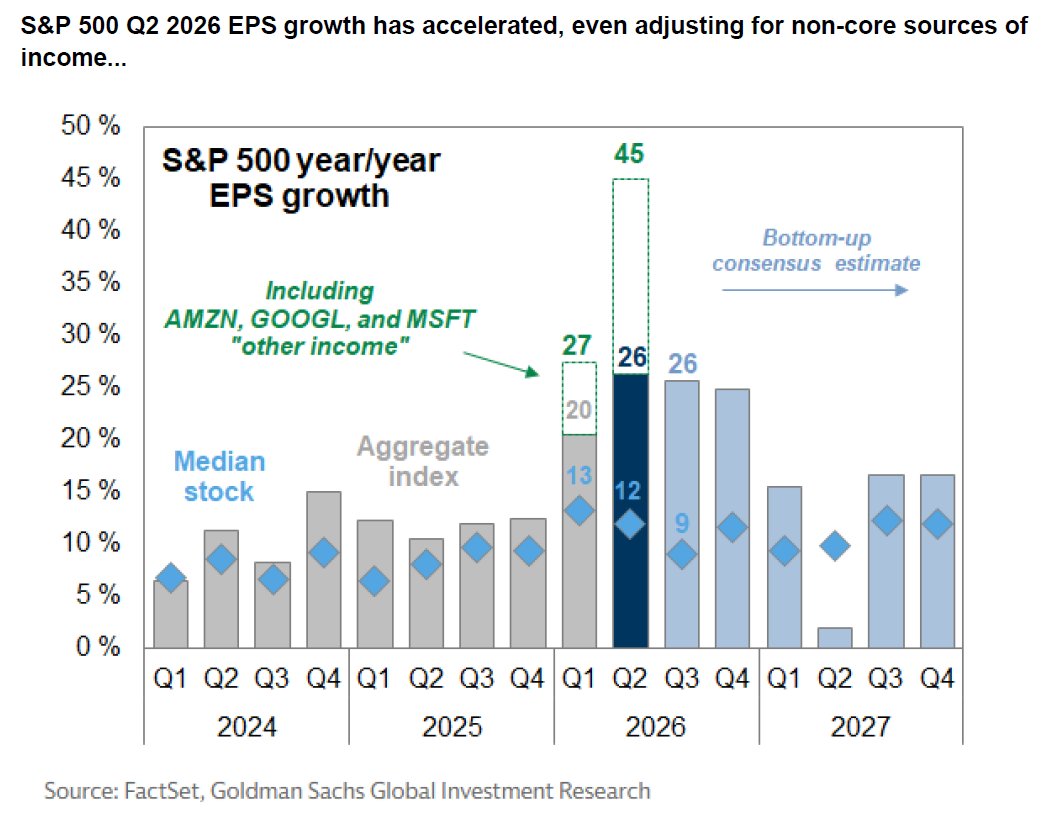
S&P 500 EPS growth is tracking 45% YoY in Q2 compared with a consensus estimate of 22% coming into the quarter. However, 19% of that growth is attributable to Alphabet and Amazon's combined $151 billion of "other income" related to equity investments. Excluding these gains, S&P 500 EPS growth is tracking at 26%, an acceleration vs. Q1 and the fastest pace of growth since 2021 - Goldman
Absurd and inhuman violence is spreading ferociously through the sacred places of the Christian East, profaned by the blasphemy of war and the brutality of business, with no regard for people’s lives, which are considered at most collateral damage of self-interest. But no gain can be worth the life of the weakest, children, or families. No cause can justify the shedding of innocent blood.
Not seeing many people talk about this, but maybe we should be.
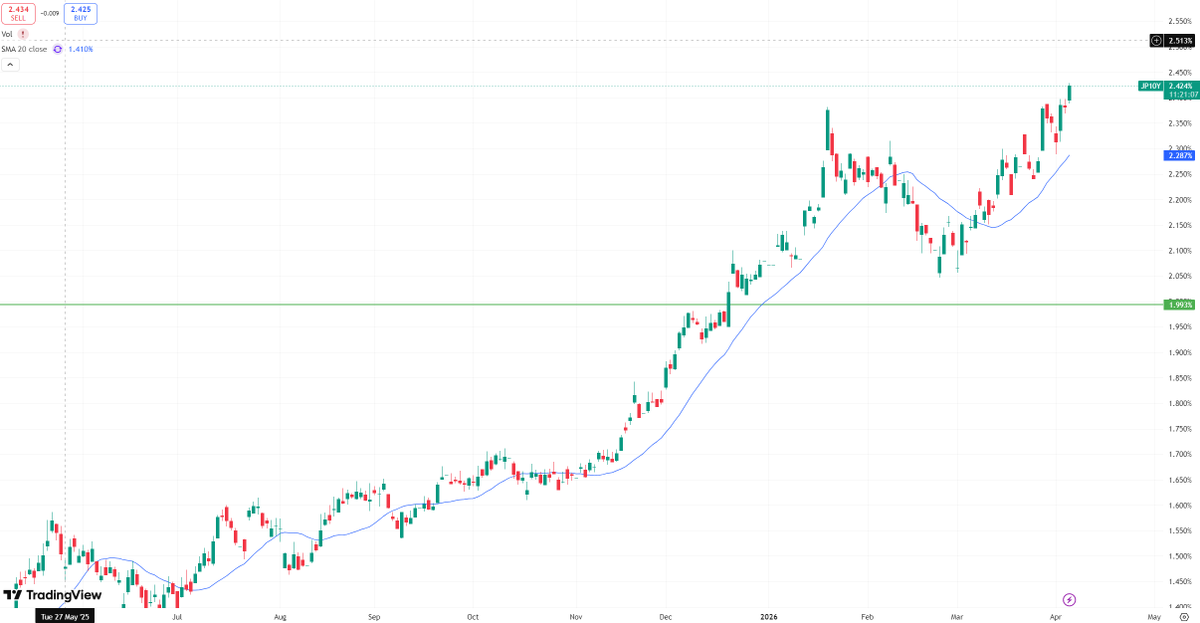
Japanese 10yr yields are now sitting at multi-decade highs around 2.42% (chart attached).
Now I know what you are thinking… “yields are rising everywhere and 2.42% is alot lower then US yields 4.35%?” Japan is different. For decades Japan has been the anchor of global yields. Zero rates, yield curve control, endless liquidity. If you wanted cheap funding, you went to Japan. That regime changed a while back but the speed of the adjustment is what is concerning. This is not a spike. This is a clear trend. Higher highs. Higher lows. Week after week.
Why does this matter? Because Japanese capital has been recycled globally for years. US Treasuries, European bonds, EM carry trades. All funded out of Japan. If domestic yields in Japan are now 2.4%, you have to ask yourself, does this speed up diversification away from King Dollar.
This is how global liquidity quietly tightens. No headlines. No panic. Just a slow grind higher in yields that eventually forces repositioning.
We all focus on the Fed. We all focus on US yields.
But this one is creeping up in the background. Largely unnoticed. For now.
#JPY
Got the wife evacuated, so have time to drink a tea and think about the Strait of Hormuz. I've sailed through the it a few times years ago and done antipiracy operations in the Strait of Malacca.
Maps can be deceiving. The best way to think about the Strait of Hormuz is a four lane highway, with two lanes per direction for the largest ships like crude carriers, cargo vessels, and warships in the center of the channel where it is deepest and free of obstacles.
Then on the outside of those lanes, you have medium sized ships, going Jebel Ali to other regional ports like Sohar, since a lot of international cargo goes direct to Jebel Ali then is cross loaded across the region.
On the outside of those lanes, along both coasts, are dhow fishing boats and all manner of local, smaller craft. Maritime trade crisscrossing this region goes back hundreds of years. The Portugese wrote how disappointing it was to find a tight network of trade already established in the region when they arrived in the 15th century.
It is hard to describe how crowded these waters are. You sometimes wonder if you could walk to Iran across the decks of ships and not get your feet wet.
The amount of traffic makes distinguishing between normal traffic and a threat incredibly difficult.
Is that dhow fishing, transiting between coasts, laying mines, gathering intelligence, or a tender for surface drones? Hard to discern while sailing ducks in a row escorting a lumbering tanker or cargo ship.
Operation Prosperity Guardian in the Red Sea proved to be a Houthi victory when a land power with no navy to speak of fought the most powerful navy on earth to an agreement.
The Hormuz problem is harder now the Iranians have proved they have the will to fight, no matter how much pain is leveled at them from afar.
The shipping lanes in the Strait of Hormuz go around the Musandam penninsula.
This turn exposes ships to 270 degree of fire control in layered systems from Qeshm, the surrounding high ground, to further inland, with surface drones now added to the mix.
Iran doesn't need to mine the entire strait. Iran just needs to turn that main shipping lanes around Musandam into a kill box and divert approved ships past Qeshm, out of the main shipping lanes like a watery weigh station. It has started doing this.
The U.S. has created a hard problem for itself.
NATO understandably wants nothing to do with this. If the most powerful navy in the world can't solve this, what difference does European navies make.
With the watery weigh station past Qeshm, Iran isn't closing the strait to global commerce. It is simply doing what the U.S. does with the dollar, exerting power over the chokepoint it controls.
Understandably the U.S. doesn't like this, so why can't the U.S. just send warships to escort ships through?
Well, when you escort a ship through a strait, you tend to stay ducks in a row.
So if warships are sent to escort tankers, they are now just another target in the strait.
Even if the warships could maneuver through local traffic to screen ships, lets go back to the 270 degree turn around the penninsula.
The warships would be receiving layered waves of fire likely worse than they faced off with in the Red Sea against the Houthis from essentially three directions while having the longer route to run to protect the tankers around the peninsula.
As the Hormuz Crisis drags on, anything less than breaking Iran's control of the strait will be seen as a loss for the U.S., much like the Battle of the Red Sea was against the Houthis.
The argument in the post is commonly said, but not entirely accurate.
tl:dr, the Genius Act says stablecoins are backed one-for-one by Treasury Bills. So, increased stablecoin issuance creates demand for Treasuries and lower interest rates.
So, where does the money come from to purchase a stablecoin? Suppose the funds are already in the financial system (i.e., a bank account or money market fund). In that case, it is just a transfer from one account that is backed by government securities to another account backed by government securities. The net change in Treasury demand is zero. Every American buying Stablecoins is not increasing Treasury demand.
If it comes from outside the U.S. and is denominated in a foreign currency, they could, in theory, create new demand for Treasuries in dollars.
How much of this still exists? Tether has been around for almost 12 years. People in developing nations were not waiting for the Genesis Act to have the confidence to put their life savings into stablecoins. If they were going to do this, they moved to Tether many years ago because its risks were lower than those of their unstable national currency and unsafe banking system.
---
Further, this argument that the Genuis Act was secretly concocted to create Treasury demand is part of the reason this bill is not good for the crypto community. It was not to make stablecoins a better version of US dollars in regulated financial accounts. Instead, it is a way for the Tradfi system to assume control of these Stablecoins for its own selfless reasons, like funding a bloated Government, and making sure they cannot compete with bank deposit accounts (by not allowing interest to be passed to the Stablecoin owner.)
If Blockbuster had bought Netflix in the early days, it would have killed it.
If Yellow Taxi had bought Uber in the early days, it would have killed it.
To me, the Genesis Act is trying to do this via regulations on Stablecoins.
@biancoresearch Bullish case is AI helps solve sustainable and renewable energy production which ushers in a new era of growth and pushes into a new level of space exploration
Broadening?
The S&P 500 Equalweight ETF ($RSP) had its highest-ever volume day today, beating the prior record (yesterday) by more than 12 million shares. It outperformed the S&P 500 both days.
@calvinfroedge Sucks that we are so caught up in the mindset of what’s to happen next that we never truly appreciate the present. How do we slow down in life while also remaining relevant in a fast paced world 🤔
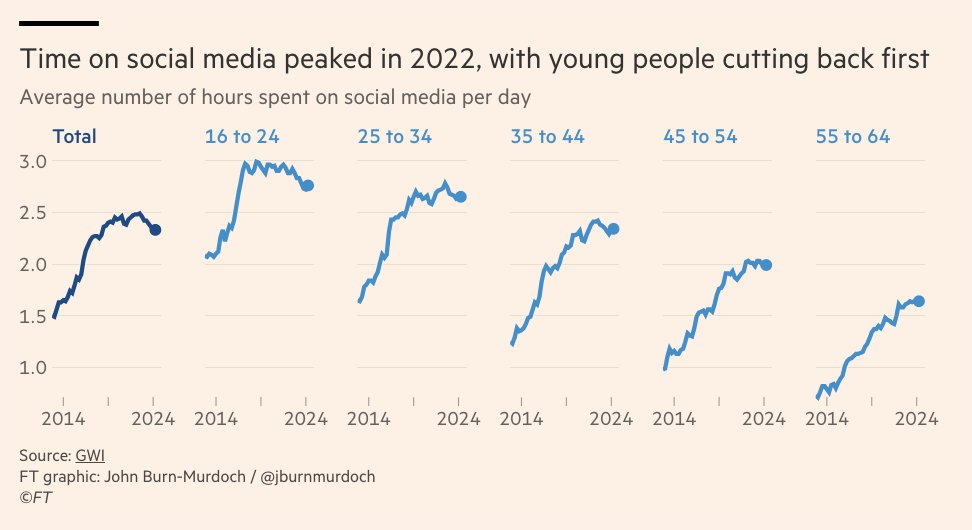
"Time spent on social media peaked in 2022 and has since gone into steady decline, according to an analysis of the online habits of 250,000 adults in more than 50 countries...Usage has traced a smooth curve up and down over the past decade-plus" https://t.co/wuIluUXpw4
Richmond Public Schools has announced that all students will now receive free breakfast and lunch every school day, with no paperwork or applications required from families. https://t.co/TMYTH1PgZx
It looks like $META’s depreciable life on its capital base ($210B at 6/30/25) was 11-12 years, as of the 2Q. If the true economic life on its GPU’s is actually 2-3 years, most of its “profits” are materially overstated.
BREAKING: A “click-to-cancel” rule, which would have required businesses to make it easy for consumers to cancel unwanted subscriptions and memberships, has been blocked by a federal appeals court just days before it was set to go into effect, per AP
As compliance carbon markets expand, voluntary carbon markets (VCM) may be on the verge of a breakthrough. Experts see a convergence that could unlock major funding for carbon removal tech—potentially scaling credits 100x. #CarbonMarkets#NetZero#VCM#CDR
https://t.co/2WXuFq96s0