What truly hinders progress in biology research? You may have your favorite – automation, lack of great ideas, regulatory hurdles – but here's one I believe outweighs everything else – research planning. 1/3
@NikoMcCarty@markwbudde@plasmidsaurus I actually quite enjoyed the raw feel of this podcast, inc. weird camera angles :D In our hyperpolished times, this stands out as genuine content. Also loved your remarks and pushbacks and would love even more questioning of guest's assumptions in the future episodes.
"The cognitive equivalent of aerobic activity is contemplation — the intentional focusing of your mind's eye on a singular topic, with the goal of increased understanding."
I increasingly value focus on 1 thing until I get it fully. Never realized this is called contemplation!
In @nytopinion
“In a short span of time, we transformed the way we thought about health,” Cal Newport writes. “I’ve come to believe that a similarly rapid revolution is possible in how we respond to our diminishing ability to think.” https://t.co/6qc3UpeXSk
It is plausible that, 10 years from now, medicine for dogs and cats becomes *definitively* more advanced than medicine for humans simply because the in vivo data to train AI models is so much easier to get
Enjoyed the piece, esp. the fact that historically lab notebooks were "a space for working through research questions" than for recording observations. Agreed with the conclusion that paper notebooks will remain important for the former – sth I've been rediscovering recently too.
lab notebooks are close witnesses to the process of scientific discovery - unlike the more polished and retrospectively written published articles. i trace their history from early modern science to our time
the greatest regret i have is underestimating the value of long term compounding.
friendships, people, places, all get better with decades. beautiful things dont even start to reveal themselves for years. it is entirely what life is about. a few good things for a long time.
Some of the most underinvested areas in frontier biology that could accelerate civilizational progress:
- Cheap, large-scale DNA synthesis (writing entire chromosomes or full organisms)
- Real-time, non-destructive RNA sequencing in living cells
- Highly accurate AI-powered polygenic scores for complex traits (disease risk, cognition, longevity) → enabling full genome design
- Ultra-precise, multiplex genome editing (far beyond CRISPR) with minimal off-target effects, scalable across millions of cells
- Safe, efficient, tissue-specific in vivo delivery systems
- Safe and effective human germline engineering
- Accelerated clinical trials via testing on decedents (with consent)
- Next-gen human enhancement: muscle, cognition, mood — beyond GLP-1s
- Ectogenesis / artificial wombs
Who’s actually building in these areas? Drop names, companies, or researchers below 👇
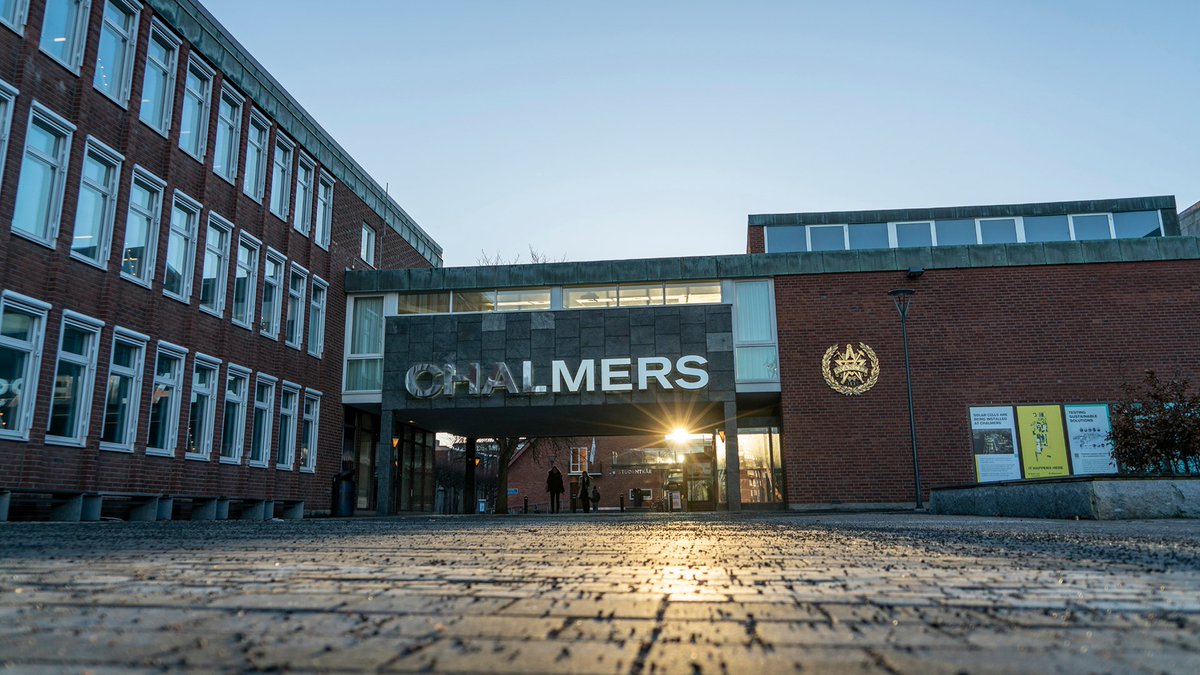
Come build your independent career at Chalmers. We have an open faculty position in Data-Driven Life Science. These are generously funded positions where you have full scientific independence, low teaching load, and excellent infrastructure. Link in thread!
Watched the liftoff, and headed to the lab feeling like an astronaut about to do something big. Engineering biology *is* as exciting, wondrous and impactful to humanity as space missions -- but much more affordable. So grateful to be able to contribute to it daily!
Liftoff.
The Artemis II mission launched from @NASAKennedy at 6:35pm ET (2235 UTC), propelling four astronauts on a journey around the Moon.
Artemis II will pave the way for future Moon landings, as well as the next giant leap — astronauts on Mars.
@SynBio1 Models already comb recent literature, so isn't it just a matter of prompt engineering to get potential collaborators surfaced that match your research interests? Doesn't have to be a centralized service.
It means we need to continue sharpening genome engineering tools (my Insitute's mission!), readying them for the high-throughput mentality (our lab's mission!) in unorthodox ways (my mission?!). 7/7
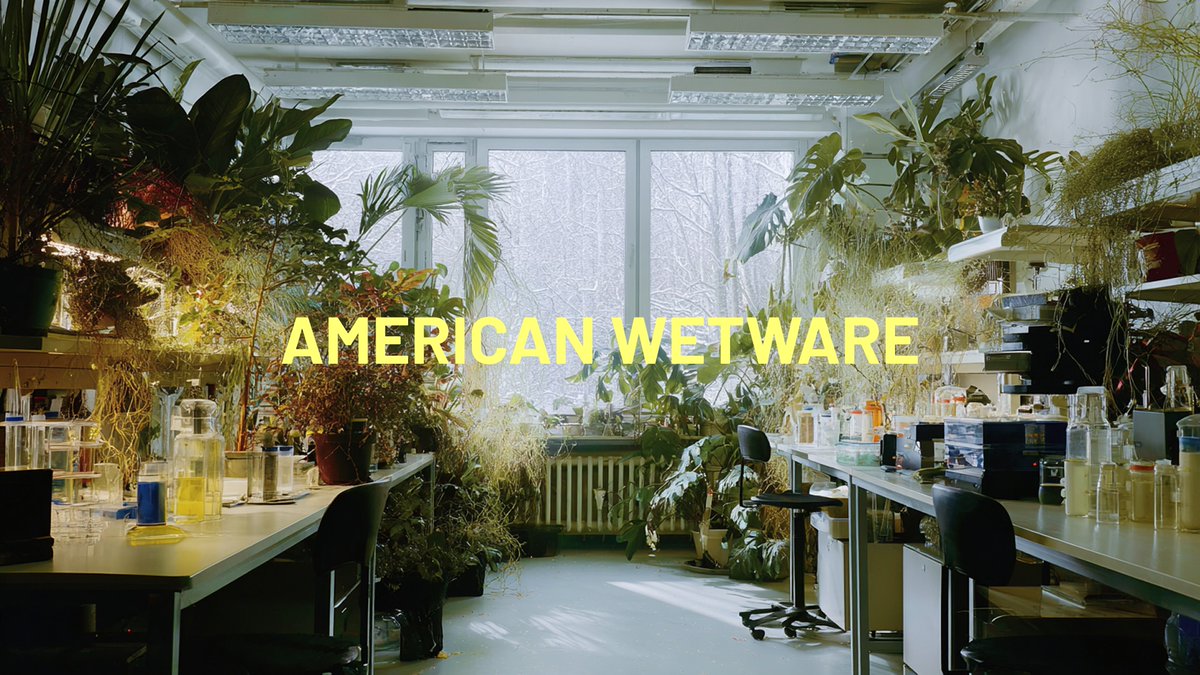
My quick take on American Wetware.
Thesis is spot on what biology needs: "We believe the missing piece is a design language. To us, a design language means “a shared vocabulary and a set of principles that allow people to interact with a complex medium in an organized way.”" 1/n
Today we’re launching American Wetware, a design studio for building with biology 🇺🇸💧
I’m doing this together with @thisischristina and @p_maverick_b
Our mission is to learn the design language of biology
(3) Importantly, the new tools must scale, such that we transition from horses to conveyor belts. I don't buy lab automation though – it sounds like faster horses to me. Rather, I'd bet on taming the almighty miniature factories: cells and droplets. 6/n
Inspired by the winning ideas -- I expected much more vagueness. And also jealous -- people seem to have so many good ideas and even implement them! Great times for biology ahead.
Announcing the winners for the "Fast Biology Bounties."
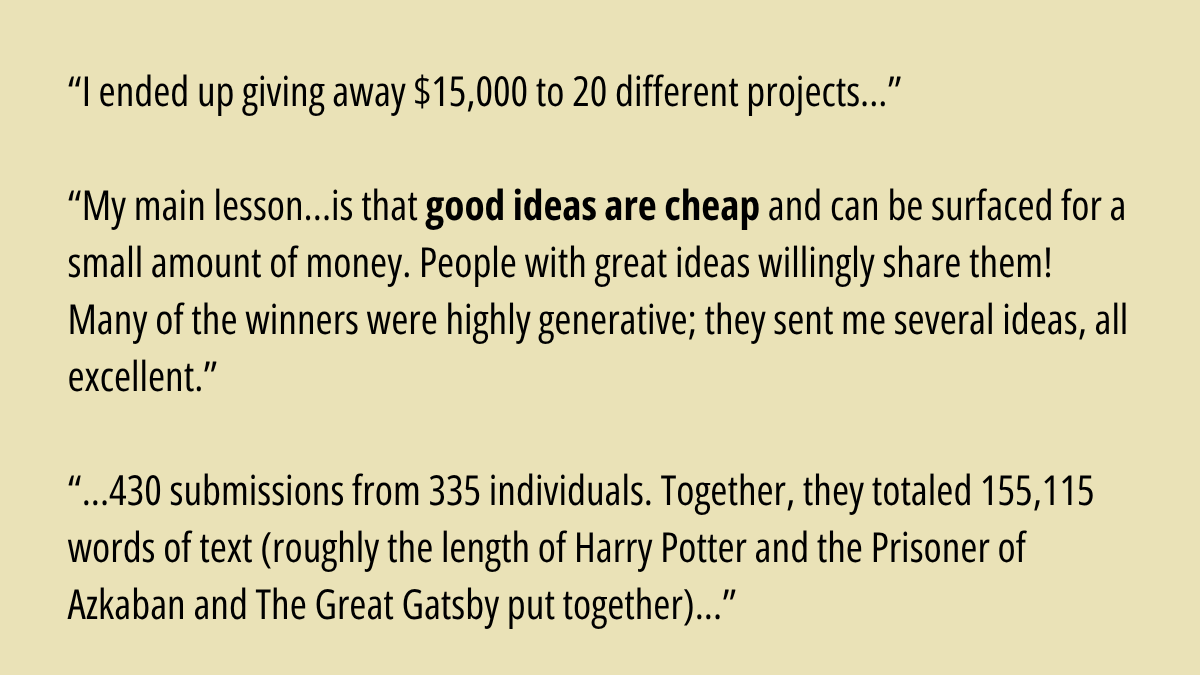
I ended up giving away ~$15,000 for 20 projects after reading 430 submissions from 335 individuals. Many winners were "highly generative," meaning they sent me 3-5 excellent ideas and were glad to have them shared freely and openly.
There were some major failure modes, too. Some ideas surfaced repeatedly, but I didn't do a good job of connecting "like-minded" people. I'll fix this next time.
Also, I managed everything manually using my personal email. This was tedious, and I'm working on building a platform that will automate a lot of this. I'd like to send feedback and scores for every submission in future contests.
Many more details in my blog post, which breaks down all the numbers, what I learned, and highlights some of the winners.
Some people who I gave money to:
- Sebastian Cocioba for a laser-based PCR thermocycler, in which infrared heating replaces aluminum blocks.
- Bryan Duoto for writing and publishing a colony-to-sequence cloning workflow that uses magnetic beads and Nanopore sequencers. Scientists can verify clones in 1–3 hours instead of waiting overnight.
- Jeff Nivala for an idea to synthesize proteins directly from DNA, without relying on any RNA intermediates.
- Sierra Bedwell for a clever automation system that uses off-the-shelf parts to screen thousands of environmental DNA samples in parallel.
- Xavier Bower for "IceCreamClone," an interactive cloning strategy ranker that looks at a scientist’s available “parts,” or sequences, and then determines whether they ought to use Gibson, Golden Gate, restriction digest, or another strategy to assemble them together. The software also catches likely cloning errors and estimates the cost and time required for each option.
- Andres Arango for multiple ideas, including using antifreeze to accelerate DNA ligation by 2-3 orders of magnitude, and an idea for computationally designed protein cradles for expressing membrane proteins in E. coli.
This is so hard to imagine that I couldn't believe it to be the case. But it's true! And indeed seems to have helped people realize that preemies are not doomed babies as apparently was believed back then.
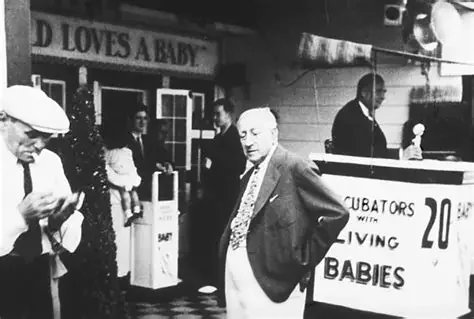
From 1903 to 1943, Martin Couney used incubators to save the lives of about 6500 premature babies and paid for it by charging admission to tourists
I don't know how I feel about this but it's worth remembering that very different biotech business models are possible