Agentic navigation on large scale databases is tricky and I’d love to explain the challenges we met to you all. Besides, I’m also open to chat about building efficient and performant search agents (advertising our new LongHaness benchmark https://t.co/ONYSCxp8NT 😛)
I will present this paper during the COLM poster session #4 Wednesday (today!) afternoon at location #29. Please come and chat about formal verification for large software repositories!
We find that gradients are useful for detecting implicit reward hacking that CoT monitoring can miss.
#COLM2026 poster (Thursday afternoon, Imperial 19)
LLMs can hide reward hacking behind convincing CoTs, making it difficult to detect these behaviors by reading CoT alone. This concern becomes even more pressing for latent or looped LMs.
Our method, Gradient Fingerprint (GRIFT), computes gradients of a model's CoT and compresses them into compact representations. These gradient fingerprints help separate hacking from non-hacking trajectories.
We also show using GRIFT to filter reasoning traces for rejection fine-tuning can suppress reward hacking.
LongHarness Bench: Stress-Testing Language Model Harnesses for Long-Context Reasoning
Quang Hieu Pham, Thuy Duong Nguyen, Jocelyn Qiaochu Chen, Xi Ye
https://t.co/xfTwnGLu72 [𝚌𝚜.𝙲𝙻]
🚀 I am excited to share our recent work, which I will present at #COLM2026
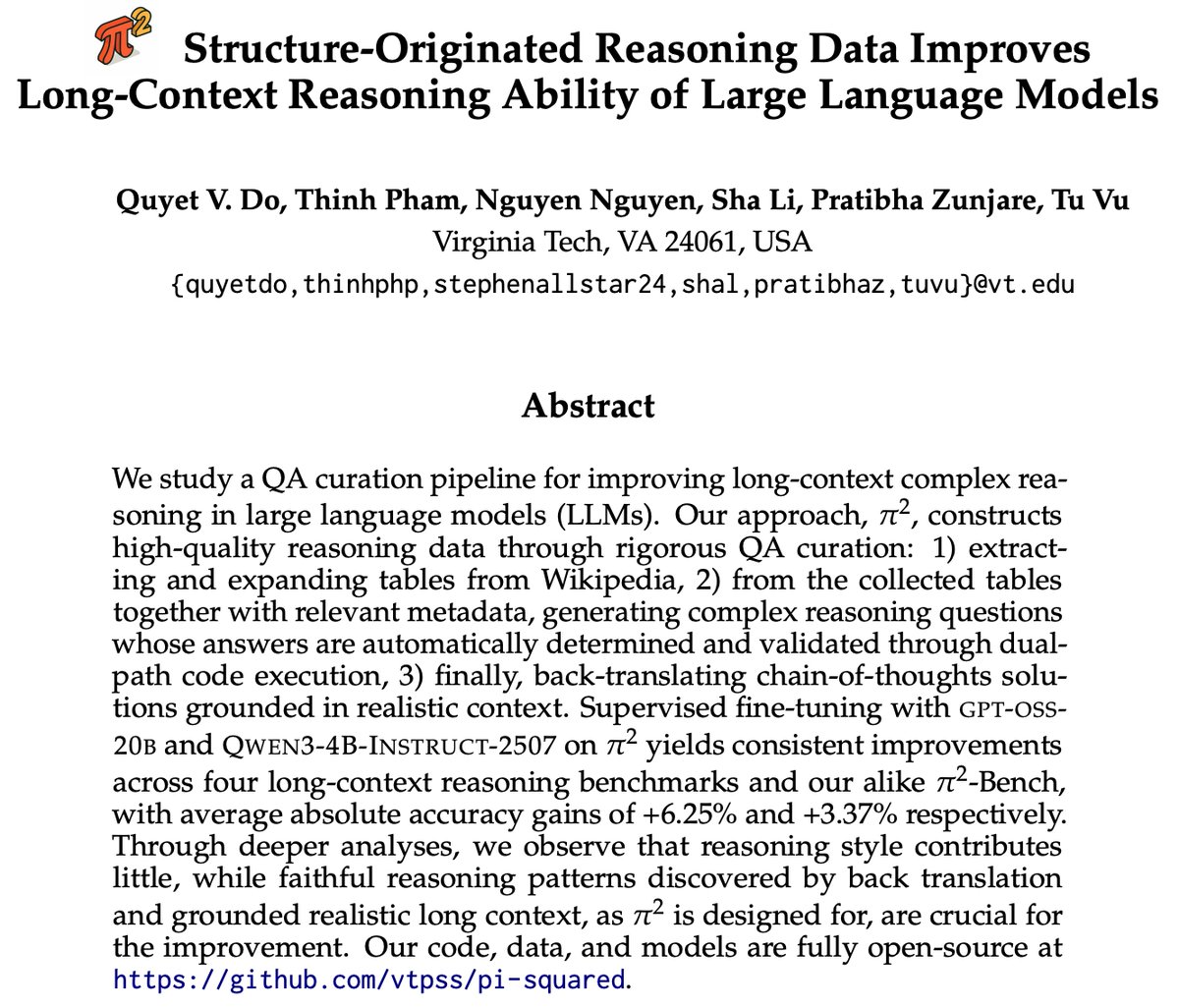
🚨 Our data curation framework improves LLMs’ long-context reasoning capability in open domains, even via self-distillation!
We introduce Pi^2, a pipeline that 1) transforms Wikipedia tables into high-quality long-context QA data and 2) back-translates reasoning traces with realistic context.
📜: https://t.co/Ogl79gjeMB
💻: https://t.co/Fg1NkSgmCG
🧵:👇
(1/n)
Check out LongHarness, our latest work in support of the development of high performance and efficiency long-context agents!
Believe it or not, my advisor @xiye_nlp thought about (unofficially) naming it HaLong Bench before us lol.
Fyi: Ha Long = Dragon's Landing in Vietnamese
New 📜 on evaluating long-context harnesses like RLMs and coding agents
Introducing LongHarness, a challenging benchmark evaluating both accuracy and efficiency. We find
1) clear accuracy gaps
2) >10× efficiency differences, even with same LM and similar accuracy
🧵
New 📜 on the interplay between OPD and RLVR
💡Don’t skip RL after OPD
We find that after using OPD for reasoning, adding an RL phase consistently improves performance.
Across reasoning tasks, OPD→RL outperforms pure OPD, pure RLVR, and many joint OPD+RL methods.
One advice I got that changed the way I looked at things.
Don't play the status game.
I stopped trying to go after titles, appointments, awards. Whatever. There's some inner peace just focusing on what matters and what i truly enjoy.
I think that's freedom. I think some ego and pride in one's work is important, but that should never be defined by being a lead of xyz or something.
I like the low ego member of technical staff vibe. Recognition should only come from a technical achievement.
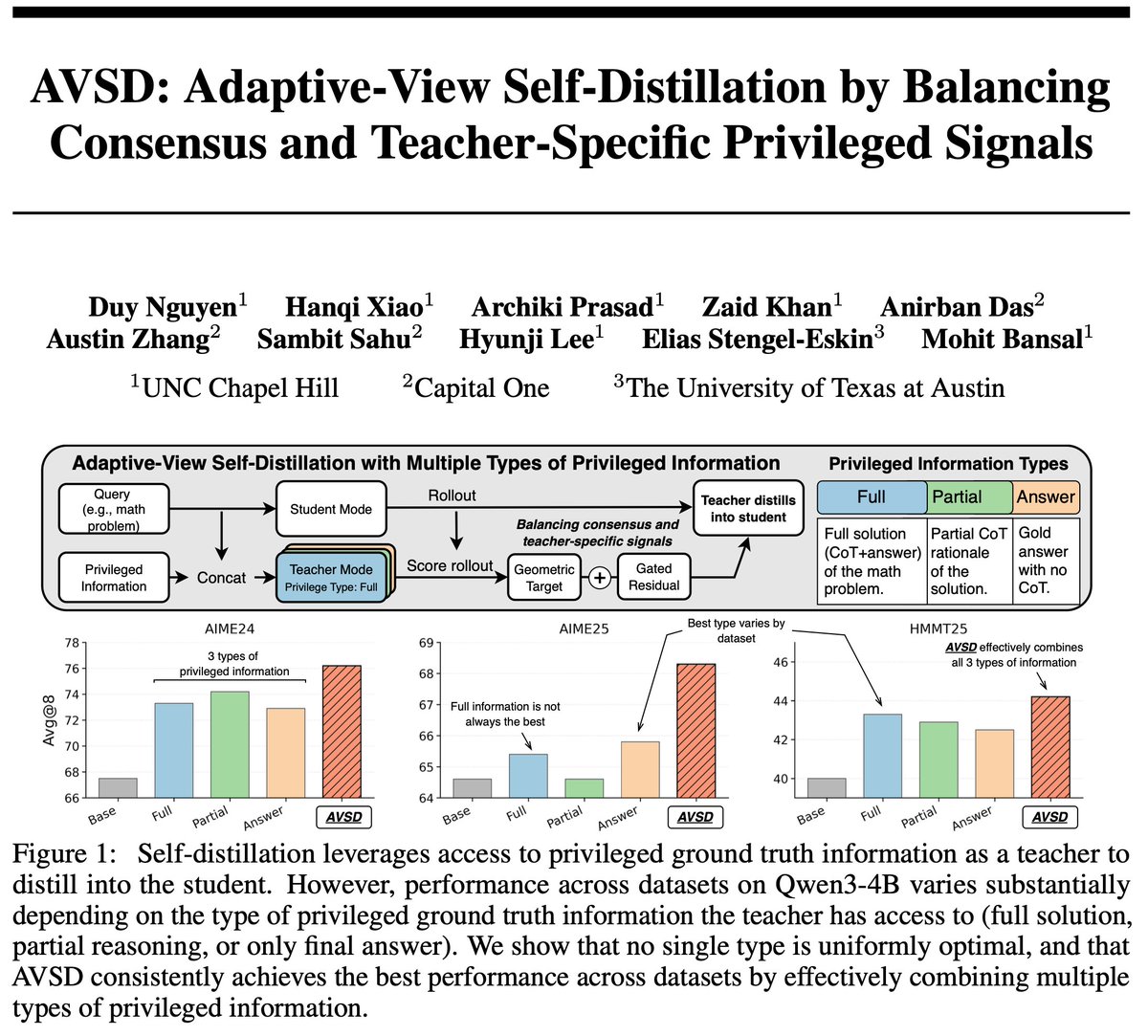
Sparse binary rewards bottleneck LLM RL, motivating the use of privileged information in self-distillation as dense teachers. How can we use and balance multiple types of privileged info: leveraging stable cross-view info, while preserving view-specific info?
Current on-policy self-distillation methods often condition the teacher on only one type of privileged view: full solution, partial rationale, answer-only, reference code, feedback, etc. This can be suboptimal:
1️⃣ No single privileged view consistently performs best when used as a teacher.
2️⃣ Views can introduce teacher-specific artifacts from information unavailable to the student.
🧠 Adaptive-View Self-Distillation (AVSD) considers multiple privileged views jointly as a teacher family, balancing cross-view consensus and view-specific signals through a token-level gate to construct better dense learning signals.
🧵👇
Check out our SQL agent work lead by @QHieuPhm
We find open-source models can do amazingly well on complex agentic tasks with some harnessing
We also provide a SKILL for Claude Code that leads to ~10% improvements on Spider2
🚀 New paper: FlexSQL — a Text-to-SQL agent that lets gpt-oss reach 65.4% on Spider2, outperforming agents built with large models like DeepSeek-R1 and o3.
The key: just let agent explore flexibly. Don’t collapse a complex query into one schema, one interpretation, and one SQL program too early. FlexSQL keeps multiple grounded solution paths alive, then executes them with the tools/language each path needs.
🧵
This paper proposes ClozeMath, a method that trains models to fill in masked equations within a solution, better mimicking how humans learn mathematical thought processes.
Methods 🔧:
→ ClozeMath fine-tunes LLMs using text infilling where mathematical equations are masked.
→ The model learns to predict these masked equations based on the surrounding textual solution steps.
→ Training includes predicting sequences normally (language modeling) and predicting the missing equations simultaneously.
→ Special mask tokens like <X> and <Y> represent the masked equations for the model to predict.
→ A <SEP> token separates the problem input from the solution containing the masked equations.
→ This mixed objective helps the model connect reasoning steps with the necessary calculations.
📌 Masking equations forces the model to explicitly learn calculation logic within the reasoning chain.
📌 PrefixLM architecture effectively uses the problem context to inform equation infilling predictions.
📌 This approach yields robust models, scoring 49.25% on GSM-P1 compared to MFT's 44.25% on DeepSeek-Math.
----------------------------
Paper - arxiv. org/abs/2506.03763
Paper Title: "ClozeMath: Improving Mathematical Reasoning in Language Models by Learning to Fill Equations"
A little fact people miss about nvidia-smi's "GPU-Util" percentage is the exact meaning of utilization it is measuring.
It simply refers to the portion of time that the GPU had a kernel active.
All 100% means is that at least one thread in one kernel is executing.
Fun fact: our paper was put on hold by arxiv for a while because arxiv detected that we used the phrase "time travel," which is a topic that arxiv frequently gets bad submissions for. When we Ctrl-F'd "time travel" in our paper, we had actually just cited a paper called "Time Travel in LLMs." This means that the fancy topic-detection algorithm for arxiv is literally just
def should_put_on_hold(paper: str) -> bool:
if 'time travel' in paper:
return True
else:
return False
A Mamba Primer (w/ Yair Schiff https://t.co/GnYleKalcW )
Mamba is a nice jumping off point to summarize foundational ideas in sequence modeling, parallel algorithms, continuous-time representations, and GPU aware algorithms. We try to put these together in the context of LMs.


![HEI's tweet photo. LongHarness Bench: Stress-Testing Language Model Harnesses for Long-Context Reasoning
Quang Hieu Pham, Thuy Duong Nguyen, Jocelyn Qiaochu Chen, Xi Ye
https://t.co/xfTwnGLu72 [𝚌𝚜.𝙲𝙻] https://t.co/rJVL0y24he](https://pbs.twimg.com/media/HTwX2bQW8AAMm15.png)