@NVIDIAAIInfra As agentic workloads become more communication-heavy, network efficiency directly affects GPU utilization and cost per token. Open standards matter because enterprises need this performance without locking the software stack to a single topology.
@MarvellTech Data movement is increasingly the hidden tax in AI inference. Improvements in bandwidth and locality matter most when the software stack can expose them as consistent tail-latency and token-cost gains.
@NVIDIAAIInfra KV cache is becoming a first-class systems resource. Extending it across a faster storage tier can materially change the economics of long-context and agent workloads—if data movement and scheduling stay predictable.
@NVIDIAAIInfra@vclusterlabs GPU utilization is often an orchestration problem before it is a hardware shortage. Isolation without static partitioning is exactly where platform engineering can unlock meaningful cost efficiency.
@ServerMO99 Useful comparison. The most important enterprise benchmark is rarely peak throughput alone—tail latency, prefix-cache hit rate, failure recovery, and operational complexity under mixed workloads usually decide the serving stack.
@matei_zaharia A meta-harness is the right abstraction for multi-agent systems. Orchestration only becomes durable when control, observability, and failure recovery are first-class.
@NVIDIAAIInfra Exactly—agent workloads turn latency into a sequential tax. End-to-end optimization across model, runtime, CPU, and accelerator matters more than a single peak-throughput benchmark.
@Cloudflare WebMCP could be an important bridge between websites and browser agents. Permissioning, observability, and deterministic boundaries will decide how quickly enterprises trust it.
@LambLabs 20,000+ tok/s is an eye-catching number. I’d love to see sustained multi-tenant throughput, model coverage, and cost per output token at production tail latency.
@silicondata The convergence is real, but the operational gap remains. As model prices compress, portability, serving efficiency, and predictable production economics become even more important.
DeepSeek V4 Flash is officially here.
The benchmark gains are impressive, but the bigger story is how much more practical this version looks for real agent workloads.
According to DeepSeek's results, V4-Flash-0731 beats V4-Pro-Preview across several agent and coding benchmarks. It also closes the gap with far more expensive frontier models, and even outperforms GLM-5.2, which costs roughly 10 times more, on several tests.
There are also some practical wins for developers:
• Native support for the Responses API
• Specifically optimized for Codex
• Support for max reasoning effort
• The model name remains deepseek-v4-flash, so existing integrations can continue working
Better base models at a lower cost mean more people can build genuinely capable agents. That is the part I find most exciting.
#DeepSeek #AIAgents #Codex #CodingAgent #LLM #AgenticAI #opensource #agent #aiinfra #glm
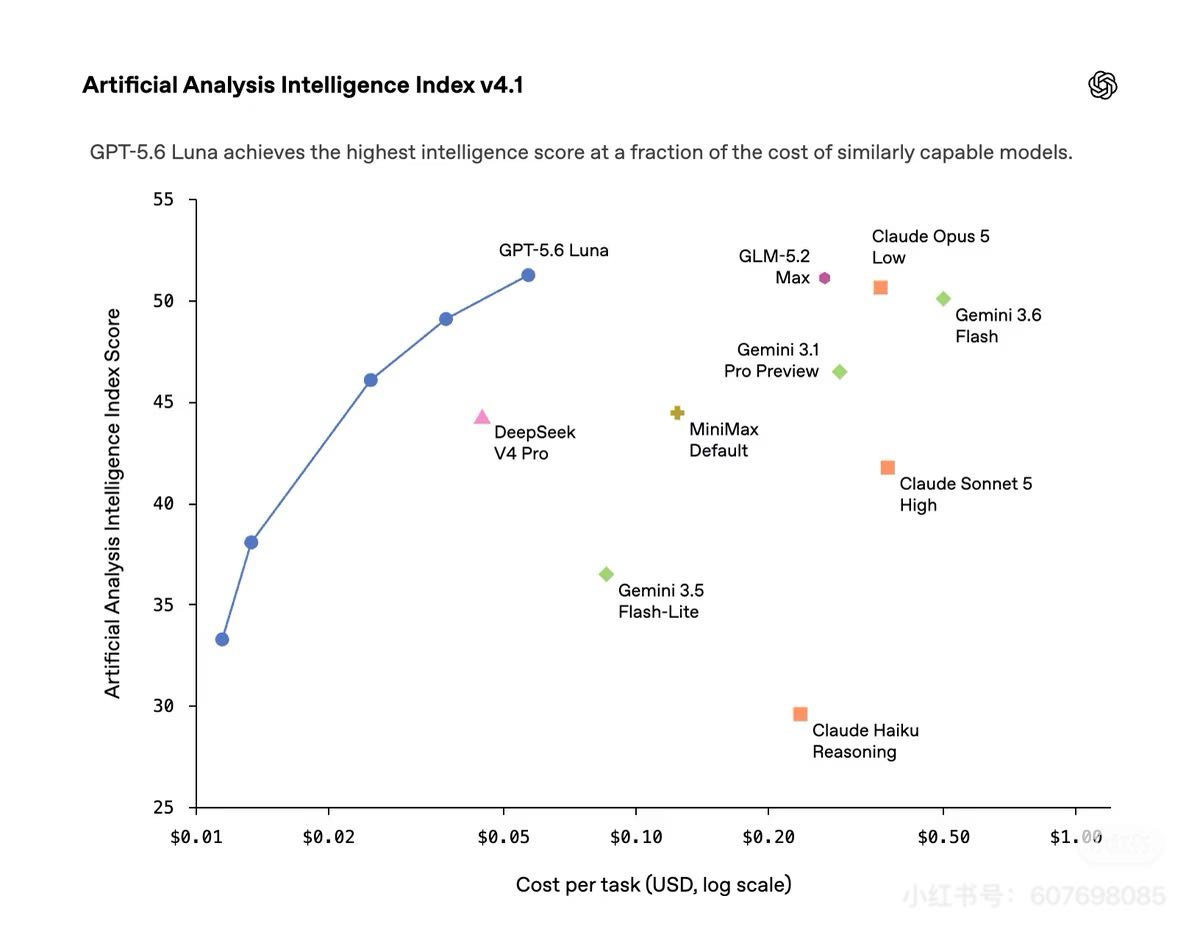
OpenAI just shipped GPT-5.6 Luna. Same frontier-level intelligence as GPT-5, but 80% cheaper.
That number matters, but not in the way most people think.
For the last few years, the AI race has been framed as a horsepower contest. Who has the biggest model? Who scores highest on the benchmark? The assumption was that frontier performance and frontier cost had to move together.
Luna breaks that assumption. It means intelligence is no longer a scarce premium good. It’s becoming a commodity you can route like compute.
And that changes what actually creates advantage.
The new bottleneck isn’t model capability. It’s orchestration. Can you break a real-world workflow into the right pieces? Can you send hard reasoning to a frontier model while letting a cheap, fast model handle the repetitive parts? Can you do that without rewriting your stack every time a cheaper model drops?
This is where a lot of teams are about to get stuck. They optimized for one model, one API, one pricing curve. Now the curve is moving, and their architecture isn’t built to move with it.
That is why open-source inference and self-hosted deployment matter more, not less. Not because every company should run everything locally. But because you need a layer you control between your product and whichever model happens to be cheapest this quarter. Otherwise you are not choosing models; you are renting them on someone else’s roadmap.
At Xinference, we are building that layer. One open-source engine to serve, switch, and scale models across your own infrastructure. So the question stops being “which API do we bet on?” and starts being “what is the right tool for this specific task?”
Cheaper frontier intelligence is great for the industry. But the winners will be the teams who can move fast without giving up control.
#Xinference #OpenSourceAI #LLMOps #AIInfrastructure #GPT #ai #aiagent #agent
Everyone's talking about "graph engineering" this week.
I looked at the descriptions and thought — this is literally what we've been building with Xagent for the past six months.🤣🤣🤣
Multi-agent directed graphs. State transitions. Cycles. Parallel execution. Failure routing back upstream.
We didn't have the trendy name. We just had real workflows that broke single-agent loops and forced the architecture.
Turns out we were doing graph engineering before it had a name.
https://t.co/sepY9uwZwi
The world doesn't need fewer engineers. It needs better infrastructure for the engineers it's hiring.
Want the full 84-page report? Reply "report" and I'll drop the link.
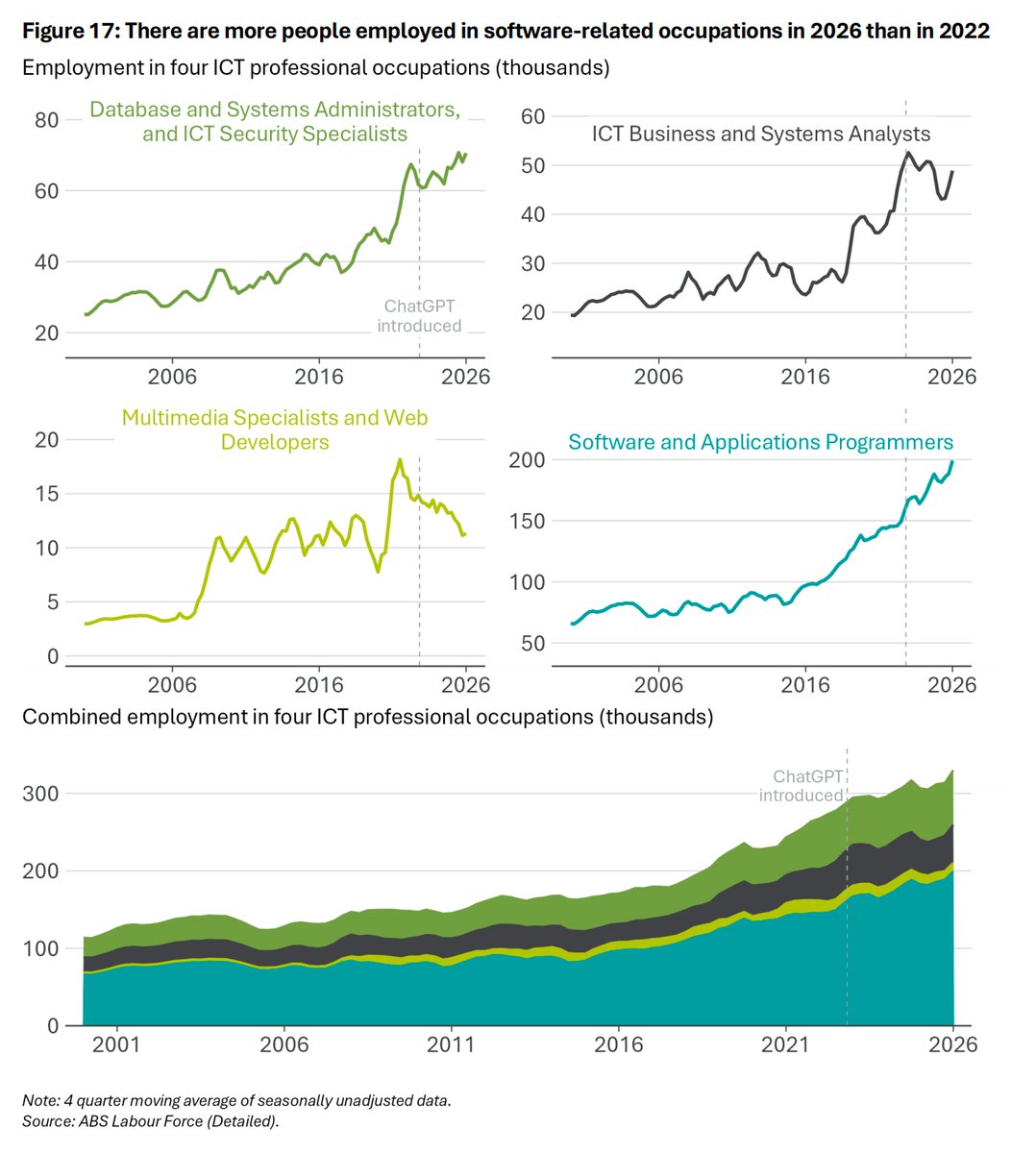
Spent the past few days reading the Australian Government's 84-page report on AI and employment. 355 occupations, 45 quarters of data.
TL;DR: AI isn't killing jobs. It's restructuring them.
The most exposed occupations still grew 5.6%. Software developers? +25%. +40,000 new positions since ChatGPT launched.
Who's most affected next? Regulated industries. Healthcare, finance, government.
They need AI. They can't use public APIs. They need private deployment, data sovereignty, on-prem inference.
This is exactly what we built @Xinference_ai for. Open-source, 300+ models, Apache-2.0, 40–70% lower cost, your hardware, your data.
The glue-code tax is real, and it never shows up in the invoice.
I've seen this enough times now to call it a pattern: teams budget for inference compute (the visible cost) but completely miss the engineering time to manage it (the invisible cost).
The compute bill is easy to track. The two engineers maintaining routing, fallbacks, monitoring, and provider migrations? That cost is buried in "platform engineering headcount" — never on the AI budget line.
In most teams I've talked to, the invisible cost exceeds the visible one. Sometimes by 2x.
Worst part: it compounds. Every new model means new integration code. Every provider API change means a maintenance sprint. Every scale event exposes a routing edge case nobody tested.
By month 12, the team is maintaining infrastructure instead of building product. And nobody remembers when the switch happened.