Lawyer building in the age of AI.
Exploring AI, law, first principles, and systems thinking.
Building AI agents. Sharing what I learn.
Read. Think. Build.
US vs China update. Stanford's AI Index put the US–China gap at 2.7%. Here's what two years of real-world use from the Text Arena shows.
Gap three years ago: +278. Today: +29.
@AnthropicAI's Claude Opus 4.6 Thinking vs. Baidu's
@ErnieforDevs Ernie 5.1 at the top.
The US has never lost #1, but the race keeps closing.
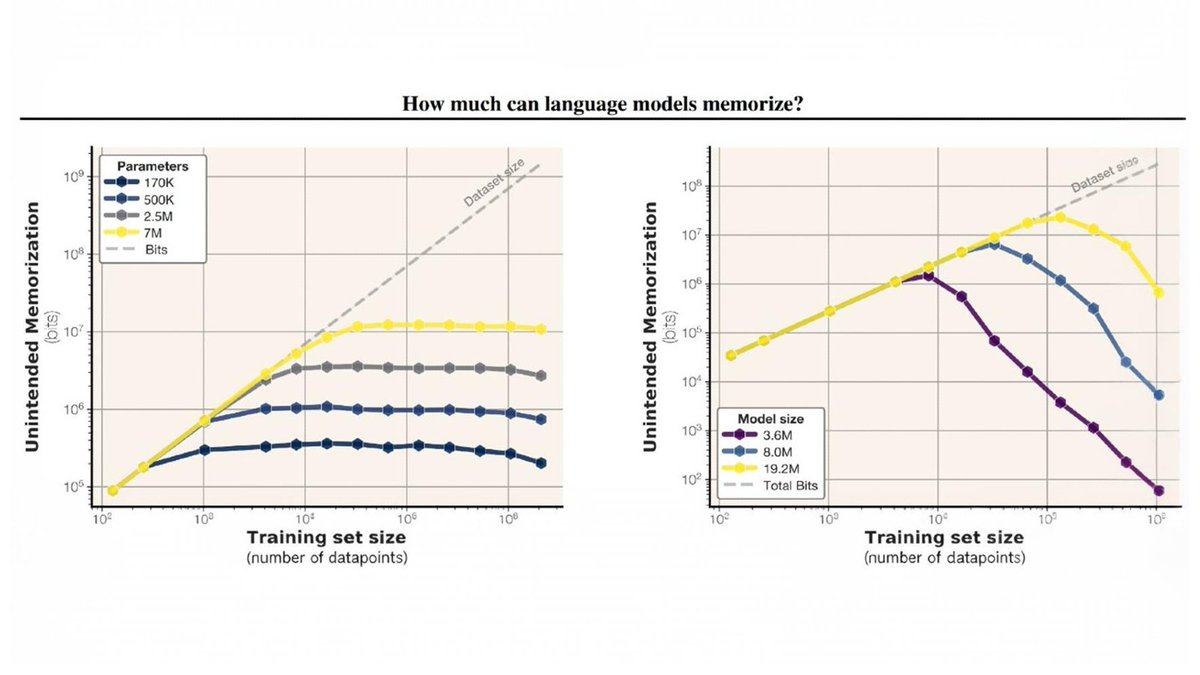
How much can an LLM memorize?
This ICML paper separates unintended memorization from generalization and estimates GPT-style model capacity at about 3.6 bits per parameter, offering a sharper way to reason about data, scaling, and privacy.
You can read the full paper here 👉 https://t.co/c8KeGPZ3Fk
Besides code migration & heavy tasks: How should I best use Feble before July 7?
Prompt like this :
Based on our chat history, what you know about me, and my goal to become a super individual — before Feble5 gets taken down, what important tasks should I run and what prompts would you recommend? 🚀
Announcing the hosted X MCP.
Agents now have access to the best real-time information source in the world.
Connect Grok, Cursor, or any MCP-compatible AI tool to the X API without any setup!
Check it out here: https://t.co/5MzPYwGFzD
Don’t take shortcuts. Every shortcut comes with a hidden cost.
AI is a shortcut too. Don’t let it replace your understanding or your ability to create. Read books yourself. Write articles yourself. Build something yourself.
We’re sharing the next major milestone in our non-invasive brain-to-text decoder research: Brain2Qwerty v2.
Building on v1, which was published today in @Nature, Brain2Qwerty v2 is the highest-performing end-to-end pipeline capable of real-time sentence decoding from raw brain signals. It advances beyond character-level performance to decoding words and semantics, enabling accuracy for overall communication.
We believe this research has the potential to make a real difference for the millions of people who suffer from brain lesions or disorders that prevent them from communicating.
🧵👇
It suddenly occurred to me how forunate we are to live in a universe governed by laws.
Imagine a world without order.
Imagine if the laws of physics changed every day. Imagine if nature had no patterns and no consistency.
We wouldn't even know what beauty is.
The future belongs to lawyers who can think across angles: legal, economic, business, psychological, technological. The hardest specialty is being a generalist.
A senior Anthropic engineer just dropped 11-page PDF on "Loop Engineering" for agentic systems.
The shift: you stop prompting the agent. You build the system that prompts it instead.
Schedule → Discover → Build → Verify → Repeat
Every loop runs one turn, five moves:
• Discovery: it finds its own work - failing CI, open issues, recent commits - instead of being handed a list.
• Handoff: each task gets an isolated git worktree so parallel agents don't collide.
• Verification: a second agent, told to assume the code is broken, reviews the first. The "thing that can say no."
• Persistence: results get written to disk, never left in a context window that gets flushed.
• Scheduling: an automation wakes it on a timer. That's what makes it a loop.
The key insight: an agent grading its own work always praises it.
This 11-page PDF changed how I'm building agentic systems today.
Read it now, then explore the article below.
Introducing Computer for Counsel.
Computer now connects the research databases, document tools, and matter-management systems lawyers use every day. Pull citable sources from @midpageAI, @LegalZoom, @Docusign, @netdocuments, and more.
Available for all Pro and Max subscribers.
Hands down the absolute best Claude Cowork tutorial you’ll watch in under 25 minutes!
Made by Tina Huang (@hellotinah), former Meta data scientist turned content creator 👇