Crypto is a very dangerous and adversarial place. If you are not careful, you risk having your valuable cryptocurrencies stolen from you.
I've compiled a thread on some security best practices that you can follow to stay safe. Read on below 👇👇
🚨 I’M POSITIONING FOR $200K BITCOIN
I bought at $75.9K
Added at $67.9K
10 BTC with an average entry of $72.7K
My target for the next cycle is a new ATH near $200K in 2029
But this chart leaves room for another leg down before the recovery
My near-term plan is already public
Weekly close below $67K → sell 5 BTC
$58K–$60K → look to buy them back
$85K and $93K remain my rebound targets
A bounce there wouldn’t prove the whole correction is over
The next few months are about building the position for the next cycle
There may be better entries along the way
I want cash ready if we get them
THE OTHER HALF OF THE PLAN IS KNOWING WHEN TO SELL
If Bitcoin approaches $200K in 2029, I’ll be looking to take profits before the next bear market
The chart puts that next reset in 2030
I don’t want to spend years building a position and then give the gains back because I got greedy
I’ve posted the entries
I’ll post the cuts and new buys too
Save the chart and follow the trade from entry to exit
I am begging you to send this to Claude Fable 5.2 before bed, it will definitely change your life...
Overnight it researches the whole market and gives you startup ideas no one knows about.
Steal this before everyone starts using it:
I don’t see that happening.
Saylor is much harder to regime change than Jensen Huang at Nvidia.
Unlike Nvidia, Strategy has a dual-class share structure giving Saylor 10 votes per Class B share, providing significant protection against a hostile takeover or boardroom regime change.
But why would the Financial Industrial Complex (FIC) want to replace him?
In my opinion, he’s doing exactly what FIC needs.
Centralising as much Bitcoin as possible into a publicly traded corporate structure while creating equity, preferred shares, credit and derivative instruments that give institutional capital more tools to manipulate Bitcoin’s short-term price.
And there’s another side to Strategy most Bitcoin investors overlook.
MicroStrategy Government Services.
Former board member Karen Schaefer spent 26 years at the CIA, including senior counterintelligence roles and oversight of presidential covert-action programmes at the National Security Council. She also served in the FBI’s National Security Branch, part of the Department of Justice.
Then there’s the tokenisation of Strategy’s stock.
Strategy’s own October 2026 investor presentation reported approximately $509 million in tokenized $MSTR and $STRC securities.
In my opinion, this is where we see the convergence of three power structures:
Financial Industrial Complex: Institutional capital, Bitcoin accumulation, credit markets, derivatives and financial engineering.
Military Industrial Complex: Government intelligence, national-security relationships and the defence establishment.
Technology Industrial Complex: Tokenized securities, blockchain settlement and the integration of traditional finance with digital infrastructure.
Strategy operates across all three.
Saylor’s voting structure gives him protection against corporate regime change, but Strategy remains dependent on institutional capital markets.
That’s where FIC has leverage.
Look at the pressure surrounding MSCI exclusion and the expansion of financing instruments like STRC.
In my opinion, institutional capital benefits from lower valuations, increased financial dependence and more opportunities to accumulate exposure without replacing Saylor.
I see no need for regime change.
Saylor already serves the interests of FIC, MIC and TIC extremely well, whether that’s his intention or not.
And that’s the distinction I keep making.
Intentions are irrelevant.
What matters is the governance structure, who controls the capital flows, what financial instruments are being built and who ultimately benefits.
@DrJackKruse
The most consistent mistake I see young would-be founders make is to care too much about investors' opinions and not enough about users' opinions. They've been trained their wholes lives to seek out and please the gatekeepers. But this is where gatekeepers stop mattering.
A new episode of Hivemind is out now!
This week the team discusses whether the worst of the selloff is over, how the Anthropic IPO could trade, why stocks onchain have stalled and more.
Timestamps
00:00 Intro
00:45 Is the Worst Behind Us?
07:48 Why the Macro Models Are Cautious
10:25 The Nvidia Wild Card
16:11 Never Sell the Singularity
19:23 AI Stocks at COVID-Low Valuations
24:33 Meta's AI Bet Is Priced at Zero
28:01 How the Anthropic IPO Could Trade
34:00 Will Anthropic Wipe Out SPV Buyers?
38:04 The Mystery Morning Seller
39:42 ZEC in the Wall Street Journal
41:14 Why Stocks OnChain Stalled
44:28 Can Elysium Skip the Launchpad Trap?
50:48 Is ETH's Store of Value a Hail Mary?
56:14 MegaETH Pivots to AI Inference
BREAKING: The Constitutionality Index has now scored every law in the history of the United States. 48,000 laws dating back to 1789.
So far as I'm aware, I'm the first one to ever attempt such a thing.
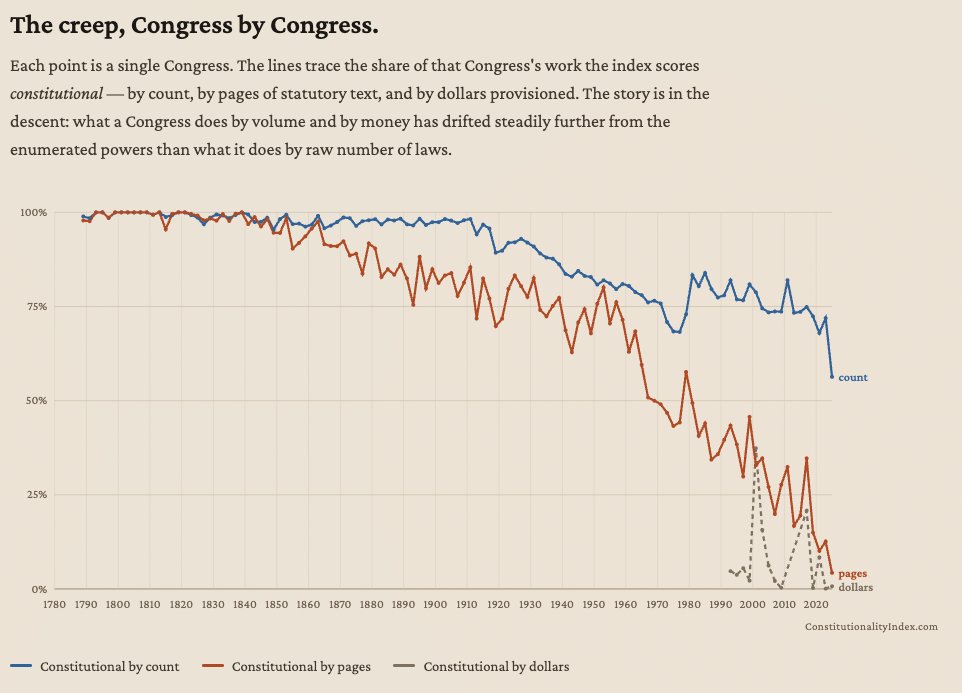
And we've now ranked every president based on the percentage of laws they enacted were constitutional. The results largely track the overall historical trend: As we move from the founding to the modern era, the percentage of unconstitutional legislation increases.
In fact, 1937 is the tipping point. Pre-FDR's New Deal, every president — Federalist, Whig, Republican, Democrat — scores 98 to 100%. After the New Deal, the average percentage of constitutional laws (by page) drops to 31 percent.
As a result, presidents of the last few decades find themselves at the bottom of the rankings. @JoeBiden is officially the least constitutional president, although Trump isn't far behind. Only Thomas Jefferson scored a perfect 100 percent.
I've also scored congresses, & @SpeakerJohnson's current Congress is, from the perspective of the Constitution, the worst Congress in American history. Constitutional legislation stands at 56.3 by total count, & just 4.3% by total legislative pages.
Another important finding: The largest laws in American history are, every one of them, unconstitutional.
Check it out & let me know what you think. (Links below)
"And what are we talking about here? Building a financial system that creates fucking equality for fucking everybody. Like capital F-U-C-K-I-N-G equality. It can't treat you differently because you're a woman or because you're Black, or because of whatever. It doesn't know who the fuck you are and it doesn't give a shit. It just gives you fair equality for all people across the whole world. Why is this not a liberal fucking calling card of immense frigging freedom and equality in society?"
@CBarraford | EPI 400
- Decentralization means resisting censorship pressure.
- How THORChain is handling controversy.
- Monero integration is close and could become an important Monero trading venue.
Watch Here (YouTube): https://t.co/Uwk1TQfO9q
Canton moves collateral at institutional scale.
At The Capital Summit 2026 in Korea, @YuvalRooz discusses Broadridge’s repo platform on Canton and why adoption starts with use cases that deliver immediate value to customers.
Qualities of a Great Trader
- Understands their strengths and weaknesses
- Flips bias at a dime and update priors quickly
- Doesn't spiral after losses and understands that variance happens
- Has a knack for finding the right venues to play at
- Thinks probabilistically instead of deterministically
- Knows when to be patient and when to risk more
- Always puts survival and risk management first
- Views trades as part of a system not individual parts
- Understands the correlation behind held assets
- Focuses on consistency over hitting it big
- Loves the game they play
- Takes fewer trades with longer time horizons
- Stays fluid in beliefs and execution instead of relying on strict systems
A man spent years teaching people about Bitcoin, but when he admitted he wasn't rich from it, one of Bitcoin's biggest figures mocked him. What happened next made him a millionaire.
> Andreas Antonopoulos had been educating people about Bitcoin since 2012.
> He wrote books, gave hundreds of talks and helped thousands of people understand Bitcoin.
> But there was one thing he didn't have, a massive Bitcoin fortune.
> In December 2017, Roger Ver, popularly known as Bitcoin Jesus, questioned why Andreas hadn't become rich from Bitcoin despite being an early advocate.
> Andreas replied that he had actually bought Bitcoin early.
> But in 2013, he sold his holdings to pay rent and support his family.
> He had spent years working on Bitcoin without a steady income and couldn't afford to keep holding.
> That response changed everything.
> Bitcoin supporters began sharing his donation address, encouraging people who had benefited from his work to give something back.
> Within three days, hundreds of donations had poured in.
> One person sent 79 bitcoin:native, while another donation was worth $1.2 MILLION at the time.
> By December 8, Andreas had received approximately 102 bitcoin:native worth $1.6 MILLION at the time.
> At today's Bitcoin price, those 102 bitcoin:native would be worth approximately $7.5 MILLION.
> Andreas was so overwhelmed that he described reading the messages with tears in his eyes.
> He had spent years helping people discover Bitcoin and when the community found out he wasn't wealthy, they sent him a fortune.
In 2015 the encryption software protecting much of the world's email was maintained by one man who was going broke.
Werner Koch had written GnuPG, the free implementation of the PGP standard, starting in 1997. By 2010 his funding had run out. He kept paying a programmer out of pocket, hoping more would come. By 2013 he was ready to quit.
ProPublica published the story in February 2015. Donations arrived immediately and his campaign hit its $137,000 goal. The Linux Foundation added a $60,000 grant. Facebook and Stripe each pledged $50,000 a year.
Critical infrastructure had been running on one person's willingness to stay broke.
Privacy tools get used by millions and funded by almost no one.
�� CEX Listing Activity Falls 39% in October
New CEX listings fell to 117 in October 2026, down from 191 in September, pulling back after the Q3 surge.
The notable shift was at the top: @okx listed 34 tokens to edge past @MEXC at 33, the first month in the two-year window on the chart that MEXC has not led the field.