Backtests / P&L curves from world's largest database of options strategies. All include slippage of $1.25-$5 per contract/side. Overfitting always likely.
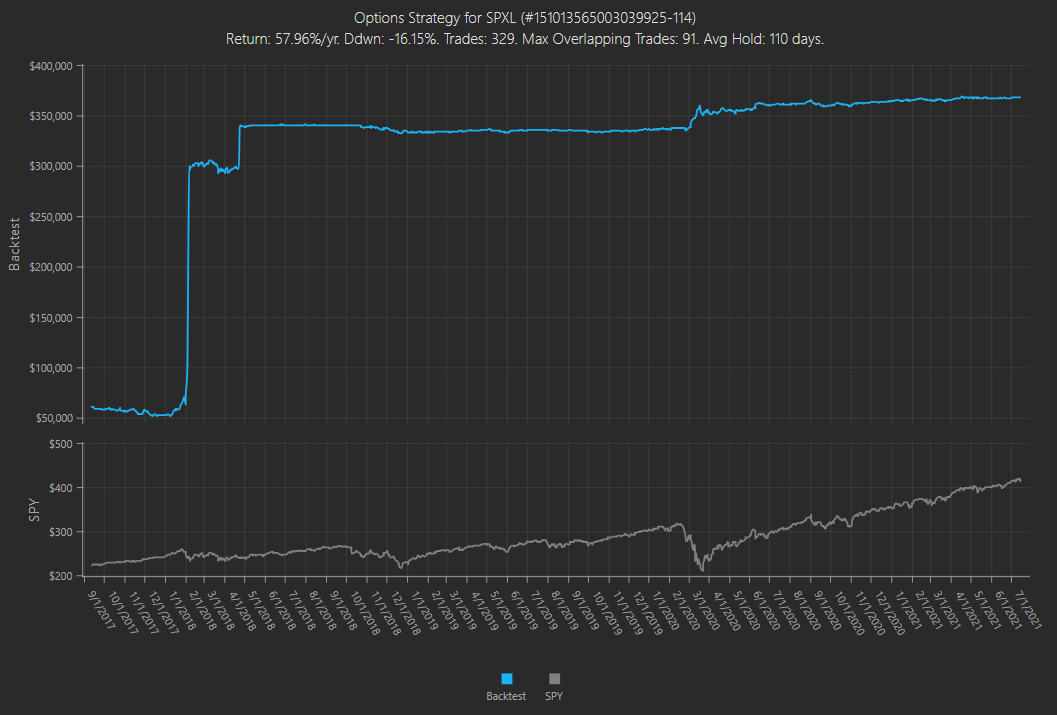
@Ksidiii@Maksim_P_M@sdav1986@bennpeifert There is a way to tail hedge with moderate complexity (not much adjustments or trading). See this backtest.
https://t.co/qehAV5ovah
An interesting tail hedging strategy. Positive delta on $SPXL (through options and shares), while buying long-term $SVXY / $SVIX puts. Basically betting on $SVIX getting decimated during tail events.
@Ksidiii None of the backtests show that buying LEAP $SPX calls is generally profitable or beats the market across multiple years. Though there are periods when buying certain bullish call structures/combos can be highly profitable.
An interesting tail hedging strategy. Positive delta on $SPXL (through options and shares), while buying long-term $SVXY / $SVIX puts. Basically betting on $SVIX getting decimated during tail events.
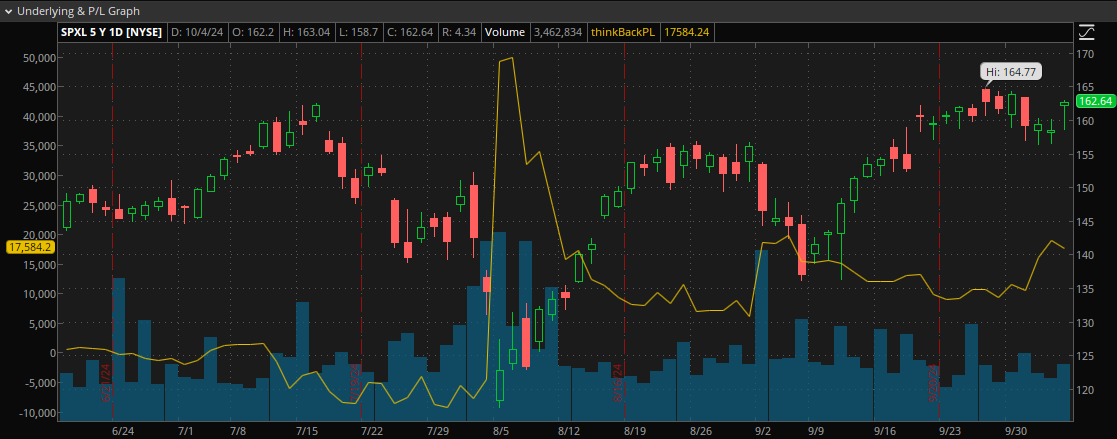
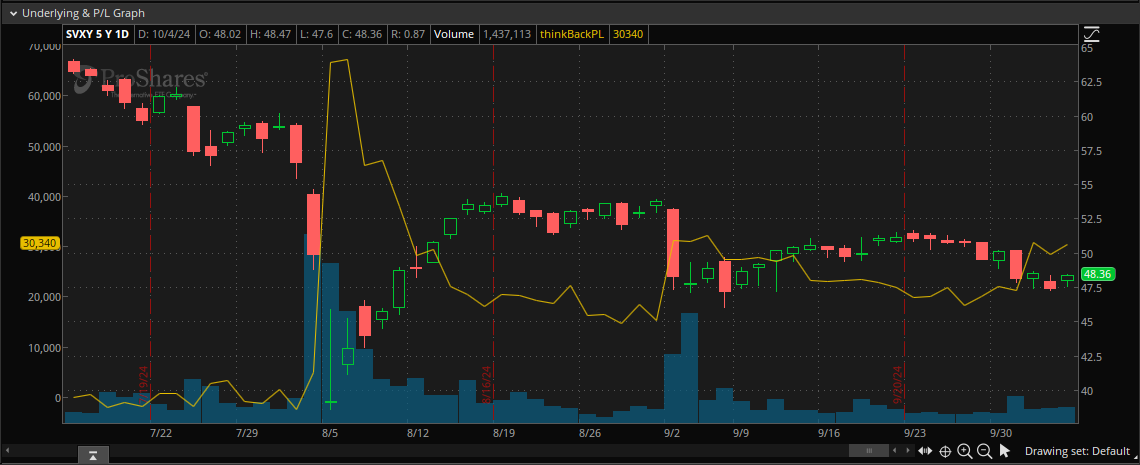
Just tested a sample trade if it were made a few months ago June 15, and here's how it would perform around August 5 vol crash, making up to $50K profit. Even right now it would still be in profit since $SVIX hasn't recovered from the recent drop.
@1WhiteTruck@AKJtrader
@AKJtrader True, though in 2018 $SVXY got deleveraged from -1x $VIX to -0.5x VIX. Only later $SVIX was introduced as the new replacement and recently has shown its weakness on August 5. So this approach might work better again now.
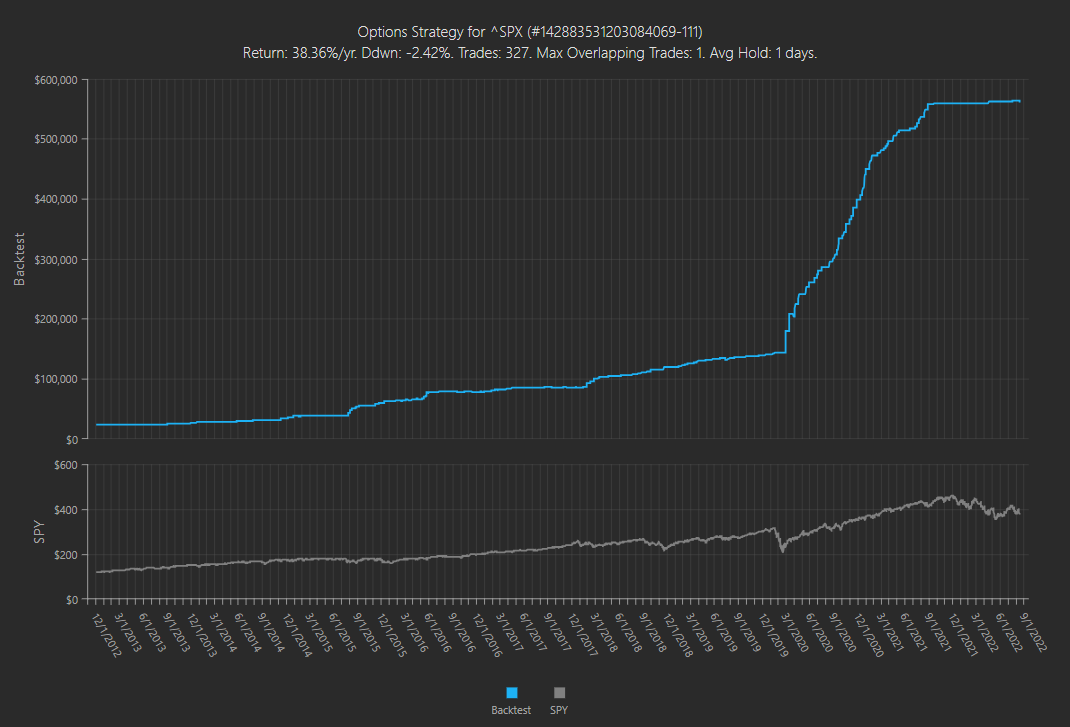
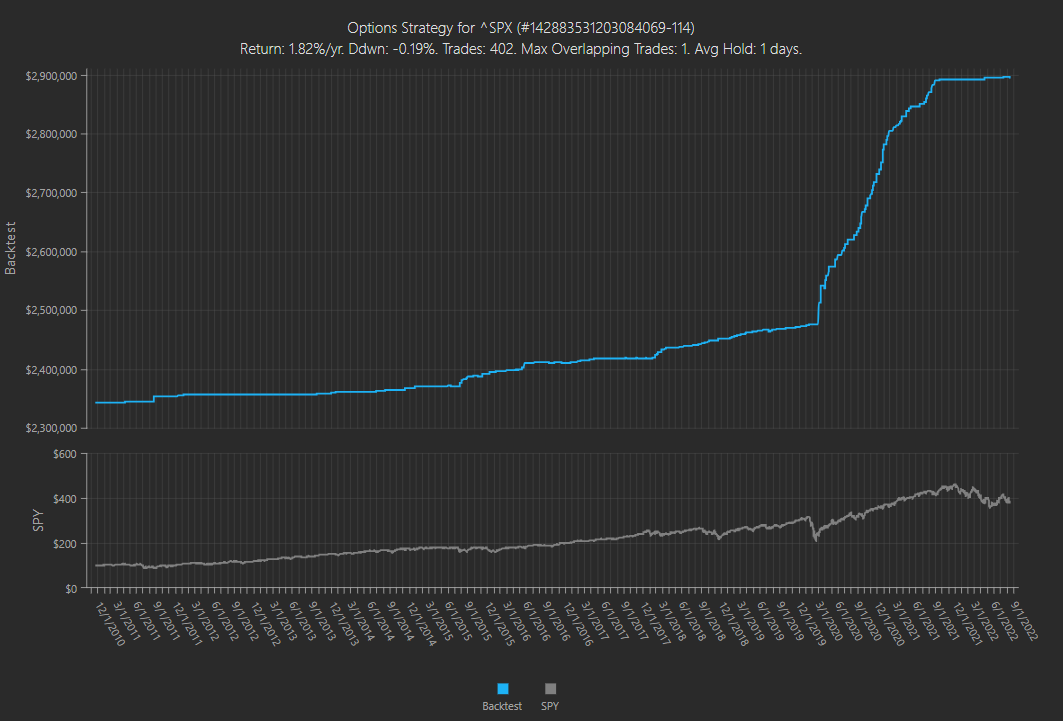
CAGR/annual returns may not be useful when backtesting options. Here is a sample $SPX options strategy returning 38%/year, and the same strategy returning 1.82%/year. Different brokers like IBKR vs Schwab require different margin on these, each allowing for different % returns. Margin requirements also change at different times, making actual returns not predictable.
Certain strategies can also be executed against existing portfolio or inventory, thus providing different returns depending on how they fit within.
For these reasons, we use proprietary metrics for our performance and optimization.
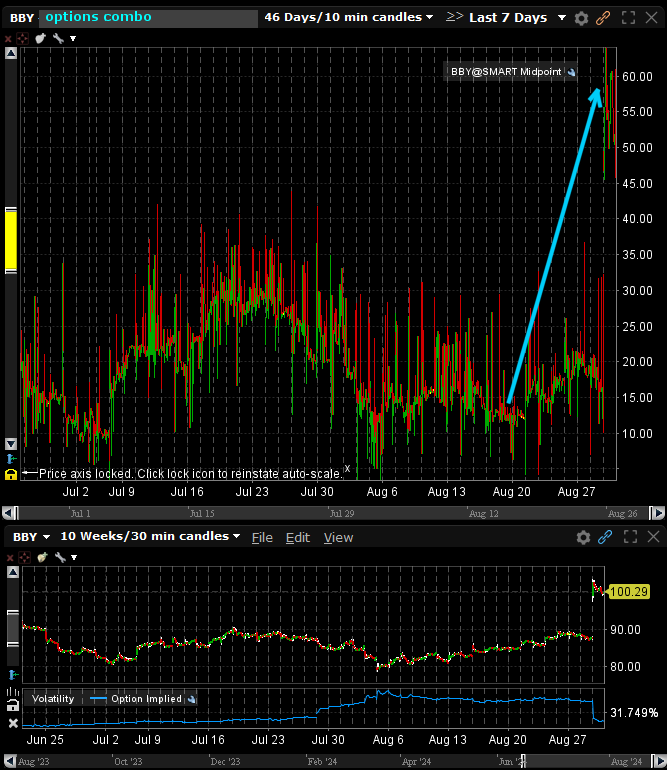
This single-name options strategy returned 70%/year. The enclosed price chart is based on a $BBY combo prior & after earnings, though the strategy isn't earnings-related and can lie in wait for weeks, even months. The trade went from $12 recently to $60 now.
Another practical conclusion from overfit backtests or AI/ML research, is that maybe the system doesn’t have enough tools/indicators/features to come up with more proper ways to evaluate certain ideas, thus it resorts to nonsensical methods of testing certain correlations. A natural way of improving our system is to identify the nonsensical methodology and either disable it to let the system find a different approach, and/or replace it with proper/logical approach to see if the system is able to validate it and potentially continue optimization from there.
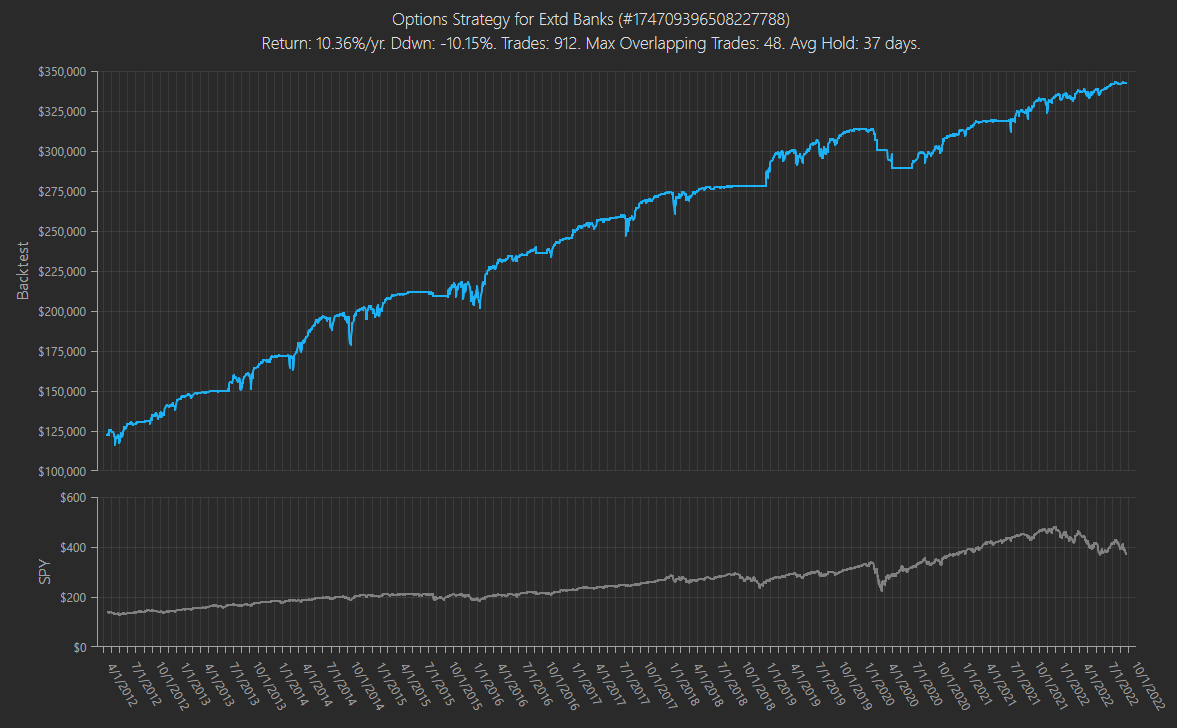
Example of an overfit(?) earnings strategy with 10%/year over 11 years, just from bank earnings.
It buys calls on the underlying bank while selling $UVXY calls one day prior to earnings.
It holds the position long after earnings while utilizing stops. In the end it may be more about shorting $UVXY than trading bank earnings, though this may be enhanced by bank stocks trending up.
Top trade was on $HOPE in Oct 2020 when the stock doubled in value. Single largest loss was on $UVXY in 2018 Volmageddon.
Quite basic entry rules, though the selection of $UVXY calls to sell short is nonsensical.
One source of overfitting applying only to options is the options chain itself. For example some top backtests may be based on selling very low strike puts on $SPX. But such strikes may not appear until after a market crash. Same with selling DOTM calls on $UVXY & $VXX options.
Yet maybe even an overfit strategy can be useful in research and act as a source of ideas.
In the example below, the idea of using falling bank stocks as stops for exiting short volatility / $VIX / $UVXY trades might be worth exploring further. Whether this idea has merit or not, it may lead to other ideas later on. So are overfit backtests totally useless, or can they be used as source of ideas for further research?
Example of an overfit(?) earnings strategy with 10%/year over 11 years, just from bank earnings.
It buys calls on the underlying bank while selling $UVXY calls one day prior to earnings.
It holds the position long after earnings while utilizing stops. In the end it may be more about shorting $UVXY than trading bank earnings, though this may be enhanced by bank stocks trending up.
Top trade was on $HOPE in Oct 2020 when the stock doubled in value. Single largest loss was on $UVXY in 2018 Volmageddon.
Quite basic entry rules, though the selection of $UVXY calls to sell short is nonsensical.
(the top trade on $HOPE was held since October 2020 till March 2021, profiting about as much from $HOPE calls as from the short $UVXY calls, in essence making twice as much profit as if holding $HOPE calls only, or shorting $UVXY calls only)
Don’t they need to disclose their holdings periodically? Though we can also raise funds privately. Yet funds don’t have an exit path and we’ve built higher valuations in the tech space, thus we may build better valuation again as a tech company. We’re planning a suite of products, starting with free products and trade streams for retail, ending with offering key strategies and methodologies for pros and small funds. It will be more clear once we launch, just needed to build a strong and validated value first. Almost there.
Potentially one of my favorite $SPY / $QQQ options strategies because I understand its (skew-based) alpha and believe similar results are reproducible. 20%/year over 11 years.
@durdewicz For people asking whether we’d offer training or key research and top strategies at a higher cost (not retail level), we’re considering such option as well. It will just take more time to figure the details.
Yes, just not sure yet when & how. This is already taking much longer than it should, as initially we wanted to offer generic strategies with minor alpha. This later progressed into finding new sources of alpha and producing much more profitable strategies. However, the most profitable ones share similar sources of alpha that we cannot disclose due to very high cost of R&D and therefore high value of IP that is difficult to protect. Offering a single strategy may reveal details of our key methodology across many strategies. And offering such strategies to retail may not recoup our costs, while spawning many "gurus" who'd be happy to repackage them and resell them as their own. There is also risk of alpha decay with many people placing similar orders, which would further expose the methodolohy while affecting market makers' inventory in a way that may negate the alpha. Thus usually such IP is not available to retail, or to any 3rd parties. However, we have related projects in the pipeline that may include publishing selected strategies, and live streaming of variety of options trades, including those with high expected profitaibility.