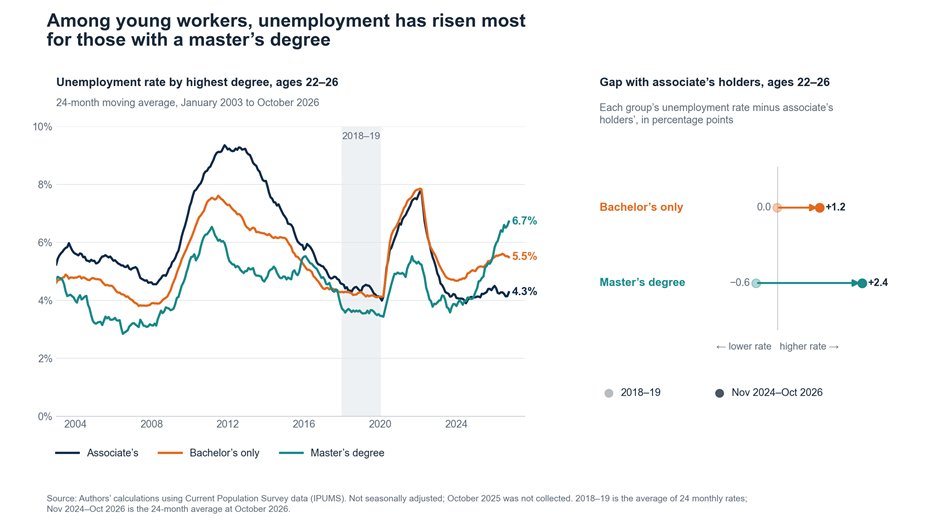
Whenever David Brooks writes something related to education, he typically sounds like a nincompoop. However, if I was still teaching, I would have stdnts read excerpts from this piece he wrote. It's exceptional --The People Who Will Thrive in the AI Age https://t.co/e8LZ5wLS2L
This post by Tycoon Lee Kim Yew, Mahathir's crony, has gone viral in the Chinese community. I am providing the AI translation for all. It is clear he is losing hope for the future of the Chinese community.
Let me know if you agree with him ...
#Malaysia#Chinese#Politics #Future
The market for drugs is deep and diversified, and the size of the prize is huge if you get it right. A single blockbuster drug can generate annual revenue on the scale of a major software company.
Pharma has unusual economics – it's a hits business in drug development and an annuity business once a drug succeeds.
AI could change both by improving the odds of success and simultaneously decreasing development time and cost.
Full piece on why AI will make pharma even bigger: https://t.co/A96FDSSk57
If you know a loved one suffering from cancer or another long-term illness:
1. Upload all of the patient's medical records (e.g., to a Google Drive folder)
2. Tell ChatGPT or Claude to install my free /fuck-cancer skill (just point them at the link: https://t.co/4fi5N8hsSG)
3. Point the skill at the folder to create a one-page brief, research clinical trials, and more.
You're also welcome to fork the skill and modify it for other long-term conditions.
tl:dr Use the full power of AI to beat shitty diseases.
Mon dernier post disant aux jeunes de ne pas faire d'études a fait réagir. Je précise.
Je ne suis pas contre l'éducation. Je pense que c'est la chose la plus noble qui existe. Je crois profondément au rôle du professeur.
Je déconseille de faire des études pour une raison simple : l'école aujourd'hui n'est plus un outil d'éducation. C'est un outil d'endoctrinement.
Revenons à ce que l'éducation était censée être. Socrate, le père de la philosophie occidentale, résumait toute sa sagesse en une phrase : je sais que je ne sais rien. Le point de départ de toute pensée, c'est le doute. Montaigne voulait une tête bien faite plutôt que bien pleine. Plutarque disait que l'esprit n'est pas un vase qu'on remplit, mais un feu qu'on allume. Kant définissait les Lumières comme la sortie de l'homme de sa minorité : ose penser par toi-même. Et Nietzsche avertissait qu'on récompense mal un maître si l'on reste toujours son élève.
Tout est là. Le rôle de l'école, c'est de vous apprendre à apprendre. De vous apprendre à douter. Y compris de ce qu'on vous enseigne. Un vrai prof devrait vous donner les outils pour critiquer son propre cours.
Aujourd'hui, c'est l'inverse. En grande majorité, l'école est devenue une machine à faire ingurgiter, à formater, à dire ce qu'il faut penser. Wokisme, anticapitalisme, décroissance : on ne vous présente pas ces idées pour les discuter, on vous les installe comme des évidences. Et quiconque les questionne devient suspect.
Le résultat, je le vois tous les jours. Beaucoup de jeunes sont totalement bloqués mentalement. Incapables d'avoir une pensée créative. Pas parce qu'ils sont moins intelligents que les générations d'avant. Parce qu'ils se sont fait broyer par le système.
Attention, ce sont souvent d'excellents exécutants. Bosseurs, rigoureux, capables de rendre exactement ce qu'on attend d'eux. Mais derrière, il y a une pensée dogmatique absolument terrifiante. Des certitudes qu'ils n'ont jamais examinées. Des opinions dont ils ignorent l'origine. Ils ne savent pas pourquoi ils pensent ce qu'ils pensent.
Et à l'ère de l'IA, c'est le pire profil possible. L'exécution scolaire, la machine le fait déjà mieux que vous. Ce qui restera rare, c'est la capacité à penser contre, à douter, à créer.
Ce système ne se réformera pas à la marge. Il devra être complètement reset. Et ça passera par une étape primordiale : la dégauchisation de l'université et du corps enseignant. Pas pour remplacer une idéologie par une autre. Pour revenir au rôle essentiel de l'éducation : la pensée critique, la capacité à remettre en question l'autorité, et apprendre à apprendre.
Ce jour-là, on reviendra aux humanités. À l'art. À la philosophie. Aux profs comme mentors, pas comme prêcheurs. À une éducation qui forme des esprits libres plutôt que des esprits conformes.
En attendant, si vous avez 18 ans, ne confiez pas votre cerveau à un système qui veut le formater. Lisez les philosophes. Doutez de tout, y compris de moi. Et construisez.
New episode with John Hempton (@John_Hempton), legendary Australian hedge fund manager and short seller.
I wanted to get John’s thoughts on the likelihood of an overbuild / bust in AI compute, and what implications that has for the Australian government’s data centre push.
John talks me through why he thinks the global compute build-out is “fibre optics Mark II” - i.e. why AI is “the most amazing technology of your lifetime”, yet compute looks like “the worst business in the world”.
John’s recipe for the worst business in the world is: “high capital cost, low marginal cost, competition, and technical improvement”. With these ingredients, new entrants push prices down to marginal cost, businesses can't recover their capital costs, and they go bust.
To get an adequate return on the $7 trillion of capex expected to be poured into compute by 2030, John estimates you’d need $2 trillion per year in revenue.
That would most likely have to come from businesses replacing workers (or not hiring new ones), as consumers won’t get you there. But companies typically don’t fire people for a 10% saving. So to pay $2 trillion a year, they’d need to save at least twice as much, or $4 trillion in wages.
The OECD wage bill is about $40 trillion per year. So you’d need to save, for argument's sake, 10% of the wage bill across the entire OECD.
But that kind of saving seems politically and practically implausible in such a short timeframe.
So expect excess supply and bankruptcies. (Again, none of that is to say the underlying tech is useless - far from it.)
John also shares the thing that shocked him most about Anthropic's S-1: namely, how compute-efficient it is. By his estimates, Anthropic has spent only about $12 billion on training compute over the lifetime of the firm. Which makes the $7 trillion build-out look even worse.
There's so much more of interest in this conversation, but let me share one last thing. There's an interesting question as to exactly what the productive infrastructure left over from any overbuild will be. It might not be the GPUs, but the fabs and/or energy generation. John tells a great story about how old chip fabs he thought were worthless ended up finding an application making the tiny sensors in car air conditioners and Tesla batteries.
After all this, the policy implication for Aus govt is to happily facilitate the compute build-out, but just don’t subsidise the world’s compute the way China subsidised the world’s solar panels (another example of a bad business).
Watch below, or wherever you get your podcasts!
0:00:00 – The most amazing technology of your lifetime
00:03:10 – A short seller discovers jaggedness (from first principles)
00:19:40 – The Situational Awareness blow-up
00:24:46 – The worst business in the world
00:31:02 – Fibre optics, Mark II
00:42:41 – The best model was shockingly cheap to train
01:01:26 – Why the $7 trillion build-out can't earn its return
01:11:13 – What survives a compute bust?
01:22:59 – A data centre is a better neighbour than a prison
01:27:30 – A bad business is not a bubble
A computer science professor wrote a book in 2012 that quietly destroyed the entire follow-your-passion industry and replaced it with something actually useful.
Cal Newport was finishing his PhD at MIT in 2011 when he started noticing something that did not match the advice he had been hearing his whole life. The people he met who loved their work rarely talked about having followed their passion.
They talked about having gotten unreasonably good at something specific, which then opened doors to interesting work, which then produced the feelings of meaning and autonomy that other people tried to find by following their passion directly. The sequence was reversed from the standard advice. Mastery came first. Passion came after.
He wrote a book about it the next year. So Good They Can’t Ignore You, published in 2012. The title is from a line comedian Steve Martin used when asked for career advice. The book is about 230 pages. It has quietly reshaped how a generation of serious people think about their careers.
The core argument is specific and uncomfortable. The passion hypothesis, the idea that the key to loving your work is figuring out what you are passionate about and then finding a job that matches it, is almost entirely wrong. Newport walks through the evidence. Most people do not have a pre-existing passion that maps to a career. Most people who force themselves to follow a pre-existing passion end up broke, disappointed, or stuck in a job that bears no relationship to the fantasy they chased. Most people who report loving their work arrived at that love by a different route entirely. They got very good at something that the world actually wanted, accumulated what Newport calls career capital, and then used that capital to shape a working life that gave them autonomy, mastery, and purpose.
Newport lays out the alternative method in four rules. First, stop focusing on passion and focus on becoming excellent at valuable skills. Second, adopt what he calls the craftsman mindset. You are not here to find work that suits you. You are here to build skills so valuable that work worth doing becomes available to you. Third, use the career capital you accumulate to buy control over what you do and how you do it, which is one of the strongest predictors of job satisfaction across every field studied. Fourth, use the same capital to shape your work around a specific mission, which arrives late, after years of accumulated skill, rather than being discoverable through introspection alone.
The method is harder than the passion method. It takes years. It requires you to get good at something boring before it becomes interesting. It gives you no permission to quit when you are not immediately in love with your work, because the love is on the other side of mastery rather than preceding it. It also actually works, which the passion method, for most people, does not.
The polymath element is in Newport’s sourcing. He walks through research from organizational psychology, from longitudinal studies of career satisfaction, from interviews with professionals in dozens of fields, and from the biographies of people who built unusually interesting working lives. The argument is tested against evidence, not just asserted.
I read So Good They Can’t Ignore You in 2020. Stopped looking for my passion that month. Started getting good at specific things instead. Three years later the work I actually wanted to do had become visible, because the skills I had built made it available in a way it had not been before.
Where to find it: Grand Central Publishing has the paperback.
Follow your passion is comforting advice. Get so good they cannot ignore you is harder, and it works.
This morning, Elon Musk summed up in two words what a lot of people feel but can't explain: "Communism sucks."
He's right. But two words won't convince a single college sophomore. So let's take the time to actually make the case.
Let's start at the beginning. With Marx.
In 1867, Marx publishes the first volume of Capital. His entire system rests on one idea: the value of a good comes from the labor needed to produce it. So if the boss gets rich, he must be stealing part of that labor from the worker. Profit is theft. Exploitation is built into the very mechanics of capitalism.
It's elegant. And it's wrong.
Four years later, in 1871, Carl Menger in Vienna and William Stanley Jevons in England show, independently, that value isn't in the object. It's in the mind of the person buying it. A diamond isn't expensive because someone dug a lot. People dig a lot because it's expensive. You can spend a thousand hours baking a mud cake. It will never be worth anything.
In 1896, Böhm-Bawerk drives the point home: the third volume of Capital, published after Marx's death, contradicts the first. The system doesn't even hold together on its own terms.
Then in 1920, Ludwig von Mises delivers the fatal blow. Without private ownership of the means of production, there are no prices. Without prices, there is no economic calculation. And without calculation, the planner is flying blind. He doesn't know whether to make more steel or more shoes, where, or for whom.
Hayek finishes the job in 1945: prices are a telecommunications system. They compress millions of scattered pieces of information into a single number that no one, no ministry, no committee, no genius, could ever centralize.
That's Marx's mistake. It isn't primarily a moral error. It's a mechanical one. He thought the economy was a machine you could steer from the top. It's an information network you can only let run.
History ran the experiment at full scale. Soviet shortages. The Great Leap Forward and its tens of millions of dead. North Korea next to South Korea. East Germany next to West Germany, with a wall that wasn't built to keep people out. Marx predicted the growing misery of workers in industrial countries. The exact opposite happened: in 1820, roughly three out of four humans lived in extreme poverty. Today it's about one in ten. And China only took off after 1978, when Deng Xiaoping brought markets back.
But the real irony is somewhere else.
Marx claimed capitalism produces crises by its very nature. So let's look at the great crises of the last century and ask who was at the wheel.
In 1929, after a decade of easy credit, the Federal Reserve let the money supply collapse by about a third between 1929 and 1933. Congress piled on the Smoot-Hawley tariffs in 1930. In 2002, Ben Bernanke, future Fed chairman, publicly told Milton Friedman: "Regarding the Great Depression. You're right, we did it. We're very sorry."
In 1971, Nixon suspended the dollar's convertibility into gold and froze wages and prices. The result: a decade of stagflation and double-digit inflation.
In 2008, the crisis followed years of a Fed funds rate at 1% in 2003 and 2004, Fannie Mae and Freddie Mac backed by an implicit government guarantee, and federal policy pushing mortgages toward households that could never pay them back. They called it "the crisis of capitalism." It was a crisis of credit manufactured by the state.
In 2010, Greece. A public debt crisis, with doctored books.
In 2022, after the Fed more than doubled its balance sheet in two years, we were promised inflation would be "transitory." It hit 9.1% in the United States.
Markets produce bankruptcies. Local bankruptcies, which correct mistakes and free up resources. Systemic crises are born when someone claims to steer the whole system: the price of money, credit, the currency itself. Hayek called it the fatal conceit. Marx and Keynesian interventionism share the same faith: the pilot who knows better than everyone else.
And this is where it gets fascinating.
Statists have understood something most people haven't seen yet: AI is obliterating their worldview.
First, it finishes off the labor theory of value. When an agent produces in ten minutes what used to take a team a week, value obviously no longer comes from hours worked. It comes from the idea, the judgment, the risk, the taste. Exactly what Menger said in 1871.
Second, it kills the expert's monopoly. Socialism has always depended on the planner who knows better than you. Today, anyone has a doctor, a lawyer, a tax advisor and an engineer in their pocket. The information asymmetry that gave the bureaucrat his authority is collapsing.
Third, it creates abundance. And Marxism is an ideology of scarcity. Its entire logic is a fight over a fixed pie. When the pie explodes, "they're stealing your share" stops working.
So they're trying to stop it.
In March, Bernie Sanders and Alexandria Ocasio-Cortez introduced a bill to freeze the construction of new AI data centers across the United States. The same Sanders wants a 5% annual tax on billionaires' wealth. Taxing the value of a founder's shares every single year means forcing him to sell his company piece by piece. Collectivizing the means of production, 2026 edition. With a tax form instead of a Gosplan.
Europe went even simpler: it regulated before it ever built.
Communism promised to hand the means of production to the people.
AI is doing it. No state, no plan, no permission.
That's exactly what they'll never forgive it for.
After some recent trends, I finally decide to read the Harry Potter books.
And I came away with something I didn't expect.
I came away with an understanding of what makes a generationally beloved classic.
It isn't authorial skill. Rowling is certainly talented, but, at least at the time, she was also relatively unpolished, and the series has plenty of rough patches. Uneven pacing, awkward plots, exposition dumps, two-dimensional secondary characters. I could write quite a few lines about what might be fixed. And I probably will at some point.
But none of that matters.
Because a generationally beloved classic is almost never the best book of a generation. A generationally beloved classic is the book that most perfectly captures what that generation yearns for.
Hogwart's School of Wizardry did that for millennials, just as the quest to destroy the One Ring did so for the boomers.
Boomers grew up hearing tales of recent history, and the heroism of previous generations, who got us through the great depression, and the great war. Their father, or grandfathers, or both, were heroes. But they were left growing up in the 1950s, a near-ideal time of growth, happiness, and prosperity.
Near-ideal isn't ideal. Humans need goals. The boomers were left with no great struggles to fight, no great tasks to do, nothing that could make them feel like they measured up.
So they invented something. A new struggle. A moral struggle. They decided that, because the great depression, and the great war, had happened when the institutions of Western Civilization existed, therefore those institutions were responsible. That those institutions needed to be torn down, gutted, and rebuilt in the new Boomer Morality.
This was their great quest, what allowed them to imagine themselves heroes. As an added bonus, it allowed them to imagine that the men who fought WW2 were not. They were, after all, adherents of the old creed.
When the hippies took to the streets, chanting "fascist scum, your time has come", they meant the very same people who had fought the Nazis.
Lord of the Rings dovetailed perfectly into this narrative. Its central struggle, its great quest, is not a martial struggle or a political struggle, but a moral struggle... the quest not to seize an object of power, but to destroy one.
Frodo was not some great warrior, or wise wizard. He was an innnocent, whose virtue was moral worth. The young, unaccomplished, and very small man had to resist the temptations of power, and to destroy it, because it was wicked.
Is it any wonder that the boomers decided to tear down and hollow out the institutions of society, rather than inherit and incrementally improve them?
Even to this day, any younger person who seeks power, wanting to improve the world, is subjected to any number of brain-dead aphorisms about Boromir and the Ring.
Never mind that Tolkien never intended any of this. Never mind that the Ring wasn't a symbol of anything. It was a ring. It was evil not because it represented power... it was simply evil because it was made by evil for evil purposes, and possessed a malign will of its own.
LOTR, the way the boomers read it, fit perfectly into their worldview, and they imagine themselves perpetual revolutionaries, always fighting the evils of power, even now when they are 70 years old and own everything.
Which brings us to millennials. They grew up in the world that the gutting of Western institutions left us. They went to government schools run by characters straight out of a Franz Kafka novel, sent there by parents who inexplicably hated them from the time they were old enough to talk.
When they yearned, they didn't yearn for a great moral struggle, or to tear anything down, or to be revolutionaries.
They yearned for a society that cared about them, for parents who loved them, for a civilization that saw them as the future, and invested in them accordingly.
They wanted to go to Hogwart's. They wanted get a letter by owl, telling them that the reason they didn't quite fit wasn't because they were inadequate, but because they were special.
They wanted to be the special ones, the chosen ones, the boys and girls who lived. And that last sentence may sound a bit conceited... until you realized that when they wanted to be special, they wanted to be special in precisely the way that Harry Potter was special, the way that every child in a healthy family is naturally special... not because he is talented or great, but because his mother loved him.
This is what saved Harry Potter in the inciting incident of his young life. This is what millennials wanted for themselves. Not to be astronauts and war heroes and rock stars, but to fit into a place like Hogwarts. To be mentored by wise and caring elders like Dumbledore. To be part of a community. To have mothers who loved them.
To write a story like this isn't necessarily to understand a generation, because it never seems to happen except by accident.
It is, rather, to help a generation understand itself.
That's why fan fiction, with visions like this picture, matters. Not because it has so large a footprint as to change the world, perhaps, but because it represents the spirit of an age.
It tells us what people want. And if we look carefully, it tells us why.
Earlier today I wrote that school destroys critical thinking. Many of you asked for proof.
The proof is Marx.
Marxism is probably the most tested theory in human history. Tested on paper by the best economists in the world. Tested at full scale on hundreds of millions of people, across several continents, for more than a century. And it failed every single test.
A free mind, one that checks its ideas against reality, cannot remain Marxist. If so many people still are, it's not a problem of intelligence. It's a problem of method. They were never taught to verify.
Let's start from the beginning.
In 1867, Marx publishes Das Kapital. Everything rests on one idea: the value of a good comes from the amount of labor it contains. The boss's profit is therefore labor stolen from the worker.
Four years later, in 1871, Menger and Jevons independently show that this is wrong. Value doesn't come from labor. It comes from the usefulness the buyer sees in the good. An hour spent digging a useless hole creates zero value. That's the marginal revolution, and all of modern economics is built on it.
In 1896, Böhm-Bawerk shows that Marx's system contradicts itself: real prices don't match labor values, and Marx knew it. The foundation collapses.
In 1920, Mises asks the question that kills it: without private property, there are no market prices. Without prices, how does a central planner know what to produce, how much, and with which resources? Answer: he can't. Hayek finishes the job in 1945: economic knowledge is scattered across millions of minds, and no central bureau can ever gather it.
That's the theory. Now the predictions.
Marx predicted the revolution would break out in the most industrialized countries, England and Germany. It happened in Russia, an agrarian country. Wrong.
He predicted workers would grow poorer and poorer under capitalism. They grew richer than at any point in history. Wrong.
He predicted the State would wither away. Everywhere his ideas were applied, the State became total. Wrong.
Now the experiments.
USSR: forced collectivization, famine in Ukraine, millions dead, the Gulag.
China: Mao's Great Leap Forward. Between 15 and 45 million dead depending on the historian. The largest famine in human history, produced by a plan.
Cambodia: the Khmer Rouge killed roughly a quarter of their own population in four years.
Then there are the natural experiments. The most brutal ones, because they eliminate every excuse.
Korea. Same people, same language, same culture, same history. In 1945, the North was richer than the South. Today, income per person in the South is about 29 times higher than in the North. Only one variable changed: the system.
Germany. One people cut in two. One side had to build a wall. Not to keep people out. To keep them in.
Venezuela. The largest proven oil reserves on the planet. Nearly 8 million people fled the country. 21st-century socialism ended with Maduro captured last January.
Meanwhile, the other system, the one you were taught to hate, did this: in 1820, about three quarters of humanity lived in extreme poverty. Today, around 10%. And the biggest escape from poverty in history, China after 1978, happened at the exact moment the Communist Party brought markets back.
From Marx to Maduro, 150 years of data. All pointing the same way.
So how does anyone stay Marxist?
With the magic sentence: "that wasn't real communism."
Think about what that sentence means. A theory that fails every time it's tried, whose believers then declare that none of the attempts counted, is no longer a theory. It's a faith. Karl Popper saw it as early as 1945: Marxism survived its refutations by making itself irrefutable.
A mind trained to think for itself asks one question: how many failures does it take before you question the hypothesis? One, two, ten, forty?
That's exactly the question school never teaches you to ask.
Marx isn't taught as a hypothesis to test against the data. He's taught as a morality tale: there are oppressors and oppressed, and the right side is obvious. You learn the conclusion, never the method.
A four-year-old would ask: "Okay, but where did it work?" Fifteen years of schooling later, they've stopped asking.
A system that teaches you to obey has no interest in teaching you to verify. Because the day you start verifying is the day you start being free.
And that day, you stop being a Marxist.
All university rankings are very flawed.
I wondered how we could rank unis as purely as possible? So I looked at the career path of ~100,000 engineers over 10yrs. Universities rank high when its graduates work at companies, ranked PageRank style, that engineers compete harder to join.
Stanford, MIT, Harvard were top 3, but the extent they were above the rest surprised me. Brown at #6, Waterloo at #7!
This is the single most insightful thing I have ever heard about the changing landscape of modern business. Haters are gonna hate, but there is a reason he is the most successful venture capitalist of all time. And no, it's not just luck.
Respect. 👊