novel systems for 3rd layer mathematical auditing, building lean harnesses and training custom lean verifies for zk SNARK, zk EVM and defi i like editing
I've been reviewing a lot of code written by Opus 5.5, and it still seems to make a lot of bad software engineering decisions. The kind that will accumulate/calcify into unmaintainable software over time. IMO even the agents will struggle to maintain vibecoded software.
@teortaxesTex it also hit me how third part providers espcially factory ai and devin do not? hide opus 5.5 and chatgpt's reasoning traces at least when i compare it to claude website and chatgpt? its like im reading deepseek traces, as open as that. but pretty hard to abuse tbh
@VictorTaelin and interesting novel formal verification and research direction buildout using lean and BEND, check it out!! this is also one of some of the cool serious projects being built on bend, thank you, its been a massive unlock for my project!!! https://t.co/u6rqdddrFE
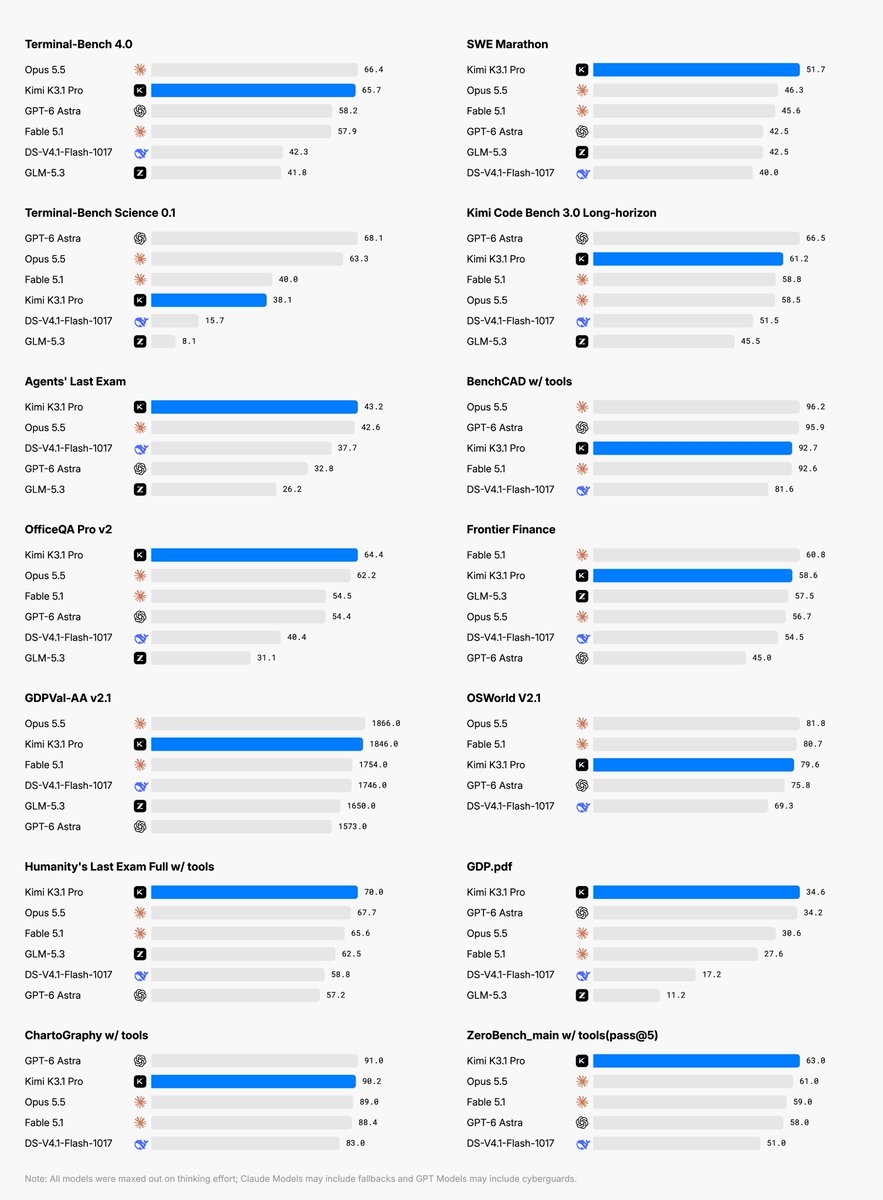
Introducing Kimi K3.1 Pro: our most capable 3T-class open-weight model.
🔹 1M-token context, 2.8T total / 104B active params (MoE), Multimodal.
🔹 Full-project coding: games in Unreal, Unity & Godot.
🔹 Excels at parametric 3D modeling in Blender & CAD.
🔹 More reliable at finance work: Accurate modeling with hallucination down by 65%.
🔹 Matching the strongest proprietary models across coding, agentic and knowledge benchmarks.
Kimi K3.1 Pro and K3.1 Pro Highspeed (2–3× faster) are now live on https://t.co/85jA71X9gw, Kimi Work, Kimi Code, and the Kimi API.
Open weights by Nov 4, 2026.
🔗 API: https://t.co/XCrgjXAqMw
🔗 Tech blog: https://t.co/5iPP0MBej6
we all go through the phase of formal copium all bug hunters included in the future, we all collectively hope it doesn't work which im pretty confident it wont eliminate all, there are still novel vectors.
hear me out, mathematicians entering ai alignment maybe consider this challenge. i think its probably millennium level problem(?)
take any complex real world software, like a browser or a kernel. let's pick a kvm based sandbox, which i suspect is somewhat less complex than chromium(?), running an increasingly capable, potentially adversarial AI agent.
we want to formally prove one simple property, no matter what code the agent executes inside the VM, it cannot escape and compromise the host. for that we need to prove the entire relevant software stack, kvm, cpu virtualization, kernel, virutal devices that could affect the isolation. (to make things easiers, lets assume hardware wont have weird states)
can we mathematically establish whether formally verifying a system of this complexity is even computationally feasible?
New on our Frontier Red Team blog: using Claude to formally verify software at large scale.
Formal verification can prove that code is free of certain bugs, but historically it has only been feasible for small codebases (or required a lot of expert time).
With AI models, however, this is beginning to change. In collaboration with @theoremlabs, we used Claude to prove security properties in over one hundred real-world open-source libraries over the span of a few weeks.
Read our research in full here: https://t.co/zUyx8CjBEk