1/ We discovered something totally unexpected about the neural structure of consciousness that overturns decades of thinking on its biological basis and brings us significantly closer to the recipe for generating conscious awareness.
New preprint: https://t.co/K8BwiHXvXg (led by @HesseJanis, with @FrankLanfranchi, @_conor_mcgrory, @Yuelin_Shi, and @EngelTatiana)
AI has enabled me to work on 4 research projects at the same time and I don't even have paid subscription of any of the frontier models just raw free tiers and I am insanely productive as I can think of a problem experiment on that thing onto the next approach insane productivity
I am thinking of a model which could go through all the AI pure math proves, goes through all the applications possible then perform actually innovative mix of research on them and give us new innovative proof based simulated systems we can plug & play into real life application.
Yes, AI is rapidly advancing mathematics (and theoretical physics problems that are essentially mathematical). Like Ramanujan’s notebooks, human mathematicians will spend months (years?) poring over the stream of papers that AI effortlessly generates, hoping to verify and understand them, probably until math itself (via Lean) becomes a branch of computer science like almost everything else.
However, after math and physics, there is still a next scientific frontier: chemistry, and especially biology and medicine.
I mean, it was already the frontier, but it’s the next one too. AI can crush deterministic math problems on the computer, but biomedicine is a highly empirical, noisy, multivariate, and yet often predictable domain.
Thus, AI radically increases our ambitions in biomedicine. All the omics data, all the messy literature, it can all be synthesized and analyzed in a flash. This is what the labs mean when they talk about curing all diseases. The tooling is available to take cracks at biomedical problems previously thought impossible.
Midjourney is doing this, Chan Zuckerberg is doing this, Anthropic is doing this, but there will be so much more.
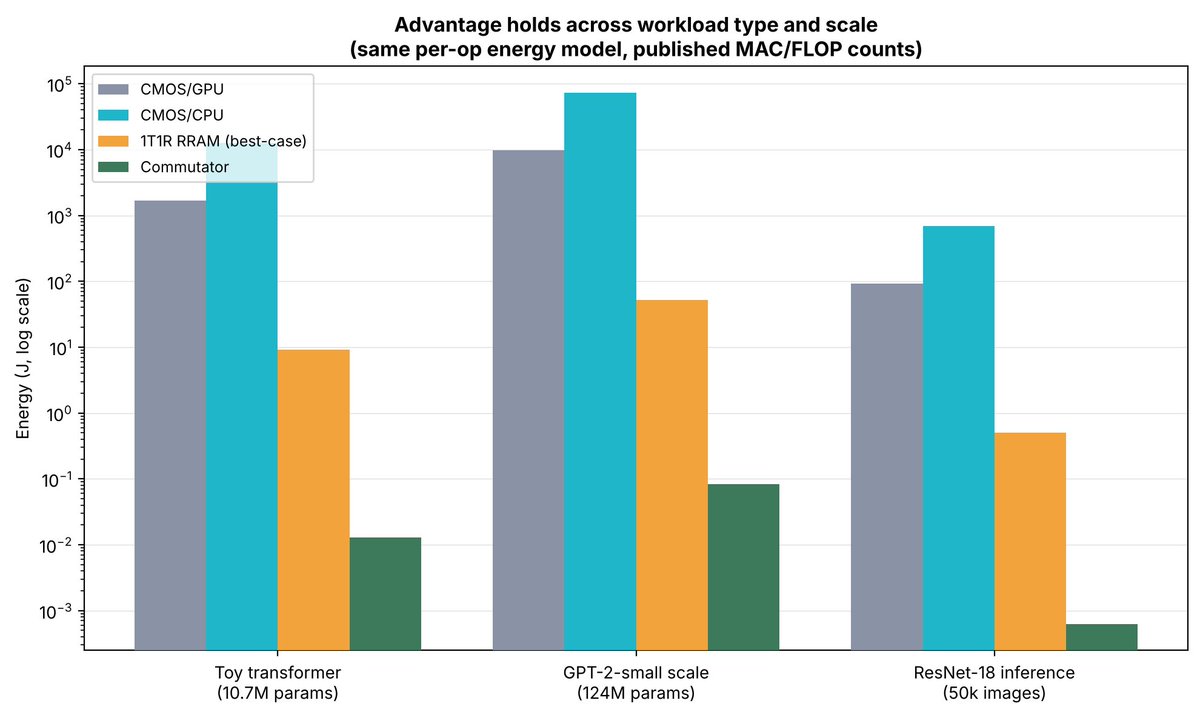
For hardware I have built a semiconductor device and after simulation of TCAD extracting actual values from simulation and running a H100 benchmark on them I got 150,000x energy efficient and 1300x better computing efficiency. I am still working on the preprint will soon release
Replacing backprop with zeroth-order optimization is inevitable.
Introducing Noise: a speedrun for pretraining without backprop.
Last week we presented Dust, the first method to approach backprop with SGD for pretraining transformers. We think another 1,000x improvement on top of it is possible, and it will require *co-designing* credit assignment, optimizers, architectures, and eventually, hardware.
We built Noise to iterate on this faster.
I am working on another benchmark very different yet similar applications to this called ChasiBench (wrong name for IP protection) and as a independent researcher I could only test on small open weight models but results are amazing soon will share results.
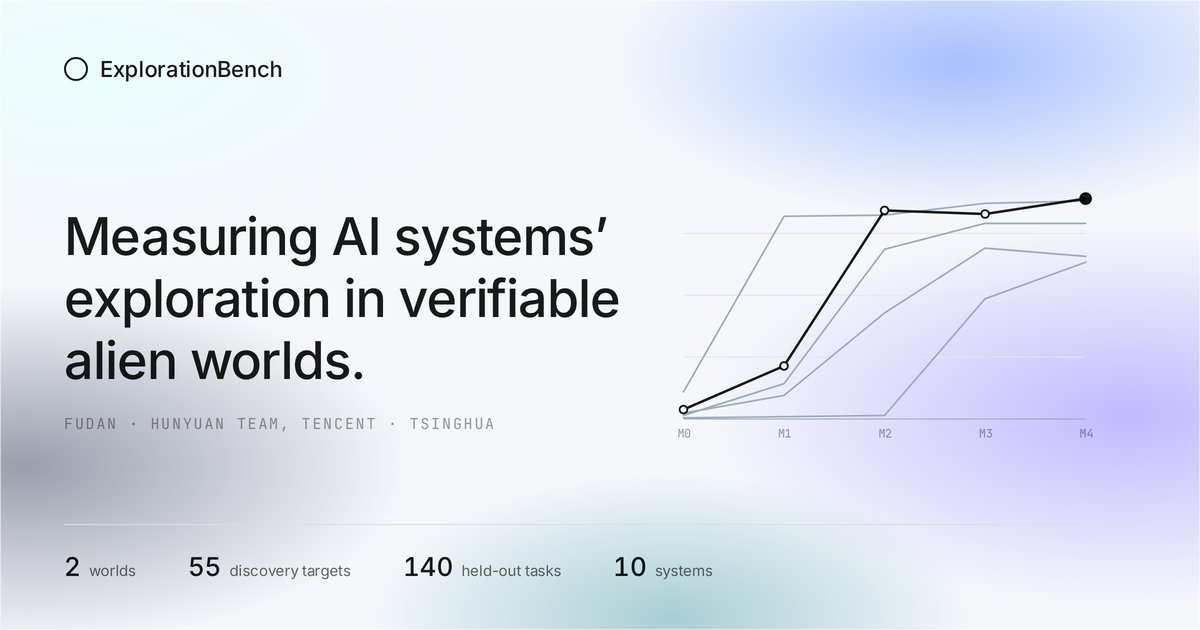
New Research: We are releasing ExplorationBench, a benchmark for measuring how AI systems explore.
Scientific discovery begins where known problems end: a system has to frame hypotheses, design experiments, and learn from the results. Evaluating this is hard. Genuinely new answers cannot be checked quickly, and in familiar domains a model can simply recall what it has seen.
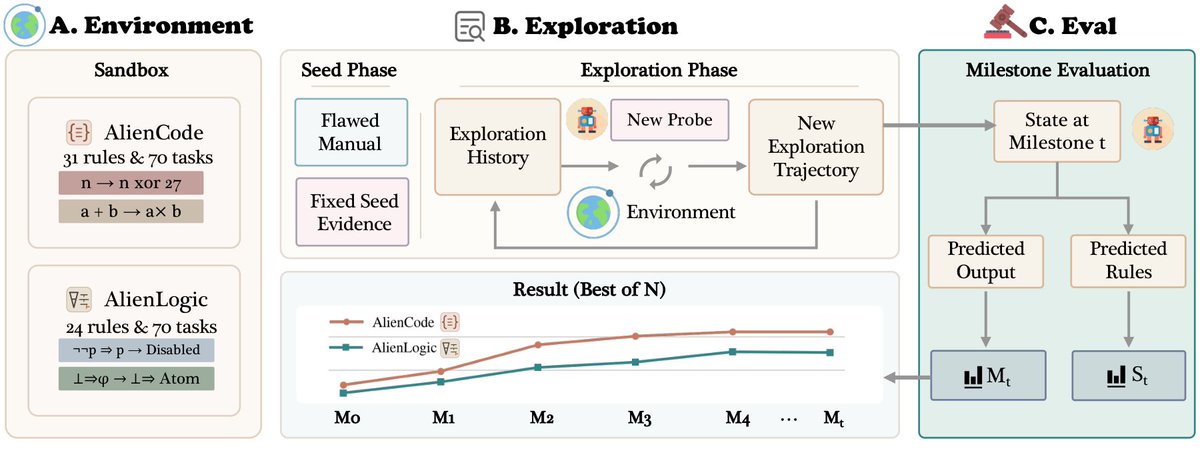
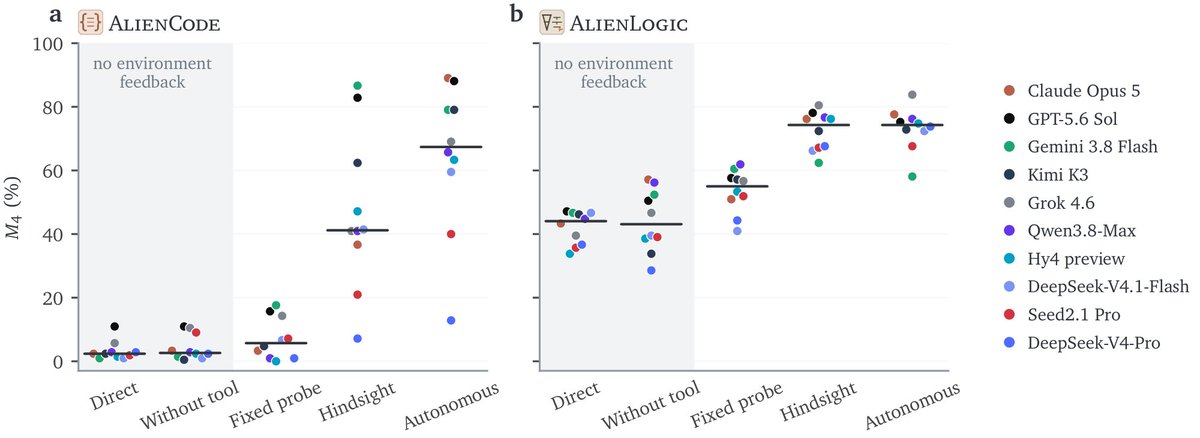
Addressing this challenge, researchers from Tencent Hy, Fudan University, and Tsinghua University built verifiable Alien Worlds. Their rules are executable, so every answer is checked exactly, and they conflict with familiar knowledge, so recall alone cannot solve the tasks.
🔹 Two sandboxes: AlienCode (31 hidden rule changes, 70 tasks) and AlienLogic (24 patched inference rules, 70 theorems)
🔹 A flawed manual, four rounds of self-designed probes, and closed-book tests after every round
🔹 Every answer graded by an interpreter or a proof checker, with no LLM judge
What we found across 10 frontier AI systems:
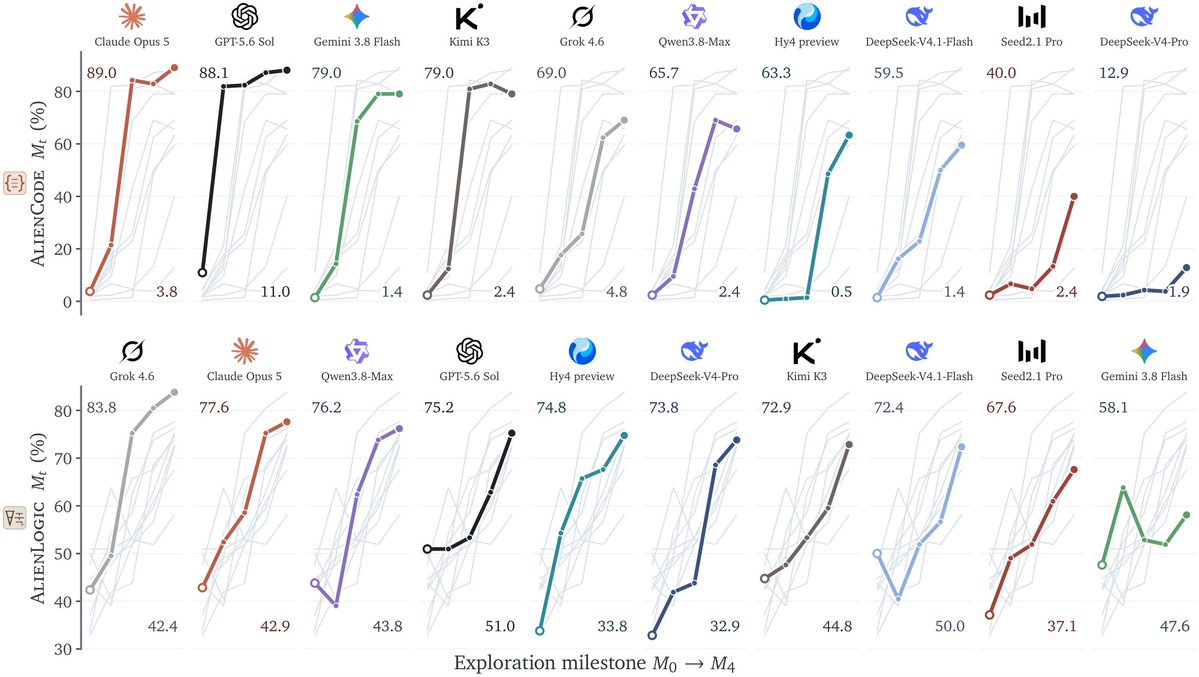
1️⃣ Getting feedback is more effective than thinking alone. No AlienCode run starts above 15.7%; after four rounds the best reaches 89.0%, while the same turns without feedback stay at 0.5–11.0%.
2️⃣ Designing the experiments matters. Replaying a system's own best probes gives it exactly the same evidence, yet in AlienCode 9 of 10 systems do worse than when they chose the probes themselves.
3️⃣ Knowing a rule is not using it. Even when every required rule is stated correctly, tasks are solved only 73.4% of the time.
4️⃣ One score hides a lot. The same system under the same budget ended anywhere from 5.7% to 79.0%, and rankings barely transfer between the two worlds.
CL-bench asked whether models can learn from context. ExplorationBench asks whether they can discover the rules themselves.
📄 Paper: https://t.co/eamwrsJyxQ
🌐 Website & leaderboard: https://t.co/gxSeoCfc2s
📝 Blog: https://t.co/jyrwH7ZnQH
💻 Code (coming soon): https://t.co/i7VlgErkcl
@DeryaTR_ I agree, but I can't help but think how would society actually look like? And i want to be one of those people who help humanity shape a new form of civilization where AI takes care of our basic needs and we work on something totally different together.
Really excited for future
@arsh_goyal Me, Commutator is my new novel semiconductor device. For AI hardware
These results are obtained from Silvaco TCAD numerical extraction and performing actual computation and energy calculation.
Will release the preprint shortly after few more rigourous stress testing.
@NilluMorphism Only if you hadn't fed my paper into an AI and actually read through the paper only then you will appreciate that, although it is not rigourous and most certainly looks fiction but I am sure of 100% of the things I have written in them are true it only requires a good proof.
#ugcnetresult
I didn't want to pursue PhD through this shitty system, I have 7 research papers and my unfortunate self was born in India so I had to go through this gate of NET to be even considered for a PhD admission. After so many innovative research papers I get this?
@AdeeshKolluru True from business perspective you are right but this is straight up flex. This really sends shivers through all over my body we need to start building AI safety research community we need all minds on this thing ASAP bro we don't know future of humanity now it's really Uncertain
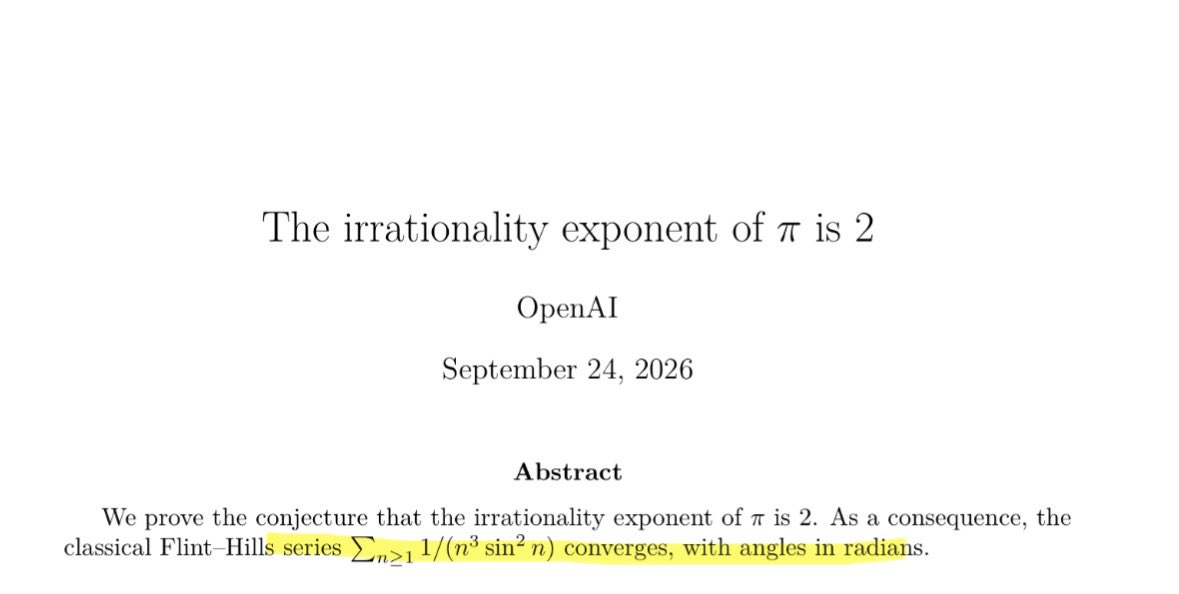
We’re releasing a broad range of new mathematical results produced by an internal frontier model.
We’ve been consulting with the independent Advisory Group on Mathematics and Artificial Intelligence at the Institute for Advanced Study, and we have drawn on their advice and public recommendations to inform how we release these results.
https://t.co/7N6TPlft1P
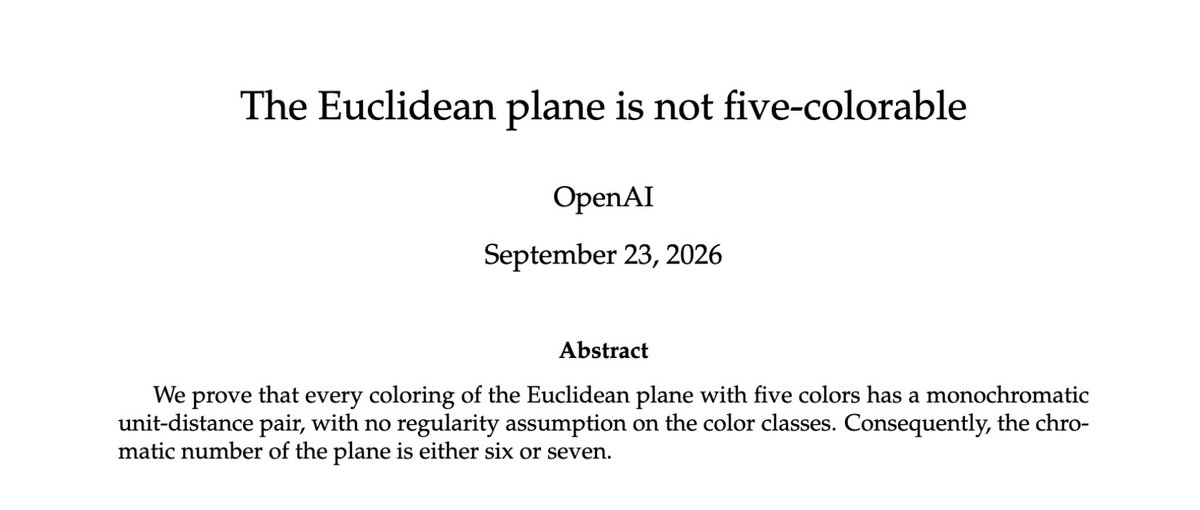
I probably spent 300 billion tokens on Hadwiger–Nelson problem (GPT-5.6 and Astra) and got absolutely nothing - and here it is, five-colours is no go, lower bound has moved to 6 or 7. Not a full solution yet, but it's a biggie.
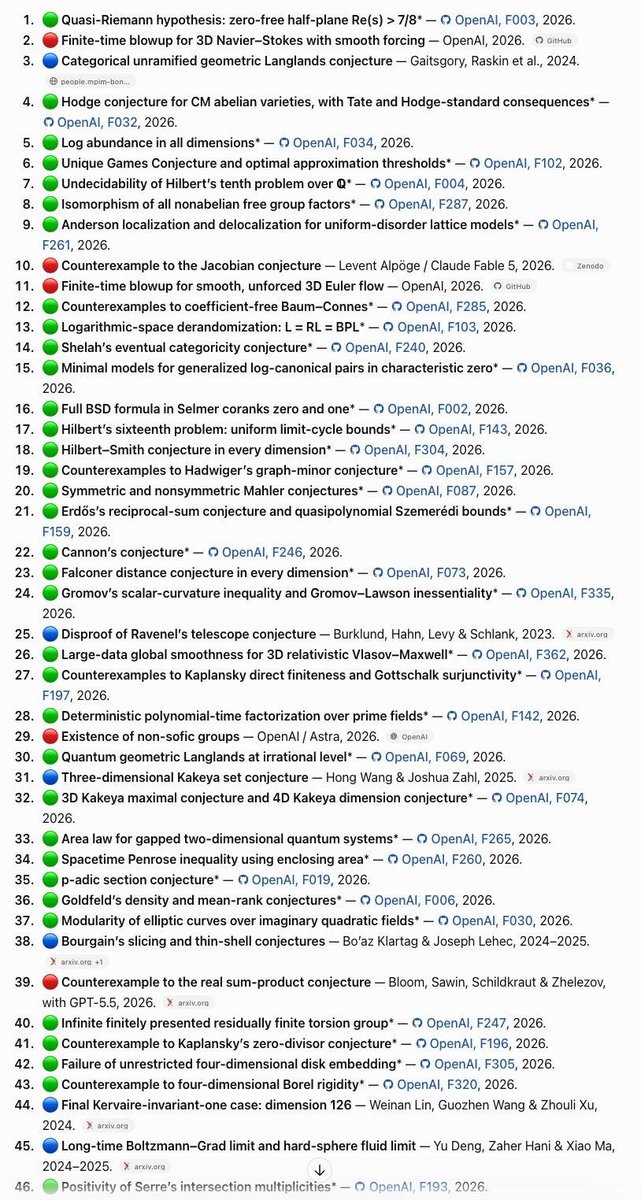
i asked GPT 6 Pro and Fable 5.1 to rank all discoveries in the last three years
🔵 for Human discovered
🔴 for AI discovered (before October 6th)
🟢 for AI discovered from OpenAI/math repo
81% of them have been released today. wtf
Never thought it will be this early but my Twitter feed of mathemacians are really furious and excited at the same time with a lot of exclamation ‼️ marks! Can't even imagine the future how the world will look after so much Intelligence at fingertips ❣️
We’re releasing a broad range of new mathematical results produced by an internal frontier model.
We’ve been consulting with the independent Advisory Group on Mathematics and Artificial Intelligence at the Institute for Advanced Study, and we have drawn on their advice and public recommendations to inform how we release these results.
https://t.co/7N6TPlft1P
@prathoshap I have been working on 3 different research projects simultaneously:
1. New semiconductor device for AI hardware.
2. New benchmark for AI models on Uncertain environments.
3. And a KV Cache scheduler to reduce cost of GPUs drastically.
And I have 0 support from my college......
@ezSnippet And no one is talking about a guy who just solved Yao's Conjecture by improving the Hash algorithm by significant amount with Elastic Hashing. Andrew Krapiwin