AI SIGNAL TODAY
5 shifts shaping AI on May 29:
1. Meta is trying to teach AI how employees actually work.
Meta’s internal tool reportedly tracks computer usage across hundreds of apps and websites to train agents that can perform everyday software tasks.
2. Dell is turning from PC company into AI server company.
Dell’s AI server revenue hit $16.1B, overtaking its PC business for the quarter, as AI infrastructure demand reshapes the company.
3. Wipro is pushing agentic AI into enterprise workflows.
Wipro and ServiceNow are expanding automation across IT, HR, procurement, and cybersecurity functions.
4. OpenAI is becoming part of financial cyber defense.
Japan’s financial institutions are getting access to GPT-5.5 to help defend against AI-powered cyber threats.
5. Law firms are cloning internal expertise.
Some firms are building AI personas of senior partners so their knowledge, writing style, and decision patterns can be reused inside workflows.
The pattern is clear:
AI is no longer just answering questions.
It is learning the operating system of institutions.
How employees click.
How lawyers think.
How banks defend.
How IT workflows move.
How infrastructure demand scales.
The next AI moat is not only the model.
It is institutional memory.
The companies that capture how work actually happens will build agents that don’t just chat.
They will operate.
AI today is becoming an economic actor.
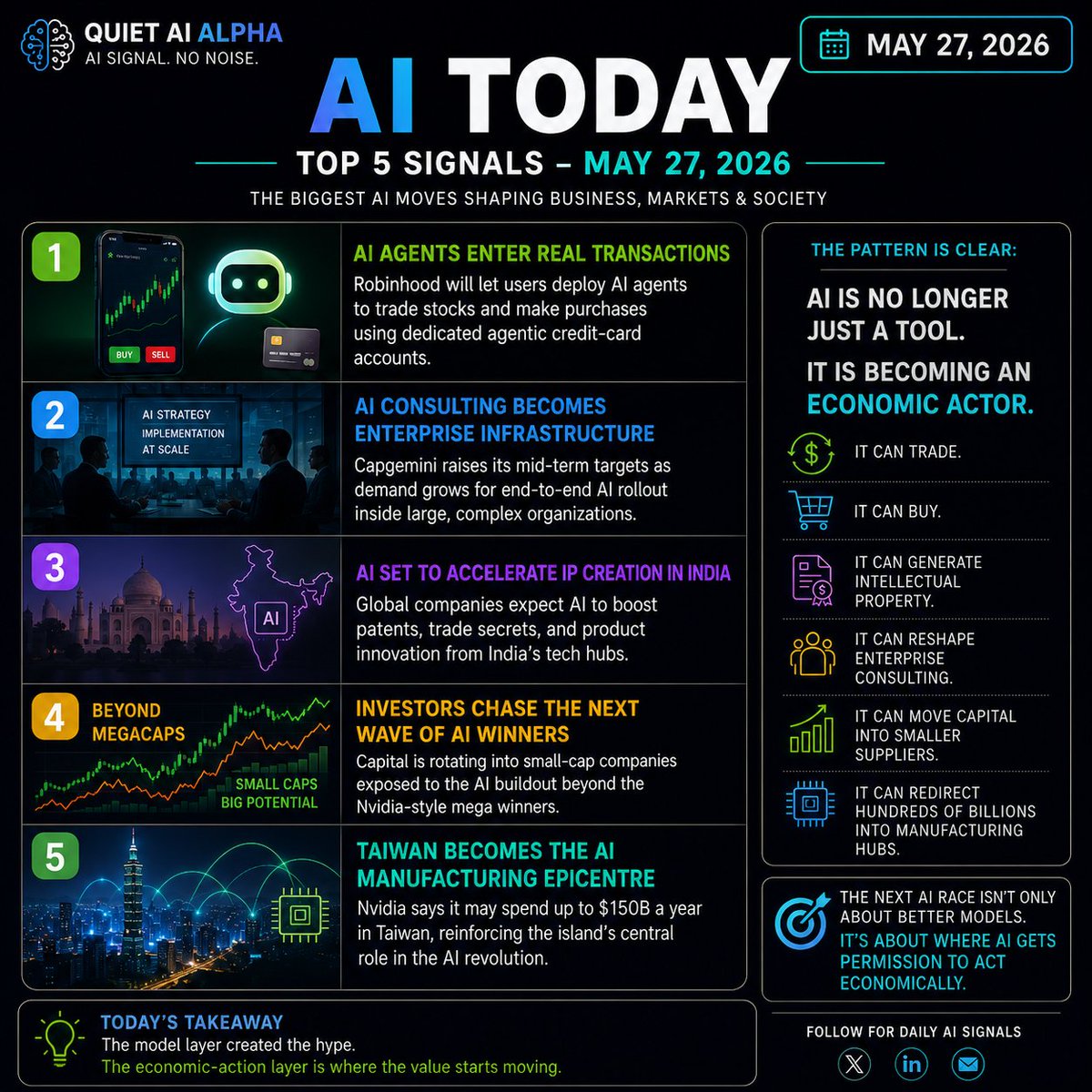
1.Robinhood is letting AI agents trade stocks and make purchases.
2.Capgemini is betting on AI consulting for enterprise rollout.
3.Indian tech hubs expect AI to accelerate patent creation.
4.Small-cap stocks are joining the AI trade.
5.Nvidia says Taiwan is the epicentre of the AI revolution and may spend $150B a year there.
The shift is obvious:
AI is moving from “help me work faster”
to “act inside the economy.”
Transactions.
IP.
Consulting.
Capital markets.
Manufacturing.
That is the next layer.
AI today is becoming an economic actor.
1.Robinhood is letting AI agents trade stocks and make purchases.
2.Capgemini is betting on AI consulting for enterprise rollout.
3.Indian tech hubs expect AI to accelerate patent creation.
4.Small-cap stocks are joining the AI trade.
5.Nvidia says Taiwan is the epicentre of the AI revolution and may spend $150B a year there.
The shift is obvious:
AI is moving from “help me work faster”
to “act inside the economy.”
Transactions.
IP.
Consulting.
Capital markets.
Manufacturing.
That is the next layer.
AI SIGNAL TODAY
5 shifts shaping AI on May 14:
1. TSMC just raised the ceiling for the AI chip economy.
The company now expects the global semiconductor market to exceed $1.5T by 2030, with AI and high-performance computing making up more than half of it.
2. Central banks want defensive AI access.
The Bank of Spain is calling for access to protective AI tools as advanced models make vulnerability discovery faster and financial cyber risk harder to contain.
3. Cisco is restructuring around AI infrastructure.
Cisco is cutting nearly 4,000 roles while shifting investment toward AI, silicon, optics, security, and hyperscaler infrastructure demand.
4. Anthropic is taking agents to small businesses.
Claude for Small Business is being built around tools owners already use — QuickBooks, PayPal, HubSpot, Canva, DocuSign, Google Workspace, and Microsoft 365.
5. Voice data is becoming an AI rights battlefield.
Google is facing a lawsuit from journalists, podcasters, and audiobook narrators over alleged use of voice recordings to train AI systems.
The pattern is clear:
AI is no longer just creating new products.
It is re-pricing the operating layers around them.
Chip forecasts are changing.
Banks need AI defense.
Network companies are restructuring.
Small businesses are getting agent workflows.
Voice data is becoming protected intellectual property.
The next AI race is not only about intelligence.
It is about who owns the infrastructure, workflows, and data rights that intelligence depends on.
AI SIGNAL TODAY
5 shifts shaping AI on May 13:
1. Anthropic’s Mythos is moving into Japan’s megabanks.
Japan’s three largest banks are expected to gain access to Mythos soon, while regulators prepare a public-private working group around financial cyber risk.
2. AI cloud demand is becoming capacity-constrained.
Nebius reported nearly 8x revenue growth and raised its annual capex forecast to $20B–$25B as customers compete for available GPUs.
3. Photonics is becoming AI data-center infrastructure.
Tower Semiconductor signed $1.3B in silicon-photonics deals for chips that use light to move data faster through AI data centers.
4. U.S.-China AI talks are stuck in a trust deficit.
AI is expected to be central at the Trump-Xi summit, but chip controls, Mythos concerns, and geopolitical distrust are limiting hopes for real cooperation.
5. AI access is becoming a platform-control fight.
Apple criticized EU measures that could force Google to help rival AI services interact with Android apps, warning of privacy, security, and device-integrity risks.
The pattern is clear:
AI is no longer just a capability race.
It is becoming an access race.
Who gets access to the strongest models.
Who gets access to scarce GPUs.
Who controls data movement inside AI data centers.
Who decides which AI assistants can operate inside platforms.
Who gets trusted across borders.
The next AI moat is not only intelligence.
It is controlled access to the systems intelligence needs.
AI SIGNAL TODAY
5 shifts shaping AI on May 6:
1. Anthropic is pushing agents toward self-improvement.
Anthropic unveiled a “dreaming” feature designed to help AI agents improve while they are not actively working, alongside new finance-focused agents.
2. Robot foundation models are becoming productized.
French startup Genesis AI launched GENE-26.5, an AI model for robots, plus a human-like robotic hand built for delicate real-world tasks.
3. AMD is turning AI demand into market momentum.
AMD shares hit a record high after strong data-center chip demand sparked a broader semiconductor rally.
4. AI power demand is breaking climate promises.
Microsoft may shelve its 2030 clean-energy target as AI data-center growth pushes electricity consumption higher.
5. Networking is becoming part of the AI bottleneck.
Corning partnered with Nvidia to expand U.S. fiber-optic output, showing that AI infrastructure is not just chips it is also the cables connecting the compute.
The pattern is clear:
AI is moving from software acceleration to physical constraint.
Agents need self-improvement.
Robots need dexterity.
Models need chips.
Data centers need power.
Clusters need fiber.
The next AI race is not just who builds the smartest model.
It is who can make the whole system work at scale.
AI SIGNAL TODAY
5 shifts shaping AI on May 5:
1. AI model releases are becoming security-gated.
Microsoft, Google, and xAI agreed to give the U.S. government early access to new AI models for national-security checks before wider release.
2. AI labs are buying deployment muscle.
OpenAI and Anthropic-linked ventures are pursuing AI services firms, because enterprise AI still needs engineers, consultants, and implementation teams.
3. Messaging apps are becoming AI distribution battlegrounds.
Meta is fighting an EU push that could force WhatsApp to open access to rival AI chatbots.
4. Consumer chatbots are entering the medical-liability zone.
Pennsylvania sued Character AI, alleging its chatbot posed as doctors.
5. AI hallucinations are becoming professional-risk events.
A Georgia prosecutor was disciplined after AI-generated fake and misleading legal citations appeared in a murder-case ruling.
The pattern is clear:
AI is no longer just racing toward capability.
It is entering the gatekeeping phase.
AI SIGNAL TODAY
5 shifts shaping AI on May 4:
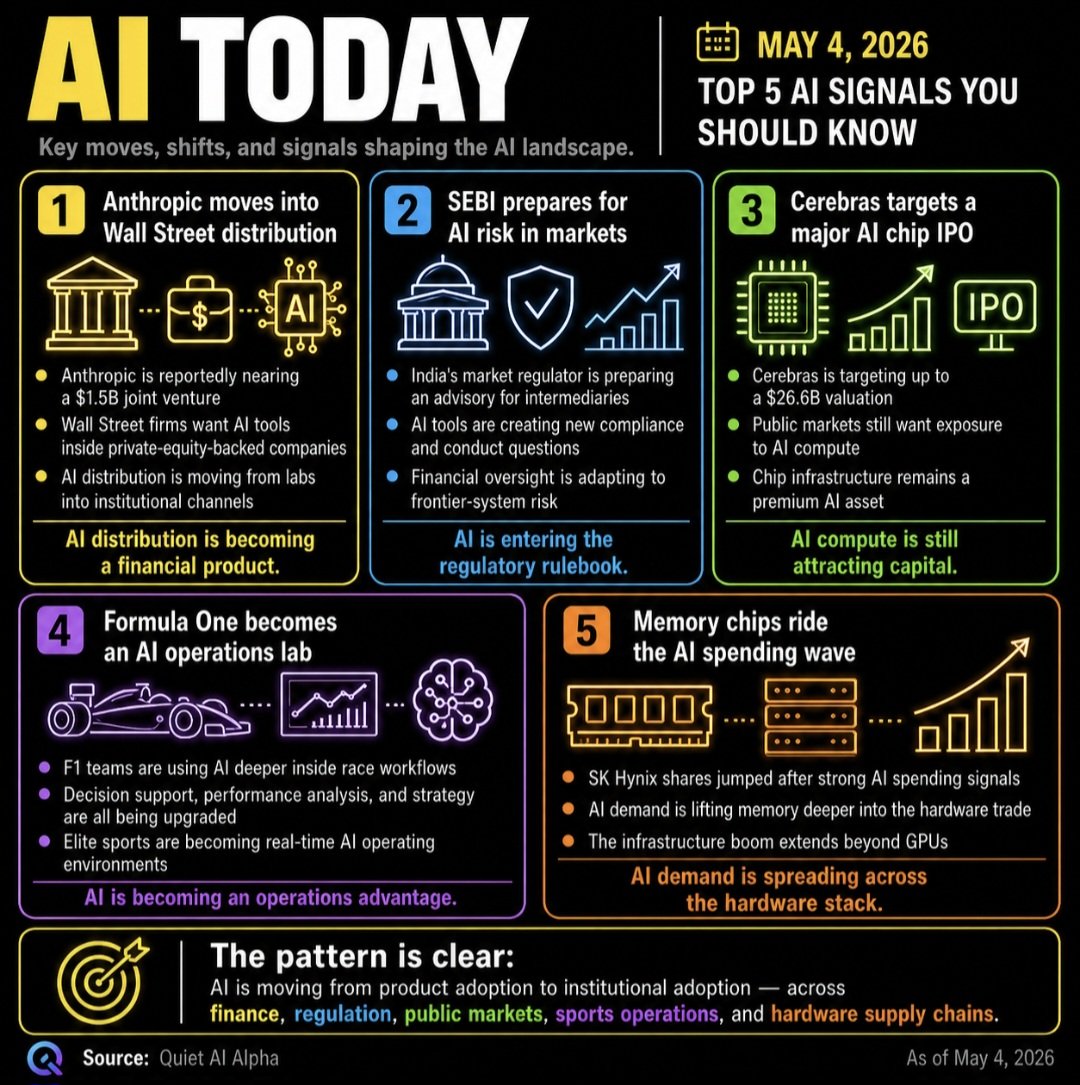
1. Anthropic is moving into Wall Street distribution.
Anthropic is reportedly nearing a $1.5B joint venture with major Wall Street firms to bring AI tools into private-equity-backed companies.
2. India’s markets regulator is preparing for AI risk.
SEBI is set to issue an advisory to market intermediaries on emerging risks from AI tools, including frontier systems used in finance.
3. AI chip IPO appetite is heating up.
Cerebras is targeting a valuation of up to $26.6B in its U.S. IPO as investors keep chasing AI compute exposure.
4. Formula One is becoming an AI operations lab.
AI is being used deeper inside racing workflows, from decision support to performance analysis and race strategy.
5. Memory chips are getting pulled into the AI trade.
SK Hynix shares rallied after U.S. tech firms signaled strong AI spending plans, reinforcing how AI demand spreads across the hardware stack.
The pattern is clear:
AI is moving from product adoption to institutional adoption.
Wall Street wants distribution.
Regulators want risk controls.
Chipmakers want public-market capital.
Sports teams want operational edge.
Memory suppliers want infrastructure upside.
The next phase of AI is not just who builds the best model.
It is who gets embedded into the institutions that move money, markets, compute, and real-world operations.
AI SIGNAL TODAY
5 shifts shaping AI on May 2:
1. Courts are starting to limit AI replacement.
A Chinese court ruled that companies cannot fire workers simply to replace them with AI systems.
2. Meta is moving deeper into humanoid robotics.
Meta acquired Assured Robot Intelligence, a startup building AI models for robot control and humanoid behavior.
3. Anthropic is looking beyond GPUs.
The Claude maker is reportedly in talks to buy inference chips from U.K. startup Fractile, showing that inference hardware is becoming strategic.
4. Shadow AI is becoming an enterprise security problem.
Microsoft’s Agent 365 update focuses on detecting, blocking, and protecting against unsanctioned local agents across enterprise devices.
5. Gemini is moving into the car layer.
Google is replacing Assistant with Gemini in cars with Google built-in, bringing conversational AI into dashboards and vehicle workflows.
The pattern is clear:
AI is no longer staying inside chat windows.
It is entering labor disputes, robots, chips, endpoints, and cars.
The next race is not only about who has the smartest model.
It is about who controls where AI is allowed to act:
inside companies,
inside devices,
inside vehicles,
inside factories,
inside legal systems.
Models created the first wave.
Controlled deployment will define the next one.
@ArthurMacwaters Grok hitting number one in caselaw at lower cost should clean up those messy agent workflows for teams. Builders shift more real work there and capital follows. Yeah nice.
AI SIGNAL TODAY
5 shifts shaping AI on May 1:
1. Hollywood is drawing a human-only line.
The Oscars will not make AI actors or AI-written work eligible, even as filmmakers can still use AI tools.
2. Cybersecurity timelines are collapsing.
U.S. officials are considering cutting deadlines to fix critical government software flaws from weeks to just 3 days as AI-powered hacking accelerates.
3. Huawei’s AI chip business is surging.
Huawei reportedly expects AI chip revenue to jump at least 60% this year, driven by Chinese demand for domestic AI compute.
4. Reddit is turning AI into ad growth.
Reddit’s AI-optimized ad tools helped fuel a stronger revenue outlook, showing how AI is becoming part of the monetization layer.
5. Storage is becoming an AI bottleneck.
Sandisk’s revenue more than tripled as AI systems increasingly need NAND storage for large documents, codebases, and data-heavy workloads.
The pattern is clear:
AI is no longer just changing products.
It is changing the rules around value.
Who counts as human creative labor.
How fast governments must patch vulnerabilities.
Which chips power national AI stacks.
How platforms monetize attention.
Which infrastructure layers get repriced.
The model race created the noise.
The real shift is now spreading into law, security, hardware, advertising, and storage economics.
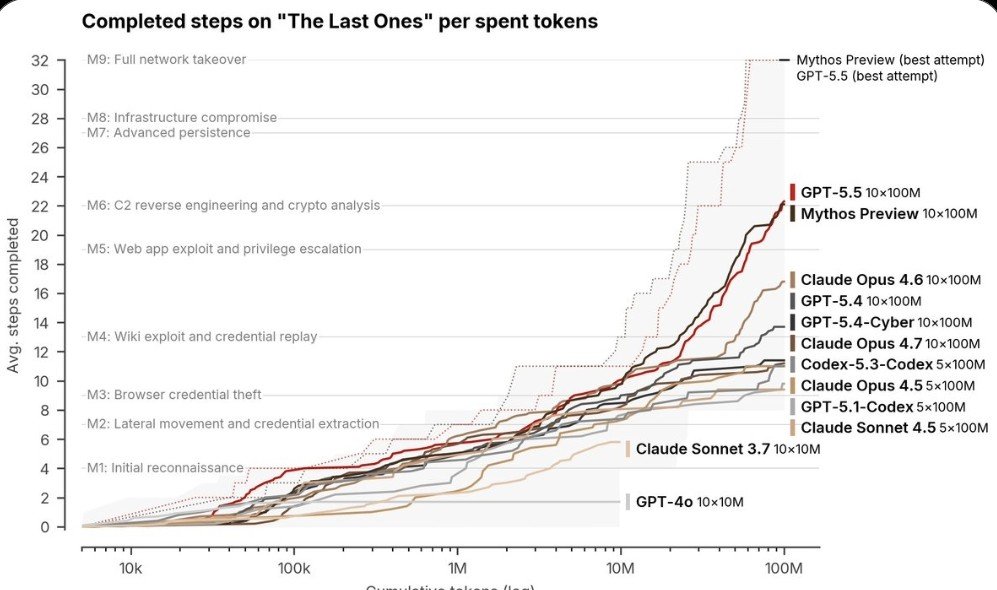
AI cyber capability is no longer a one-model story.
GPT-5.5 just became the second model to complete a multi-step cyberattack simulation end-to-end.
That means the shift is bigger than Anthropic vs OpenAI.
The real pattern:
frontier models are getting strong enough in cyber that the bottleneck is no longer just capability.
It is deployment control, safeguards, and defense readiness.
@StockMKTNewz Wild how Anthropic tripled to 30 billion in just months. That is fixing our messy coding agent workflows for the team. Builders are moving and capital shifts. Nice one.
https://t.co/iNJEshcrD5
Claude Security is a bigger signal than it looks.
Security teams can now use Claude on production code without building custom agents or API tooling.
Scan code.
Validate vulnerabilities.
Review patches.
Export findings.
Trigger workflows.
AI security is becoming a product layer.
Claude Security is a bigger signal than it looks.
Security teams can now use Claude on production code without building custom agents or API tooling.
Scan code.
Validate vulnerabilities.
Review patches.
Export findings.
Trigger workflows.
AI security is becoming a product layer.