"A little learning is a dangerous thing ;
Drink deep, or taste not the Pierian spring :
There shallow draughts intoxicate the brain,
And drinking largely sobers us again."
— Alexander Pope
This is what we've been trying to tell you. 🤦♀️
More than 86,700 rent-stabilized households in NYC earn more than $200,000 per year.
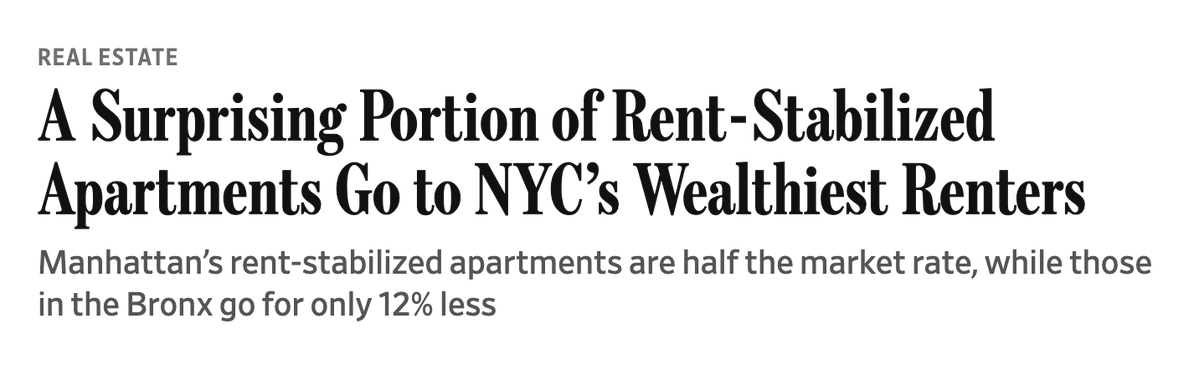
"The best housing deals in New York City happen to go to some of the wealthiest renters in the area, according to The Wall Street Journal’s analysis of New York City’s 2023 Housing and Vacancy Survey."
"... part of this is by design ...
"New York's rent-stabilized system doesn't generally test for income status, so it isn't supposed to weed out wealthy renters."
Median rents for New York's rent-stabilized apartments are HALF of market rate, according to WSJ.
Wealthy earners receive the biggest discounts.
The top 25% of earners in NYC rent-stabilized apartments receive a $1,000 monthly discount in median rent, relative to market-rate costs. That's a 33 percent savings.
The bottom 75% of earners receive a $300 monthly discount compared to market rate, equaling a 15 to 22 percent savings.
Rent stabilization without means testing benefits those who don't need it.
A rent freeze only makes it worse.
My friend Dean Ball has advanced an argument for the de facto protection of American frontier intelligence providers.
Dean does not propose banning Chinese open-weight models. Banning things requires Congress. He proposes something more characteristic of the modern administrative state: every agency issues enough warnings, bulletins, and speculative security notices that no regulated company will risk touching them.
Even a reader sympathetic to Dean would call this protectionism, and protectionism has a long history in America.
More precisely, it's a proposal to use the informal, coercive power of the terminal, late-stage bureaucratic state to clear the American market of a cheaper frontier competitor to OpenAI or Anthropic.
But throughout the history of American industrial protectionism, it has always had two features. First, it's done in the daylight, and two, it comes with a bill.
In the spring of 1952, the United States was fighting a war in Korea. Truman concluded that a shutdown would endanger soldiers abroad and ordered the Secretary of Commerce to seize and operate most of the nation's steel mills.
The Supreme Court sent him straight back to Congress in the Youngstown Steel case.
Justice Black, writing the majority's opinion, begins with the rule that Dean's proposal is seemingly designed to evade: that presidential power "must stem either from an act of Congress or from the Constitution itself."
It's easy to flatten the Youngstown decision into the proposition that the president could not seize a steel mill. Its actual lesson is subtler: that an emergency does not dissolve the difference between making a law and executing one, that the importance of the object does not create the authority, that the inconvenience of the regulatory process is not inherently a source of presidential power.
Truman's approach failed not because steel was unimportant, but because it was so important that the constitutional bargain had to be made and the policy had to be carried through the front door.
Much like policy proposals from the rest of the AI agenda, Dean is proposing a smaller action in formal appearance and a much larger one in practical effect.
We will not ban Kimi, we will not prohibit it from use, and we will certainly not publish a rule declaring Chinese weights unlawful. But we will whisper about it. A regulator may even ask management whether it has considered the reputational consequences of relying on the Chinese model, but the agency certainly will never be coherent enough to ask anyone to stop. It merely ensures that continuing becomes professionally indefensible.
This is how we grow the administrative state, with bureaucrats that we placed in these roles, without accepting responsibility for the actual process of governing.
America has tried this experiment before. Operation Chokepoint didn't make payday lending, firearm sales, or any of the other seemingly distasteful businesses caught in its net illegal, but it encouraged banks to understand that serving legally disfavored customers would invite regulatory interest. We didn't pass a law, we simply just asked, "Are you sure you really want to be doing this?"
Reputational risk was powerful precisely because it's not law. It has no limiting content. A regulator did not need to identify a violation or even a material financial risk. He only needed to make the bank afraid of being asked what was actually going on here.
The analogy is almost embarrassingly exact to Dean's policy proposal. Dean need not prove that a Chinese model contains a backdoor, nor prove that it uses any more distillation than American models do. He simply needs to announce that there may be one. The agency does not need to order a company to stop using it, but simply ask whether management has considered the risk. The absence of formal policy is by design.
The Supreme Court dealt with this technique in NRA v. Vullo. New York's financial regulator could not directly punish the NRA's speech, so she allegedly pressured the insurers and banks she regulated to sever their relationships with it. The Court's rule was unanimous: government officials may not use their offices to "coerce private parties" into suppressing what the government disfavors. The communication must be understood in the context of the regulator's power, including the regulated party's knowledge that the person offering advice can also investigate, prosecute, fine, and settle.
The current administration has gone even further. In April 2026 the FDIC and OCC issued a final rule to prohibit regulators from criticizing institutions, formally or informally, on the basis of reputational risk, and from encouraging banks to deny services to lawful but politically disfavored businesses. In June, the federal banking agencies removed the remaining references to reputational risk from their supervisory materials.
Dean is proposing that this administration recreate for AI the same machinery that all of us argued against when we were widely debanked.
A government that can quietly remove Kimi from the market can also quietly remove gun makers, crypto companies, churches, newspapers, or American open-weight models from it. The bureaucracy does not remain attached to the intentions of those who staff it at the current moment. You don't get to build this machine just because your friends happen to be in office right now and keep it pointed at where you left it.
Protectionism through a whisper is not a more modest protectionism than by law.
Protectionism also has always come with a bill.
OpenAI and Anthropic increasingly speak of themselves as national institutions. Their compute is "strategic infrastructure," their losses are "national security losses." Their competitors are not just competitors, but instruments of hostile states, and their access to power, chips, capital, copyrighted material, and public customers is a matter of national survival and great power competition.
When Washington decided that the atom was too dangerous and too important to remain an ordinary private business, Congress created the Atomic Energy Commission and transferred the Manhattan Project assets and responsibilities to it. Production facilities and reactors were government-owned, and technical information sat under federal control, and private participation only returned later through a statutory licensing regime. The existential framing of the atom by its greatest proponents produced public control.
When national security concerns helped to preserve AT&T's integrated position, that is, a monopoly, in 1956, Bell did not receive this protection for nothing. The consent decree required compulsory licensing of roughly 9,000 patents and restricted Western Electric's commercial activity outside the telephone system. The settlement diffused the inventions accumulated inside the protected monopoly into the broader economy before breaking it up just a few decades later.
The pattern is really simple. It's not that every tariff necessarily demands nationalization. It's that the bigger the shield you are asking for, the bigger the bill you owe to the American taxpayer. And OpenAI and Anthropic have been unambiguous about asking for the biggest shields of all time.
Listen to what they are asking for: public infrastructure, privileged energy, federal preemption of state law, favorable copyright treatment, government contracts, export controls, and a domestic market swept clear of their strongest price competitor, all filed under national security interests.
And what do they want to pay? Almost nothing. OpenAI has floated giving 5% of the company to the American taxpayer.
They would like the benefits of nationalization at the price of being an ordinary public company.
There is also a profound moral hazard buried in Dean's proposal, as well as adjacent commentary on this. The labs say the Chinese companies distilled their models. Perhaps they did. Perhaps distillation matters. And perhaps the Chinese labs are running distillation attacks on scales that the Western labs are. I can't be sure of this. But if the reward for failing to secure an API is that the government removes the resulting competitor, the taxpayer is paying the lab to be careless.
We know how to secure an API. Know-your-customer laws exist. Access controls exist. Extraction detection exists. If you spend some fraction of the hundreds of billions being raised to defend the asset whose theft is said to threaten the republic, you might be able to stop some of this.
Theft remains theft when the lock is bad, but the owner of a badly secured store does not receive ownership of the street for his failure to protect it.
Dean's fourth point is that open-weight AI ends in communism: the state builds the training runs and subsidizes the product of intelligence and gives the models away. But, at least for me, this is not a particularly Chinese idea, but one of the most American ones imaginable.
The roads we build are public. Our radio spectrum is publicly allocated. The government funded the early internet and much of the research base behind modern computing. The state is welcome to build a platform, and American businesses are welcome to be built on top. Just because they're bad for our market position doesn't mean we get to call them Chinese in some fundamental way.
There will be inference companies and application companies and security companies and fine-tuning companies and data companies and chip companies and 10,000 businesses we don't even have names for yet. A public road existing does not abolish the trucking industry, nor does it nationalize it.
Sure, this may reduce the value of a couple trillion dollars of equity in the first generation of model companies, but it's certainly not communism. This technology may be civilizational without its present owners being permanent. And that is the thing that I feel like none of you will say out loud: that AI is welcome to be a civilizational technology when we ask for support, and an ordinary private product when anyone asks what the public receives in return.
The United States has two honest options.
First, treat AI as a competitive industry. Then the answer to Kimi is a better model, run cheaper and exported harder, with written rules excluding Chinese systems from defense, intelligence, and critical infrastructure when a concrete security case can be made.
Or two, decide frontier AI is too important for ordinary competition. Protect the labs through pseudo-nationalization, guarantee there's a market for them, and exclude the rivals.
But in that second case, the American taxpayer must be paid, likely through a majority of equity in these companies, if not full nationalization.
What no one gets is that private upside, public infrastructure, government-mandated scarcity, and immunity from cheaper competition delivered through a late bureaucratic state issuing warnings is a disgusting ask for something that is easy to name: regulatory capture.
There is a serious American argument for protecting industries that we can't afford to lose. But there has never been a serious argument for doing it invisibly, for free, through a bureaucracy instructed to manufacture fear, even if we can do it because our friends happen to be in office right now.
If the labs want to be protected, they should ask for it in the way that Americans have always asked for it.
In public. With a price.
Two things to remember if you don't like your life right now...
1. "Tolerating" always becomes resentment, and resentment kills joy.
2. Overcoming hard things is actually correlated to happiness.
Pursuing what you really want may seem hard, but doing it will make you happier.
I think there is general confusion around how AI works, AI tokenomics, and ultimately *what is actually priced in* for the AI trade - and that some of the existing arguments are at odds with one another
Firstly to clear this up - what Brad and Gavin are saying are completely in agreement, what Gavin is laying out here is the *mega bull case* as he so states in the first sentence of his tweet lol
The base case we are all living with is that the labs are going to continue to generate a significant amount of revenue this year and next year. OpenAI was already the fastest growing company of all time (and still is)... but Anthropic has just grown *SO* fast that OpenAI's growth look slow by comparison
The basic chain for all of this together is as follows:
Power (generation, interconnect, regulation) ->
DC Shell (construction, equipment, regulation) ->
Semiconductors (compute, memory, interconnect, adv packaging, wafer capacity) ->
Hardware (networking, storage) ->
Software (data, infra, inference) ->
Models (open, closed, agentic loops, harness)
How each of these interact with one another affects the ultimate cost - which is model cost
Consider the following:
Nvidia manufactures the bleeding edge chip for training and inference. It is very good at both training, and inference. Nvidia is the largest customer of TSMC, the memory players, substrates, lasers, transceivers etc - anything you can name on. And now to soon include power into this equation. The unit of compute is fungible because the software runs ubiquitously across all clouds, multiple industries, across all models. It is bankable by increasingly more financial institutions - infrastructure PE funds, even some IG debt now - because it is ubiquitous and observable what the market is. For this Nvidia charges the highest compute margins - ~80% on hardware.
Consider the labs:
Anthropic and OpenAI are inferencing across a fleet of *largely Nvidia / Google TPUs w/ some incremental gains of Trainium*. There are new entrants to the field - Cerebras, AMD, and potentially some 2027 tapeouts of new ASICs - OAI Jalapeno, new start ups etc. Anthropic and OpenAI make the best models, with a dominant share of wallet $ (Assume ~$100B ARR) at an estimated gross margin of ~70%. (economic estimates vary from 40-90% depending on what you are including). But almost certainly contribution margins on model inferencing is pushing the number higher than 70%.
After establishing that though, I think it's incredibly important to state that while these things seems at odds with one another, this balance is not necessarily zero sum.
The thought experiment
Yes it is true that if Nvidia margins were 0, OpenAI and Anthropic could offer their intelligence at cheaper rates. How much cheaper? My estimate is
NVDA DC = ~12.5B / yr
Amazon Basics ASIC DC = ~$6B / yr
(About 1/2 the cost - so if NVDA hardware is 2x the performance, then the cost advantage goes away - and actually that ASIC is worse off bc has much worse recontracting value so arguably depreciation curve should be shorter)
So really, the labs cutting NVDA out could only offer the tokens at ~50% to 60% cheaper at their own economics. Is that signficant? Certainly. Is it an OOM difference? Not necessarily - so that's why they have prudent attempts to diversify away from NVDA (it's just good business), but they continue to rely (and actually if considering Ant's share gains, are increasing their spend on NVDA - while having competing programs).
In the case of Open Source vs Closed - Nvidia obviously wants the proliferation of this because by definition all OS models will run best on Nvidia hardware out of the gate. Yes NVDA hardware will be good, but they will have this lead because of everything NVDA has been doing for the last 4 years in developing their platform ecosystem from the infrastructure (partnerships, funding, neoclouds) to the software (vLLM / other inferencing sw, inference clouds, Nemotron, NIMs, Nemoclaw etc), to install base (sovereign clouds, global partnerships, neoclouds, hyperscalers, etc) - to proliferate NVDA around the world. Anywhere there is inference that exists outside of a walled garden (the proprietary labs) - Nvidia will exist. The only ones who could potentially cut NVDA out are the labs. And the value that is captured from the labs are estimated to be in the hundreds to trillions of $ - which are obviously of much value to the world if it were offered much more cheaply.
Which brings us to the debate at hand -- which one is right?
The truth is no one knows. You can ask the labs, you can ask Jensen - anyone who tells you definitively is just lying to you. But you can build a plausible path to the future state using a few reasoning blocks. Here's a reasoning thread (feel free to generate your own thinking):
- Bull case: Spend on the world's intelligence is about $30T / yr
- What would you spend to augment that, maybe worth 30-50% of that? $10-15 T as a market?
- Bear case: about 30M software developers in the world each earning $100K a year = $3T spend in salary. GitHub commits up 3x = $9T of productivity on $100B of ARR? *Even if you assume 90% of this is slop and useless, you would get $900B of ROI on $100B of spend*
I have more reasoning chains, but I thought this one by Jensen was compelling - but this is where we can't give too much away :)
But in spirit of crowdsourcing - some other interesting ideas I have that I am still thinking about (and encourage you all to consider as well):
- Optimizations always happen - the question is just to what extent and for what reason
- Agentic revenues was really what unlocked step function revenue growth - if open source is really just 6mo behind, then we should see really good agentic capabilities out of open models now too
- Harness and model now tightly have to be integrated
- Open Source never really makes sense as a sustainable business model - businesses investing at this scale always has to find a way to monetize that - "there is no free lunch" - not just a one model fits all... the only player that has an incentive to train on the frontier and keep completely free IS Nvidia
- Rev / GW of AI labs are already nearing the highest metrics ever - now to be fair Meta and GOOG never really thought of Rev / GW as metric to lead their buildouts - was always a cost to doing biz - but it's not like we are being "stupidly inefficient" with power spend now - true mkt creation
- wafer constrained, power constrained world. what's the optimal move?
I am not understanding how this AI trade can play out well. I saw Gavin’s tweet about lower cost open source models, which conflicts with Altimeter’s assertion that the frontier guys will continue to gain more share. Either way, the casualties will be brutal. If the frontier models continue to dominate, OpenAI and Anthropic do well, but costs remain high and the whole Jevons Paradox thesis is delayed. That doesnt seem like a great outcome given where valuations stand today. On the other hand, if the low cost open source models take meaningful share, Jevons Paradox kicks in, but OpenAI and Anthropic business models may be at risk, they may struggle to consistently make money, and therefore their trillions of dollars in future purchase commitments that are the cornerstone of the buildout of “the ecosystem” may not be money good, creating potential liquidity problems and death spirals with all of the leverage now in the system.
To me it appears that the odds of a major disruption of some sort is extraordinarily high one way or the other. And it may be the next iteration of companies that are either tiny and private now or that havent even been started yet that will figure out how to make money from whatever wreckage transpires.
Am I crazy or is this plane unlikely to land smoothly?
@GavinSBaker my instinctive reaction was your oft repeated point elon musk (short for tech) has done more for environment than all the environmentalists will ever
i'm obsessed with what's happening in AI reforestation right now
this Franco-Brazilian startup called MORFO took a patch of land in Brazil that was rock-hard and compacted from years of cattle farming. they replanted it using a single drone. months later the ground was covered in grass, bushes, and small trees. the land came back to life.
here's how the whole thing works.
1. drones scan the terrain with high-resolution cameras and sensors
2. AI analyzes the imagery alongside soil samples, moisture levels, slope, and surrounding vegetation
3. the system picks from a catalog of 300+ native species, deciding exactly which plants will thrive in which specific spot
4. the drone fires biodegradable seed pods packed with seeds, nutrients, and moisture at 180 capsules per minute
5. satellite and drone imagery monitors regrowth over time, with AI tracking vegetation cover and biodiversity
6. two people and one drone cover 50 hectares a day. a person planting by hand manages about one hectare.
and MORFO isn't alone. AirSeed in Australia drops 250,000 seed pods per day into bushfire-scarred koala habitat, replanting swamp mahogany that koalas depend on to survive. Flash Forest in Canada fires 50,000 pods daily into wildfire-destroyed boreal forest, planning the replanting alongside Cree Indigenous communities. re-green won Prince William's Earthshot Prize after planting 6 million seedlings across 30,000 hectares of Amazon and Atlantic Forest.
five companies across four continents built this same approach independently. nobody coordinated. the physics of the problem demanded it.
knowing which seeds belong in which soil used to require years of ecological fieldwork, manual planting crews, and budgets that made large-scale restoration nearly impossible. now two people with a drone and an AI model trained on local soil data can replant 50 hectares before lunch.
this is the AI work that'll still matter in 50 years.
@BillAckman Bill. you have such grt ideas, resources, network & force of personality. would be so much effective to join with like minded folks eg @StevenFulop@Partnership4NYC and organize more powerful delivery mechanism to address these issues. get on local tv, air ads, interviews etc
@JFKairport the immigration lines for arrivals is 1.5 hours ??!!! it’s not even an exaggeration? peak tourist season and handful of desks manned 100 plus people in the lines
@mcuban this seems like a familiar pattern. debate and raise some valid points. but when the issue becomes too obviously difficult and demonstrably wrong for solutions that @RoKhanna advocates for he walks away from the debate. see the california billionaire tax debate
@bgurley@sapinker exactly. if tobacco companies and consumer goods companies have to pay the price for the harm. see no reason why @AnthropicAI and @OpenAI are not fair game.
@TheValueist like a million times. makes me concerned if these are hugely consensus by now. but outside there’s is so much skepticism both re investment implications and ai adoption itself
Crime is now a choice.
Agree with @GavinSBaker in @chamath, @Jason, @DavidSacks and @friedberg's recent @theallinpod episode.
Safety used to follow wealth. Where there was money, there was safety. Where there was not, families were left to absorb the difference. Today?
That's over.
@Flock_Safety partners are reducing crime month after month, with a cost of less than $20 per person, per year.
Some of the biggest drops come from places that had been told for decades it wasn’t possible.
Greenville, MS. Poverty rate above 20% for decades. Violent crime rate the New York Times wrote about. 79% reduction in less than a year with Flock. 90% reduction in homicide.
As communities get safer, I think it’s going to feel strange to visit some of the wealthiest parts of America that choose to allow crime to flourish.
No one could have predicted this
“Jersey City was one of the busiest apartment-construction markets in the entire New York metro region, adding thousands of new units as developers chased the post-pandemic demand surge. When all that inventory came online at once, landlords had to compete on price to fill the units, which pulled rents down from their 2024 peak. The building boom is why renters are getting a break now."