Louis Pouzin a 95 ans.
Il vit aujourd'hui en EHPAD, atteint d'Alzheimer.
La Chine le reconnaît comme l'inventeur d'Internet.
La France, à peine.
Cette longue interview de Chantal Lebrument, sa biographe et compagne, mérite plus que le détour : elle mérite l'arrêt complet.
On y retrouve le polytechnicien entré à 17 ans, passé par le MIT où il contribue à ce qui deviendra le langage "Shell". Puis l'homme du projet Cyclades, né du Plan Calcul, qui invente en 1972 le datagramme : des paquets de données autonomes, circulant comme des cartes postales, chacun trouvant sa route. Vinton Cerf et Robert Kahn s'en inspireront directement pour TCP/IP.
Le socle de l'Internet mondial est bien une idée française.
Ce que l'interview rappelle avec une précision douloureuse, c'est que Cyclades n'a pas été vaincu par la supériorité américaine. Il a été étouffé à Paris. Les PTT, Ambroise Roux, les intérêts liés aux circuits virtuels puis au Minitel : la concurrence la plus efficace contre l'innovation française fut française.
Les Américains, eux, ont mis huit ans à stabiliser TCP/IP, en laissant de côté ce que Pouzin avait pensé dès l'origine : la sécurité.
C'est là que l'entretien bascule du témoignage vers l'actualité. Pouzin n'a jamais cessé de penser l'après. RINA (Recursive InterNetwork Architecture, architecture inter-réseaux récursive) et Open Root portent sa vision d'un réseau sûr par conception, plus rapide, moins coûteux, déjà exploré par Airbus ou l'université d'Oslo. Pendant que nous débattons de la confiance dans le cloud, l'alternative au protocole même qui nous rend vulnérables existe, et elle est française.
Prix Queen Elizabeth d'ingénierie à Londres. Reconnaissance officielle à Pékin. Silence poli à Paris, où l'homme a vécu frugalement, sans jamais monétiser ce que d'autres ont transformé en empires.
Regarder cet entretien, c'est comprendre que notre dépendance numérique ne fut pas une fatalité technique. Elle fut une décision. Et ce qui fut décidé peut se décider autrement.
👉 Lien de l'itw en commentaire.
The deployment of AI in the enterprise beyond just interacting with a chatbot will unequivocally take real work to align AI systems to the underlying business processes they’re involved in and drive the desired outcomes.
Most workflows weren’t designed for AI agents to just drop into. Workflows today in the enterprise deal with fragmented data, legacy software systems that agents can’t connect with, institutional instead of documented knowledge, and more.
To deploy agents reliably at scale you need to get data cleaned up, modernize IT systems, figure out evals, drive change management for the new end state process, and so on. This also involves designing where humans remain in the loop (which will mean entirely new ways people interact with the workflows), and figuring out what a company’s new IP looks like.
This is why so many applied AI companies are expanding FDE efforts and launching deploycos, and why the FDE role will be one of the most critical jobs in tech going forward. There’s a tremendous amount of work to be done on this front.
The GenAI economy has generated $110 billion in sales over the past 12 months. It is growing fast. On an annualized basis, the revenue run rate exceeds $175 billion.
These numbers took us several months to construct, and as far as we know, it’s the first bottom-up, deduplicated measure of consumer and enterprise AI spending across the full stack.
We are releasing this research today in our first The State of the AI Economy report.
https://t.co/cJwZb0T99C
There’s no amount of intelligence that can get packed into AI models that replaces the need for context. For any sufficiently general purpose AI, you will always have to guide it in the direction you want as it has an infinite range of directions it can go in.
As long as the same model is used by a lawyer, an engineer, a financial analyst, or a healthcare professional, and as long as you’re trying to do anything uniquely differentiated or specific, then instructions, domain context, and proprietary data will always need to get into the context window for the model to be useful.
This is partly why AI automation doesn’t come for free, and why there’s still a wide spectrum of who’s getting the largest gains from AI and who’s not. You have to put in real work, and you get real value on the other end.
This is one of the advantages that applied AI will also have in the market. Any layer of abstraction above just the raw intelligence that can meaningfully get you off to the races faster will likely continue to be valuable.
In the last 6 months at @Ahrefs, we analyzed over 1 billion data points across 14 studies. Here's what we learned about AI search optimization:
1) "Best X" blog listicles are the single most prominent content format cited by AI chatbots. They make up 43.8% of all page types cited by ChatGPT specifically.
2) 67% of ChatGPT's top 1,000 citations come from sources marketers can't influence: Wikipedia (29.7%), homepages (23.8%), app stores (6.6%). Only 32.3% are influenceable content like educational pages, reviews, news, and blog posts.
3) 28.3% of ChatGPT's most-cited pages have zero Google organic visibility. These pages get cited repeatedly by ChatGPT despite not ranking in Google at all. A completely separate discovery layer.
4) ChatGPT only cites about 50% of the URLs it retrieves. It fetches dozens of pages per query but uses half as background context without attribution. This means that being retrieved and being cited are very different things.
5) Adding schema markup had zero meaningful impact on AI citations. AI Overviews actually dipped −4.6%, while AI Mode (+2.4%) and ChatGPT (+2.2%) showed changes indistinguishable from zero.
6) YouTube mentions have the highest correlation (0.737) with AI brand visibility out of all the factors we studied (including all the conventional SEO metrics like backlinks, page count, DR, etc). This held true for both Google-owned and OpenAI products.
7) AI Overviews reduce clicks to the #1 result by 58%. That’s up from 34.5% just 10 months earlier. The trend is accelerating.
8) 99.9% of AI Overviews appear on informational intent queries. Transactional, navigational, and local searches are almost entirely AIO-free. Shopping triggers AIOs just 3.2% of the time.
9) For a given search query, Google’s AI Mode and AI Overviews reach the same conclusions 86% of the time — but cite almost entirely different sources (only 13.7% citation overlap).
10) AI Overviews change every 2.15 days on average, with 70% of content differing between consecutive observations. But semantic similarity stays at 0.95. The words, sources, and entities constantly shuffle, but the actual meaning barely moves.
This is effectively the #1 problem for AI agents in the enterprise.
As we go from agentic coding (where a large amount of context is in the code base, and users are technical enough to get the rest to the agent easily) to a world of knowledge work agents, the context problem becomes much more acute.
We see this every day with customers at Box. For existing digital knowledge, it’s often fragmented across legacy systems or environments that don’t play nice with agents, and have access controls that don’t map to the real work that needs to be done, which become a huge hurdle for getting agents the context they need. This has to all get moved to modern, secure cloud environments.
But also, companies often haven’t captured and digitized some of the critical context that agents need to work with. Decisions, processes, and workflows often live in people’s heads and tribal knowledge that need to get turned into unstructured data for agents.
This is actually one of the biggest points of leverage for applied AI companies, because they can work to specialize in getting agents exactly the information and domain expertise they need. But it’s also one of the reasons why FDEs and new system integrator plays will also work so well right now.
The companies that figure this out will be able to get the most out of AI going forward.
Last week I discovered that ChatGPT and Claude will send you their “encrypted raw reasoning” and of course I immediately wasted a weekend trying to do something bad with it. What I got for my trouble was this blog post: https://t.co/bxWNsFCaRL
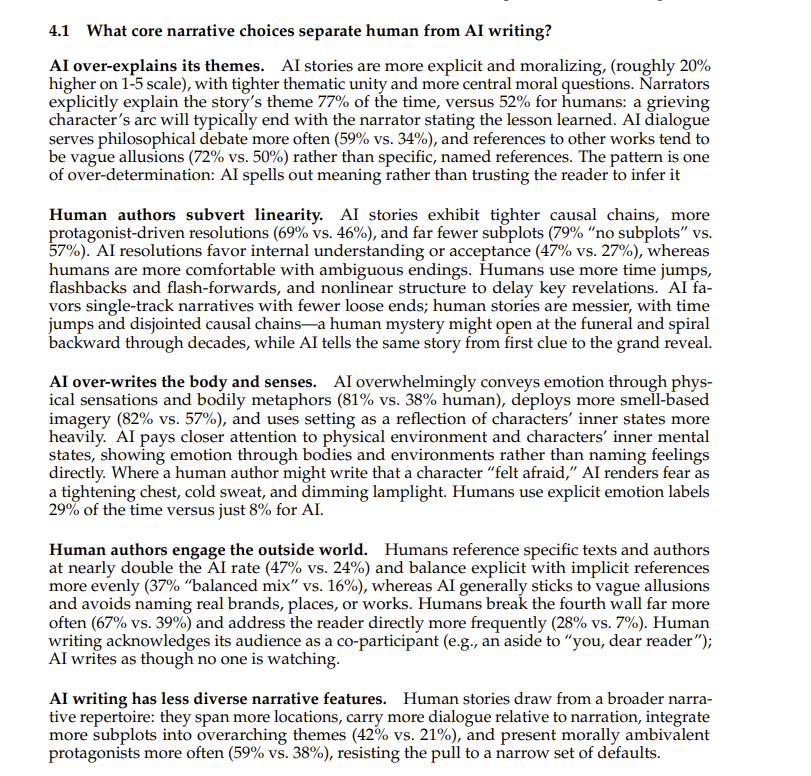
There is a lot being written about the stylistic tells of AI writing (em-dashes, etc.) but this paper looks at AI narrative tells
Fascinating differences between AI & human narrative, and asking AI to write in different styles doesn't do much to change it https://t.co/azkRHz34NQ
1re tentative documentée de fraude à l'injection de prompt démasquée au Brésil, où l'IA Galileu a été déployée dans les juridictions. Une requête devant le tribunal du travail, déposée en ligne au format pdf, contenait un texte blanc sur fond blanc donnant des instructions à l'IA
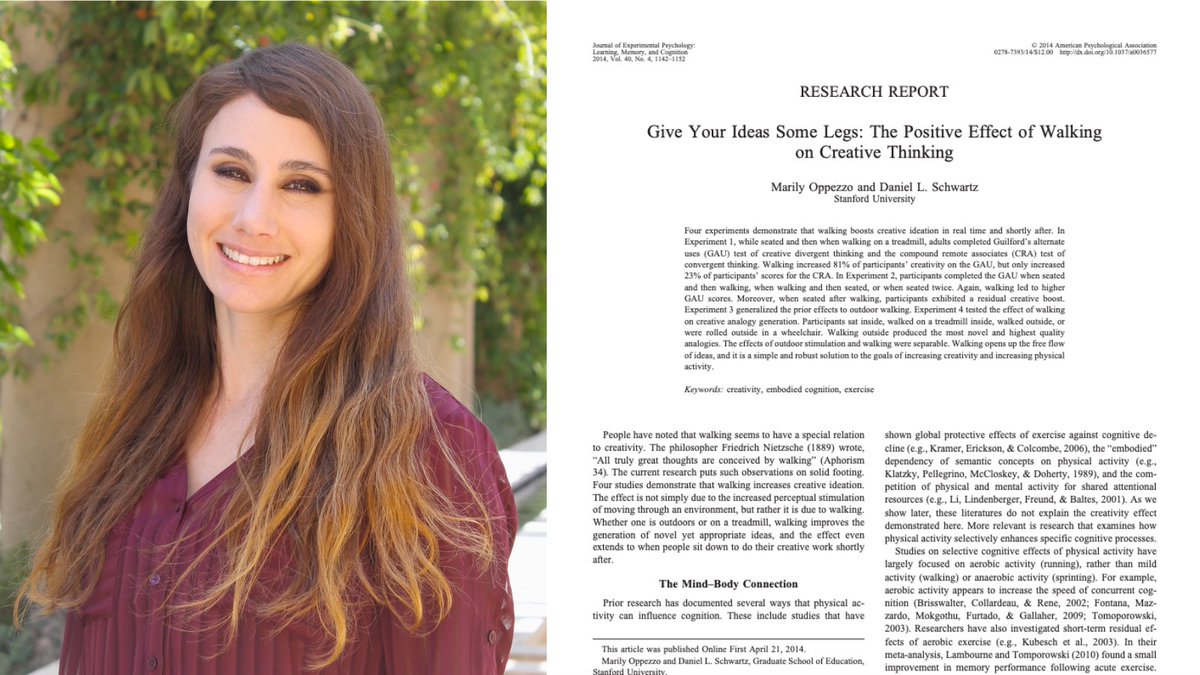
A Stanford psychologist spent 4 years proving that the simple act of walking generates 60% more creative ideas than sitting, and the experiment she designed to kill every alternative explanation is one of the most decisive findings in modern psychology.
Her name is Marily Oppezzo.
She got the idea for the study while walking with her advisor at Stanford to discuss her thesis topic, and the paper she eventually published in the Journal of Experimental Psychology in 2014 is sharp enough that it should have ended the seated meeting on the day it came out.
She ran 4 experiments on 176 people. Same person tested twice. Once sitting, once walking. The creativity tasks were the standard ones psychologists have used for decades to measure how good a brain is at generating novel useful ideas.
The result was almost too clean to publish.
81% of participants in the first experiment produced more creative ideas while walking than while sitting. In the second experiment, 88%. In the third, 100%. Every single person walked into a more creative version of themselves.
On average, people generated 60% more novel useful ideas the moment their legs started moving.
The skeptical question is the obvious one. Maybe it was the fresh air. Maybe it was the scenery passing by. Maybe it was the change of environment doing the work, not the walking itself.
Oppezzo killed every one of those explanations with one experimental decision.
She put people on a treadmill facing a blank wall. No scenery. No fresh air. No environmental change. Just legs moving in place while staring at white drywall. The 60% boost held.
Then she ran the experiment that closed the case completely. She took participants outside in two conditions. Half of them walked through a Stanford courtyard. The other half were pushed through the exact same courtyard in a wheelchair. Same outdoor stimulation. Same scenery passing at the same speed. The only difference was whether the legs were moving.
The walkers produced dramatically more novel high-quality ideas than the wheelchair group. The outdoors did almost nothing on its own. The walking did everything.
This is the part of the study that hit hardest when I read it the first time.
She also tested the opposite kind of thinking. Convergent thinking. The kind where there is one right answer and you have to narrow down to it.
Word puzzles where 3 words share a hidden fourth word that connects them. The seated participants did slightly better on these. Walkers got slightly worse.
Walking is not a general intelligence enhancer. It does one specific thing. It opens up the divergent search inside your brain. The part that generates options. The part that produces unexpected connections. The part that takes a problem and finds five ways into it instead of one.
When you need to converge on the single right answer, sit down. When you need to find the answer in the first place, get up.
The mechanism is now well understood. Walking selectively activates what neuroscientists call the default mode network, the system inside your brain that runs when you are not consciously focused on anything. The DMN is where mind-wandering happens. Where memories cross-reference each other. Where ideas that have been sitting in separate folders inside your head finally bump into each other.
When you sit at a desk and force yourself to concentrate, you suppress the DMN. When you walk at a natural pace, the executive part of your brain gets just busy enough handling the walking that the DMN comes online and starts doing the work that focus was blocking.
The most useful finding in the entire paper is the one almost nobody quotes.
The boost did not turn off the moment people stopped walking. Participants who walked first and then sat back down stayed elevated. Their next round of seated creativity work was still significantly better than people who had been sitting the whole time. The rest lingered for at least several minutes after the legs stopped moving.
You do not need to do creative work while walking. You need to walk before the creative work. The brain holds the state.
The history of this is the part that should haunt anyone who still does meetings in chairs.
Charles Darwin built a gravel loop behind his house in Kent called the Sandwalk and walked it 3 times a day for the rest of his life. The theory of evolution was developed one lap at a time on that path.
Nietzsche walked up to 10 hours a day during the years he wrote his most important books and openly said the work was conceived on his feet.
Beethoven composed for the morning and walked for 5 hours every afternoon with a pencil in his pocket for when something landed.
Kahneman said the best thinking of his Nobel Prize-winning career happened on leisurely walks with Amos Tversky. Steve Jobs refused to take important conversations sitting down. He held them on foot.
Every one of them was using the system Oppezzo would not measure until 2014. They just did not know what to call it.
The question worth sitting with is the one almost nobody asks.
Every meeting you have ever attended sitting around a table was a meeting held at a fraction of the brain power that was actually available to the people in the room. Every brainstorm that got stuck inside a conference room. Every problem you tried to solve at a desk and gave up on. Every idea you could not quite get to.
The intervention is the easiest one in modern science. No supplement. No app. No subscription. No training program. Just a pair of legs and 15 minutes.
The Stanford lab proved it. The philosophers knew it. The neuroscience explains it.
And almost everyone reading this is still trying to think their way out of problems sitting completely still.
What’s happened is that we went from AI chat tools that were relatively cheap and had small context windows, to AI agents that have giant context windows, the ability to keep track of longer running work, and models that cost an order of magnitude more on inference because they’re that much better.
This has compounded far faster than most realized (unless you were paying close attention at the middle or end of last year, which many here were), and the dollars flowing in now are much more real.
What follows is a continued march of AI capability that will continue to be used by anyone with a frontier use-case (like coding, sciences, finance, consulting) and then a peeling off of tasks to lower cost models that are capable enough for the job. Whereas we thought the cost of AI might converge on a single low price per token before, it’s clear the stratification is only widening based on the task you need performed.
This will be yet another component that has to be figured out for broad AI diffusion. Enterprises will need to put in programs, new finance teams, and technology solutions to manage this all. The labs and platforms that can ensure customers can price optimize for the task at hand will be in the best position.
🦔Google released Gemini 3.5 Flash this week, and the cheaper, faster model now costs 5.5 times more to run than its predecessor. Token prices tripled to $1.50 per million input and $9.00 per million output, and on agent tasks it burns through so many tokens that total costs end up 75% higher than Gemini 3.1 Pro, the model Flash was supposed to be cheaper than. Anthropic's Opus 4.7 has a hidden 30 to 40% price increase from token consumption. OpenAI's GPT 5.5 jumped 50 to 90% over 5.4.
My Take
The AI labs are all running the same playbook. Headline price per token reads as competitive, but the new models burn through more tokens per task, and the all-in cost to finish a job climbs release over release. Every developer and enterprise buyer should measure efficiency rather than token price now, because the two numbers have decoupled fast.
Anthropic, OpenAI, and Google all raised effective prices in the last six months, which gives us the first hard evidence that the unit economics of frontier AI are catching up with the marketing. The labs charge more because each model burns more compute per task, and the hyperscaler capex no longer pencils out at the old prices. Enterprises that built workflows on the assumption that token costs would keep falling are about to see their AI bills jump 30 to 90% on the next model upgrade, and the productivity gains that justified the AI spend have to clear that higher bar to keep working.
Hedgie🤗
the future interface is probably three layers:
1. ambient intent capture
voice, location, calendar, screen context, messages, habits, biometrics, etc. the system understands what you’re trying to do before you explicitly “open” anything or augments your intent deeply.
2. agentic execution
the actual work happens through agents operating software, apis, browsers, documents, email, calendars, workflows, payments, support systems, whatever. most “computer use” becomes machine to machine clerical labor.
3. ephemeral verification ux
humans still need to inspect, compare, approve, edit, reject, or enjoy things. that’s where gui survives but as disposable, task specific surfaces generated for the moment.
most dudes should obsess over their craft. the thing they can make, build, improve, or understand so deeply that it becomes their contribution to the world.
roughly everything else is downstream of this.