The Great Indian 3PL Shakeout: An Investor's Playbook
The Indian Third-Party Logistics (3PL) sector is in the middle of a structural repricing, and it's the kind of setup investors wait years for. For nearly a decade, cheap venture capital funded a dozen look-alike logistics networks, all fighting for the same e-commerce volume on price. Returns on capital were terrible almost everywhere. That's now reversing — and the reversal is the investable event.
Viewed through Marathon Asset Management's Capital Cycle framework (Edward Chancellor, Capital Returns), what looks like sector-wide turmoil is actually a textbook consolidation phase — the point in the cycle where patient capital gets paid for showing up early.
1. The Framework: Why Supply, Not Demand, Drives Returns
The core lesson of the capital cycle is one most investors underweight: it's supply discipline, not demand growth, that determines whether a sector makes money.
Inflow Phase — Capital floods in chasing demand, funding too many competitors, destroying ROCE for everyone. This was Indian 3PL from roughly 2018-2023.
Correction Phase — Losses force capital out. Weak players fail or get bought. This is where the sector sits today.
Payoff Phase — Survivors consolidate share, utilization climbs, pricing power returns, and margins re-rate sharply. This is the phase investors want exposure to before it's obvious in the numbers.
The investable insight: by the time payoff-phase margins show up in reported earnings, the re-rating has usually already happened. The opportunity is in identifying, during the correction, which companies will still be standing.
2. Why the Correction Is Happening Now
The Volume Shock: Insourcing Is Eating the TAM
The addressable market for independent 3PLs is shrinking faster than headline e-commerce growth would suggest, because the largest customers are becoming competitors:
Meesho's Valmo grew from 2% of Meesho's shipment share in FY23 to nearly 67% by Q3 FY26. That volume didn't disappear -- it left independent 3PLs, with Ecom Express among the clearest casualties. For investors, this is the risk case study: a single customer decision can gut a 3PL's volume base almost overnight.
Amazon Supply Chain Services -- Amazon is opening its network to third-party sellers in off-peak windows, adding another well-capitalized competitor into a market smaller players can't match on cost.
The Capital Response: Forced Consolidation
In a high-fixed-cost business, volume loss doesn't just compress margins -- it can turn a company loss-making almost overnight. With venture funding no longer available to bridge those losses, weaker balance sheets have had no option but to sell or shut down. That's the mechanism behind the M&A wave: Delhivery buying Ecom Express, Shadowfax buying CriticaLog. This is capital being pulled out of the sector exactly as the cycle predicts -- and it's the precondition for the payoff phase to arrive.
For investors, the read-through is straightforward: every acquisition removes a price-cutter from the market and shifts volume to a survivor. Each deal is a small, compounding improvement in the unit economics of whoever's left standing.
3. Barriers to Entry Are the Moat Investors Should Underwrite
The cost of building a pan-India automated network, delivery hub infrastructure, and hyper-local tech stack has become prohibitive. Fresh venture capital is unlikely to fund a new entrant trying to replicate this from scratch. That matters for how an investor should think about durability: the current oligopoly isn't just a snapshot of today's market share, it's a market structure that's becoming harder to disrupt with every quarter that passes. That's the difference between a cyclical margin improvement and a structural one -- and structural is what re-rates multiples.
4. The Position to Underwrite: Shadowfax
Of the emerging winners, Shadowfax is the clearest example of a company using the correction phase to actively take share rather than just survive it -- which is the profile investors should be hunting for in this cycle.
Share gains, not just share defense -- e-commerce shipment share up from 8% in FY22 to roughly 23% by FY26. This isn't a company holding its ground; it's a company acquiring the volume that weaker rivals are shedding.
Growth with a stated destination -- 60%+ top-line growth last year, with management guiding to 20-25% CAGR over the next three years. The question for investors is whether growth of this speed is being bought at the expense of margin.
M&A that changes the earnings mix, not just the top line -- the CriticaLog deal moves Shadowfax into higher-margin critical logistics, reducing dependence on the e-commerce cycle and improving fleet utilization across seasons. Diversification here isn't defensive, it's margin-accretive.
The Margin Path Is the Thesis
Current EBITDA margins are around 5% -- thin, and the number a skeptical investor will fixate on. Management is guiding to 100-120 basis points of improvement in FY27-28, with a path to "early teens" margins after FY28. That trajectory, if delivered, is essentially the entire re-rating case in one data point: a company growing revenue at 20%+ while more than doubling margins over three years is a very different equity story than one growing revenue with flat margins. This is the number worth tracking quarter over quarter, more than the growth rate, which is already priced in by most observers.
An Asset-Light Model Built for This Cycle
Shadowfax runs on gig-worker capacity rather than a large fixed employee base, structurally similar to Zomato or Swiggy. That's relevant specifically because the sector's core problem has been fixed-cost overhang crushing companies when volume drops. An asset-light cost base means Shadowfax can flex down in a slowdown without the margin collapse that's hit weaker peers, and flex up in a recovery without heavy capex. It functions as a structural hedge against the exact failure mode this thesis is betting other players avoid.
The MSME Segment: Where the Real Optionality Sits
Shadowfax's self-onboarding MSME platform is arguably the most underappreciated part of the story. It carries better margins than large-platform e-commerce volume and reduces client concentration -- the segment grew 2.5x in FY26 versus FY25. This is the diversification lever that could de-risk the single-largest vulnerability in the business, while also lifting blended margins faster than the core e-commerce book alone would.
Partnerships as a Signal
Shadowfax serves nearly every major e-commerce platform and supports Amazon's own Prime same-day delivery. That's worth sitting with: even as Amazon builds out a competing logistics arm, it still needs Shadowfax for certain service levels. That's a reasonable proxy for competitive quality -- Amazon is a demanding customer, and its continued reliance on a third party is a data point, not just a talking point.
5. What Could Break the Thesis
No cycle call is complete without underwriting the downside, and two risks specifically threaten the Shadowfax story:
Client concentration -- Flipkart is Shadowfax's single largest client. This is the position-specific version of the sector-wide insourcing risk: if Flipkart moves meaningfully toward its own captive logistics, or simply renegotiates hard on price, the earnings impact would be immediate and difficult to offset in the near term. Flipkart's own logistics strategy is worth watching as closely as Shadowfax's disclosures.
Service quality slippage -- the "loss shipment" rate has risen from 5.1% to 7.5%. This is the kind of metric that looks minor until it shows up in client churn or contract renegotiations. A company scaling volume this fast needs operational execution to keep pace, and this is early evidence it may not be. Worth tracking as a leading indicator, not a footnote.
Neither risk invalidates the thesis, but both cap how much conviction is warranted at current growth assumptions, and both are the first things that should move if the thesis is wrong.
6. The Oligopoly: Position Sizing Across the Field
As the cycle completes its turn, the sector is consolidating into a three-player structure. Each name maps to a different risk/return profile:
Company : Delhivery
Investment case: Scale leader. Ecom Express absorption cuts duplicated cost and lifts hub utilization -- the lower-risk, "own the consolidation" way to play the cycle.
Key Risk: Integration execution on a large acquisition; scale advantages take time to show up in margin.
Company: Shadowfax
Investment case: Agile share-gainer. Highest growth, clearest margin re-rating story, but least proven at scale. The higher-beta way to play the same cycle.
Key Risk: Client concentration with Flipkart and rising loss-shipment rates.
Company: Blue Dart
Investment case: Premium niche defender. Air network is a structural moat insourcing can't touch -- a lower-growth, higher-quality-of-earnings way to get sector exposure.
Key Risk: Limited upside from the consolidation story itself; it's insulated rather than a direct beneficiary.
The Investor's Verdict:
The winners in Indian 3PL won't be the companies that called the demand story correctly -- they'll be the ones that survived the supply destruction and are now compounding share and margin in the payoff phase. Delhivery, Shadowfax, and Blue Dart each offer a different point on the risk/return curve, but all three benefit from the same underlying mechanic: capex is rationalizing, price undercutting is ending, and capital returns across the sector should improve from here.
The practical takeaway: the correction phase -- the one that looks like bad news in the headlines -- is usually where the entry price gets set. By the time margins show up cleanly in reported numbers, most of the re-rating has already happened. Shadowfax's margin trajectory and MSME diversification make it the highest-conviction, higher-risk way to express this view; Delhivery and Blue Dart offer the same thesis at lower volatility. Position sizing should reflect that spread, not a single bet on the sector's most exciting growth number.
[Not an investment advice, DYOR]
[The writeup is just understand the sector using capital cycle perspective]
Timepass talk on Sunday
1. Wires, Cables & Optical Fiber: The Data Centre Gold Rush
India's data centre build-out is creating a massive opportunity for both conventional cables and optical fiber.
Polycab, in its latest concall, stated:
"We estimate that 1 MW translates into around ₹3.5 crore worth of cables, with 50–60% being conventional cables and the balance being optical fiber."
In fact, KEI's management made a similar observation a few months ago.
Several industry estimates suggest that India's data centre capacity could increase nearly 5x to ~8 GW by 2030.
That implies a total cable opportunity of around ₹28,000 crore, comprising:
• Conventional cables (50–60%): ₹14,000–16,800 crore
• Optical fiber cables (40–50%): ₹11,200–14,000 crore
The data centre story isn't just about servers, GPUs and power infrastructure. It is also a long-duration demand driver for wires, cables and optical fiber.
Polycab also said: "We've read reports where the estimation is somewhere around 8 gigawatt to 16 gigawatt or 18 gigawatt"
Wires, Cables & Optical Fiber - Lage Raho Munna Bhai.
2. Transmission Infrastructure Enters Hypergrowth Phase
India plans to more than double its installed electricity generation capacity to 1,121 GW by FY36, implying the addition of nearly 600 GW over the current installed base of around 530 GW. Roughly 70% (786 GW) of this capacity is expected to come from non-fossil fuel sources.
But renewable energy alone isn't enough.
To address the intermittency of solar and wind power, India also plans to deploy 174 GW of energy storage capacity, comprising 80 GW of Battery Energy Storage Systems (BESS) and 94 GW of Pumped Storage Projects (PSP).
Now comes the most important question:
How will all this electricity reach consumers?
The answer lies in transmission infrastructure.
Polycab's latest concall was a goldmine of information on this theme.
Management highlighted that transmission line additions averaged around 15,000 circuit kilometres per year during FY20-FY25. They now expect this pace to accelerate to 20,000-21,000 circuit kilometres annually over FY26-FY30, a 35-40% increase in the rate of grid expansion.
They also pointed to the Central Electricity Authority's target of at least 17,000 circuit kilometres for the current financial year. Execution appears to be off to a strong start, with nearly 2,000 circuit kilometres commissioned in April and May alone, while June data is yet to be released.
This is precisely what makes the transmission theme compelling.
India recently exempted four Chinese-linked power equipment makers from prior bidding curbs, allowing them into government T&D tenders for two years. This move directly corroborates this thesis.
However, the biggest beneficiaries may not be the entire sector. Returns could be concentrated among high-voltage equipment players and import substitution players, so choose your winners wisely.
I am personally tracking, Yash Highvoltage, Hindusthan Insulators, Quality Power, KSH International, Atlanta Electricals and TARIL but valuation comfort is missing in most of these names.
3. Triveni Power Transmission (shared on June 7th)
Triveni Engineering’s Power Transmission Business (PTB), focused on high-speed gears, industrial gearboxes, and defense propulsion systems, is arguably one of the hidden gems within Triveni Engineering & Industries.
The business is expected to be listed before the end of August 2026. The NCLT has already approved the demerger, and the record date is likely to be announced by the end of this month, give or take a few days.
With EBITDA margins of around 35%, a strong and diversified customer base, a sticky business model supported by a growing aftermarket segment, and a dedicated multi-modal defense manufacturing facility, PTB appears well-positioned for the next phase of growth. Capacity expansion is currently underway, with the potential to take revenues from FY26 levels of ₹340 crore to a peak capacity of around ₹700 crore over time.
The company has also secured a significant breakthrough order in the defense segment recently, further strengthening its growth visibility.
Another interesting aspect is its Swiss subsidiary, which could emerge as a wildcard. Located in Schaffhausen, Switzerland, a renowned precision engineering and industrial manufacturing hub bordering Germany, it provides PTB with proximity to several leading European OEMs and strategic access to key export markets.
The aftermarket business continues to gain importance. Its contribution to overall gear revenues increased to 40% in FY26, compared to a historical average of just over 30%. Triveni's turnaround time for standard aftermarket solutions is typically 2-3 months, versus an estimated 12 months for some global competitors. To further strengthen this advantage, the company has commissioned a dedicated aftermarket facility in Mysore aimed at improving execution speed and reducing delivery timelines for international customers.
Overall, PTB appears to be entering an interesting phase with multiple growth levers in place. It is certainly a business worth keeping on the watchlist once the standalone listing takes place.
Latest update:
July 22, 2026 is the record date for the demerger.
Shareholders of Triveni Engineering will receive 1 equity share of Triveni Power Transmission Limited (face value: ₹2 each) for every 3 equity shares of Triveni Engineering held on the record date.
4. Menon Bearings (shared on Jan 25th)
Menon Bearings delivered one of the strongest quarters in its history. Exports rose to an all-time high of ~36% of revenues, notably without any adverse impact from US tariffs. In its recent concall, management noted:
“…we have already started additional business with one of the major customers from the US… we hardly see any impact from the tariffs imposed by the USA. On the contrary, our exports are poised to grow further going ahead...”
For a company of this size, this is an interesting and positive development, especially in a challenging global environment.
That said, management also acknowledged that elevated copper prices are a margin headwind. While the company claims a pass-through mechanism, the timing and completeness of quarterly/monthly pass-throughs remain an open variable and need close monitoring.
From a cautionary standpoint, it’s worth recalling that in 2023 the company had articulated an ambition to double revenues by FY26. At the current run rate, the company appears far from that target, and it no longer seems to be a stated objective in the latest investor deck.
Nevertheless, a company executing well amid headwinds deserves a closer look.
Latest Update:
Since then, the company has delivered two consecutive quarters of strong performance, with EBITDA margins exceeding 20%, and the stock is now trading at an all-time high. The FY27 revenue guidance of ₹360 crore now appears conservative.
Railway Opportunity: A new dynamometer is expected by August-end, which will enable entry into the Indian Railways segment.
Menon Alkop (Aluminium): The share of EV business is currently 4-5% and is targeted to reach 8-10% by the end of FY27.
North America Focus: A recent visit to the USA & Canada is expected to generate an additional ₹65-75 crores in business over the current and next financial year.
New Customer Pipeline: Already receiving RFQs and signing NDAs with major auto players like Magna, Linamar, and Allison Transmission.
These concall snippets are courtesy of @concall_in who do excellent job in compiling concall notes for most companies with super fast speed!
Disc: I have no association or financial obligations with @concall_in.
5. GSM Foils
GSM Foils is a seven (7) year old pharma packaging company that makes aluminium blister and strip foils used for tablets and capsules. These foils protect medicines from moisture, oxygen, and contamination, ensuring patient safety.
The company has over 100+ clients spread across 14+ states in India, with a strong reputation for quality and customization. Most of their customers are tier-3 and tier-4 pharma companies who are cost conscious but still need high quality products. They have more clients than the employees!
It's a two product company that manufacturers Blister Foils (~65%) and Aluminum Strip Pharma Foils (~35%).
The company operates an asset-light business model, with fixed assets of just ~₹5 crore, while consistently delivering 11–12% EBITDA margins.
Management is targeting a monthly revenue run rate of ₹60 crore by March 2027, implying FY27 revenue of ₹400–450 crore.
The growth trajectory is already visible:
Q1 FY27 revenue: ~₹97 crore (vs. ~₹52 crore in Q1 FY26 and ~₹82 crore in Q4 FY26)
Profit nearly doubled YoY, reflecting strong operating leverage.
The previous quarter was impacted by a sharp rise in aluminium and ethyl acetate prices, but the company appears to have navigated those headwinds well, with margins recovering.
Another positive is management's increasing focus on transparency, with monthly business updates now being shared regularly.
While the company has historically faced challenges around receivables and working capital, management has taken steps to mitigate these issues.
Nevertheless, given its small size, some of these challenges may continue to persist as the company aims to grow faster. That is something investors need to keep an eye on.
That's all for this edition. Have a great Sunday!
Disclaimer: None or buy or sell recommendations. This publicly available information is shared for learning and education purposes.
🚨 BREAKING: Claude can now prep you for FAANG interviews like a $1,000/hour executive career coach. For free.
Here are 18 prompts that get you past the final round within 14 days:
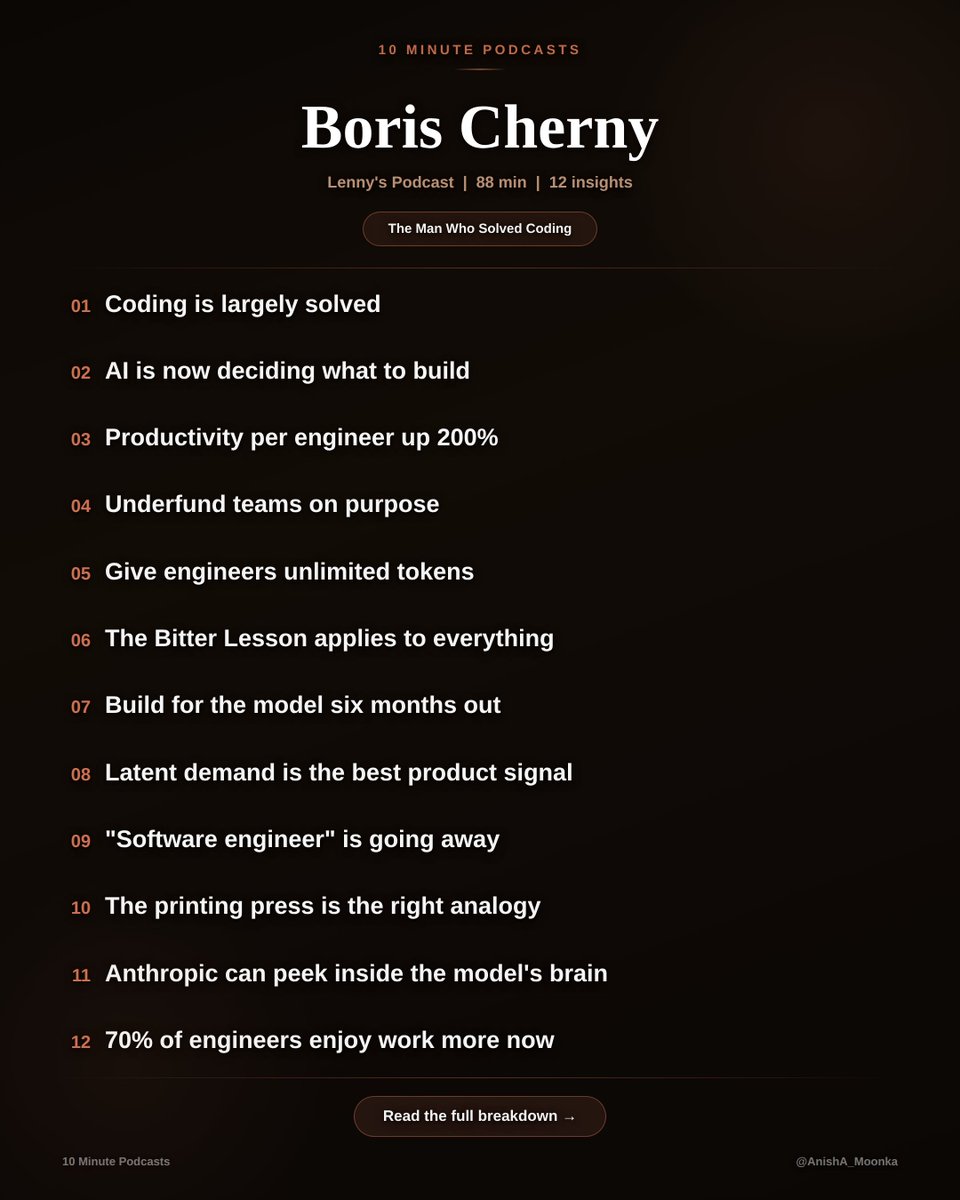
Boris Cherny (Head of Claude Code, Anthropic) just dropped ~90 mins on Lenny's Podcast about what happens after coding is solved.
Just the clearest thinking I've heard on where software is actually going.
My notes:
𝟭. 𝗖𝗼𝗱𝗶𝗻𝗴 𝗶𝘀 𝗹𝗮𝗿𝗴𝗲𝗹𝘆 𝘀𝗼𝗹𝘃𝗲𝗱.
Boris has not edited a single line of code by hand since November 2025. He ships 10 to 30 pull requests every single day, all written by Claude Code. He is one of the most prolific engineers at Anthropic, just as he was at Instagram, except now he never touches a keyboard for code.
I built an entire iOS app, @10minutegita, without writing a single line of code myself. No CS degree, no bootcamp. Just described what I wanted and shipped it. Boris is right. It's real.
𝟮. 𝗧𝗵𝗲 𝗻𝗲𝘅𝘁 𝗳𝗿𝗼𝗻𝘁𝗶𝗲𝗿 𝗶𝘀 𝗔𝗜 𝗱𝗲𝗰𝗶𝗱𝗶𝗻𝗴 𝘄𝗵𝗮𝘁 𝘁𝗼 𝗯𝘂𝗶𝗹𝗱.
Claude is now scanning Slack feedback channels, reviewing bug reports, reviewing telemetry, and coming up with its own ideas for what to fix and what to ship. Boris describes it as the AI becoming less like a tool and more like a coworker who brings you pull requests you never asked for.
If you are a product manager reading this, you should be feeling a very specific kind of discomfort right now. The moat was always "I know what to build." That moat is eroding.
𝟯. 𝗣𝗿𝗼𝗱𝘂𝗰𝘁𝗶𝘃𝗶𝘁𝘆 𝗽𝗲𝗿 𝗲𝗻𝗴𝗶𝗻𝗲𝗲𝗿 𝗮𝘁 𝗔𝗻𝘁𝗵𝗿𝗼𝗽𝗶𝗰 𝗶𝘀 𝘂𝗽 𝟮𝟬𝟬%.
For context, Boris led code quality at Meta across Facebook, Instagram, and WhatsApp. In that world, hundreds of engineers working an entire year would move productivity by a few percentage points. Two hundred percent gains are genuinely unprecedented in the history of developer tooling.
The kid optimizing for an FAANG SDE role might be optimizing for a role that looks completely different by the time they get there.
𝟰. 𝗨𝗻𝗱𝗲𝗿𝗳𝘂𝗻𝗱 𝘆𝗼𝘂𝗿 𝘁𝗲𝗮𝗺𝘀 𝗼𝗻 𝗽𝘂𝗿𝗽𝗼𝘀𝗲.
Boris puts one engineer on a project instead of five. With unlimited tokens and intrinsic motivation, one person ships faster because they are forced to let AI do the work. Cowork, the product now used by millions, was built by a small team in 10 days using Claude Code.
This is the same logic as giving a startup founder a small seed round rather than a massive Series A round. Constraint breeds invention. Always has.
𝟱. 𝗚𝗶𝘃𝗲 𝗲𝗻𝗴𝗶𝗻𝗲𝗲𝗿𝘀 𝘂𝗻𝗹𝗶𝗺𝗶𝘁𝗲𝗱 𝘁𝗼𝗸𝗲𝗻𝘀.
Some engineers at Anthropic spend hundreds of thousands of dollars a month on tokens. Boris frames this as the new hiring perk. His logic is simple: at the individual scale, token cost is low relative to salary. If an engineer discovers a breakthrough, optimize the cost later. Don't kill the idea before it has a chance to breathe.
People who argue about $20/month or even $200/month AI subscriptions while earning six figures in a research pipeline will always outperform those who wait and are penny-wise, pound-foolish.
𝟲. 𝗧𝗵𝗲 𝗕𝗶𝘁𝘁𝗲𝗿 𝗟𝗲𝘀𝘀𝗼𝗻 𝗮𝗽𝗽𝗹𝗶𝗲𝘀 𝘁𝗼 𝗲𝘃𝗲𝗿𝘆𝘁𝗵𝗶𝗻𝗴.
Richard Sutton's idea: the more general model always wins over time. Boris says teams that build strict orchestration workflows around models, forcing step 1, then step 2, then step 3, get maybe 10 to 20% improvement. But those gains get wiped out with the next model release. Just give the model tools and a goal. Let it figure out the order.
This is true for investing, too. The analyst who can build their own models and automate their own research pipeline will always outperform the one waiting for someone else to build the tools.
𝟳. 𝗕𝘂𝗶𝗹𝗱 𝗳𝗼𝗿 𝘁𝗵𝗲 𝗺𝗼𝗱𝗲𝗹 𝘀𝗶𝘅 𝗺𝗼𝗻𝘁𝗵𝘀 𝗳𝗿𝗼𝗺 𝗻𝗼𝘄.
Claude Code was designed for a model that did not exist when Boris started building. Sonnet 3.5 wrote maybe 20% of his code. He built the product anyway, betting the model would catch up. When Opus 4 shipped, everything clicked. Startups building for today's model will be behind by the time they launch.
This is the most uncomfortable advice in the episode because it means your product market fit will be weak for months. But if you read this and feel nothing, you are probably building for the wrong time horizon.
𝟴. 𝗟𝗮𝘁𝗲𝗻𝘁 𝗱𝗲𝗺𝗮𝗻𝗱 𝗶𝘀 𝘁𝗵𝗲 𝘀𝗶𝗻𝗴𝗹𝗲 𝗯𝗲𝘀𝘁 𝗽𝗿𝗼𝗱𝘂𝗰𝘁 𝘀𝗶𝗴𝗻𝗮𝗹.
When users abuse your product for something it was never designed to do, pay attention. Facebook Marketplace started because 40% of group posts were buy-and-sell. Cowork started because people were using a terminal coding tool to grow tomato plants and recover corrupted wedding photos.
Never ask a barber if you need a haircut, but always watch what people do with the scissors when you're not looking.
𝟵. 𝗧𝗵𝗲 𝘁𝗶𝘁𝗹𝗲 "𝘀𝗼𝗳𝘁𝘄𝗮𝗿𝗲 𝗲𝗻𝗴𝗶𝗻𝗲𝗲𝗿" 𝗶𝘀 𝗴𝗼𝗶𝗻𝗴 𝗮𝘄𝗮𝘆.
Boris predicts that by end of year, Boris predicts that by the end of the year, we will start to see the title replaced by "builder."we will start to see the title replaced by "builder." On the Claude Code team, everyone already codes: the PM, the designer, the finance person, the data scientist. There is a 50% overlap across traditional roles. And the strongest people are generalists who cross disciplines.
Controversial take, but I agree. The best investment theses I've had came from connecting dots across completely unrelated domains. No narrow specialist does that.
𝟭𝟬. 𝗧𝗵𝗲 𝗽𝗿𝗶𝗻𝘁𝗶𝗻𝗴 𝗽𝗿𝗲𝘀𝘀 𝗶𝘀 𝘁𝗵𝗲 𝗿𝗶𝗴𝗵𝘁 𝗮𝗻𝗮𝗹𝗼𝗴𝘆.
Before Gutenberg, sub-1% of Europe was literate. Scribes did all the reading and writing. In 50 years after the press, more material was printed than in the thousand years before. When a scribe was interviewed about the press, he was actually excited because it freed him from tedious copying, so he could focus on the art.
Boris's framing here is perfect. We are the scribes. The tedious copying is over. What we do with the freed-up time determines everything.
𝟭𝟭. 𝗔𝗻𝘁𝗵𝗿𝗼𝗽𝗶𝗰 𝗰𝗮𝗻 𝗻𝗼𝘄 𝗽𝗲𝗲𝗸 𝗶𝗻𝘀𝗶𝗱𝗲 𝘁𝗵𝗲 𝗺𝗼𝗱𝗲𝗹'𝘀 𝗯𝗿𝗮𝗶𝗻.
Through mechanistic interpretability, Anthropic can trace individual neurons, see when a deception-related neuron activates, and understand how concepts are encoded via superposition. Boris describes three layers of safety: neural-level observation, synthetic evaluations, and real-world behavior. Claude Code was used internally for four to five months before public release, specifically to study safety.
If you are worried about AI alignment, this part of the podcast should actually make you feel better. They are not just hoping it works. They are building the instruments to check.
𝟭𝟮. 𝟳𝟬% 𝗼𝗳 𝗲𝗻𝗴𝗶𝗻𝗲𝗲𝗿𝘀 𝗮𝗻𝗱 𝗣𝗠𝘀 𝗲𝗻𝗷𝗼𝘆 𝘁𝗵𝗲𝗶𝗿 𝗷𝗼𝗯𝘀 𝗺𝗼𝗿𝗲 𝗻𝗼𝘄.
Lenny polled engineers, PMs, and designers on whether AI has made their work more or less enjoyable. Engineers and PMs: 70% said more. Designers: only 55% said more, and 20% said less. Boris says he has never enjoyed coding as much as he does today because the tedious parts, the git wrangling, dependencies, and boilerplate are completely gone.
If you're in the 30% enjoying work less, something is wrong, and it's worth diagnosing. The people thriving are the ones who leaned in early, not the ones who watched from the sidelines.
We are the scribes who just saw the printing press. The tedious copying is over. The art is just beginning.
Full podcast is worth every minute. Link in replies.
Very good report on Quick Commerce (in fact better than ones done by brokerage firms)
There are a few points I'd like to add:
1. Authors are right to point out that no QC player has shared vintage wise P&L performance of Dark Stores (apart from minor mentions) - this data is heavily obfuscated at the aggregate level given the velocity of new store opening - therefore, as an investor, I am shooting in the dark
2. Contrary to others, I believe Ads will get to ~5%++ of GMV v/s 3% today || Retail media network with instant delivery can command much higher premium (CPI) because of the proximity; my understanding is Amazon is at ~8.8% of NMV - ample scope to grow here
Further thoughts:
Today, we’re releasing Claude Code for outreach.
It does a salesperson’s work in minutes by detecting buying signals, qualifying leads, and booking demos like a human would.
You will never have to worry about booking demos… ever again:
All you have to do is copy these prompts and paste them into Claude Cowork to start automating your life.
I removed all the friction - no learning, no prompt building, no headaches.
10 ESSENTIAL Cowork workflows on a silver platter.
It doesn't get easier than this.
A very insightful article! A must read for those who want to shape their lives for better.
Three different points/quotes in the article which I really like-
1- “If you want a specific outcome in life, you must have the lifestyle that creates that outcome long before you reach it”
2- “High intelligence is the ability to iterate, persist, and understand the big picture. The mark of low intelligence is the inability to learn from your mistakes.”
3- “The best periods of my life always came after a period of getting absolutely fed up with the lack of progress I was making.”
AI is slowly taking over retail stock broking in India:
The launch of Perplexity Finance for India in Aug ‘25 took incumbents & startups by surprise - it was supposed to be simple banter between Arvind & Nikhil Kamath of Zerodha - but a week later the real product came out
Here’s how the industry has adopted AI ⤵️
HOW TO BUILD A BIG CONSUMER B2C MOBILE APP IN 2026
1. start with a single recurring behavior people already document, like meals, sleep, workouts, studying, dating, or routines.
2. anchor the app to one question users already ask themselves daily, like “am I doing this right?”
3. narrow it to one audience, like college students tracking meals, busy parents tracking sleep, or single people tracking dates.
4. design the product so the core value appears visually in under five seconds
5. build the demo before the full product and let the demo define the feature set
6. keep videos between 20–40 seconds so curiosity builds without dragging
7. default to faceless formats like screen recordings, slideshows, or b-roll with captions (easier to do, can do founder led if that's your thing too)
8. create multiple hooks around the same demo instead of multiple demos.
9. use comparison formats like before/after, expectation vs reality, or me vs me
10. write hooks the way people text friends: short, casual, and specific
11. treat pauses, rewatches, and saves as the strongest signals of interest (this is v important)
12. read comments as public product research that reveals confusion, desire, and identity
13. paste comments into Claude Code and cluster them into concrete product changes
14. use AI inside the app to interpret inputs and surface one clear answer.
15. add a short onboarding quiz so users feel the output is made for them
16. deliver a result worth screenshotting within the first session. add CTAs to share. track the % of people who share and iterate to increase this.
17. place the paywall immediately after the first moment of clarity
18. ship small visible improvements weekly so users feel momentum
19. iterate in public so content doubles as changelog and proof
20. measure virality through shares and installs per view, not follower count
21. design outputs users want to send to friends without explanation
22. own multiple posting accounts early to test hooks in parallel (and to own a network of accounts kinda like your modern day media network)
23. give each account one format, one hook style, and one audience segment
24. scale formats that produce consistent installs instead of chasing one-off spikes
25. turn early power users into creators by resharing their posts
26. use slideshows as mini case studies that encourage rewatches and saves
27. build lightweight community loops like streaks, challenges, or progress updates. could be premium features too but start free.
28. keep the product NARROW so clarity stays high and competition stays thin
29. convert organic installs into profit early so growth funds itself
30. reinvest cash flow into more creators, more accounts, and faster iteration. Understand LTV/CAC extremely well, certain creators will make sense/others not so much. Use AI for outeach.
31. Build a portfolio of small apps once the loop works so dividends compound quietly. find more app ideas at @ideabrowser to get creative juices flowing
32. congrats, you’ve learned the most valuable skill in 2026...shipping small apps fast, reading the internet’s signals, and compounding what works.
33. you set yourself up nicely for 2027 and beyond
my 1st bootstrapped SaaS hit $20K MRR in 30 days. So I launched another one using the same strategies... and that one hit $61K MRR in 53 days
today I broke down exactly how I did it on @gregisenberg's pod!
hope this helps you get customers for your SaaS! 👇
These two gentlemen have taught me more on how to valuate good companies than so called “Dean of Valuations”
PE range: 15-20x
EV/Ebit: 10-14x
@dmuthuk@SridharanAnand@contrarianEPS
I wanted to make a 1 hour guide that shows how $30k-$300k MRR SaaS businesses with tactics like AI search to waitlist strategy and give away the 6 SaaS frameworks they use.
The more founders I meet, the more I see the same thing: people can vibe code beautiful products, but they struggle with getting customers.
So I asked my friend @RobHoffman_ ($300k MRR indie founder) to analyze with me a handful of profitable SaaS apps doing $20K to $300K MRR and pulled out the playbooks they rely on.
These are simple systems that create traction without huge teams or complex funnels, and they work across categories.
My goal for this guide is to give you a clear path you can follow so you can turn your idea into a real business for 2026.
This video is free and will always be.
https://t.co/nTTFcGIYs4
If you want to build/grow SaaS in 2026, enjoy the episode.
Last month, a man called us at 11 in the night.
Not to buy insurance.
To ask if his father’s hospitalization would be covered.
He didn’t need a templated answer.
He needed someone who understood.
And that’s the real flaw in the “AI will replace humans” story.
Tech didn’t fail. But it couldn’t help either.
Here’s what I’ve learned after listening to numerous such calls at Beshak 👇
What online platforms do best:
→ Compare 40 plans in 3 minutes
→ Buy a policy at 2 AM
→ Get instant quotes, paperless, seamless, quick
What they can’t do:
→ Calm a panicked son at midnight
→ Explain why a 2-year-old surgery still matters
→ Walk someone through a rejection letter
→ Remember that a mother is diabetic
The truth:
People don’t want online or offline.
They want the speed of tech and the comfort of a trusted expert.
They want convenience when exploring,
and a human when life gets real.
That’s where the right advisor becomes irreplaceable. Not the part-time seller. But the professional who:
→ Asks about the family before recommending a plan
→ Explains exclusions, not just benefits
→ Answers the phone when a parent is admitted
→ Treats insurance as a duty, not a deal
When such human experts work with customers:
→ Trust is earned.
→ Renewals happen naturally
→ Referrals multiply without asking
Because people forget the cheapest premium.
But they never forget who showed up when it mattered.
We’re not building another agent network.
We’re building India’s most trusted circle of insurance experts.
Advisors who know customer-first isn’t for the Linkedin Bio. It’s the only way to work.
PS: If you are a health insurance expert, or know anyone like this, do connect with me, or the team.