Imagine if we have Super-AGI, and we ask it questions like "how to fix global warming?"
The galaxy-size brain will reply,
"Dump cars, make more rail. Don't be pussies, turn the AC off. Go vegan. Ban private jets. Turn off datacenters used to make those awful AI-slop movies..."
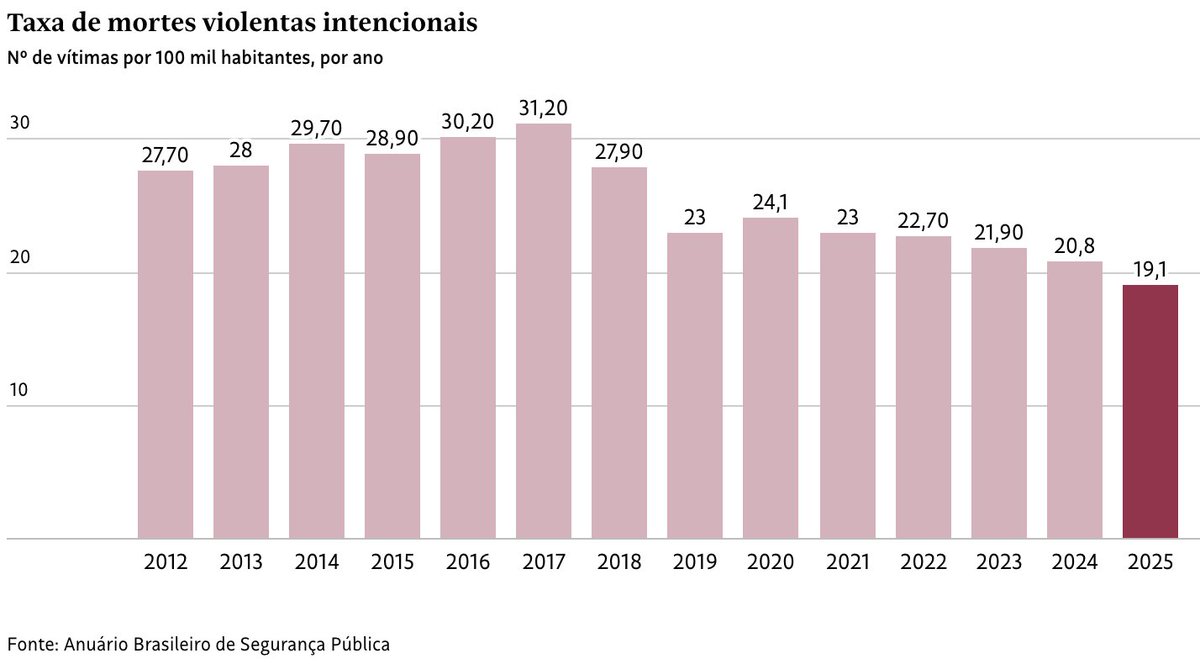
Good news out of Brazil: The murder rate fell again last year and is now down 40% from its 2017 peak.
Many possible reasons why, from fewer clashes among gangs to more effective policing in some places.
Femicides and killings by police remain high, as do other kinds of crimes. The current murder rate of 19 per 100k is still almost 5X the United States
Former editor in chief of three tech publications over 20 years here.
At some point, as tech became the comparative advantage of the US economy, and a major political power in its own right, tech publications and the mainstream media, did, in fact, become reflexively critical and antagonistic to tech companies—and tech media declared war on their own audiences.
This shift may have been over-determined and have many causes—SV’s libertarianism became less romantic and counter-cultural as media and journalists became more progressive; media became poor and precarious at the time that tech got rich and triumphant—but it was a real falling-out. I saw it myself.
"In other words, the toll from USAID cuts by 2030 seems to be *at best* around two-thirds of a million people; that’s about as many people as were killed during the Civil War. At worst, Musk is tied to the deaths of millions."
https://t.co/Vdmf3OkGC8
Some considerations that many folks seem not to get:
1. It can be a bubble even if the tech works. (For instance, if the tech doesn't have a high-demand use case.)
2. It can be a bubble even if the tech works and has strong product-market fit. (For instance, if the tech cannot be economically viable.)
3. It can be a bubble even if the tech works, has strong product-market fit, and has a path to eventual economic viability. (For instance, if profitability takes too long to achieve or makes margin/competition assumptions that fail to materialize.)
4. It can be a bubble even if the tech works, has strong product-market fit, and is currently highly profitable. (For instance, if demand has a hard ceiling and growth stops once the ceiling is reached.)
5. It can be a bubble even if the tech works, has strong product-market fit, is currently highly profitable, and has unlimited future demand.
Literally all it takes for something to be a bubble is for lots of people to over-enthusiastically bet their money on it, and subsequently get panicky.
Importantly, bubbles can be attached both to things that are completely hogwash, like the Metaverse, and to world-changing developments like the Internet or railways. Bubbles don't care. They're brought into existence by the thoughts and feelings of investors, not by actual tech or products.
"The bubble has burst" doesn't mean "the tech didn't work" or "people stopped using the tech." It only means that people got panicky, investor money dried up, and valuations collapsed. Internet adoption didn't stop in 2000.
Just saving this here to document a story and as a self reflection on whether AI is really making me more productive
Yesterday morning I found a way to complete the new HVM approach, that is much faster than before. I spent a few hours writing a spec, and then used Opus to implement. About 3k lines of C code later, everything worked and performance was incredible: 5x faster than HVM4 (stable at ~10x now). So, in one day I had outclassed HVM4. Incredible. I'd never have implemented that so fast manually.
Now, enter today. I want to turn this into a real thing, but I haven't fully read the 3k lines yet. So, how do I trust it? I spent the whole day auditing the code. With AI. Several bugs found, most minor like forgetting to collect() some argument. But then I stumble upon this:
λ{ inl: 1 ; inr: 1 }
This was a test. But wait. This is matching on inl/inr. So the branches should receive the value of the Either. But they were numbers instead. Numbers aren't functions. This makes no sense. So why this is a test?
It then stuck me. The AI completely misunderstood how function arities work. It literally assumed for no good reason that HVM5 was supposed to handle under/over-applied functions. For no good reason. I never wrote that. It never asked either. It just kinda thought "HVM is weird in some aspects, this might be one of them..." - and then it went on to implement a massive system to handle cases that should never happen to begin with. And all of that code is obviously wrong because it should not even exist. It is wrong. It is damage. And it is there.
But it isn't too bad either. I just told Opus that it was wrong. Perhaps not so politely. And it solved it just fine.
But then this begs the question. I spent ~20 hours in this file, and it is STILL not done. I went from 0 to 95% in the first 5 hours. Yet, 15 hours later, it is still not 100%. I suppose that is the real effect of using AI. If I had just written the C file manually in the last two days, would I not be further than where I am *right now*?
Surely, the first version would have taken much longer to drop. But when I'd finish writing all that code, there would be zero, literally zero retarded shit. And, just today, I caught 5 or 6 retarded shit. And the worst part is: I don't know what the number of retarded shit left is, but I'm afraid it is >0.
So if I have to read it all, review it all to ensure there is no retarded shit... what did I achieve by using AI, other than that dopamine anticipation?
@mgaldino A notícia em si pode não abalar tanto, mas o news cycle passa a ser negativo. Até agora o efeito eleitoral do escândalo Master parecia afetar o PT (via assoc difusa com STF), o sinal pode trocar daqui para a frente.
Like @davidbessis and others, I think that Hinton is wrong. To explain why, let me tell you a brief story.
About a decade ago, in 2017, I developed an automated theorem-proving framework that was ultimately integrated into Mathematica (see: https://t.co/nGCIUk44TP) (1/15)
It’s hard to overstate the rubicon that was just crossed. Arbitrarily kidnapping a foreign head of state with no legal basis, no warning, and no coherent explanation (Trump just pardoned Honduras’ ex-pres for the same acts) because Trump dislikes him and wants the spectacle.
Publicly, reactions will split along partisan lines—Milei applauds, Lula condemns. Privately, however, military leaders across South America will see this as deeply unsettling, accelerating debates on how to reduce long-term vulnerability to the United States.
Given Washington’s shifting justifications—oil, drugs, democracy—South American military planners will inevitably ask what this precedent means for their own security. The concern won’t be ideological; it will be strategic, and it will cut across governments of all stripes.
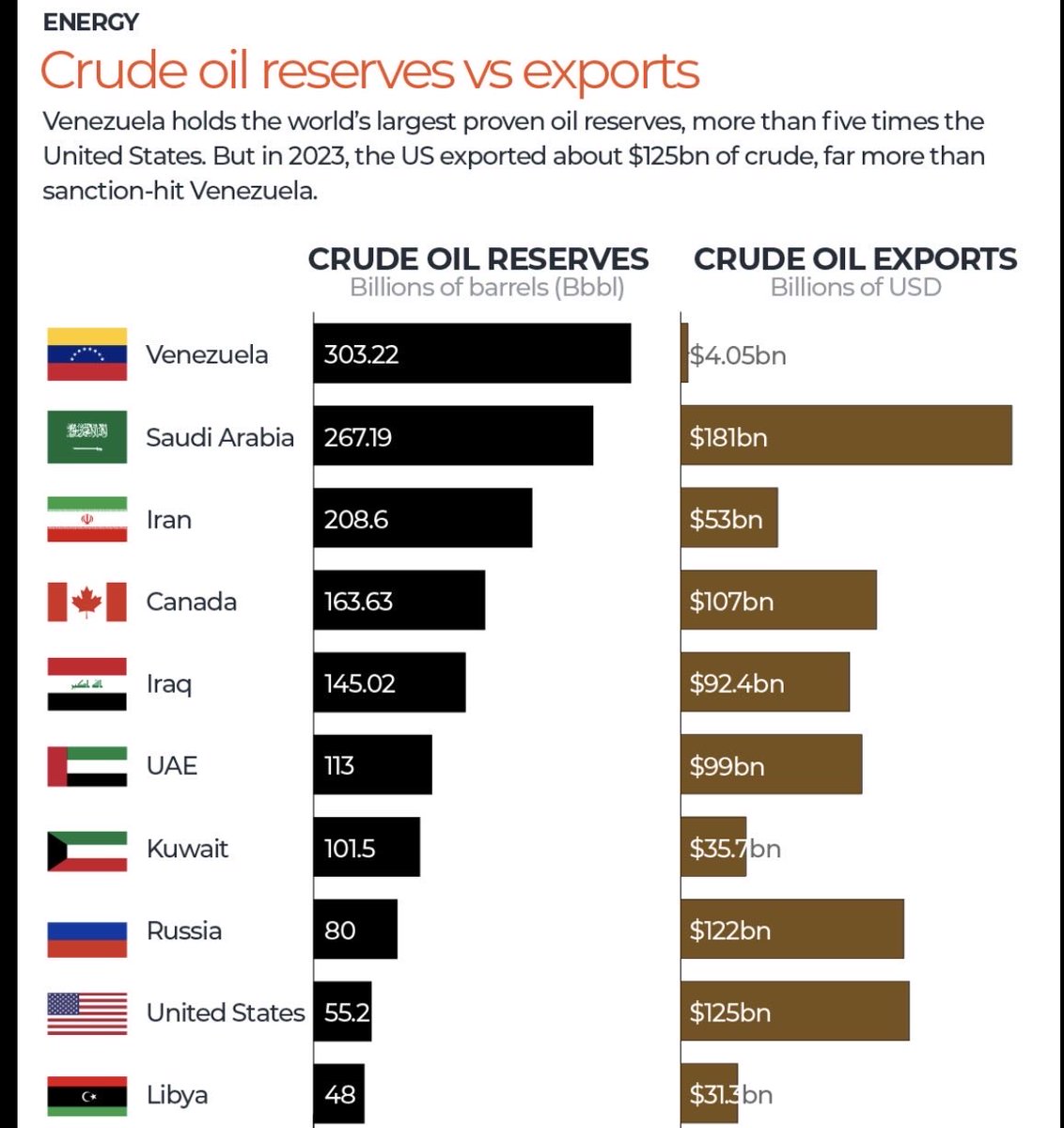
From a Chilean or Brazilian perspective, Panama in 1989 was troubling but distant. US military action against Venezuela is different. It targets a large South American country with the world’s biggest proven oil reserves—much closer, bigger, and harder to ignore.
Calling the US strike on Venezuela the “first US military attack in Latin America since Panama in 1989” badly understates its significance. Latin America isn’t a single strategic space. What matters is this: it’s the first time the US has attacked South America. 🧵👇
Os bombardeios em território venezuelano e a captura do seu presidente ultrapassam uma linha inaceitável. Esses atos representam uma afronta gravíssima à soberania da Venezuela e mais um precedente extremamente perigoso para toda a comunidade internacional.
Atacar países, em flagrante violação do direito internacional, é o primeiro passo para um mundo de violência, caos e instabilidade, onde a lei do mais forte prevalece sobre o multilateralismo.
A condenação ao uso da força é consistente com a posição que o Brasil sempre tem adotado em situações recentes em outros países e regiões.
A ação lembra os piores momentos da interferência na política da América Latina e do Caribe e ameaça a preservação da região como zona de paz.
A comunidade internacional, por meio da Organização das Nações Unidas, precisa responder de forma vigorosa a esse episódio. O Brasil condena essas ações e segue à disposição para promover a via do diálogo e da cooperação.
To believe this is about drug smuggling, you have to ignore Trump’s pardon of the former Honduran president for drug smuggling.
To believe it’s about Maduro’s democratic legitimacy, you have to believe Trump cares even slightly about democratic legitimacy.
Alternatively: