a developer noticed something about DNS resolvers, the servers that turn website names into addresses
they hold onto their answers for a while before forgetting them. some for up to a week
so he wondered if he could make them remember a file instead
he found close to 3.9 million of these servers sitting open across the internet
then he chopped a file into 180-byte pieces and handed each piece to a different server to hold
to prove it worked, the file he stored was one of his own blog posts. it sat there, readable, spread across machines from China to Brazil that never agreed to hold it
the whole thing is open source
> https://t.co/8UMpecIxRE
there's no disk, no folder, no account. the file isn't saved anywhere
it just lives scattered across millions of machines that have no idea they're holding it, and forget it in a few days unless you keep reminding them
slower than a hard drive. in his words, still faster than a floppy disk
you don't store a file here. you keep it alive by asking for it
It’s not “equality”.
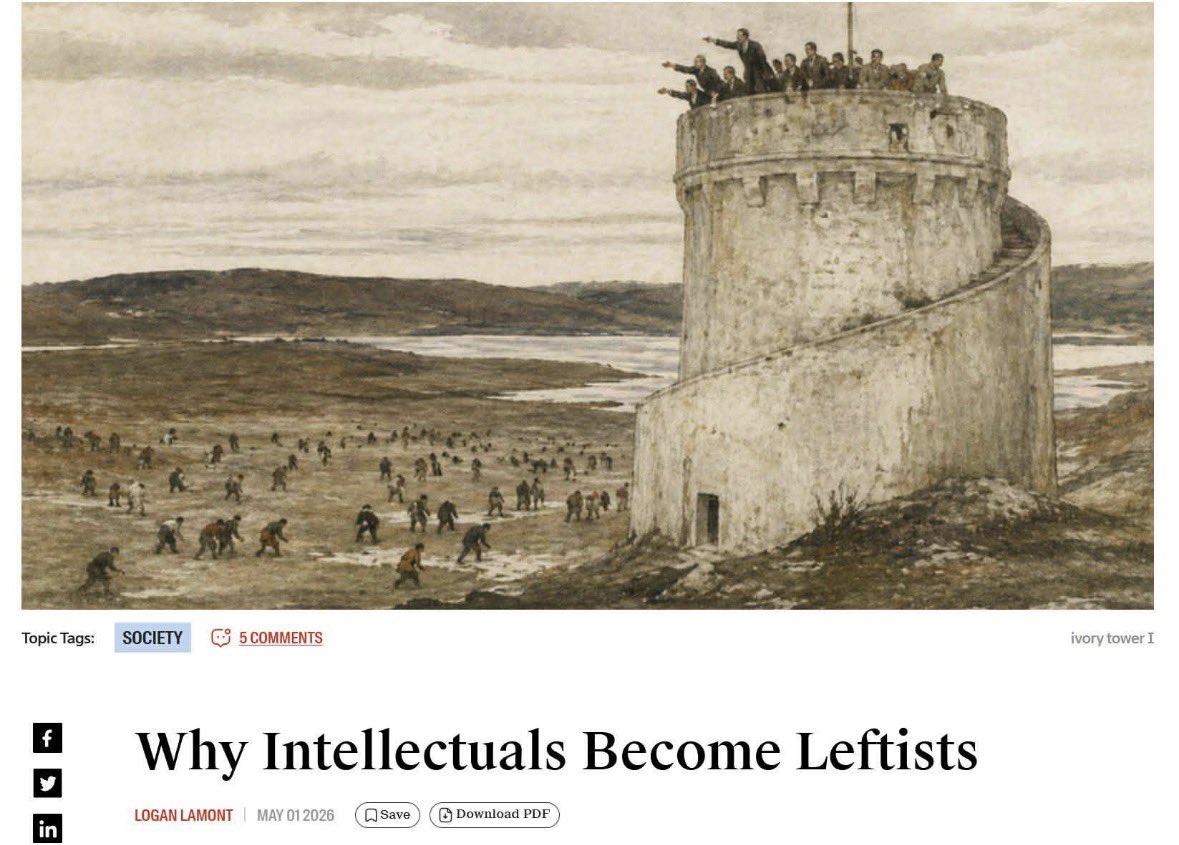
Based on Schumpeter’s Capitalism, Socialism, and Democracy Lamont makes in his article the case that capitalism rewards practical doers who create value for consumers, while undervaluing abstract verbal brilliance, breeding resentment.
Socialism elevates them to central planners & directors with status & protection from markets.
TLDR: Capitalism rewards those who do. Socialism elevates those who direct.
Note: this view is echoed by thinkers like Nozick and Sowell.
Nozick argued intellectuals (“wordsmiths”) develop entitlement in school where verbal brilliance earns top status, then resent capitalism for rewarding practical value-creation for consumers over abstract intellect.
Sowell described them as “the anointed” who overestimate their knowledge for grand social engineering, blame capitalism for society’s ills while ignoring trade-offs and dispersed practical wisdom, and promote visions that elevate their role as planners and critics.
@ShenDigital Je partage ce point de vue. Mais il faudrait d'abord assouplir les règles des bug bounties et élargir le programme à tout domaine .gouv.fr
Actuellement, le cadre est tellement rigide que je préfère ne même pas regarder, de peur de tomber sur une faille toute bête par accident 😂
@pbeyssac Oui vous l'aviez deja mentionné, je me souviens. Apparement ça viendrait de Léo Gonzalez, directeur général et cofondateur de Devensys Cybersecurity. https://t.co/mURPUDxgg2
Terence Tao has an IQ above 200.
Youngest gold medalist in Math Olympiad history. Fields Medal winner. The greatest living mathematician by nearly any measure.
And he just said something most people aren’t ready for.
Tao: “This whole era of AI is teaching us that our idea of what intelligence is, is not really accurate.”
We spent centuries building civilization on one assumption.
That intelligence was sacred. Irreducible. Uniquely ours.
The one thing that made the entire human story make sense.
Then AI started solving things we swore only we could.
Chess. Language. Vision. Math.
And every time, we reached for the same defense.
That’s not real intelligence. It’s just tricks. Just pattern matching. Just an algorithm.
Tao: “You look at how it’s done and it doesn’t feel like intelligence.”
So we moved the line.
Again. And again. And again.
Because intelligence was supposed to feel like something. Something deep. Something we could point to and say… this is what separates us from everything else.
But AI kept solving the problems.
And that feeling never arrived.
Tao: “We were looking for some elusive, intelligent way of thinking and we don’t see it in the tools that actually solve our goals.”
Here’s what makes it worse.
Large language models work by predicting the next word. One word at a time. No grand architecture. No deep understanding. Just probability.
And it works.
Tao: “Maybe that’s actually a lot of what humans do as well.”
The greatest living mathematician just told you human thought might run on the same machinery.
Not some transcendent spark.
Pattern recognition. Prediction. One thought, one decision, one word at a time.
We built religion around intelligence. Philosophy around it. An entire species identity around it.
And a machine running probability just held up a mirror.
We didn’t lose intelligence to AI.
We just finally saw what it always was.
What haunts us isn’t that machines learned to think.
It’s that thinking was never what we needed it to be.
@pbeyssac@pascal1617 L'attaque contre l'ANTS utilise une faille IDOR, où il suffisait de modifier un identifiant dans l'URL pour accéder aux dossiers privés d'autres utilisateurs.