@IvanWerning@lucasllach In any case, I’m thankful and happy to have started following futebol closely at the same time he arrived. With my intrinsic bias of course, and still recovering from yesterday. Good luck for your team Ivan!
@IvanWerning@lucasllach Got what you’re saying, though Rooney is not on the impartial side. Don’t agree with the generalization, of being alone. Maybe speaking Portuguese gives me another vantage point - on what some teammates say. Also, former mates keep being friend(ly).
Why did U.S. Consumer Sentiment Index fall as unemployment and inflation returned to normal 2023-24?
@UMN_Econ JMC Leonardo Barreto @Leo_BarretoV builds calibrated dynamic general equilibrium model with rich consumer heterogeneity to answer the question.
https://t.co/VZY3Oqw3l5
Should IMF limit foreign borrowing by governments of developing nations?
@UMN_Econ JMC Juliana Gamboa-Arbelaez @julipuligamboa argues any such restrictions need to depend on conditions in the country and how the government spends borrowed funds.
https://t.co/iVJ85CphNF
Carlos and I had several helpful and fun discussions about our research projects. I would note that he has (7!) other projects at the draft stage in his website! Prolific researcher, interesting questions and a great personality. Carlos, when are we writing a paper?
How do global value chains evolve over time?
@UMN_Econ JMC Carlos Bolivar analyzes how firms change intermediate input suppliers in 43-country, 56-industry world trade model with changing transportation costs and stochastic country-industry productivity.
https://t.co/ofdxWJGBo6
Scott is a JMC at UMN this year. Apart from his timely JMP, he showcases a wide set of skills on projects spanning a very diverse set of topics and interests, from fiscal rules and sovereign borrowing, to international trade, to climate and development! Check him out 👇
Why is agricultural productivity in India so low?
@UMN_Econ JMC Scott Sommers @scott_sommers56 argues weather shocks magnify land market restrictions as source of misallocation in agriculture. He uses micro data to build model of heterogeneous farmers.
https://t.co/GPr4FM1oJl
UMN JMC Teresa writes about the impact of IMF intervention in debt restructuring, focusing on maturity and conditionality. Fiscal discipline reduces fear of dilution, increases prices and allows for longer maturities. Tere is a great colleague, interested, curious and caring.
How does IMF intervention after sovereign default help debtor country?
@UMN_Econ JMC Teresa Balestrini @mtbalestrini evaluates differences post default for countries that restructure within IMF program versus those that directly negotiate with creditors.
https://t.co/tuDcjB22Pv
Thank you to Rui Albuquerque and Domingos Seward who curate the blog “Portuguese Economy Research Report” for including this entry on my paper on a debt crisis with strategic investors.
🔗: https://t.co/zKqS4TkJKU
📢 Happy to share an update on “A Debt Crisis with Strategic Investors: Changes in Demand and the Role of Market Power”
🔗: https://t.co/0b5Vck55Fa
🧵A thread:
1. This holiday season, have you really thought about how online retail has transformed shopping? It's wild! I can get all my gifts from the comfort of home. But e-commerce giants like Amazon have changed our communities too. Are we better off?
👇 @gaboto94 keeping up with the tradition of great Argentinian economists, on the job market from Minnesota. Check him out! I have known him for the past 6 years and seen first hand the great economist and person he is.
Why does Latin America suffer from high inflation, high informality, and low financial intermediation?
@UMN_Econ JMC Gabriel Devoto's @gaboto94 hypothesis: Government’s use of inflation as fiscal tool causes informality and low financial intermediation.
https://t.co/0nKsVYuWY1
👇 @ba_mauz is on the market. I met Mauricio in my second year, as his TA for Macro in his first year. I’ve learned a lot from him since then and I miss dropping by his office to discuss economics. A strong economist with a diverse set of research interests!
How will climate impact poor households in developing countries?
@UMN_Econ JMC Maurico Barbosa-Alves @ba_mauz constructs a model of Brazil in which high temps lower crop yields and agricultural incomes but poor road networks also increase food prices.
https://t.co/2GMS9SUJFE
And after 6 years, PhDone 🎓
What a journey! Thankful for the guidance of my advisors, Manuel Amador and @TimTkehoe, and the support of family and friends.
A debt of gratitude to my wife. And today I got to see my son in my defense, Minneapolis changed our lives.
Bonus: This project is part of a broader effort: 1) Interaction of elasticities across securities and its implications for maturity choice; 2) How do sovereign debt models fare in matching this key statistic. Check my website for more to come.
🔗: https://t.co/aHHgeOZkNv
8/8 Read the paper for more on:
1. Different elasticity measures: separating changes in bidder behavior and in the government decisions
2. Differences across maturities
3. Differences across types of auctions
4. Details on data
5. Mitigation Strategies on inefficiency costs
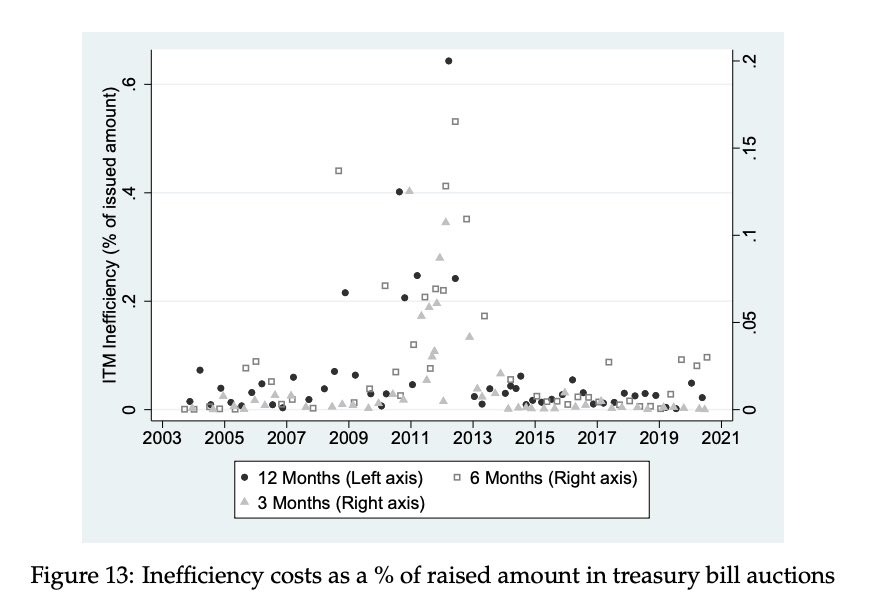
7/8 As dispersion across bids increases, investors exploit their market power by bidding below valuation to avoid the winner’s curse. This difference between bids and valuations, the money left on the table by the government, goes up to 0.6% of the amount issued at the auction.
6/8 I use a model based on Hortaçsu and McAdams, and Kastl. I find that investors bid their valuation in normal times.
Even though a small number of investors has market power, in normal times, the lack of dispersion across bids makes them effectively behave as price takers.