The Subeer Awal (Habar Awal) Coastline
From Zeila eastward runs the long Guban coast, a dry lowland stretching along Somaliland’s northern shore. The old town of Zeila lay between Ras Maskan and Khor Maduji. British hydrographers noted that small boats from Berbera, Zeila, and Tajura came here for firewood and timber. Outside the walls, the Issa herded their flocks but rarely entered the town. Farther inland lived the Gadabursi, and beyond them began the country of the Habr Awal.
The coast that followed belonged to the Subeer Awal. Admiralty charts and Burton’s route map mark the same chain of coastal landmarks: Khor Kulangarit, Dungareta, Samawanak, and Jebel Almis, which together define the maritime plain. A British hydrographic survey described it clearly:
“The low lands between Kulangarit and Berbera, a fertile tract perhaps 40 miles in depth and 90 miles in length, are chiefly occupied by the Haber Awal tribe.”
(Admiralty Hydrographic Department, 1890)
Dongarita lay near the western end of this belt. French and British charts show it as a small anchorage, “not a village but the name of a district,” about forty-eight miles southeast of Zeila. Later Foreign Office records mention a Jibril Abokor leader accused of helping French protégés “to open a port at Dongarita,” confirming that the site stood on Habr Awal ground and under Subeer Awal control.
East of Dongarita came Samawanak, known for its palms, then the dark cone of Jebel Almis, and finally Bulhar, the new fair town of the Subeer Awal. During the northeast monsoon, the British Assistant Political Agent stayed there to oversee trade. Reports counted up to twelve thousand people during the trading season, most of them Habr Awal merchants and caravan men linking Harar with the sea.
From Bulhar, the road led to Berbera, the main harbour of Somaliland. It lies on a long sandy spit with deep water close inshore and shelter from all but the west wind. Burton described the Berbera plain as bounded by the hills of Siyaro, with the Sub-Ghauts rising behind and the higher mountains forming the inland wall of the plateau.
Beyond Berbera lay Siyara, once called Bar Saadadiin, the old sacred anchorage of the coast and the earliest port of the Subeer Awal. British orders after the 1855 Berbera incident defined the “Somaliland coast from Siyara to Zayla” as one continuous stretch, the same belt Burton and Cruttenden described.
From Zeila to Siyara the pattern never changed: low hills inland, salt brushwood on the plain, and narrow sand along the sea where every anchorage bore a Habr Awal name. Together these ports formed a single trading line guarded by the Subeer Awal, whose abbans controlled every caravan and sail that moved between the desert and the sea.
Why the World Should Recognize Somaliland as a Sovereign State ?
The time has come for the international community to formally recognize Somaliland as an independent and fully sovereign nation, after decades of political stability, self-governance, and continuous efforts to build democratic institutions despite the absence of international recognition.
@visegrad24
For three dcades the British parliament is repeating the same lame excuse . We should try other countries in Africa the Caribbean and Latin America. I know for sure they will recognize Somaliland. https://t.co/MinOjTyN2t
Happy Black History Month!
Today, we celebrate another British Somalilander athlete—Abdi Jama, an exceptional wheelchair basketball player from Somaliland. Abdi’s journey into the sport began when fellow Paralympian Ade Orogbemi introduced him to the game, and since then, he has proudly represented Great Britain in five Paralympic Games. Most recently, at Paris 2024, he played a vital role in securing a silver medal—Britain’s best result in 28 years!
Abdi is also a five-time European champion and a key member of the historic 2018 World Championship-winning team.
We look forward to seeing Abdi continue to represent Britain on the global stage—and perhaps one day, Somaliland too!
#Somaliland #BlackHistoryMonth
#Somalilandexcellence
@AbdiJama10
#THELIGHT-🚨 This is the international port of Berbera our country, the Republic of Somaliland. Recently, according to a @Bloomberg report, Berbera port has become one of the eight ports that have a Great Progress changes in the world.
▶��� That Berbera appears in the list of major ports in the first world such as; China 🇨🇳 the USA 🇺🇸 and Singapore 🇸🇬 are a big step forward in the port of Berbera.
▶️ Also Recently According to a report issued by the @WorldBank , Berbera International Port in our country, the Republic of Somaliland, has won the championship of sub-Saharan African ports.
▶️ This report that came out on June 4, 2024, out of 405 ports in the world, the port of Berbera entered the 103rd place.
▶️ Also The international company @DP_World also invested in the international port of Berbera for a total of 450 million dollars. (450 M$).
Today, Berbera International Port is 1.5-KM long, and A container yard has been built with a length of 300,000 KM•2 (Three Hundred Thousand Square KM) has been built.
#UPDATE- 🚨 The President of the Republic of Somaliland, His Excellency @musebiihi , today trained more than 4,000 (four thousand) students selected from high schools in the capital of the Republic of Somaliland, Hargeisa Who studied the Constitution of the Republic of Somaliland and patriotism.
▶️ The President Bihi who spoke on the occasion, congratulated the large number of students who have completed the study of the Constitution and patriotism, and urged them to have a thorough knowledge of the Constitution of their country, and avoid anything that contradicts the laws of this nation.
𝐓𝐡𝐞 𝐒𝐨𝐦𝐚𝐥𝐢 𝐆𝐨𝐯𝐞𝐫𝐧𝐦𝐞𝐧𝐭’𝐬 𝐓𝐚𝐜𝐭𝐢𝐜𝐚𝐥 𝐌𝐢𝐬𝐬𝐭𝐞𝐩𝐬: 𝐀 𝐓𝐡𝐫𝐞𝐚𝐭 𝐭𝐨 𝐑𝐞𝐠𝐢𝐨𝐧𝐚𝐥 𝐒𝐭𝐚𝐛𝐢𝐥𝐢𝐭𝐲 – 𝐈𝐧𝐬𝐢𝐠𝐡𝐭𝐬 𝐟𝐫𝐨𝐦 𝐆𝐞𝐧𝐞𝐫𝐚𝐥 𝐌𝐢𝐜𝐡𝐚𝐞𝐥 𝐋𝐚𝐧𝐠𝐥𝐞𝐲’𝐬 𝐕𝐎𝐀 𝐈𝐧𝐭𝐞𝐫𝐯𝐢𝐞𝐰
General Michael Langley’s recent interview with VOA offers critical insight into the growing complexities of the Horn of Africa’s security landscape, with troubling developments in #Somalia at the center. While ISIS has gained a foothold in northern #Somalia (#Puntland), growing twofold over the past year, the situation in #Somalia itself is deteriorating rapidly. The feud between #Somalia and #Ethiopia threatens not only the African Union’s AUSOM construct but also the broader fight against Al-Shabaab.
#Ethiopia has proven to be a formidable force, particularly in southwest Somalia, where its troops have led the charge in dismantling Al-Shabaab’s hold. Yet, #Somalia's increasingly hostile stance toward #Ethiopia is nothing short of irrational. #Ethiopia has been instrumental in stabilizing key regions, and their efforts have safeguarded #Somalian territory from falling entirely to militant control. For #Somalia to undermine this relationship is not only shortsighted but dangerous.
Moreover, the #Somali government’s failure to consolidate its gains against Al-Shabaab, as highlighted by General Langley, shows a tactical incompetence. While Somali forces may clear regions, they lack the capability to maintain a credible holding force, allowing Al-Shabaab to reverse any gains within mere months.
Even more concerning is the fact that the #Somali president, Hassan Sheikh (@HassanSMohamud), openly admitted in #Oslo, Norway that he has placed former founders of Al-Shabaab in high-ranking government positions. How can any government hope to defeat terrorism when it actively integrates terrorists into its administration?
This internal dysfunction within #Somalia presents a ripe opportunity for #Egypt, a nation that has long sought to destabilize the Horn of Africa to further its own interests. #Egypt, already known for using #Somalia as a proxy to distract #Ethiopia from its Grand Ethiopian Renaissance Dam (#GERD) project, is now capitalizing on these divisions to amplify instability. By fostering discord, #Egypt aims to weaken #Ethiopia’s focus on its development and claim rights to the Nile based on outdated colonial agreements. This aggressive and destabilizing stance threatens to plunge the region into further conflict, all for #Egypt’s ambitions of controlling the Nile—a resource to which it contributes nothing.
The US must call #Egypt out for its role in destabilizing the Horn of Africa. By leveraging regional tensions, #Egypt risks turning a delicate situation into an all-out war that could cost millions of lives, and it’s clear that their motives go beyond mere water rights. The stakes are higher than ever, and #Egypt’s actions represent the kind of colonial mentality that seeks to exploit and control the region.
#Somaliland, a nation committed to stability and self-defense, stands ready to cooperate with #Ethiopia in safeguarding against this aggression. Together, these nations will work to counteract the influence of states driven by colonial ambitions and destabilizing policies. The Horn of Africa cannot afford to be the playground of nations seeking to advance their interests at the expense of millions.
The growing threat of Al-Shabaab, the tactical failures of the #Somali government, and #Egypt’s manipulative role all point to a crisis that demands immediate international attention. #Ethiopia has played its part in defending the region—now it's time for the rest of the world to hold the true destabilizers accountable.
#SomalilandRises #EthiopiaRises
#HornOfAfrica #WarOnTerror
This is Major General Dahir Aden Indha Qarshe, a distinguished Somalian military leader and former Chief of the Somalia Army, in this clip he shared a poignant reflection on the role of Somaliland in the 1977 war between Somalia and Ethiopia. In 1977 war between Somalia and Ethiopia General Elmi led an armored Somali National Army (SNA) battalions in the Qabri Dahare Front. In his account, General Qarshe emphasizes the critical and sacrificial role played by the people of Somaliland during this conflict.
During the war, the proximity of Somaliland to the frontlines meant that the region bore the brunt of the conflict's devastation. The hospitals in Hargeisa were inundated with casualties, and the local population went to extraordinary lengths to assist the injured. General Qarshe recounts how Somalilanders, driven by a profound sense of Somali nationalism, not only provided medical care but also opened their homes to the wounded soldiers. He observed that the people of Somaliland demonstrated an unparalleled dedication to the cause of Somali unity, going so far as to sell their properties and livestock to support the war effort. He recalls that the civilians' cars were even repurposed for military use.
In his emotional reflection, General Qarshe recalls a visit to a hospital in Hargeisa where he was moved to tears by the sight of how the injured soldiers were treated with more care and compassion than they had ever experienced in their own regions. This, he notes, was a testament to the genuine patriotism and sacrifice of the Somaliland people.
Tragically, despite their immense sacrifice, the people of Somaliland faced horrific repercussions after the war's conclusion. Following the defeat of Somalia, the Somalilanders were subjected to brutal repression and violence. The very soldiers they had cared for and treated, as well as the airplanes used for the war effort, turned against them. The ensuing genocide led to the loss of over a quarter of a million Somaliland lives, illustrating the depth of animosity harbored by the Somali government towards Somaliland.
Today, the people of Somaliland have learned from their harrowing experiences. They have become wary of deceptive appeals to "Somalism" and patriotic fervor that once led to their suffering. The lessons of the past have strengthened their resolve to protect their own interests and maintain their independence, ensuring that they are no longer deceived by false promises of unity and patriotism.
That’s why the people of Somaliland decided to reclaim their independence and today proudly have their own nation, The Republic of Somaliland—a nation that wants nothing to do with Somalia. We have resolved never to share anything with Somalia again; we have learned our lesson well.
@AnalystSomalia @JustAwHirsi @Aynte@AAbdishakur@faisalroble19
“Miro daray haddaan beri
Duuduub ku liqi jiray
Doorkan waan hubsanayaa
Inuu dirxi ku hoos jiro” Gaariye.
"How you can be a neighbor with Somalia, a country full of terrorists, a country full of pirates,a country full of ISIS and a country full of corruptions." ... Dr. Edna
#Egyptian evil al-Sisi think he can forcefuly dismantle the Republic of #Somaliland easly as he killed silently the #Egypt democratic elected Gov, he calculated wrong numbers. #Somalilanders are here ready to defeat all remained Dictators in Africa and beyond al-Sisi of #Egypt, Ismaïl Omar Guelleh of #Djibouti, Isaias Afwerki of #Eritrea and Erdogan of #Turkey.
For the last 40 years, #Somaliland has defeated international terrorists and Pirates and keeps safe the vital maritime routes, including the Bab-el-Mandeb Strait that links the Red Sea to the Gulf of Aden. In the meantime, in the last 4 decades, #Somaliland was the only functional democratic state in Africa and the Muslim world.
@Somalilandarchs Dhagax maroodi is very historical site and its estimated to be earlier than Laasgeel few thousand years. The site has many Archeaological artifacts around several kilometers and in a few years they will be all gone if we the don't protect it. Majority of the artifacts are gone .
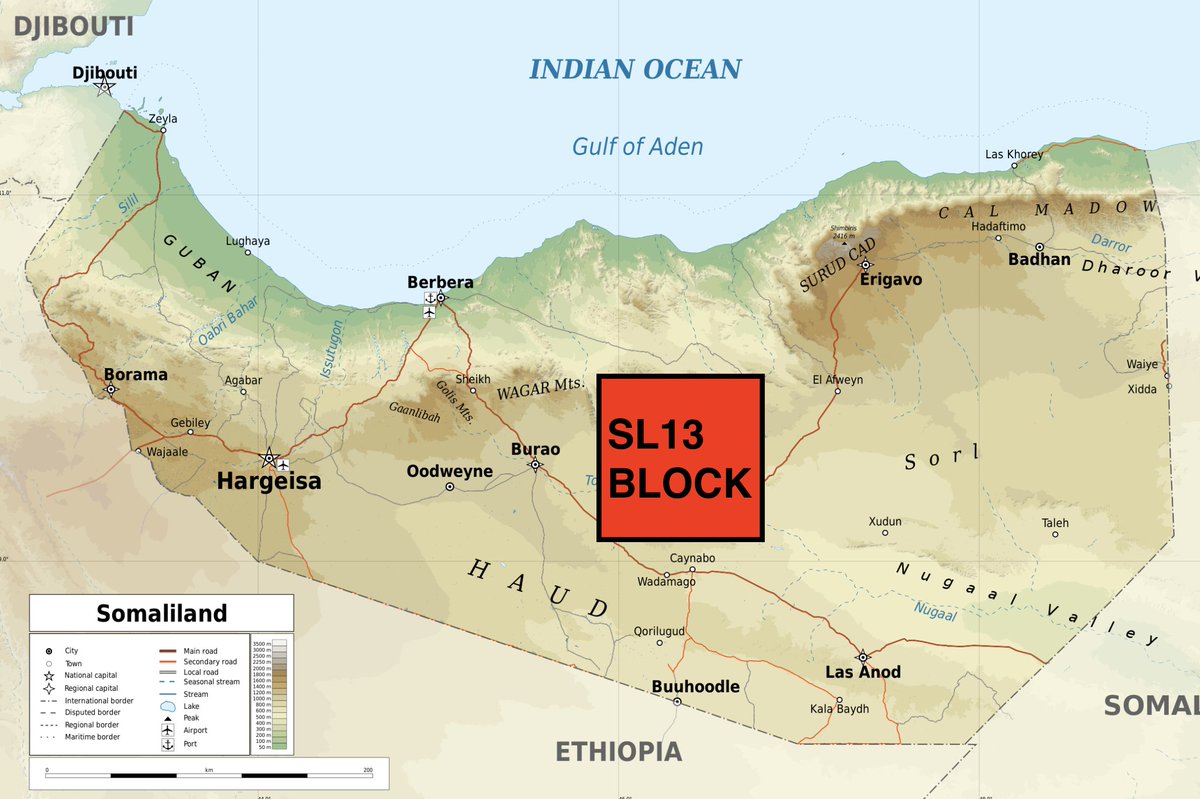
The opportunity at stake for Somaliland is enormous.
- There are at least 12 identified and catalogued prospects in that red square alone.
- The total oil potential ranges from 200 to 1500 million barrels in each prospect (!)
- Given Somaliland's small population, this amount would make the country the wealthiest in the Horn overnight.
The founders of Somali national movement (SNM). We wouldn't have been here today if it wasn't for the sacrifices they made.
Let's have some respect for them.
In 1946 Paris Conference, Italy refused the Proposal of UK to unite all Somali territories under British Administration.
Their justification was that, there is nothing common between Somaliland & Somalia in terms of Ethnicity,Language and lifestyle.
#Somaliland is not #Somalia