2025:
- 90% of the code is written by AI.
- Developers are celebrating.
- “Finally, no more boilerplate 😌”
- Productivity charts going up.
- Managers tweeting about 10x efficiency.
2026:
- 100% of the code is written by AI.
- Hackathons are just prompts.
- PRs are auto-approved.
- Standups sound like:
“AI generated it, looks fine to me.”
- Tech Twitter declares: Software engineering is dead.
2027:
Reality hits.
- 10% of the code is written by AI.
- 90% of the time is spent understanding, debugging, rewriting, and apologizing for AI-written code.
Senior SWEs are now paid 10x.
Not to write code, But :
- to figure out why it works
– explain how it broke
– clean the “clever” abstractions
– delete 5,000 lines and replace it with 50
– tell management “yes, this is unmaintainable” in polite English
Junior devs can generate code.
Mid-level devs can ship features.
Senior devs can save companies from their own AI optimism.
AI didn’t kill software engineers.
It just made judgement, architecture, debugging, ownership, and taste insanely valuable.
Writing code was never the hard part.
Understanding code always was.
[artificial intelligence, generative ai, software engineering, clean code, debugging, system design, scalability, tech layoffs, developer productivity, startup culture, big tech, senior engineers, code quality, refactoring, tech twitter, future of work, programming reality]
In this article, you will learn how the Spotify engineering team has developed a new method for conducting memory analysis on Google Kubernetes Engine (GKE) by combining three open source tools: AVML, dwarf2json, and Volatility 3
➤ https://t.co/t24I8AcIkk
The pure zero downtime, zero data loss upgrade of @PostgreSQL 12->14 of several multi-terabyte, heavily-loaded clusters, with support of zero downtime, zero data loss return to the cluster – a great example of what's possible. And great coordinated work by multiple teams 🎉 🐘
With GitLab, we agreed that we need to create materials about it, blog posts and talks, to share details with community – there is a lot of interesting things to discuss, to make Postgres upgrades smoother.
What comes after Git?
Git was born from the collaboration problems in the Linux kernel. Nearly a decade later, new problems arose when Kubernetes (a "operating system" of the cloud) brought open-source collaboration to a new level.
Working on Kubernetes open-source, I saw the pain points of git (and GitHub) firsthand . Will a new version control system (or something that solves similar problems) spring up?
Some ideas on what a new version control system would look like.
• Atomicity across projects – GitHub is a de facto monorepo and is used as such. Splitting code with dependencies can result in complex syncing and CI pipelines. Submodules aren't an adequate solution.
• Native package management – Packages are tightly coupled with code (see GitHub's Missing Package Manager). Git's content-addressable storage tells us that we are using the right set of files for a revision. We should also have the same guarantee when consuming source code through package managers. Better yet, maybe we can build generic primitives toward a universal package manager.
• Semantic diff – Can we figure out how to use version control to have more context-aware merges? Can you believe that we still rely on a text diffing algorithm from 1976 (and its shortcomings)? Git still has trouble with file renaming. GitHub Copilot, but for merge conflicts? Semantic diff has been tried before, but language-specific implementations will likely never work.
• Merge Queue Data Structure – Two pull requests simultaneously pass all tests but fail when merged together. While more of a workflow feature rather than a version control one, it's core enough to the idea of tracking history (i.e., building the commit graph) that a strong case could be made for making it a first-class citizen.
• Fan-out pull requests – The idea that library owners could write a patch for their software and distribute it to all downstream users. While downstream users wouldn't be obligated to update, it could take a lot of the work out of N different consumers figuring out how to upgrade. Think dependabot, but with all types of updates (minor, security, and breaking). Most useful inside companies, but an analog might make sense in open source.
• Terrible UX of Git – overloaded and inconsistent commands, and more. I believe that the underlying problem is the divergence of the workflow from the tool. Either git should be fully decoupled from the pull request and merge workflow or integrated into what's now become "git flow".
• Large file storage – there are extensions like git lfs that provide some support for larger files but aren't great. It feels like fitting a square peg into a round hole. Most workflows don't seem to need large asset support – only game development and other niches. But, I imagine if we solved it in an ergonomic way, we'd open up new workflows we never thought to do – like storing binary assets or database snapshots alongside code. Why not version everything if it's easy and cheap?
• Project Management Hooks, but not Features – Should issues and bug tracking be built into the version control system? That's the philosophy behind fossil. Project management is so amorphous and fleeting that I don't believe it should be built into foundational tech. Yet, a new VCS should expose the hooks and APIs that allow the flavor-of-the-moment project management tool to be built on top.
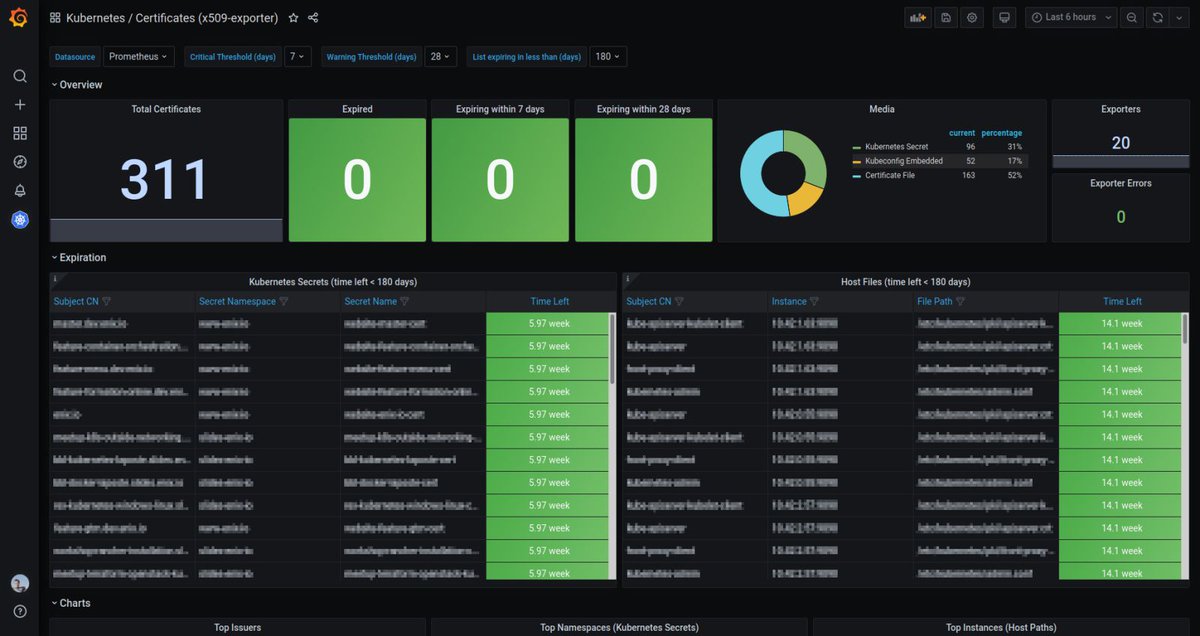
x509-certificate-exporter is a Prometheus exporter for certificates focusing on expiration monitoring, written in Go.
Designed to monitor Kubernetes clusters from inside, it can also be used as a standalone exporter
➤ https://t.co/hr1mawHOAE
Introducing #GrafanaMimir — the newest member of our OSS family. See how Grafana Mimir allows you to scale to 1 billion metrics and beyond while providing easy deployment, HA, multi-tenancy, durable storage & blazing fast query performance. https://t.co/YUcZNYxCQs
Oh my god I am so excited for @grafana’s Mimir. Finally a multi-tenant & highly-scalable & replicated time-series database.. and it even relies on cheapo object-storage! Could be time to replace the good ol’ Graphite clusters.. https://t.co/bl9UV7oCGO
Thanks to the @CNCF for recognizing all that the #opensource community has done to grow and advance this project. We look forward to this next phase for #Backstage.