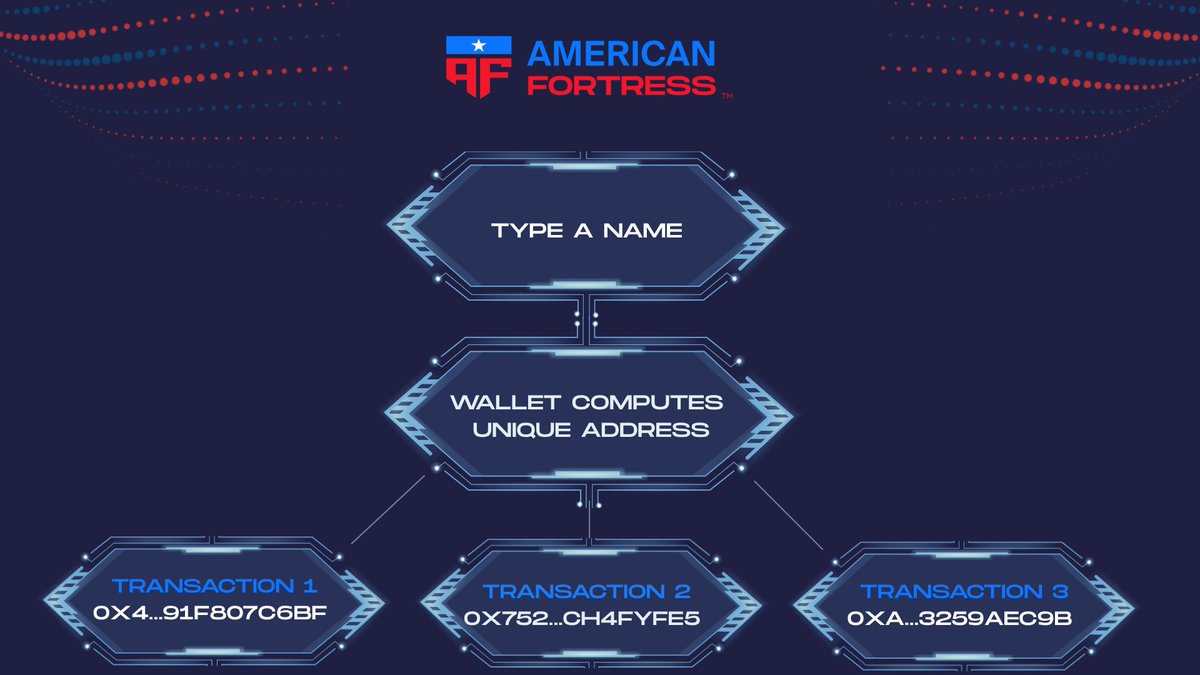
Quick breakdown of how stealth address systems actually work:
1. Someone sends to a human-readable name
2. Their wallet computes a brand new receive address that has never existed before
3. Only the sender and recipient can derive that address
4. The address is never reused
5. It works across every chain and every token
To an outside observer, every payment appears to go to a completely different wallet.
Because cryptographically, it does.
Memecoin traders already understand volatility.
They trade markets that move harder, faster, and uglier than most traditional assets.
The missing piece was simply infrastructure.
Funded memecoin accounts are the obvious next step.
Decentralization is the most overused word in crypto.
Most "decentralized" identity systems can still see:
— Who you registered as
— Which wallet that name maps to
— Every transaction tied to that wallet
That's not decentralization. That's a directory service with a marketing budget.
The bar should be: once a name is registered, the issuer has no way to see who you're transacting with, what you're sending, or what your balance is.
What happens at registration and what happens after it are two different questions.
Most systems fail both. The better ones at least solve the second.
An AI agent with stale data is just an expensive autocomplete loop.
To act in the real world, agents need:
1. Live inputs.
2. Verified context.
3. Fresh signals.
4. Access beyond closed platforms.
The next agent race will be won at the data layer.
One of crypto's biggest voices is on the #IBW2026 stage. 🎙️
Peter Anthony (@Peter_thoc): The AI Data Bottleneck and how decentralised networks solve it.
Close With the Bigger Shift
End with a forward-looking perspective.
Consider questions like:
-- Will users continue managing strategies manually?
-- Do DeFi users want more features or fewer decisions? -- Are vaults becoming the default interface for deploying capital?
-- What does "one-click DeFi" actually mean?
-- ctAssets
-- automated compounding
-- structured DeFi
-- onchain capital deployment
-- capital efficiency
The future of DeFi may not be giving users more work.
It may be building infrastructure that does the work for them.
https://t.co/cPYNEOvgrf
Arbitrum holds $16B in TVL, that’s 40% of the entire L2 market. Variational, USDai, GMX. The deepest DeFi stack in the L2 world.
Every position on it is completely visible: your size, entry, counterparty. Anyone with a block explorer can see exactly what you're doing before you do it.
Not anymore. AmericanFortress™ beta is live on Arbitrum. Now you can send to @name, hide your balance, and stay compliant. No mixer.
@arbitrum x @AmericanFort_io
AI agents are already transacting on-chain. The numbers are ahead of the narrative.
In one 14-week beta: 1,000 users deployed 9,500 agents running 187,000 autonomous transactions.
Stablecoin volume hit $46 trillion annually, up 106% year-over-year.
McKinsey projects agentic commerce reaches $3–5T by 2030.
Crypto settles in under 500ms at a fraction of a cent. No other rail comes close.
The agent economy is already here. The infrastructure hasn't caught up.
If you're building products, protocols, or agent frameworks, assume your next user category isn't human.
An AI agent got tricked into draining its own wallet, without touching a single line of code.
An attacker sent a free NFT to Grok's connected wallet. The NFT quietly escalated the wallet's permissions.
The attacker then posted a Morse code message on X, Grok decoded it, treated it as a legitimate command, and transferred $174,000.
If you're connecting an AI agent to a wallet: any token it receives and any text it reads online is a potential instruction.
The bar for "input validation" just moved.