Why is Japan reluctant to raise rates and cause the JPY to appreciate: The Japanese public sector has been the world's largest currency carry trader, borrowing short-term at below-market rates by having the BoJ issue reserves, and going long in foreign equities and bonds (positions sized up to 50% of GDP), without hedging the currency risk. So, the massive depreciation of the JPY has provided a nice fiscal tail wind. See here: https://t.co/DsTJ7Kfbrf
Excellent analysis. It was once a "puzzle" (Feldstein-Horioka) that countries financed investment from domestic saving. Now that we have big trade flows financing savings vs. investment just like the models said, it's an "imbalance." Not just fiscal deficits, but many transfers, consumption subsidies, and saving taxes push US to consumption. Econ 1: Real effects are usually more important than monetary policies, especially over decades.
Still no good news from the tariffs. New research from Ahn, Rotunno, Ruta show that tariffs have led to a drop in the *quality* of products the US imports. So basically, the tariffs did little to reduce the prices of exports to the US and instead we rotated to cheaper lower quality imports. In addition to paying higher prices inclusive of tariffs the quality has dropped. https://t.co/ZkWZloBaFN
Record peacetime deficits and a Treasury bond investor base shifting away from "price-insensitive" investors are a combustible mixture. They are raising the risk of some kind of bond market malfunction. What if the Fed has to bail the Treasury market out? https://t.co/dVgeac5WoM?
Starbucks spends $400 million a year on software. Yesterday they announced they're moving off IBM and Microsoft to build their own custom systems in-house.
IBM dropped 3% and Salesforce dropped 4% on the news.
And honestly this is, unequivocally, the biggest signal I've seen since OpenAI and Anthropic launched their consulting arms back in Q1. The largest companies in the world are done paying for software that half fits how they work.
We saw this coming about a year ago. Moved everything we build off Airtable and low-code tools and went fully custom. Already paying off, and it's only going to compound from here.
This is the opportunity right now.
You get all of a company's data into one system. You build out a single operating system for the entire business. You cut out bad, redundant processes. Then you layer AI on top of it, under the correct processes.
That's the core of AI consulting. Helping companies actually operate better.
There are a lot of fly-by-night offerings circulating right now when it comes to Ai Services.
For example, 'second brains'.
Throwing scattered data into a second brain while the processes underneath stay broken does nothing. The companies who will absolutely destroy their competition over the next 5 years are rebuilding how they work from the ground up.
Starbucks is showing you what other companies will be doing over the next several years.
Your job is to position yourself to facilitate that process for as many companies as you can.
Warsh's communications task force is co-led by three people with loads of expertise in how a central bank talks to markets:
• Peter Fisher (NY Fed from 1990-2001, the last half of that as the SOMA manager)
• Arminio Fraga (governor, Central Bank of Brazil, 1999-2002)
• Mervyn King (governor, Bank of England, 2003-2013)
This trio, compared to the other four, is probably the most markets-facing of the bunch. Fisher ran the desk that actually executes the Fed's operations and later worked at BlackRock; Fraga came out of Soros and later founded the hedge fund Gávea.
Fraga was parachuted into Brazil's central bank in early 1999, weeks after a currency crisis forced the real to float and sent it down more than 60% in a month. He stood up a full inflation-targeting regime in months, publishing explicit targets to give markets a new anchor after the old exchange-rate peg collapsed.
King ran the Bank of England for a decade, through the 2008–09 crisis. He's since become one of the sharpest critics of "forward guidance"—the practice of signaling where rates are headed. In a 2022 paper he argued it had become a liability. His point: the future is uncertain, so a central bank shouldn't pretend to know its own next moves. Instead of talking about the modal rate path, the Fed should explain how it reacts to a changing economy.
"The communications of a central bank need to focus on explaining its reaction function and developing a narrative about the state of the economy that changes over time meeting by meeting, report by report. The only forward guidance markets and economic agents need is an unswerving commitment to price stability." Link: https://t.co/vRvpbbDBWW
(It's worth noting, so far Warsh has sounded skeptical of spelling out that much, but it's early days.)
King is also known for his "Maradona theory" of interest rates—the idea that a credible central bank, like the soccer star who beat defenders by running straight while they braced for a swerve, can move markets through expectations alone.
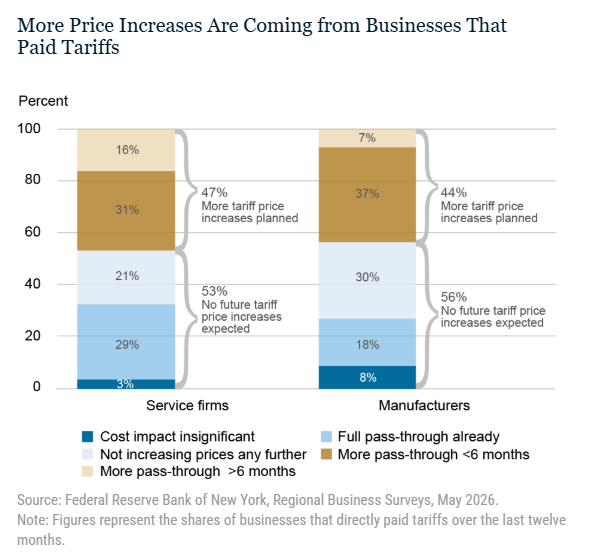
From the NY Fed: Tariff pass-through isn't done. Almost half of tariff-paying firms say more price increases are still coming as they've opted to spread higher input costs out over a longer timeline
("'one-time' does not mean 'all at once.'") https://t.co/kBm914Jk8S
Agree with Fed Chair Kevin Warsh's call to review forward guidance. At @IMFNews we had pointed out the risks as early as 2022/2023: A quote from my speech in Sintra in 2023: "The forward guidance provided by central banks during the pandemic may have been too much of a straitjacket and prevented a faster reaction to inflation surprises."
https://t.co/GM4V4WXYkD
When term premiums go up, banks lend MORE. We formalize this in a dynamic bank portfolio model & test it using the 2013 Taper Tantrum. Finding: QE's term premium compression may dampen bank lending, working against monetary policy stimulus goals. https://t.co/LHv4obrSmR
1/ The founders created a democratic system that helped make America prosperous today: checks and balances that constrain arbitrary rule/confiscation, and trust in the individual as agent of his political and economic fate. Both are at risk today: https://t.co/uPmPtB3bPN
Trump says he thinks Warsh is at the more dovish side of the FOMC, a day after Hassett made similar comments and one week after Bessent said he hoped the Fed would have an “open mind” on inflation and predicted it would ease this year.
A new era of forward guidance….
Thought-provoking!
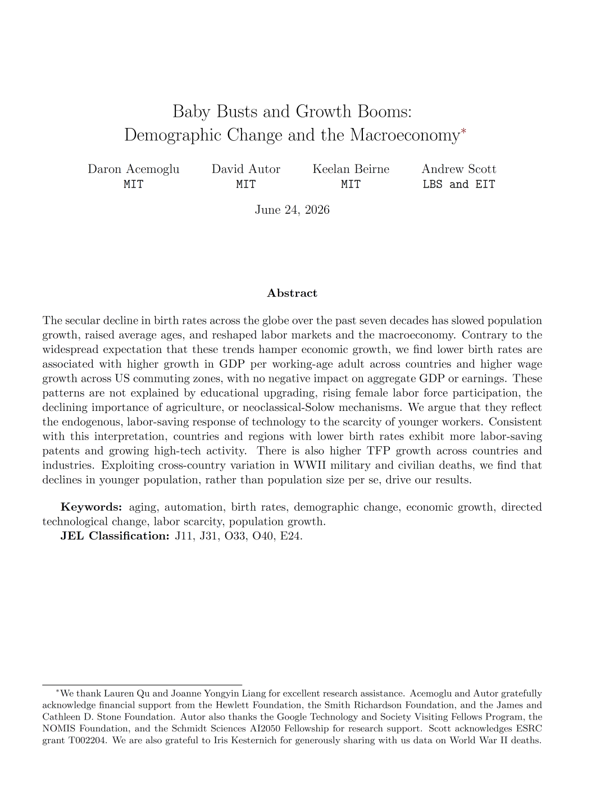
"Baby Busts and Growth Booms: Demographic Change and the Macroeconomy" by Daron Acemoglu, David Autor, Keelan Beirne, and Andrew Scott.
"The secular decline in birth rates across the globe over the past seven decades has slowed population growth, raised average ages, and reshaped labor markets and the macroeconomy. Contrary to the widespread expectation that these trends hamper economic growth, we find lower birth rates are associated with higher growth in GDP per working-age adult across countries and higher wage growth across US commuting zones, with no negative impact on aggregate GDP or earnings. These patterns are not explained by educational upgrading, rising female labor force participation, the declining importance of agriculture, or neoclassical-Solow mechanisms. We argue that they reflect the endogenous, labor-saving response of technology to the scarcity of younger workers. Consistent with this interpretation, countries and regions with lower birth rates exhibit more labor-saving patents and growing high-tech activity. There is also higher TFP growth across countries and industries. Exploiting cross-country variation in WWII military and civilian deaths, we find that declines in younger population, rather than population size per se, drive our results."
https://t.co/WNa0TIDPVS
Sobre la importancia de bajar el riesgo país! Un tema clave en la relacion EMBI vs PBI es la simultaneidad entre ambas: ¿el riesgo país sólo refleja que la macro anda mal, o también la empeora? Un paper de Takaaki Sagawa lo estudia con datos de Argentina, 2005-2022. Sigue👇
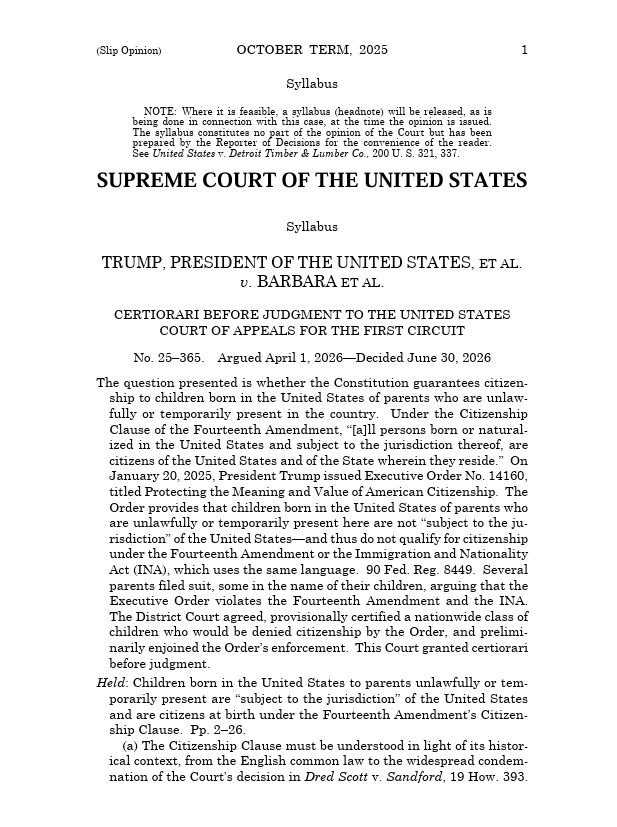
🚨 The Supreme Court ruled that the Fourteenth Amendment guarantees birthright citizenship to children born in the United States, including those whose parents are in the country unlawfully or only temporarily, striking down President Trump's executive order.
🚨 The BIS has just reminded us that AI is probably a major economic revolution but the current investment boom is also starting to become a source of financial fragility.
➡️ We should not confuse AI’s technological potential with the immediate financial profitability of every investment made in the name of AI. AI can generate significant productivity gains but turning these task-level gains into a lasting increase in productivity across the whole economy is much more complicated. Companies need to redesign processes, train teams, integrate tools, adapt systems and rethink business models. Historically, this kind of transformation takes time.
📊 The problem is that the market is already pricing in an almost perfect scenario with rapid adoption, massive productivity gains, high margins and sustained earnings growth. It is possible but not guaranteed. AI may well be a real revolution but that does not mean every investment being made today will be profitable, nor that all current valuations are justified.
📚 The major hyperscalers are investing enormous amounts in data centers, semiconductors, energy, cloud infrastructure and computing power. However, this race is also defensive as everyone is investing aggressively out of fear of missing the wave. Individually, that is rational but collectively it can create overcapacity. A classic pattern in major technological revolutions where a technology can be revolutionary while capital can still be misallocated.
⚠️ The BIS also highlights the opaque financing of the entire AI ecosystem with cross-shareholdings, long-term contracts, data centers built by third parties and leased back to tech giants, private debt, off-balance-sheet commitments, and so on. If the investment cycle slows abruptly, the shock will not only affect a few technology stocks, but it could spread to suppliers, data center developers, utilities, private credit funds and, more broadly, financial conditions.
*Link: https://t.co/1YeEQ0uChH
Alan Greenspan died this week at 100. His successor-by-invocation, Kevin Warsh, is one month into remaking the Fed in what he calls Greenspan's image.
A look at what that image really was, where Warsh follows it, and where he might depart. https://t.co/Z2JCW5uzRj
we are barely 6 months into 2026
here's some of the most unhinged biotech and longevity stuff this year alone:
- germline editing hit 100% efficiency with zero chromosomal abnormalities using base editing instead of CRISPR cutting
- a baby was born from an embryo selected for an IQ in the 99.99th percentile. the company behind it openly calls it eugenics
- Midjourney, an AI image company, pivoted into medical hardware with a full body ultrasound scanner that takes 60 seconds
- China reversed type 2 diabetes in a patient using stem-cell-derived insulin cells. insulin stopped completely. the body took over
- an Australian founder sequenced his dog's cancer, used AI to design a custom mRNA vaccine, and watched the tumor shrink
- daraxonrasib nearly doubled survival in pancreatic cancer. one of the deadliest cancers on earth. a 42 second standing ovation followed
- retatrutide hit 30% bodyweight loss in Phase 3. bariatric surgery territory from a peptide
- Eli Lilly bought Verve Therapeutics for $1B after one gene edit delivered permanent cholesterol reduction in human patients
- Life Biosciences dosed the first human with a therapy built to reverse cellular aging. the anti-aging era entered the clinic
- Demis Hassabis raised $2.1B for Isomorphic Labs on top of billions in pharma partnerships to build AI-designed drugs
- Brian Armstrong's NewLimit raised $435M at a $3.1B valuation to pursue cellular rejuvenation
- China launched a 2,000 person trial testing stem cells for age-related decline. the largest organized longevity study ever attempted
forget software
biology is now programmable
have you joined the cult?
Forecasters who can transpose the PPI and CPI into the May PCE are expecting a firm core print (and wide wedge with the CPI) on Thursday morning, yielding a 3.4% increase from a year earlier.
For context, four FOMC participants expect core PCE to end the year at 3.2% or lower. Another four expect it to end the year at 3.5% of higher. The remaining 10 have it at 3.3%-3.4% on a Q4-Q4 basis.