Yes, I understand you have to make a point, these days everyone seems to be in a rush to prove a point.
If you do that by putting other people under the bus, it reflects on your personality. If you can do it with grace and respect, it again reflects on you.
Choices one makes in words & actions - determines the outcomes.
Last one on this topic, and I have been holding this in myself for a while.
For centuries, class divides kept the labor of the poor invisible to the rich. Factory workers toiled behind walls, farmers in distant fields, domestic help in backrooms. The wealthy consumed the fruits of that labor without ever seeing the faces or the fatigue behind it. No direct encounter, no personal guilt.
The gig economy shattered that invisibility, at unprecedented scale.
Suddenly, the poor aren't hidden away. They're at your doorstep: the delivery partner handing over your ₹1000+ biryani, late-night groceries, or quick-commerce essentials. You see them in the rain, heat, traffic, often on borrowed bikes, working 8–10 hours for earnings that give them sustenance. You see their exhaustion, their polite smile masking frustration with life in general.
This is the first time in history at this scale that the working class and consuming class interact face-to-face, transaction after transaction. And that discomfort with our own selves is why we are uncomfortable about the gig economy. We want these people to look our part, so that the guilt we feel while taking orders from them feels less.
We aren't just debating economics. We are confronting guilt. That ₹800 order might equal their entire day's earnings after fuel, bike rent, and app cuts. We tip awkwardly, or avoid eye contact, because the inequality is no longer abstract. It's personal.
Pre-gig era, the rich could enjoy luxury without moral discomfort. Labor was out of sight. Now, every doorbell ring is a reminder of systemic inequality. That's why debates explode. It's not just policy. It's emotional reckoning. Some defend the system (“they choose it”), others demand change (“this isn't progress, its exploitation”).
And here’s the uncomfortable twist: the unsaid ask of clumsy ‘solutions’ isn’t dignity. It is about returning to invisibility.
Ban gig work and you don’t solve inequality. You remove livelihoods. These jobs don’t magically reappear as formal, protected employment the next day. They disappear, or they get pushed back into the informal economy where there are even fewer protections and even less accountability. Over-regulate it until the model breaks, and you achieve the same outcome through paperwork instead of slogans: the work evaporates, prices rise, demand collapses, and the people we claim to protect are the first to lose income.
And then what happens?
The rich get their old comfort back. Convenience returns without faces. Guilt dissolves. We go back to clean abstractions and moral posturing from a distance. The poor don’t become safer, they become invisible again: back in cash economies, back in backrooms, back in shadows where regulation rarely reaches and dignity isn’t even debated.
The gig economy just exposed the reality of inequality to the people who previously had the luxury of not seeing it. The doorbell is not the problem. The question is what we do after opening the door.
Visibility is the price of progress. We can either use this discomfort to build something better (which we keep doing continuously as delivery partners are our backbone), or we can ban and over-regulate our way back into ignorance. One of those choices improves lives. The other simply helps the consuming class feel virtuous in the dark.
One more thing. Our 10 minute delivery promise is enabled by the density of stores around your homes. It’s not enabled by asking delivery partners to drive fast. Delivery partners don’t even have a timer on their app to indicate what was the original time promised to the customer.
After you place your order on Blinkit, it is picked and packed within 2.5 minutes. And then the rider drives an average of under 2kms in about 8 minutes. That's an average of 15kmph.
I understand why everybody thinks why 10 minutes must be risking lives, because it is indeed hard to imagine the sheer complexity of the system design which enables quick deliveries.
Also, if you've ever wanted to know why millions of Indians voluntarily take up platform work and sometimes even prefer it to regular jobs, JUST ASK any rider partner when you get your next food or grocery order.
You will be humbled by how rational and honest they will be with you.
Having said that, no system is perfect, and we are all for making it better than today. However, it is far from what it is being portrayed on social media by people who don't understand how our system works and why.
If I were outside the system, I would also believe that gig workers are being exploited, but that's not true.
I am all for peaceful protests against anything and everything. But violent protests and stopping others who want to work from working is not okay (proof attached).
Here’s what we know – a number of these protestors were not even our delivery partners. They were agents of political interests, piggybacking on the narrative to gain political mileage.
Hiring update on the Chief of Staff –
We started with 18,000+ applications and have had the privilege of meeting over 150 incredibly talented individuals. From this, 30 exceptional people received offers, and 18 have already joined Zomato (and other group companies like Blinkit) in high-impact roles. They’re being handsomely compensated for the value they bring, and nobody paid anything to work with us.
Who are these 30 people? Founders who bootstrapped startups from their dorm rooms, engineers who rewrote entire tech stacks over a weekend, operators who turned chaos into scale, and a handful of brilliant young minds fresh out of college—people we believe will lead us into the future.
What sets them apart? A long-term mindset. They weren’t optimizing for short-term outcomes but for compounding impact—the most misunderstood mathematical miracle. Finding people who truly get this is rare, and I’m grateful we did.
4 of the 18 people who have already joined us, work directly with me, and 2 of them are in Chief of Staff roles.
And we’re not done. With 18,000+ applications, we’re still carefully sifting through this amazing talent pool. This isn’t just a one-time hiring sprint—it’s a long-term investment in the people who will build the future with us. We’ll keep reaching out to the right folks, slowly but surely.
Hello all - just want to clarify that the fssai team noted that 90 packets of button mushrooms had incorrect packaging date - these were already identified by our warehouse team and were rejected during an inward QC. This is not usual, and was due to a manual typing error on the vendor’s side. Still, the concerned vendor has been delisted from our database. At Hyperpure, we have stringent inward guidelines and tech systems that helped our teams to identify this error in time.
We are committed to upholding industry food safety standards and are focused on not compromising on product quality at any stage of the supply chain. The recent food safety inspection at our Hyderabad warehouse resulted in the Hyperpure warehouse achieving an A+ rating, highest benchmark in their ranking.
I am not sure why just these small number of mushroom packets worth Rs 7,200 (out of the crores of inventory in the warehouse), which were never going to make it to customers, are being talked about the media, while we got an A+ rating. Maybe some people benefit from the virality which they get at the expense of pulling down the Zomato brand. And maybe we all love to believe the narrative that “all big business is bad business”.
A cool new update for everyone –
You can now see the LIVE order count on @zomato for the day, right after you place your order. I just placed an order at around 11am, and the count was already over 250,000.
Have fun!
Happy Mother's Day, everyone!
You can gift a personalised celebrity video message to your mom today. Generate it with your @zomato order.
2Lac+ people have already used this feature since we launched.
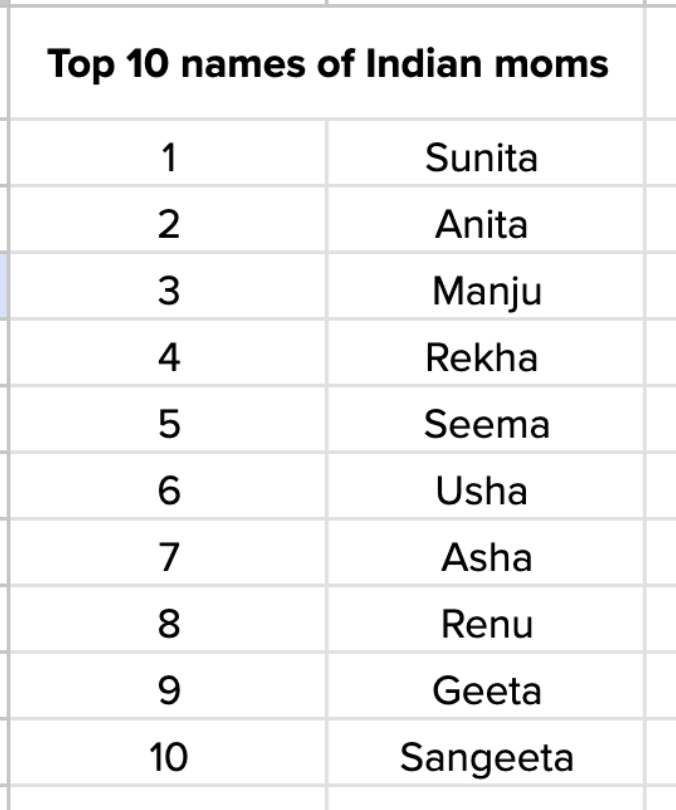
Fun fact: Sunita, Anita and Manju are top names of Indian moms ❤️
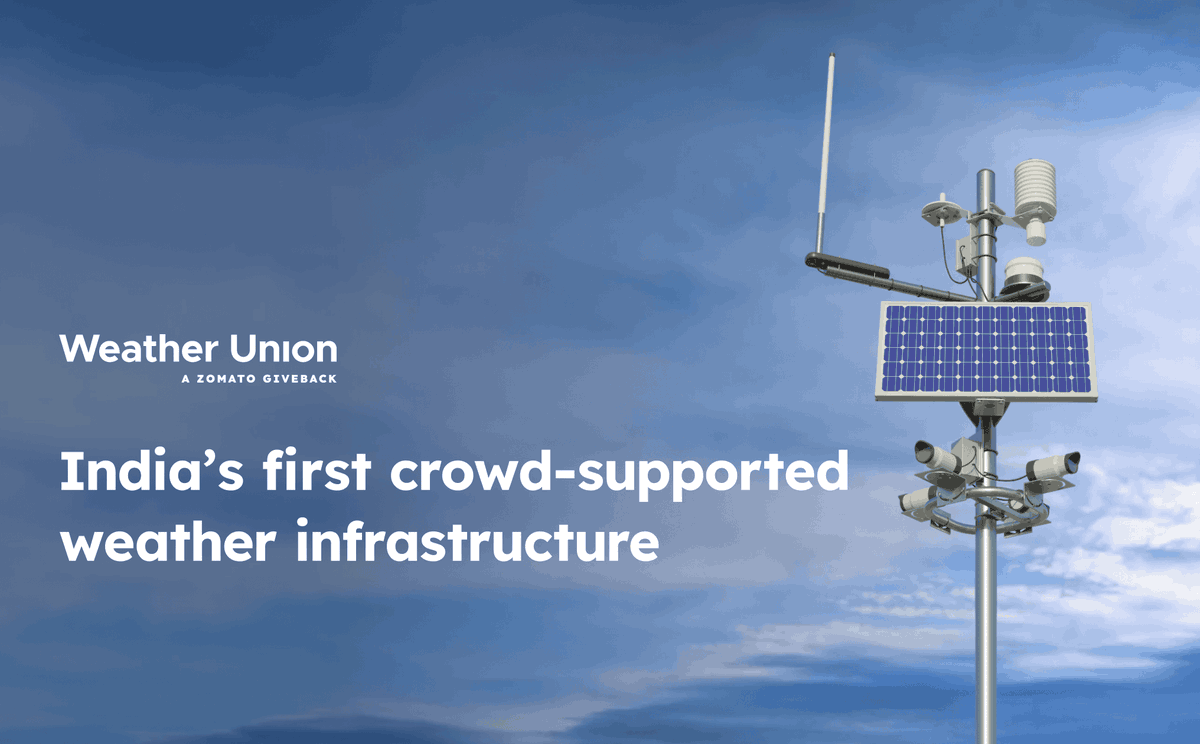
Excited to unveil India's first crowd-supported weather infrastructure, https://t.co/qE9kkfoisG. A proprietary network of 650+ on-ground weather stations, it is the largest private infrastructure of its kind in our country.
These weather stations, developed by Zomato, provide localised, real-time information on key weather parameters such as temperature, humidity, wind speed, rainfall etc. Currently available across 45 large cities, we are expanding this in other Indian cities very soon.
This rich data holds significant potential in unlocking weather use cases for enterprises and research institutes. Having already collaborated with CAS - IIT Delhi, we expect more institutions and companies to benefit from this and contribute towards the greater good of our economy.
At Zomato, it was crucial for us to have access to precise and real-time weather information to make the right business decisions to serve our customers better. Hence, we took it upon ourselves to develop a solution capable of empowering us on this front.
We are now opening up free access to this (through an API) to all institutions and companies in the country. Wait. What? Free? Really? Yes, we believe that this data is too valuable to keep to ourselves or to monetise; therefore, as a Zomato Giveback, we are opening up access to this data to everyone for public good. Multiple companies and public institutions should use real-time weather data, to boost the productivity of our economy.
Also, a lot of Zomato employees have hosted weather stations at their homes. As we look forward to further expanding this infrastructure, we welcome volunteers who want to provide us space on their premises to install these weather stations and contribute to nation building.
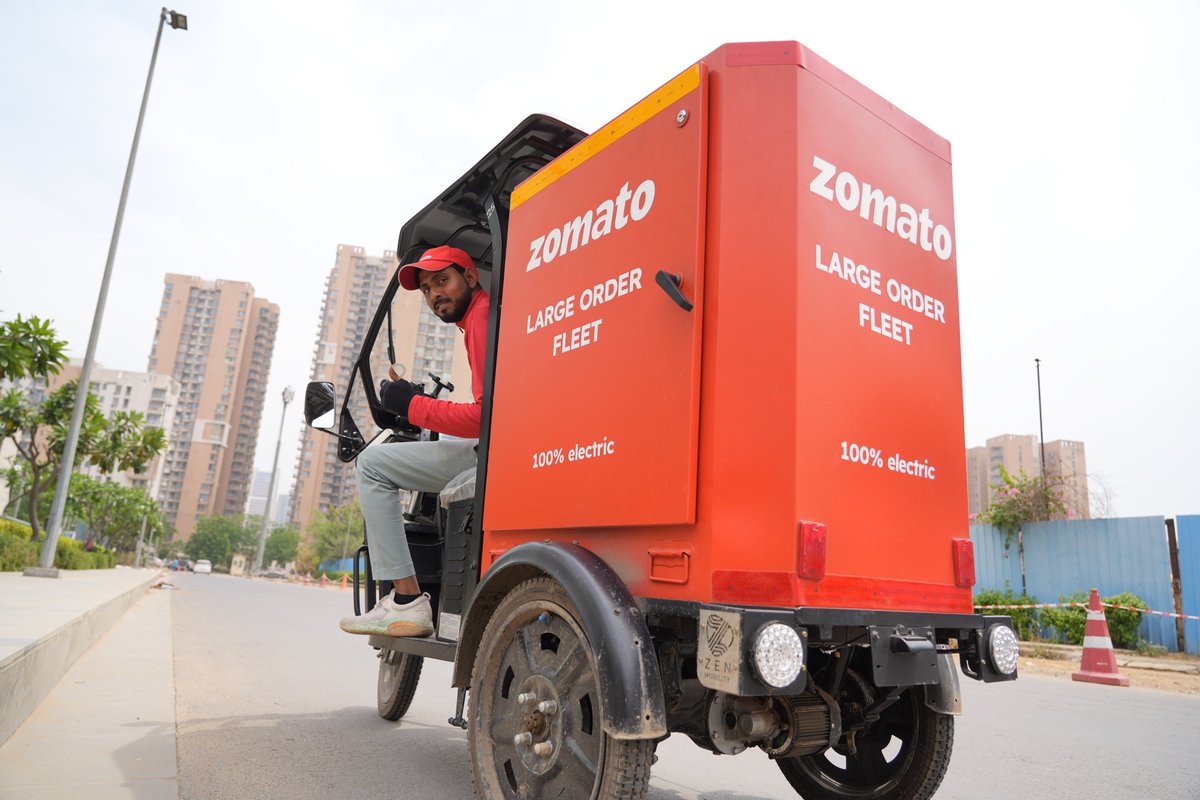
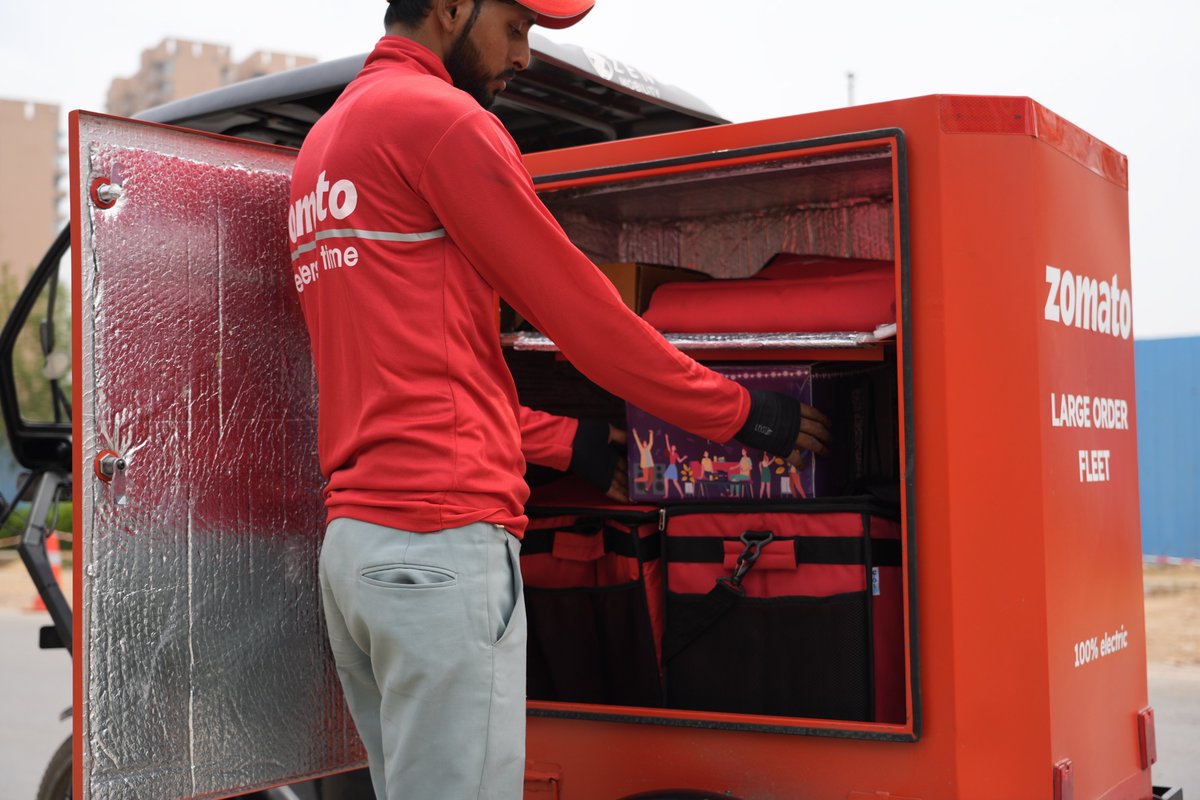
Today, we are excited to introduce India's first large order fleet, designed to handle all your large (group/party/event) orders with ease. This is an all electric fleet, designed specifically to serve orders for a gathering of upto 50 people.
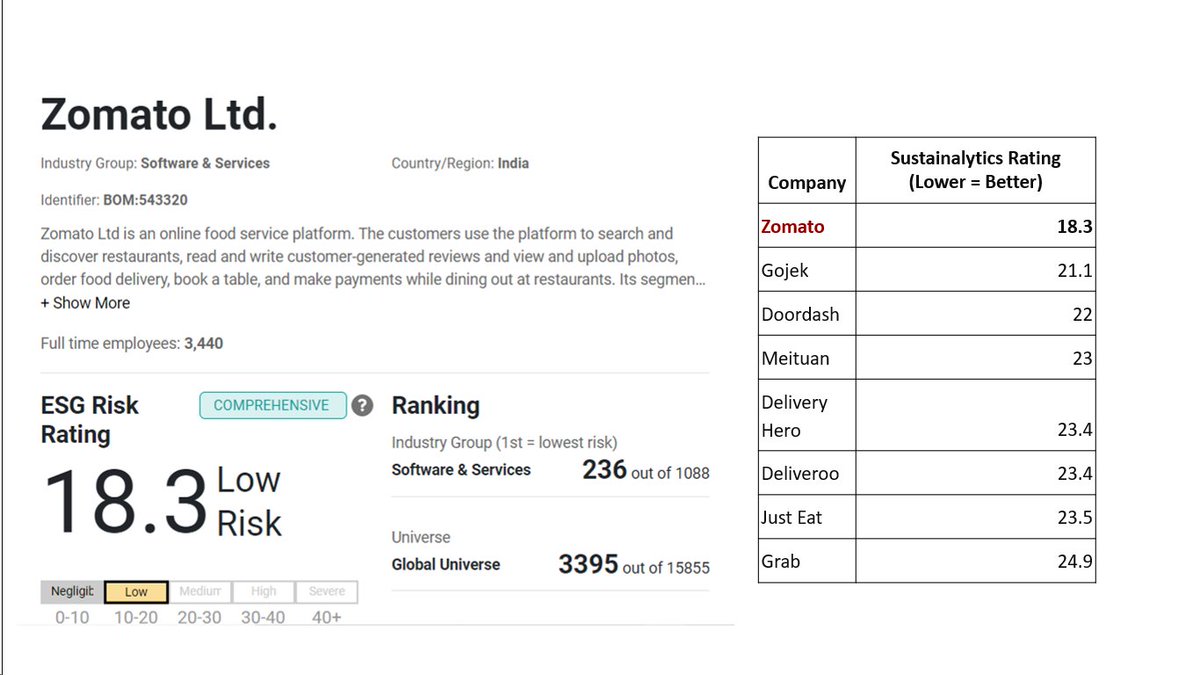
Our focus on building a sustainable business now reflects in our ESG ratings. We are the only food delivery company in the world which has achieved a low risk ESG score on Sustainalytics.
Having said that, this is only a start, and we are just 1% done.
Out now - Our Q1FY24 Report: https://t.co/C7AScxXN3A
If you have any further questions or feedback, please email us at [email protected]. Always listening!
Quick snapshots of how we’re powering India’s changing lifestyles 🧵
Over the last four years, @zomato's Hyperpure has been growing steadily. Now, the B2B vertical is looking beyond just supplying vegetables and daily utilities to restaurants.
🧵:
Zomato Feeding India’s mission is to “Make India Malnutrition Free”. Awareness campaigns play an important role in bringing long-term behavioural change – in the past #SwachhBharat#BetiBachao and #GlobalCitizen have been able to make a real dent. (1/5)
There's a jewel in every corner of India – Baked Rosogollas from Kolkata, Biryani from Hyderabad, or Kebabs from Lucknow. Zomato's Intercity legends (pilot at limited locations for now) now lets you order these iconic dishes through our app.
Read more: https://t.co/O8DOR23Wk5