We often call Euler’s identity the most beautiful equation in mathematics. But sometimes we forget the beauty of the Gaussian integral.
It is absolutely gorgeous.
And if you don’t know this integral yet, can you really call yourself a math nerd? 😉
@ajeetbharti@dpradhanbjp That 75 % criteria is for admissions to IITs and premier colleges - if a person can crack IIT, there is no way he/she can fall below 75 percent. Also this rule is not introduced now- it is there for quite sometime. Looks like NEET issue is rubbing on this for political reasons.
In the Netherlands, the Delta Works has a smart flood barrier with two giant 22 meter gates that close to protect Rotterdam when water rises more than 3 meters above normal 🌊
Raytheon’s latest SPY-6 radar contract is worth $3.2 billion. One electrical engineer in Morocco just open-sourced a phased array radar you can build from Gerber files on GitHub.
The cost ladder in radar is absurd. A Thales Ground Master 400 runs $30 million per unit. Morocco’s own air force bought eight Raytheon Sentinel radars for $67 million. The Navy’s SPY-6 engineering development contract alone was $386 million before a single production unit shipped. Commercial phased array systems for civilian use start around $250,000.
The AERIS-10 does electronic beam steering at 10.5 GHz, pulse compression, Doppler processing, and multi-target tracking on a real-time map. The 20km version uses a 32x16 slotted waveguide array with GaN amplifiers, 16 ADTR1107 front-end chips, a custom frequency synthesizer, and an FPGA handling all signal processing. GPS and IMU for accurate target coordinates when the platform moves. This is a real radar system, not a science fair demo.
The bill of materials for the extended version probably lands somewhere between $5,000 and $15,000 depending on component sourcing. Call it a 95% cost reduction from the cheapest commercial alternative. Everything is MIT licensed. Schematics, PCB layouts, FPGA code, Python GUI, all of it.
The defense procurement complex charges what it charges because the technology was classified, the supply chains were locked, and the buyer had no alternative. Open source collapses all three of those barriers simultaneously. A university lab, a drone startup, or a national defense ministry in a country that can’t afford Raytheon pricing now has a starting point that would have required a cleared facility and a nine-figure budget five years ago.
The creator is asking for beta testers, RF engineers, and FPGA developers. The project hit 20K views on X in 13 hours. That ratio of technical depth to viral speed tells you how much pent-up demand exists for radar technology outside the defense contractor paywall.
If you are a physicist or chemist and want to revisit your mathematical foundations, it’s hard to top this classic. Not only does it cover the math but it also has key physics and chemistry applications included.
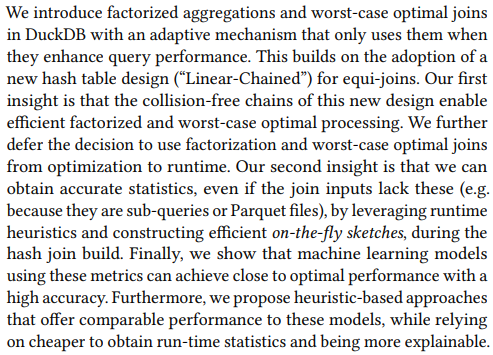
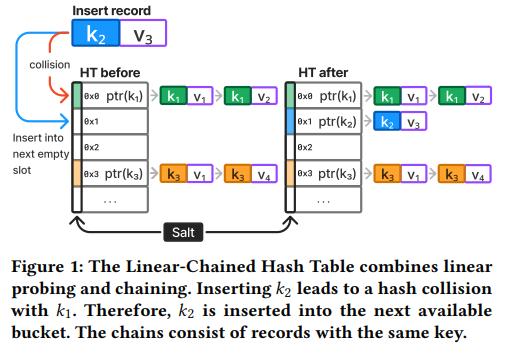
[CIDR '25] Adaptive Factorization Using Linear-Chained Hash Tables
https://t.co/lUXenMKoZz
Adaptive execution + factorization + WCOJ = great paper.
The best intro to factorized databases I know of is https://t.co/lBN47GjNm2.
Syscalls are even more expensive than they were in past (and than I thought). For security reasons branch predictor and indirect branch predictor are usually reset.
https://t.co/wzTIdW3Bxk
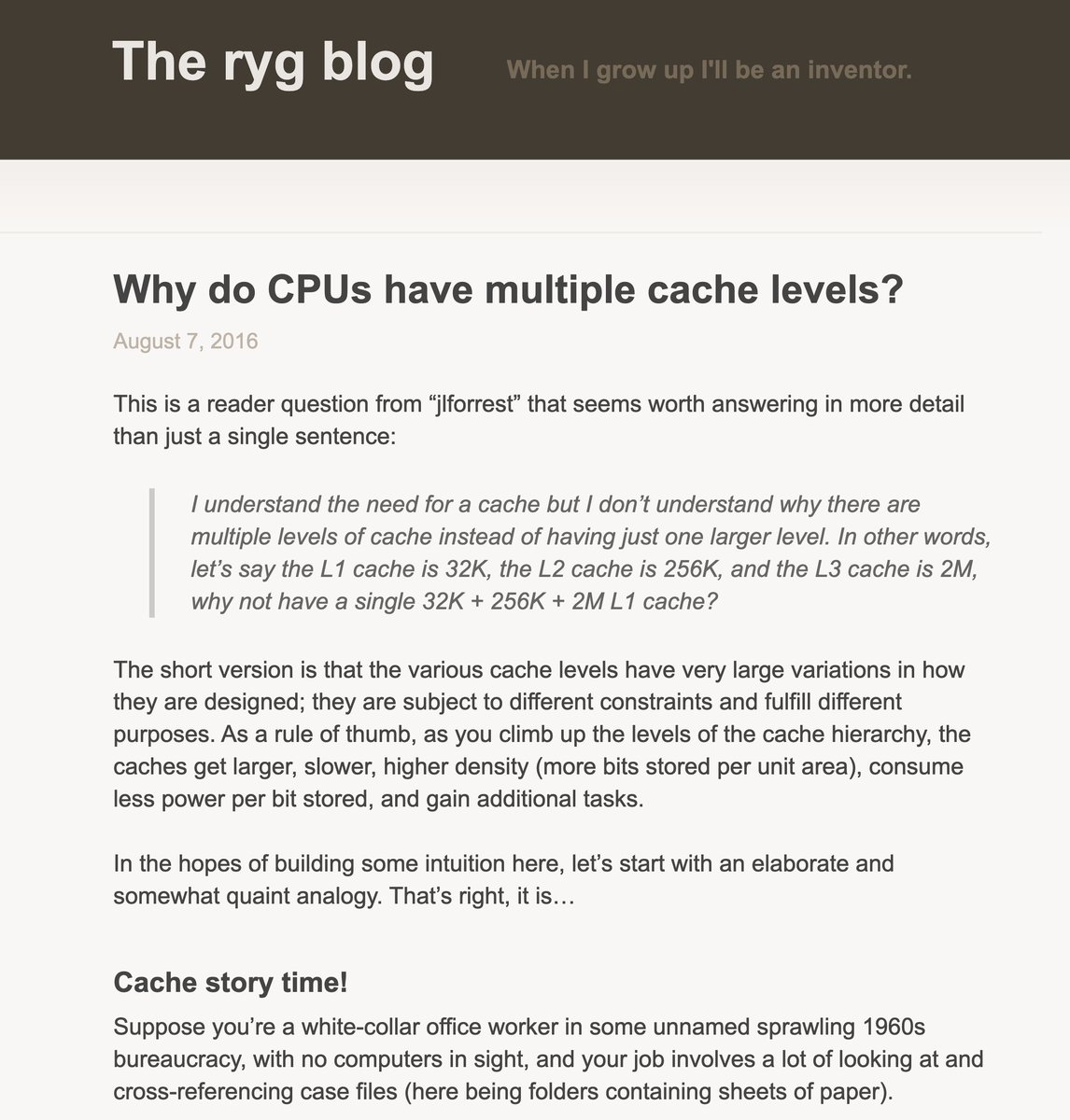
Why do CPUs have multiple cache levels? by Fabian Giesen.
One of the best explanations, and my periodic recommendation to the students.
https://t.co/RyhpjqAEhX
Not just Fibbonacci series, Indians discovered:
- Pythagorean theorem and geometric constructions (Baudhayana Sulba Sutras)
- Binary patterns, binomial coefficients, Pascal’s triangle (Pingala’s Chhandas Shastra)
- Positional decimal numeral system that we use today (Vedic period onward, formalized by Aryabhata)
- Concept of zero as a number (Jain texts 300 BCE onward, rules formalized by Brahmagupta, 628 CE)
- Negative numbers and their operations (Brahmagupta)
- Sine and cosine tables, trigonometric identities, and π approximation (Aryabhata)
- General solutions to quadratic equations and methods of solving them (Brahmagupta)
- Infinite power series for π, sine, cosine, and arctangent (Madhava of Sangamagrama)
- Precursors to Number theory, Calculus, Algebraic methods and many more
You’re in an ML Engineer interview at Google.
Interviewer: We need to train an LLM across 1,000 GPUs. How would you make sure all GPUs share what they learn?
You: Use a central parameter server to aggregate and redistribute the weights.
Interview over.
Here’s what you missed:
New series: Building a #MicroKernel in #Rust 🔧
Had some downtime between roles, so I wrote an OS from scratch. On bare metal ARM. As you do.
Part 0 is live - from zero to virtual memory.
👉 https://t.co/U1VLoLDH9y