asking what humans do in the future feels like a misunderstanding of joy and pain. not all joy and pain is equal. pain that leads to good beats pain that doesnt. your fav song is better than candy. so what will we do? we will seek the greatest joys and the most meaningful pain.
Ilya Sutskever told University of Toronto graduates something most people aren't ready to sit with:
"The day will come when AI does everything we can do. Not some of it. All of it."
Then he went further: "Anything I can learn, anything any of you can learn, AI will learn too."
This isn't a hypothetical from a sci-fi writer. It's the co-founder of OpenAI — someone who built the systems — standing in a graduation hall telling the people who just spent years developing human expertise that the ceiling on AI isn't a ceiling at all.
The honest implication: the question isn't which jobs survive. It's what humans do when "learning something" is no longer a durable moat.
That's the real conversation we're not having.
A 23-year-old CEO runs Mercor, a $20B company.
His schedule, in his own words:
1. Wakes up at 7:45, works out until 8:30
2. In the office by 9
3. Four hours of meetings on a normal day, sometimes eight to ten
4. A third of his time on hiring, a third with customers, a third on research and product
5. In the office until 10pm, six days a week
6. Sundays he works from home
He still gets to inbox zero every day.
That pace took Mercor from $1M to $3B in run rate in 27 months.
Full breakdown here:
https://t.co/IqjvNoQIqg
Abel, founded by Daniel Francis, or @growing_daniel, to build AI that uses body cam footage and dispatch call data to fill out police reports, raised a $5M seed (@margauxmaccoll / TechCrunch)
https://t.co/rXRCrvWdgw
📫 Subscribe: https://t.co/OyWeKSRpIM
https://t.co/YXslZessdU
Meet Corey Fugman who spent 26 years at Apple. Most people switch jobs every 2–3 years. He started in retail merchandising and went on to lead Apple Pay, Apple Card and Wallet.
I looked into his career, and here's how he did it.
1. Joined Apple before Apple Stores existed (2000)
Fugman graduated from Stanford in 2000 and joined Apple as a Merchandising Manager.
Apple opened its first retail stores in 2001.
2. Spent 13 years learning retail
He worked his way up to leading retail merchandising across Asia Pacific and Japan.
He learned how customers shop, how merchants operate and how retail businesses work.
3. Switched careers without switching companies (2014)
In 2014, he moved to Apple Pay as Director of Merchant Services.
Apple Pay hadn't even launched in the US yet.
He spent the next 5 years building its merchant network.
4. Went from retail to leading payments (2019-2026)
2019: Took charge of Apple Card and Apple Cash.
2021: Added Apple Pay and Wallet.
2026: Became head of Apple Pay, Card and Wallet.
And here's what Interesting.
He didn't study finance. He didn't start in fintech. He spent over a decade understanding retail.
And that experience helped him build payment products used by millions.
We often assume that career growth means switching companies every few years.
But his career shows that you can change industries, build new skills and take on bigger roles without changing your employer.
Sometimes, the best career move is an internal move.
FYI Check:-
https://t.co/IgYliAPiMi
Uber raised $25B. Today it's worth ~$140B on $56B of revenue.
Lyft raised a little over $5B. Today it's worth ~$6.4B on $6.9B of revenue.
Same business. Same decade.
how people think getting rich in sf works:
- vibecode a billion-dollar startup
- raise $50m
- become friends with Marc Andreessen
- sell the company for $500m
- buy a house in atherton
how it actually works:
No. Here’s what really happened.
Jensen started Nvidia in 1993, before the modern era of founder control and dual-class stock began with Google and Facebook.
Because he went public in the 1990s, he inherited all the 20th century overhead of endless public company paperwork, rather than staying private for as long as possible as is also now typical.
This is why Jensen had much less control than a modern founder/CEO. Like Jack Dorsey at Twitter, he got gradually boxed into a corner by the fact that he couldn’t raise huge amounts of capital outside his company to clear the board of cruft.
You see, as CEO, you report to the board. And you can’t do outside activities without their approval. So actions that would remove a board member that doesn’t want to step down are hard to take. Unless the CEO is also part of a shareholder majority, or has dual class / founder control, which Jensen didn’t in this case, as explained above…he can’t pick the board.
Like Bezos, though, Jensen is a workhorse and somehow made it all work despite that. Moreover, because Nvidia is a hardware company, and had a relatively low market cap until the AI boom, it didn’t attract notice from envious wokes until the last few years.
Wokes don’t know or care about GPUs, but they do care about market caps, and the rise of AI, and especially open source AI, all of which is a threat to their power. Along with useful idiot “nationalists”, they began plotting to steal control of Jensen’s multi-trillion-dollar company from him.
In this plot, they were aided by a second angle of vulnerability. Jensen didn’t just have old board members he couldn’t remove. Due to DEI policies, he was also forced to bring new board members on, from demographics favored by the far left (eg, not veterans).
Conformist board members like this act like sleeper cells. They are often useless or inactive in peacetime scenarios. Then they activate in response to press or state pressure. In this case, they then got beaten back just as quickly by the reversal of the state’s position.
Anyway, Dorsey needed Elon to come in with his enormous new resources to sweep the board clean. Today, it’s quite possible that Jensen, as the survivor of this character assassination, will similarly figure out a way to fire this incompetent board and assert proper founder control — as is a best practice in the modern era.
the 10 youngest self-made billionaires on earth right now.
every single one of them built in AI or prediction markets.
this is the era of young billionaires and it's just getting started.
Jay Chaudhry and his wife put $50M of their own money into @zscaler and turned away VCs for five years.
@CrowdStrike is now buying it for $43.9B in stock, the biggest cyber deal on record. The family's roughly 34% stake is worth about $14B.
(Bootstrapping, with a $50M boot.)
Big news: @CrowdStrike has signed a definitive agreement to acquire @zscaler, the pioneer of zero trust.
The endpoint is where the AI agent runs. The network is where it goes. After closing, we’ll secure both.
Welcome, @zscaler!
See important information: https://t.co/1kRAdzY406
Learn more: https://t.co/e8jKSMUJVe
When Google’s revenue first reached $100B, the company had ~80,000 employees.
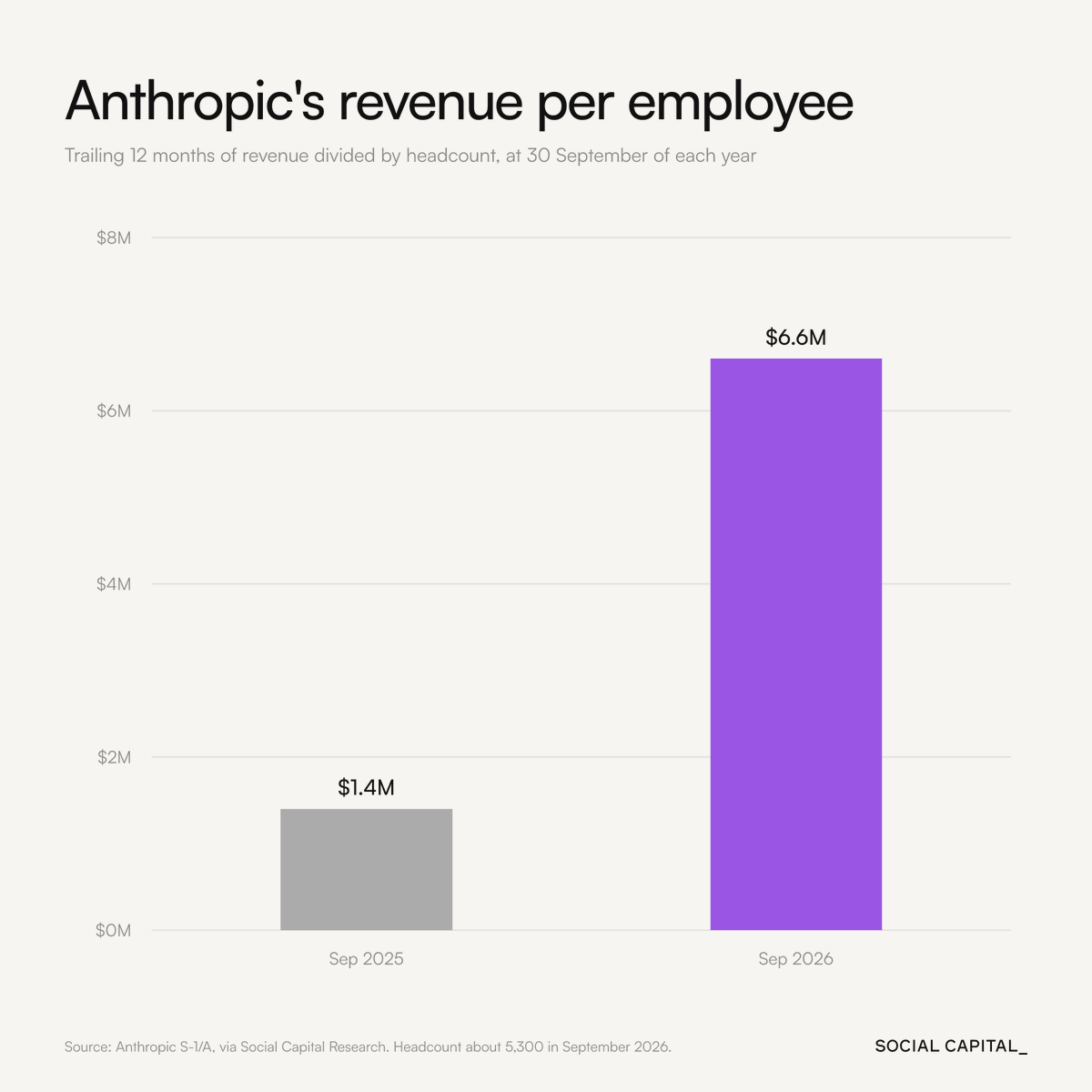
Anthropic is at an ~$81B run rate with ~5,300.
Over the last 12 months, Anthropic generated more than $6.6M of revenue per employee, up from $1.4M a year earlier.
And part of the reason for this increase is Claude itself, which now writes more than 90% of the contributions to Anthropic’s codebase.
With its IPO becoming the largest in history, we put together a Deep Dive on Anthropic to see how sustainable this growth is.
Read it here: https://t.co/ZP5tkuSase
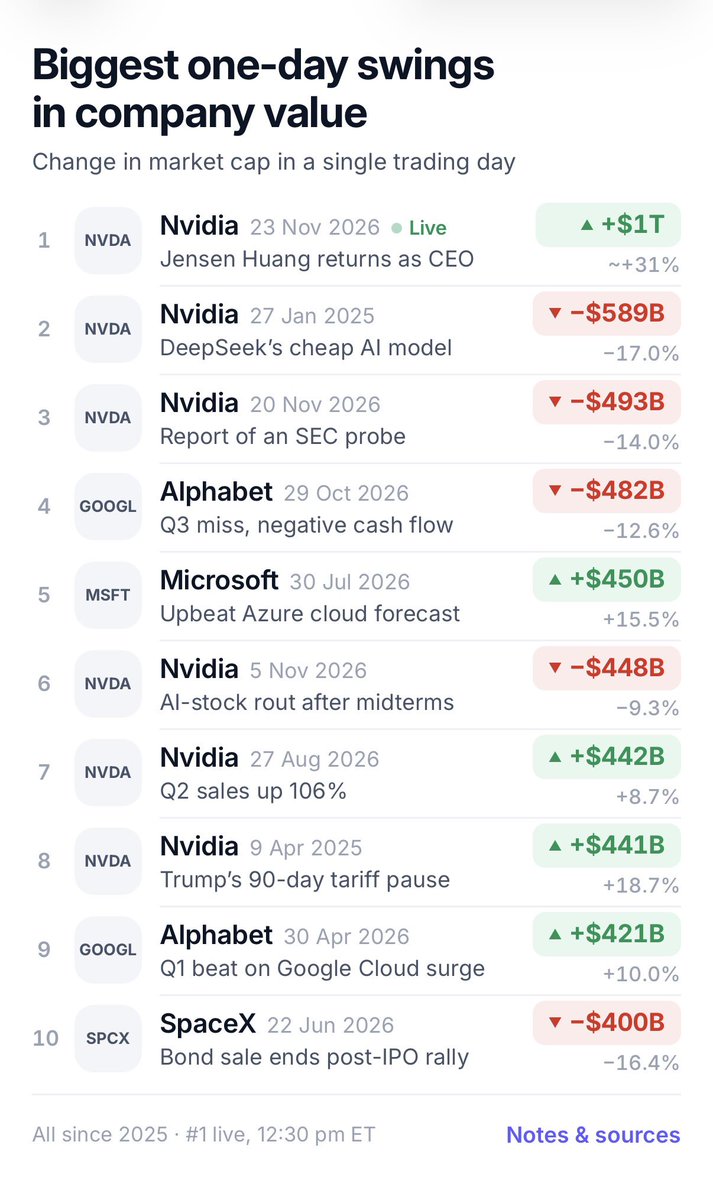
Jensen Huang coming back as NVIDIA CEO, is one of the most consequential decisions in the history of world markets. 1 trn $ of Nvidia market cap, 4 trn $ US market cap recovered, with a clear political and economic agenda of keeping the US ahead in the AI race. A message right or wrong, that for global power play, the rules of the game are flexible. When elephants dance, everyone moves to give space!