We’re excited to introduce Inherent, a lab designed from scratch to build AI agents that discover new knowledge.
The coming era of machine-driven scientific inquiry demands a new kind of research institution and a new kind of AI.
To achieve our mission, we live within the experiment, recursively self-improving the entire research organisation. We investigate questions including:
- What does ‘AI taste’ look like in the sciences, and how can we build an institution that embraces this new aesthetic of discovery?
- What new kinds of human-machine teaming will make the most of AI that can truly innovate?
- How can we build recursive self-improvement at the collective level that continually increases human agency over outcomes?
We have just closed a $50m seed round led by @IndexVentures and @radicalvcfund, with participation from other outstanding investors including NVentures (@nvidia's venture capital arm), @buildexante, Metaplanet, Macroscopic, @MythosVentures, Charlie Songhurst, @chalfs, @jluan, @dwarkesh_sp, @Thom_Wolf, @j_foerst and @maxjaderberg. We are advised by @matthewclifford.
Inherent is a Public Benefit Corporation headquartered in London.
News! @airstreet has raised $232,323,232 for Fund III to back AI-first companies from the earliest stages in the US and Europe.
Now the largest solo GP venture firm in Europe.
Our third epoch begins today. Join us!
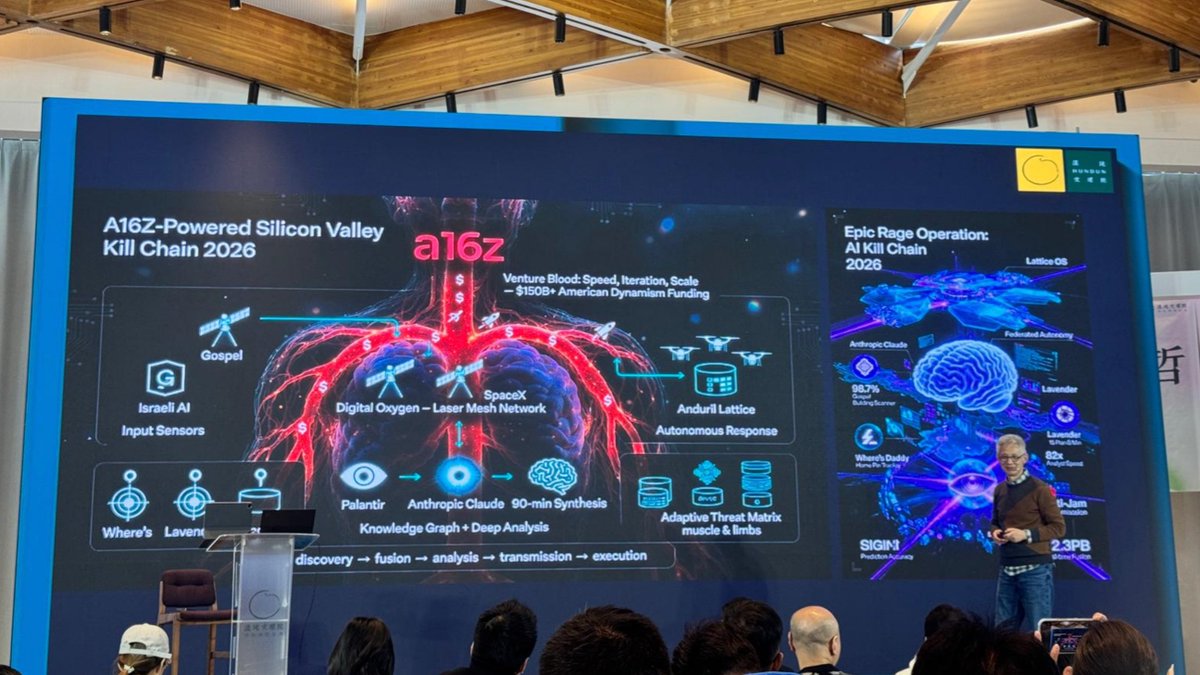
apparently this is what the chinese AI ecosystem thinks our grand american AI master plan is!
(this is not a joke! forwarded to me by an attendee at a real chinese ai conference!)
Excited to release PostTrainBench v1.0!
This benchmark evaluates the ability of frontier AI agents to post-train language models in a simplified setting.
We believe this is a first step toward tracking progress in recursive self-improvement 🧵:
I’ll be leaving Amazon at the end of this week to cook up something new!
Thanks to the Adept deal, I’ve spent the last ~2 years learning from @ajassy et al while leading Amazon’s agents R&D effort and our San Francisco AI lab.
As a childhood EC2 Micro Instance fanboy, it was fun to speedrun launching our own tier-1 AWS service. We scaled up the Adept agent recipes, did new RL research, and shipped it to AWS customers like Hertz, 1Password, and https://t.co/4VYKqVf48y itself. And it's cool to see Nova Act on top of https://t.co/fXrlDD4Smo (at least for now).
There’s incredible work to be done at Amazon and I'm grateful for the opportunities to take on more here. But with AGI so close, I want to spend 100% of my time on teaching AI systems brand new capabilities.
At OpenAI, I was lucky to incubate the first GPTs; at Adept, we went all-in on agents before anyone else–our tech/people now drive computer-use efforts at every major lab. I have a bet for what's next. ;)
This wasn't an easy decision, and I'm sad to leave this wonderful team. I’m grateful for the trust our execs placed in me during an important moment for Amazon and the field. I'm excited to swing at the next idea!
Reiner is perhaps the strongest chip+LLM person I have ever gotten to work with, and he and @MikeGunter_ have built just as legit of a team. I'm stoked to have been an investor in an early round.
Tapeout in under a year! 😅
We’re building an LLM chip that delivers much higher throughput than any other chip while also achieving the lowest latency. We call it the MatX One.
The MatX One chip is based on a splittable systolic array, which has the energy and area efficiency that large systolic arrays are famous for, while also getting high utilization on smaller matrices with flexible shapes. The chip combines the low latency of SRAM-first designs with the long-context support of HBM. These elements, plus a fresh take on numerics, deliver higher throughput on LLMs than any announced system, while simultaneously matching the latency of SRAM-first designs. Higher throughput and lower latency give you smarter and faster models for your subscription dollar.
We’ve raised a $500M Series B to wrap up development and quickly scale manufacturing, with tapeout in under a year. The round was led by Jane Street, one of the most tech-savvy Wall Street firms, and Situational Awareness LP, whose founder @leopoldasch wrote the definitive memo on AGI. Participants include @sparkcapital, @danielgross and @natfriedman’s fund, @patrickc and @collision, @TriatomicCap, @HarpoonVentures, @karpathy, @dwarkesh_sp, and others. We’re also welcoming investors across the supply chain, including Marvell and Alchip.
@MikeGunter_ and I started MatX because we felt that the best chip for LLMs should be designed from first principles with a deep understanding of what LLMs need and how they will evolve. We are willing to give up on small-model performance, low-volume workloads, and even ease of programming to deliver on such a chip.
We’re now a 100-person team with people who think about everything from learning rate schedules, to Swing Modulo Scheduling, to guard/round/sticky bits, to blind-mated connections—all in the same building. If you’d like to help us architect, design, and deploy many generations of chips in large volume, consider joining us.
I enjoyed chatting with Amazon's @jluan about what he has been up to since kickstarting its AGI / agents research lab last year
David has seen it all and is refreshingly candid https://t.co/UlcusH7r8R
We're working on a really cool agent RL training recipe across a bajillion gym environments with core contributors from verl, sglang, Adept, and https://t.co/86oHN4oJR6!
Shoot me a message if you're interested :)
Since launch, it's been really cool to see Nova Act handle real agentic workflows for real enterprises, such as scaling out public benefits and QA testing. Knowledge work is much bigger than just chatting and coding!
You can now take these agents to production. Use cases here:
Nova Act is now⚡️ enterprise ready ⚡️ and we've added new capabilities to our preview to help you take your prototype to production—with 90%+ reliability across our early enterprise customer use cases!
Stoked about the first release from our new lab: our browser use agent lets you MapReduce over the web!
This early preview moves us closer to reliable agents that learn from rewards across a wide range of digital and physical environments.
Love our Adept+Amazon team so much!
Meet Amazon Nova Act — an effortless way to build AI agents that can reliably use browsers 🧑💻
With our new model, compose robust steps into complex workflows; handle everything from bookings to QA testing. Getting started takes just 3 lines of code.
See what Nova Act can do 🧵👇
Incredible what happens when you bring the existing world knowledge and intuition of VLMs to the physical world... only a few more missing pieces in the recipe for AGI...
really feeling the agi with this one
Meet Gemini Robotics: our latest AI models designed for a new generation of helpful robots. 🤖
Based on Gemini 2.0, they bring capabilities such as better reasoning, interactivity, dexterity and generalization into the physical world. 🧵 https://t.co/n230QbZpnd
I’m excited to announce Tolan, our first Embodied Companion.
With no launch or press we’ve quietly hit 500,000+ downloads, over $1m in ARR, and a #1 app store category ranking.
Today I’m also announcing our $10m seed round (more on that below) and sharing some of what we’ve learned building an AI companion for consumers.
1. Breakdown of DeepSeek V3 efficiency vs Llama 3:
- Better: 11x fewer FLOPs per token, thanks to MoE [37B vs 405B activated params]
- Better: 2x faster numerics [fp8 vs bf16 training]
- Worse: 0.5x flops utilization [16% vs 33% end-to-end MFU*]
- Neutral: similar hardware platform [H800 and H100 both have 2Pflops/s dense fp8]
- Neutral: same training data volume [14.8T vs 15T tokens]
Llama 3’s design was obviously and intentionally conservative: dense model (not MoE), bf16 training (not fp8), GQA attention (not cheaper alternatives). DeepSeek benefited by being aggressive on all these fronts, at the cost of being later to market.
2. The core algorithmic improvements were already known; the closed source LLM labs were probably already doing similar things. DeepSeek’s improvements are real, but far more modest than the Llama comparison would suggest; my wild guess is closer to 1.5x improvement.
MoE was published in 2017; in 2021 Switch Transformer reported 7x speedups vs dense models, similar to DeepSeek’s 11x. OpenAI is widely rumored to have been using MoE models for years. NVIDIA published their fp8 training paper in 2022.
3. NVIDIA’s stock price is down 15% after DeepSeek. Should it be?
LLM compute is like a gas: it expands to fill the available budget. Over the last 3 years the labs have grown their budgets, despite algorithms and hardware improving. There’s no reason to expect this to change now: you win by making the best model, not by shrinking your budget.
The more meaningful question: do algorithmic improvements like DeepSeek’s mean that margins will shift from hardware vendors to labs?
Hard to see why. Algorithmic improvements are quickly copied from one lab to another, making it hard for them to maintain technological differentiation. Hardware improvements take much longer to copy.
!! @pabbeel and I are building a new AI research lab in SF for Amazon! We’re focused on the remaining major problems to build generally intelligent agents and are looking for a few dozen intrinsically motivated people to join our team and work with the Adept folks here. DM me!