New from the Randles Lab! 📄
Our adaptive physics refinement framework reveals how red blood cells influence circulating tumor cell transport and adhesion, while reducing memory use by an order of magnitude.
Read more: https://t.co/YvtslD4WZ6
#CancerResearch#Biomechanics#HPC
New from Randles Lab: ML models trained on CFD-simulated bifurcation lesions predict iFR/FFR from anatomy alone—enabling non-invasive, personalized planning for side-branch interventions. 🫀
https://t.co/gkAvvW1ldS
#Cardiology#DigitalTwins#ML4Health#CFD#BME#RandlesLab
New paper out! 🧵
HarVI enables real-time coronary intervention planning using ML + XR. We predict FFR, flow rate, & shear stress in ~62 mins using 1D CFD-trained surrogates.
🔗 https://t.co/nKC44At8D8
#DigitalTwins#Cardiology#ML
🚀 Can we predict immune responses with supercomputers?
Proud of Aristotle Martin for leading this work—what started as a class project is now a scalable 3D immune model running at 350x speedup! Huge step for HPC-driven immunology.
📄 Read more: [https://t.co/NFHPscPu5A]
#HPC
🚨 New publication in @npjDigitalMed!
We developed the Longitudinal Hemodynamic Mapping Framework (LHMF) to track 6 weeks of 3D blood flow in patient-specific anatomy using wearables and CFD—vs <1 min before! 💻🩺
https://t.co/waBdZOxFG1
#DigitalHealth@DukeEngineering#HPC
In this paper, we utilized longitudinal hemodynamic mapping framework to compare 6 key hemodynamic metrics under the influence of rest and activity state for in a human coronary digital twin.
Presented at: EMBC 2024
@DukeEngineering@IEEEembs#CFD#HPC
We explore the possibility of co-opting steady-state inlet flow simulations in lieu of pulsatile state models, showing we can sufficiently capture human hemodynamics during diastolic periods.
Presented at: EMBC 2024
@DukeEngineering@IEEEembs#cfd#HPC
We introduce an angiography-based computational framework that enables the calculation of patient specific 3D flow dynamics from 2D superficial femoral arteries angiography
Presented at: EMBC 2024
@DukeEngineering@IEEEembs#CFD#HPC
Our new paper examines hemodynamic changes caused by the presence of sickle red blood cells compared to normal red blood cells in patients with sickle cell disease.
Presented at: EMBC EMBS 2024
@DukeEngineering@IEEEembs
We introduce the HarVI (HARVEY Virtual Intervention) tool for #CVD that leverages #AI and extended reality to enable physicians to interactively scope out treatment strategies and get hemodynamic guidance in real time.
Paper presented @ ICCS24
@DukeEngineering@IEEEembs#VR
We assess the effects of inlet velocity waveform shape differences on hemodynamic metrics such as WSS and OSI in left coronary arteries. Results include an increased understanding of inlet waveform effects on hemodynamics.
Paper presented @ ICCS 2024
@DukeEngineering@iccs_conf
HARVEY is able to accurately measure FFR with simulations based on 2D angiography images and helps identify longitudinal vorticity as a potential marker identify at risk patients. Check out our latest work in JAHA for more information.
@DukeEngineering
https://t.co/f3dVSNrtuN
We introduce Post Hoc Replay, an in situ framework that enables subsequent post hoc reconstruction of simulation subdomains at full resolution at reduced computational resources costs.
Yousef et al., LDAV #CFD#InSitu#research@DukeEngineering@DukeUBME
Our latest paper shows how patient size can influence cerebral perfusion during veno-arterial extracorporeal membrane oxygenation (VA-ECMO).
#CFD#Engineering@DukeEngineering@DukeUBME
https://t.co/QFiR1Ka9sD
We utilized the radial distribution function and Jaccard index as metrics to quantitatively define distributions of spheres and red blood cells.
Roychowdhury et al., Journal of Computational Science
#CFD#Research@DukeEngineering
https://t.co/RVrJdgOjVx
In our first paper of the year, we quantified the trade-offs of three common constitutive laws for modeling RBC response to large strains. This work was led by
@MariannaPepona.
@DukeEngineering#Research#CFD#FSI
https://t.co/3WtZta0jMm
We validate a patient-specific blood flow model of fractional flow reserve and derive optimized, low-cost models with minimal governing parameters without compromising diagnostic performance.
Tanade et al., Front. Med. Technol.
https://t.co/3qpIVmqRsr
@DukeEngineering#CFD#XR
New work from our lab looking at the role of immersion for improving extended reality use in flow simulations is available in CVET. #CFD#XR@DukeEngineering
https://t.co/4Bt5zYZypG
We investigate how metrics like vorticity differ in health coronary vessels vs. diseased in our latest work with HARVEY.
Vardhan et al., Front. Sys. Biol.
https://t.co/dUIOSIjidn


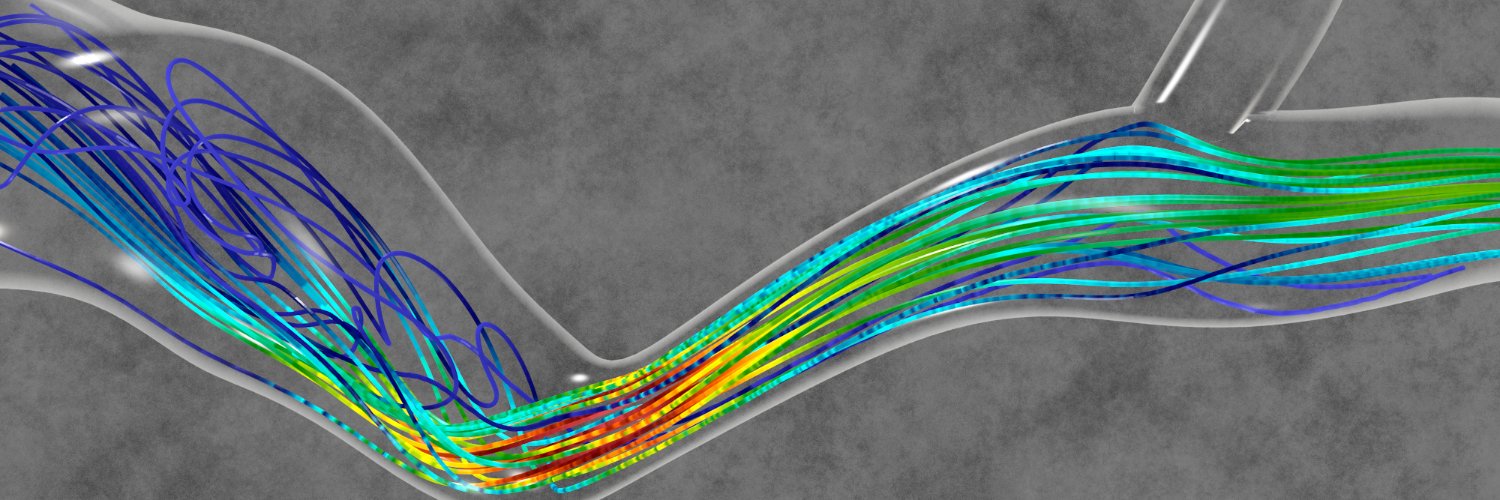


![randleslabpubs's tweet photo. 🚀 Can we predict immune responses with supercomputers?
Proud of Aristotle Martin for leading this work—what started as a class project is now a scalable 3D immune model running at 350x speedup! Huge step for HPC-driven immunology.
📄 Read more: [https://t.co/NFHPscPu5A]
#HPC https://t.co/nJEz4H2QUx](https://pbs.twimg.com/media/GlXlAUgXMAALMBv.jpg)





