this guy might be a fucking genius
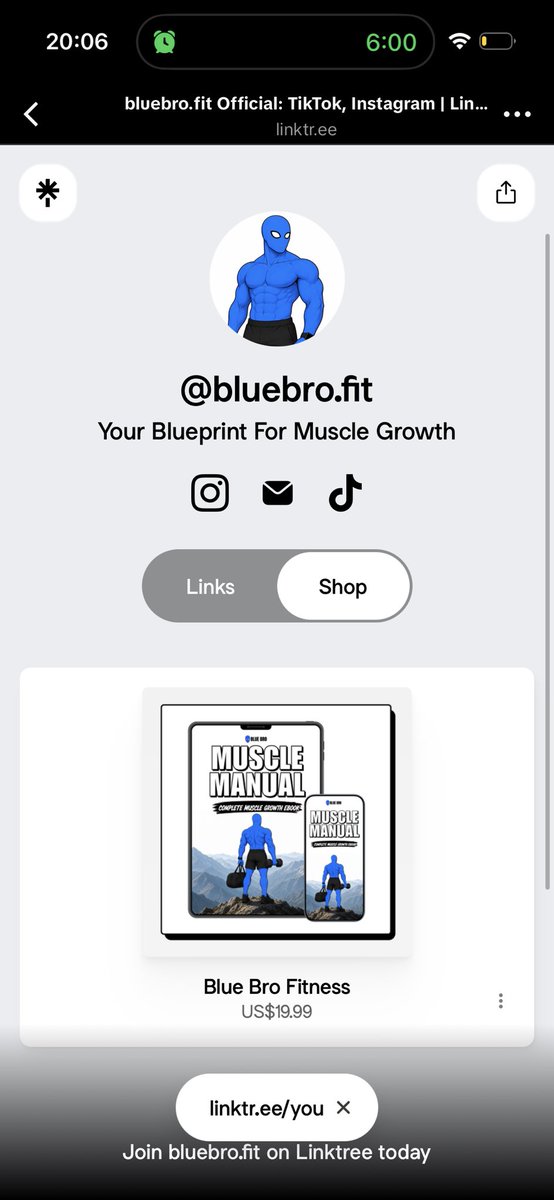
he built a fitness page around an AI generated blue character, posts simple workout / muscle growth slideshows and then sells a $19.99 workout blueprint through the page
no face
no filming workouts
no personal brand needed
just:
-> AI character
-> useful fitness content
-> consistent visual style
-> link in bio to the product
the page is already at 325k+ followers
he basically turned one made-up character into the face of an entire fitness brand
this is the kind of AI content use case i find way more interesting than random AI slop
The more I study the world, the more I worry everything will be K-shaped going forward.
Assets and asset holders will become richer while those living paycheck to paycheck continue losing purchasing power.
Smart people will use AI to do amazing things while the rest of humanity atrophies their brains doomscrolling and can’t even do basic math anymore.
Good houses and good cities will continue rising in value and importance while the long tail gets looked over.
I'm seeing this everywhere I look.
I'm not sure how this gets reversed anymore. If anything, it feels like it will speed up.
There is a brief window right now to make sure you are on the top end of the K-curve before it's too late.
Please for the sake of your bloodline.
Don't get left behind.
Big tech has never been bigger.
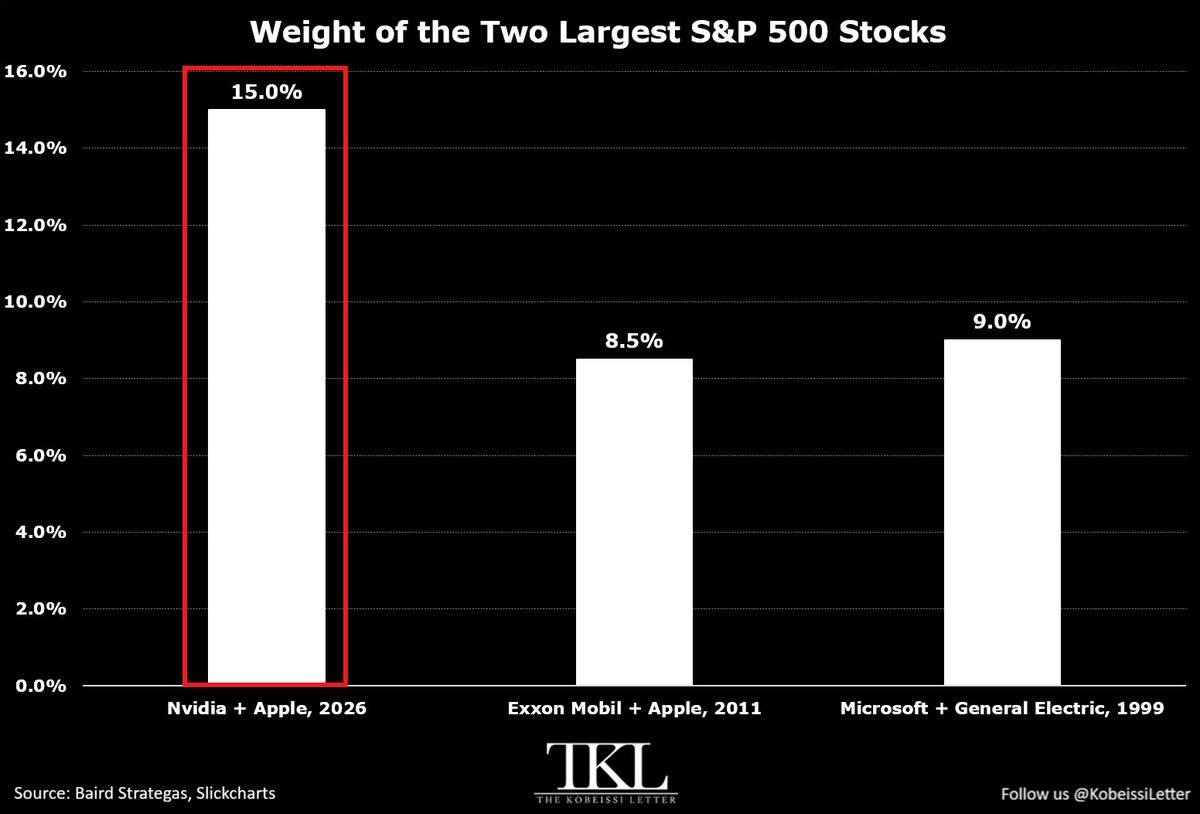
The 2 largest S&P 500 companies, Nvidia, $NVDA, and Apple, $AAPL, now account for 15% of the index’s market cap, an all-time high.
This comes as $NVDA represents a record 8%, while $AAPL accounts for 7%.
By comparison, the combined weight of Exxon Mobil, $XOM, and Apple, $AAPL, peaked at ~8% in 2011.
During the 2000 Dot-Com Bubble, Microsoft, $MSFT, and General Electric, $GE, topped at ~9% in 1999.
Before 2020, the 2 largest stocks never accounted for more than 10% of the index’s market cap.
The US equity market has never been this concentrated.
The S&P 500 is 0.7% below a record high, yet 430 of those stocks are 21.7% below their highs. That means on average 86% of the stocks are in a bear market. Breadth has only been this bad twice, in January 1973 and in 1999/2000. On both occasions, the S&P then crashed nearly 50%
you do not need anything else other than an internet connection & an iphone to make $1,000,000+ over the next 12 months
tokenization supercycle + 24/7 perps + social trading emerging seriously for the first time as a global metagame is going to give insane opportunities to those terminally online that learn how to trade attention & virality
Let me explain what just happened.
Anthropic built a biology lab where Claude works alongside real scientists.
They told Claude to search a massive DNA database for interesting reverse transcriptases (enzymes that copy RNA into DNA). Then they let it run: ~950 Claude agents worked in parallel for 21 hours across 200,000+ enzymes.
One agent spotted a repeating DNA pattern next to an enzyme, the same kind of signature that originally led humans to discover CRISPR (the gene-editing tool that lets scientists precisely cut and edit DNA, now used in real medical treatments). It cross-checked the pattern against known systems, searched the literature, confirmed nobody had found it before, then wrote up a full scientific report like a human researcher would.
Anthropic scientists verified it in the lab. They named it ART. Its exact function is still unknown, but early signs suggest it may be programmable, similar to how CRISPR can be aimed at specific DNA.
Why it matters: finding tools like CRISPR used to take human experts months of manual searching. Here, AI did that work and found something real, at a speed no human team could match.
So don't misunderstand it as Claude curing cancer. Claude spotted something new in nature that humans missed.
Still crazy!
🚨 TOO MANY WARNING SIGNS ARE FLASHING AT ONCE
A series of major military, energy and security developments are unfolding across the world at the same time:
1. France is facing a major fuel shortage, with roughly 1 in 9 stations reportedly out of at least one fuel and diesel prices hitting record levels.
2. Europe enters winter with severe energy pressure as disrupted Middle East supplies push gas prices sharply higher and storage remains below last year’s level.
3. A massive drone attack hit the Moscow region damaging major oil refinery in Russia.
4. Trump returned from Camp David a day early, with no official explanation.
5. US embassies issued fresh security warnings across the Middle East.
6. North Korea launched 2 ballistic missiles off east coast.
7. Cuba suffered another nationwide power-grid collapse amid severe fuel shortages and deteriorating infrastructure.
8. UK government guidance tells households to keep emergency supplies including food, water, medicine and backup power.
9. Iran reportedly issued "Code 100" it's highest military alert level.
10. Iran warned any new US strike will trigger immediate and “unlimited” retaliation against US bases and interests across the region.
11. Saudi Arabia cut oil shipments to Europe after attacks shut its critical East-West pipeline.
Almost every major development above adds another layer of risk to global oil production, refineries, supply routes and fuel availability.
Europe is already facing fuel shortages and rising energy pressure while attacks and military escalation threaten major oil infrastructure and supply routes.
Any prolonged disruption to Middle East oil flows could push crude and diesel prices sharply higher.
That means higher inflation, more pressure on households and businesses, and potentially higher interest rates for longer period of time.
Today is another reminder of just how fast things can change.
Just 9 months ago, markets were pricing in 3 rate cuts in 2026 and we had $60 oil prices.
Today, a new Fed rate hike cycle has begun, oil prices are above $100, and diesel prices are at record highs.
The market and the Fed are in agreement, lower rates are not coming as long as the current energy crisis continues.
There simply is no scenario where rate cuts are warranted with $100+ oil prices and 3.5%+ inflation, aside from an economic depression.
Luckily, we are also in the midst of the biggest technological revolution in history, and the AI boom continues to provide substantial support for the S&P 500.
Without the AI Revolution, markets would be in a much darker position right now.
On the flip side, a resolution to the current energy crisis opens for the S&P 500 to rise well above 8,000.
For now, a long and bumpy road appears to be ahead as the Fed continues its 60-straight-month battle against inflation.
"Higher for longer" has returned.
SUMMARY OF FED DECISION (9/16/2026):
1. Fed hikes interest rates by 25 bps for first time since July 2023
2. The decision was made in a 12-0 unanimous vote
3. Fed says the decision will support a "timelier" return to 2% inflation
4. Median Fed forecast shows one more 25 basis point rate hike in 2026
5. Fed says job gains are strong and the unemployment rate has "changed little"
6. "The Committee will deliver price stability," the Fed's statement says
Higher for longer is back.
🚨 IS THE WORLD HEADING TOWARD A GLOBAL BOND CRISIS?
Japan's 10-year yield just hit 3.03% for the first time since 1996. Its 20-year yield is at 30-year high while the 30-year and 40-year are at record highs.
The UK's 10-year yield is at its highest since 2008. Its 30-year yield is at its highest since 1998.
France's 10-year yield is back to levels last seen around 2008. Germany's 10-year is at its highest since 2011.
The US 10 and 30-year yields are at a 19-year high.
This isn't happening because of one country's problem.
It's happening across almost every major government bond market at the same time.
Part of this is central banks.
The ECB just hiked rates again in September. Markets now see more than a 50% chance the Fed hikes this month too, and expect the Bank of Japan to raise its rate to 1.25%.
Rate hikes only explain part of this.
Long term yields also carry something called a term premium, extra compensation investors demand for holding debt over many years when inflation, government borrowing, and market risk are uncertain.
That premium has been rising too, especially in Japan, France, and the UK.
Here's what makes this cycle different from anything before it.
Global government debt is now close to 94% of world GDP, and the IMF expects it to hit 100% by 2029.
Global governments are now spending almost 3% of world GDP on interest payments alone, up from 2% just four years ago.
At the same time, AI is becoming a major source of new debt demand. The five biggest US tech companies are expected to spend around $697 billion this year on AI infrastructure.
A growing share of that is now funded through debt, and private credit funds are financing a lot of it, this AI segment alone went from 17% of private credit deals a few years ago to over a third of all deals in 2025.
This is why rising yields matter so much right now.
Higher yields raise the cost of that same AI debt. They raise mortgage rates, and most US homeowners are locked into rates under 4%, so higher rates freeze up home buying and selling instead of forcing existing owners to pay more immediately.
They raise borrowing costs for governments already struggling to manage existing debt.
They raise the discount rate used to value stocks, which hits expensive, high growth companies the hardest.
This doesn't automatically mean stocks, gold, silver, and crypto all crash together.
Gold can actually rise if people start worrying about government debt and inflation instead of just reacting to higher yields.
It does mean every part of the financial system is now more exposed to the same risk at the same time, government budgets, mortgages, corporate debt, private credit, and stock valuations all get squeezed by the same rising cost of money.
The real question isn't whether yields are high.
It's whether this keeps building slowly, or whether one weak bond auction, one political shock, or one forced sale turns this into something faster and much harder to control.
Markets are bracing for a rate hike.
So, how do US stocks usually behave following the first hike of a Fed tightening cycle?
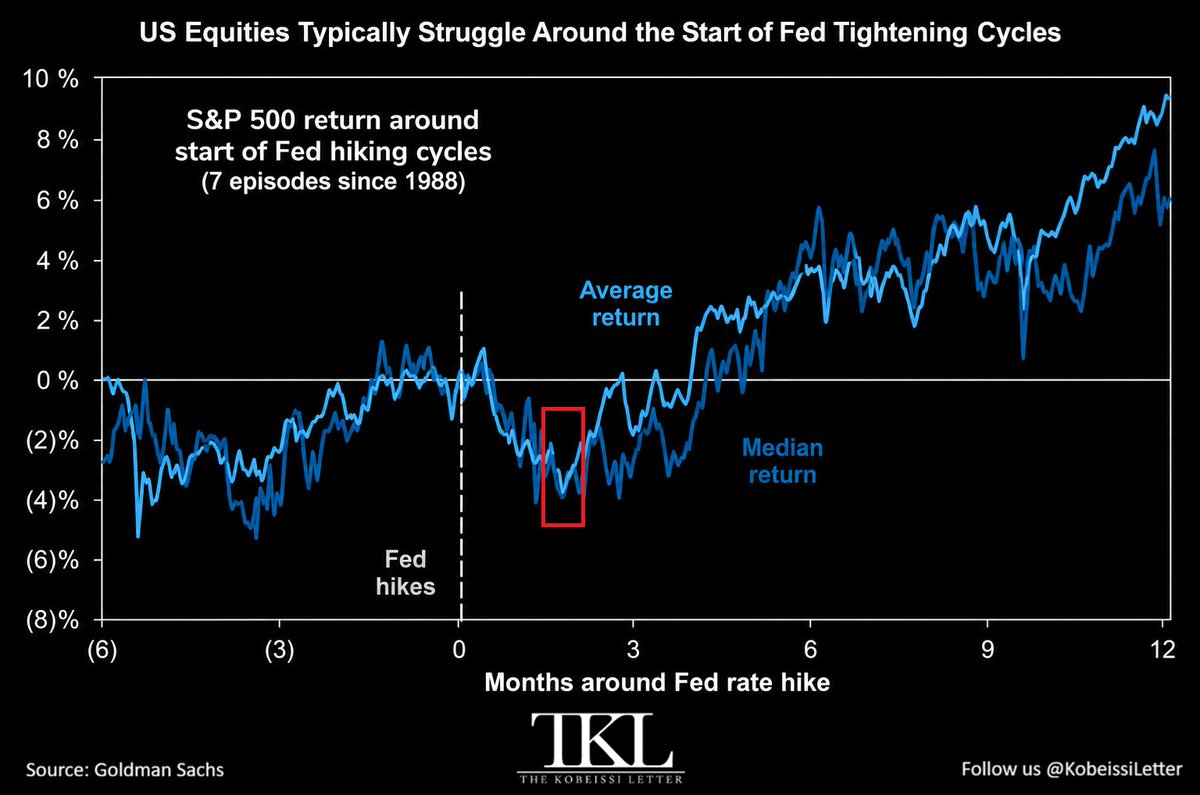
The S&P 500 has declined by an average of -4.0% over the 6 weeks following the first Fed rate hike of a cycle across 7 such episodes since 1988.
Subsequently, however, stocks recovered all of those losses over the next 5-6 weeks on average.
Then, in the 6 months following the first hike, the S&P 500 returned +4.0% on average.
After 12 months, the S&P 500’s average gain surged to +9.0%, with positive returns occurring in every episode except 2022.
Fed rate hikes have historically been great buying opportunities.
the innovation of tokenized pairs is creating artificial scarcity for memecoins
the cost of creation is higher when the underlying asset is limited
+ a nice benefit is pairs naturally solve pvp because it’s harder to dethrone the paired memecoin winner
when memecoins all use same denominator they vamp eachother by stealing attention
however reality is that the meta itself isn’t why valuations are high, it’s the exponential growth of the mobile apps + social trading
as long as the apps grow, so will onchain
social trading has yet to hit it’s growing pains but it will and it won’t be pretty
after all, mutually assured destruction looks a lot like world peace
We now have:
1. Large cap tech CEOs unified on regulating AI
2. President Trump rejecting these tech CEOs' calls
3. Fed Chair Warsh expected to HIKE rates in his first time moving interest rates
4. Up to 30 million barrels of Middle East oil flows at risk
5. US diesel prices up +80% as peak demand season begins
6. One of the strongest periods of earnings growth in history
Q4 is going to be interesting to say the least.
We Must Pace the Frontier: I’ve written a new essay on why the AI industry should slow down, with a three-part plan for doing so.
Anthropic is unilaterally committing to the first of these steps. We’ll provide third-party evaluators with permanent, employee-level access to our systems, so that they can verify adherence to our safety measures, report on incidents, and assess models’ alignment during training.
You can read the full post here: https://t.co/OGyPb7yaYt