Building an Autonomy-Enabled Rescue Aircraft: Lessons from @DARPA to @NASA GoAERO
The @NASA GoAERO Prize challenges teams to develop an autonomy-enabled rescue aircraft that is both safe and simple to fly: a deceptively difficult engineering problem once you get into the mission and payload requirements.
Eight months into the DARPA Lift Challenge gave me a new appreciation for what "DARPA-hard" actually means as a design philosophy: define a problem at the edge of what's currently possible, then force the engineering discipline needed to close that gap. That mindset is exactly what GoAERO demands.
DARPA's Lift Challenge is where I was first introduced to GoAERO, and since then I've been digging into what the competition actually requires: autonomous casualty extraction, safe operation in degraded and unstructured environments, and a payload/mission profile that leaves little room for error. The GoAERO program page (via HeroX) has extensive documentation on the technical requirements: https://t.co/fT8Hl0HGOB
To consolidate my research, I put together an explainer video summarizing the challenge and its requirements (built with help from Google Gemini): https://t.co/HFae5a6OTm
The core motivation is worth stating plainly: in an emergency or natural disaster, it can take upwards of 20 people to safely move one casualty. An autonomous rescue aircraft could accomplish that in minutes, without putting additional responders at risk.
That's the problem GoAERO is asking teams to solve, and it's the one I'm working on now.
#UAV #Autonomy #Aerospace #Robotics #DARPA #NASA #GoAERO #UnmannedAircraft #DisasterResponse #EngineeringInnovation
Thank you! This is exactly the thing DARPA Program Manager Phillip "Donna" Smith mentioned at the DLC closing event. It will provide more fuel to independent researchers and innovators, and give them the mileage they need & deserve after competing in an unprecedented challenge. So glad to have made it to the @DARPA Lift Challenge and flew our bird throughout the competition! DARPA has some of the BEST teams.
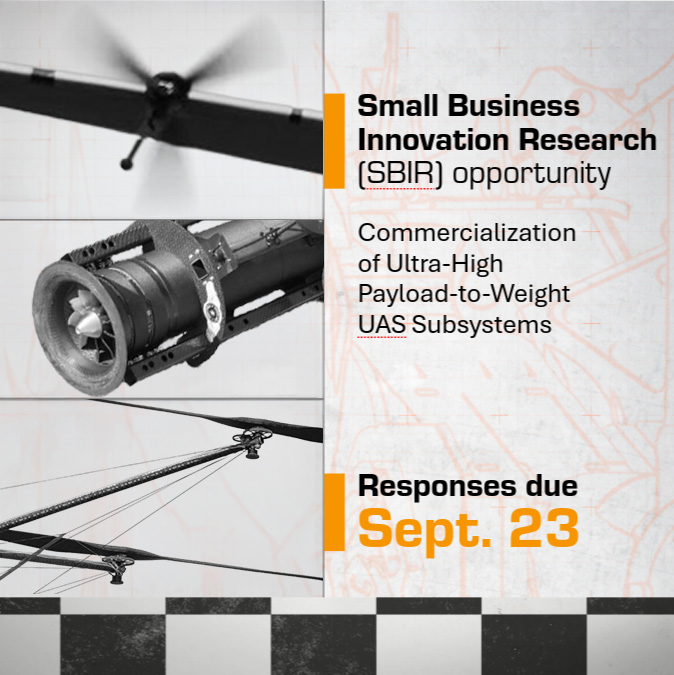
We released a new Small Business Innovation Research opportunity: Commercialization of Ultra-High Payload-to-Weight UAS Subsystems that asks for mature, high-impact subsystems to address the current payload-to-weight bottleneck & accelerate next gen heavy-lift drones.
@hargravetech Congratulations Hargrave Technologies! Your microDRIVE LPi ESCs broke some world record at the @DARPA Lift Challenge at the US Air Force Base in Dayton, Ohio. The winning team MTech achieved a 4:1 payload to weight ratio for about 2.9 nautical miles! World record!
I'm heading to Commercial UAV Expo in Las Vegas, where drone professionals across every industry come to solve real problems, evaluate proven technology, and make connections that advance their work. Come join me.
#ExpoUAV#Drones
https://t.co/LpX1Wgu1e5
@gareebscientist@gareebscientist I participated in the challenge and the 7 days were in few words “hyperCrazy”, unprecedented and some of the stuff I saw was unbelievable! We achieved a 2:1 payload to weight ratio. Team from (IITP, IIT KGP).
Lift Challenge Program Manager Phillip “Donna” Smith sits down with our @FliteTest partners to discuss the competition, its 4:1 payload-to-weight ratio goal, and the event's mission to drive aviation innovation.
To all the naysayers, a multi-rotor system broke the world record by achieving highest payload to weight ratio flight over 4:1 & flew about 3 nautical miles! This is Luke Maximo Bell at the DARPA Lift Challenge, held at the Wright Patterson Air Force Base.
Competing in this event completely changed the way I thought about heavylift vertical aviation! Thank you @DARPA and thank you all the folks who worked tirelessly to give all of us, the competitors, one of the history making and most amazing experiences! It’s unprecedented.
7 days. 61 teams. Thousands of test flights. One new world record.
The question at the heart of the competition: “What’s your ratio?”
The answer:
🏆 𝗧𝗲𝗮𝗺 𝗔𝘃𝗶𝗱𝗿𝗼𝗻𝗲 𝟯.𝟴𝟰:𝟭
Congratulations to everyone involved in the DARPA Lift Challenge.
https://t.co/0nC0tqDpKJ
@MarioNawfal I participated in the DARPA Lift Challenge, and it was very interesting to see how this bird from Driftless Robotics mentioned “missed me” in their props :)
Every legacy begins with an entry, but it is defined by the exit. In this film, our graduating batch reflects on their journey through IIT Kharagpur. The challenges, the growth, and everything that shaped them beyond the classroom. As one student put it, "Getting in is easy; getting out is the real test." Another shared a thought that captures the KGP spirit best — "You don't find your identity here, you define it." Four years, countless memories, one lasting legacy. Technology Students' Gymkhana, IIT Kharagpur proudly presents their story.
For my first post, I’m sharing a letter @NVIDIA signed on why open models matter.
AI will transform every industry, power every company, and be built by every country.
Open models strengthen safety and cybersecurity, accelerate innovation and diffusion, and enable sovereignty.
The world needs both frontier closed models and frontier open models.
https://t.co/AUKzoQ5Ikb