📢Joblib release day📢 We just released joblib 1.4!! 🤠
To update it, just run:
pip install -U joblib
Some new features: return_generator support for dask backend, collecting the results as they complete, caching coroutines, ... 😎
Full release note: https://t.co/QqWj5o7M1Q
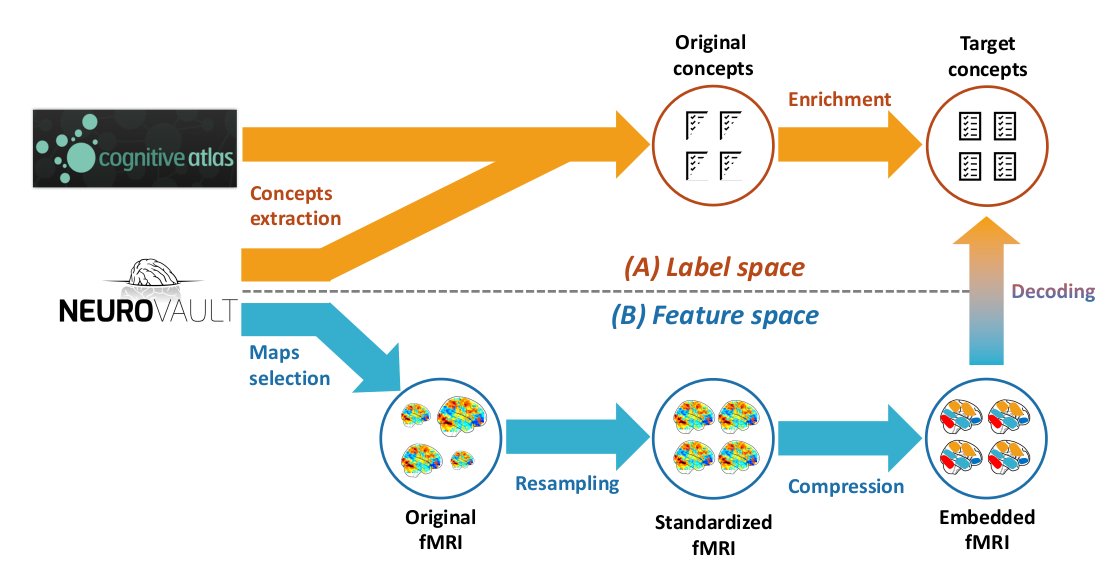
Happy to share our work on decoding cognitive processes from fMRI images without label supervision at poster 229 in #OHBM2023
We associate rich annotations from the literature with spatial reconstructions from peak activation tables to decode NeuroVault images.
@InriaMind
[SEMINAR] See you on March 14th, at @Inria_Saclay for a co-organized seminar with @soda_INRIA@InriaMind teams!
📢 Elisabeth Bik (@MicrobiomDigest) will hold a conference about "The Dark Side of Science: Misconduct in Biomedical Research".
https://t.co/fPIzGCOKi0
⏲ 12:00-1:30pm
I asked #Galactica about some things I know about and I'm troubled. In all cases, it was wrong or biased but sounded right and authoritative. I think it's dangerous. Here are a few of my experiments and my analysis of my concerns. (1/9)
Thrilled to give an oral tomorrow at 10:30 at #OHBM22!
We successfully decode 50 cognitive processes from fMRI maps by exploiting the large amount of data in @Neurovault and leveraging the @CognitiveAtlas ontology
See you in M1 for the Modeling and Analysis Activation session!
Cognitive activity can be predicted "in the wild"
For **any** cognitive neuroscience study, mental processes involved can be inferred from fMRI maps.
https://t.co/Z9X2K6rSkt
@GaelVaroquaux@Parietal_INRIA@NeuroSpin_91
Our team at Inria Saclay is looking for a software engineer interested in developing a plugin system to allow for efficient GPU computing kernels for popular machine learning algorithms in scikit-learn (nearest neighbors, k-means, T-SNE...):
https://t.co/8XyzWfDxVp #job
Super excited to finally release this handbook on writing good research code. Based on my experiences going from research to industry and research again. https://t.co/aawGMcavQY
Atm, the problem is that it is difficult with tf-explain to operate straight on the attribution maps. We aim to fix that by decoupling the map values generation from the visualization process.
This should give users more flexibility to work with the results.
tf-explain release 0.3.1:
- Fix back-propagation issues in GradCAM
- Compatibility with TensorFlow 2.5 and 2.6
- tf-explain is now backed on Zenodo
- Proper citation file
Planning release 1.0.0 for end of 2021 with one major change 👇
The plan is to split the current explain() method into 2 parts:
- explain() which will generate the raw attribution maps
- explain_visualize() which will generate visualization of the attribution maps (current explain() behaviour)
Names not definitive
@KingKudzayi@TensorFlow@DynamicWebPaige@fchollet The simplest way would probably be to generate the figures through the core API, and then use the figures the way you want in your app
https://t.co/icRlzzw1bg
Excited to share tf-explain, a @Tensorflow 2.0 compatible Python library for interpretability!
First release happened this week, with several algorithms you can use on your models or as tf.keras callbacks.
Feedback welcome!
@dynamicwebpaige@fchollet
https://t.co/aYII2FtVw0
@KingKudzayi@TensorFlow@DynamicWebPaige@fchollet When using it as a callback, the attribution maps will be computed after each step and saved to tensorboard format. You can run Tensorboard and look at the images tab to see the results!
🥳 MNE-Python 0.24released 🥳
✅ new coregistration GUI
✅ new #iEEG electrode localization GUI
✅ new time-series signal browser
✅ revamped HTML reports
We will feature select enhancements here over the next few days.
#python#meg#eeg#neuroimaging
https://t.co/QhzhaI4rq8
@braggken @cyclingalps If you are on the Alpes Maritimes side of the Var, I'd suggest:
- the Estérel and the villages behind (Tanneron, Callian)
- the col de l'Ecre by Gourdon and then going through Caussols and downhill to Saint Cezaire sur Siagne
Bonjour ! 👋
Vous avez plus de 18 ans et fait du vélo en ville au moins deux fois cette année ? 🚲
Vous pouvez aider une équipe de chercheur·e·s à mesurer l'effet des dispositifs mis en place depuis la crise sanitaire ! 🚧
Rdv sur https://t.co/M8Q26qfkZI
RT appréciés 🙏
🎉 Proudly releasing EasyFSL 0.2 🎉
It's cleaner, wider, and still fully tested and exhaustively documented, so you can save time and gain intelligence when developing few-shot learning projects or experiments. Tell me what you think! https://t.co/C9Zl4Bs2tq


![InstitutDATAIA's tweet photo. [SEMINAR] See you on March 14th, at @Inria_Saclay for a co-organized seminar with @soda_INRIA @InriaMind teams!
📢 Elisabeth Bik (@MicrobiomDigest) will hold a conference about "The Dark Side of Science: Misconduct in Biomedical Research".
https://t.co/fPIzGCOKi0
⏲ 12:00-1:30pm https://t.co/OxpPAwRe6h](https://pbs.twimg.com/media/FqyIwyNacAAvRLA.jpg)