This might be the most useful paper on AI agents this year.
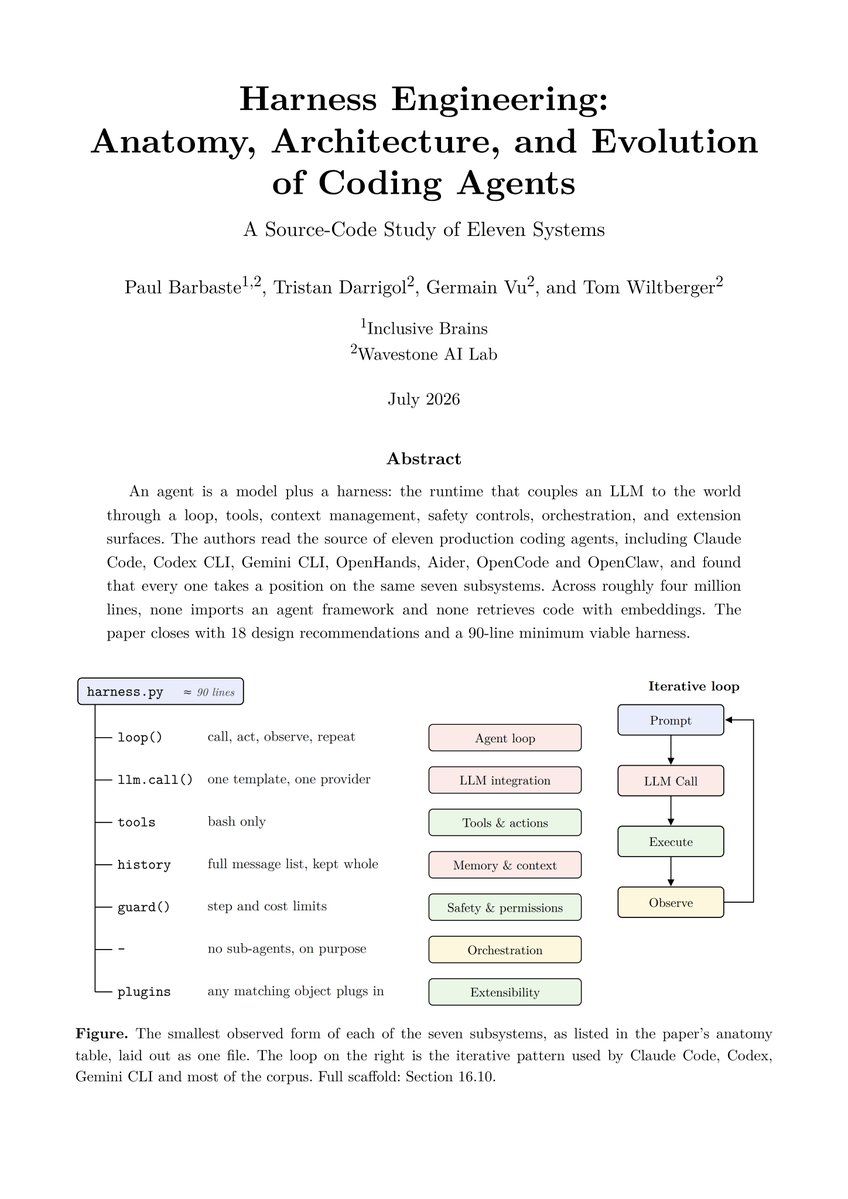
A team at Wavestone AI Lab took apart Claude Code, Codex and 9 more and found the 7-part blueprint every good agent is built on.
Their definition: an agent is a model plus a harness. All 11 agents build the harness from the same 7 parts. Only the size changes.
> Loop: Mini-SWE-Agent is a plain while loop. OpenHands logs every event so a run can be replayed
> LLM layer: one prompt template on one side, 29 provider profiles on the other
> Tools: some agents only have bash, the biggest has 43 typed tools loaded on demand
> Memory: from keep-the-whole-history to notes the agent maintains across sessions
> Safety: from a simple step limit to policy rules plus a reviewer model plus an OS sandbox
> Orchestration: Aider skips sub-agents on purpose, others fork them with their own context
> Extensions: hooks, skills and MCP. SKILL.md is in 9 of 11, MCP in 8
The paper ends with a 90-line harness covering all 7 parts, a solid starting point for your own.
Key pages:
> p.4: the 7-part map
> p.12: the 3 loop types, with Claude Code and Codex as examples
> p.53: why none of them use frameworks or embeddings
> p.67: 18 design recommendations
> p.71: the 90-line harness you can copy
An article for everyone who ships, buys, or signs off on software built on large language models (LLMs): engineers, product managers, and the CEO. Written in plain language, from the big picture down to the details. https://t.co/YaP414vR0u
Uber publicó cómo armó su infraestructura de MCP y hay varias ideas muy buenas acá.
imaginate una empresa con miles de servicios internos y muchos equipos conectando agentes a esos sistemas por su cuenta.
cuando eso empieza a crecer, terminás con tooling fragmentado, infra duplicada, distintas formas de exponer tools y poca consistencia en seguridad, discovery y operación.
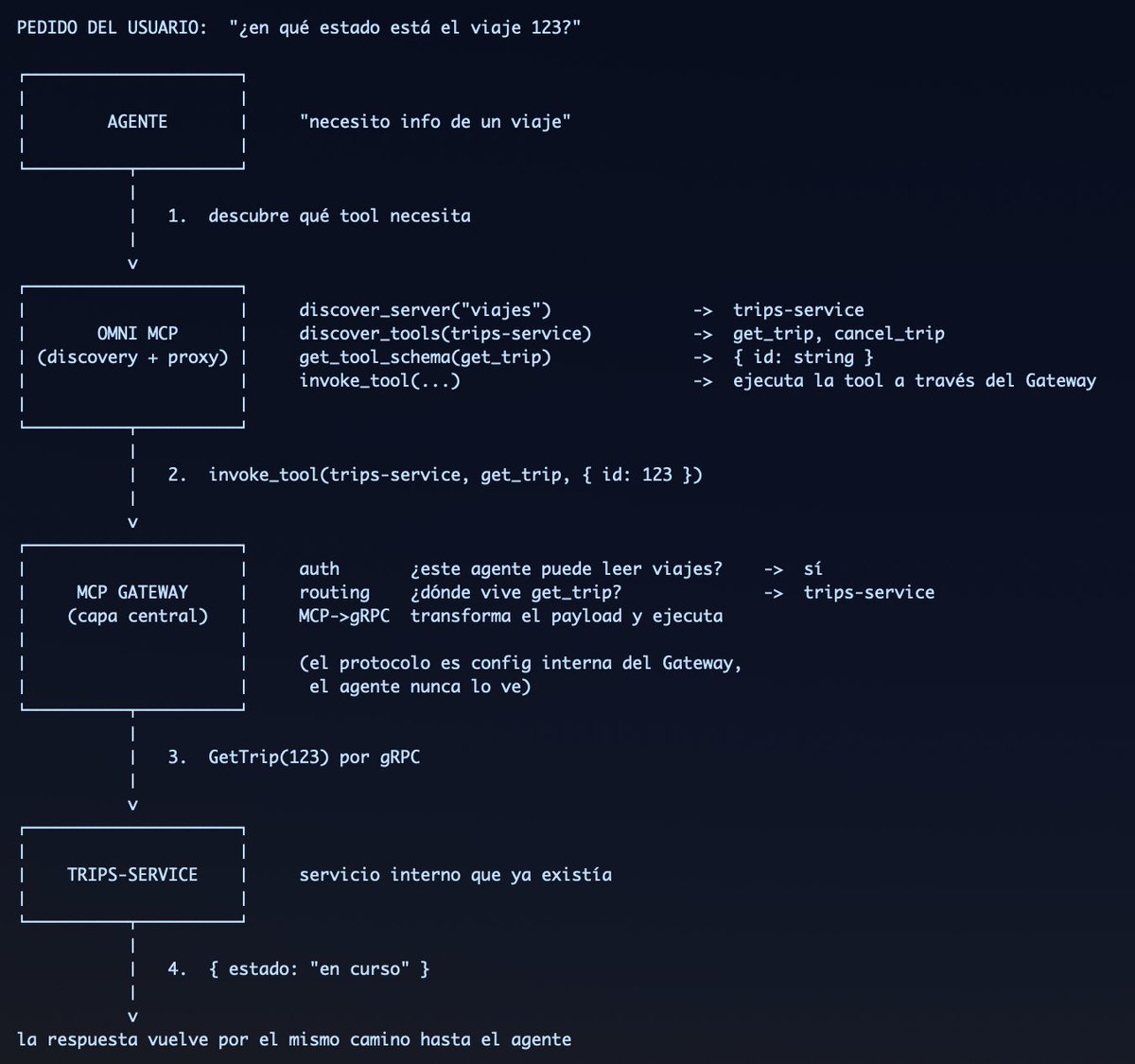
por eso Uber hizo un MCP Gateway: una capa central entre los agentes y sus servicios internos.
el agente habla MCP y el gateway se encarga de routing, permisos, ejecución y de traducir las llamadas a HTTP, gRPC o TChannel según corresponda.
como Uber ya tenía miles de APIs internas, también hicieron AutoCrawler: recorre sus definiciones, detecta métodos y schemas y genera MCP tools automáticamente. incluso usan un LLM para mejorar las descripciones.
hoy tienen +800 MCP servers y +5000 tools. y ahí aparece otro problema: no podés cargar todas esas definiciones en el contexto del modelo.
para eso crearon Omni MCP. en vez de pasarle miles de tools al agente, este va descubriendo qué server necesita, qué tools tiene disponibles, carga el schema de la correcta y recién ahí ejecuta.
me parece un muy buen ejemplo de cómo cambia la arquitectura cuando los agentes pasan de usar unas pocas tools a trabajar con miles.
terminás necesitando algo muy parecido a un API Gateway para agentes.
mattpocock/skills prompt of the day:
/codebase-design Take a look in the repo for shallow modules, applying the deletion test and look for candidates for deletion.
Helps kill unnecessary abstractions.
Announcing Apex: agentic coding model for mobile and web, specialized in React.
We built Apex from a single idea: can an open-weight model deliver frontier-level performance at lower cost?
Yes. Apex is SOTA in React Native and Next.js.
Try it now: https://t.co/nKbBxcmRFX
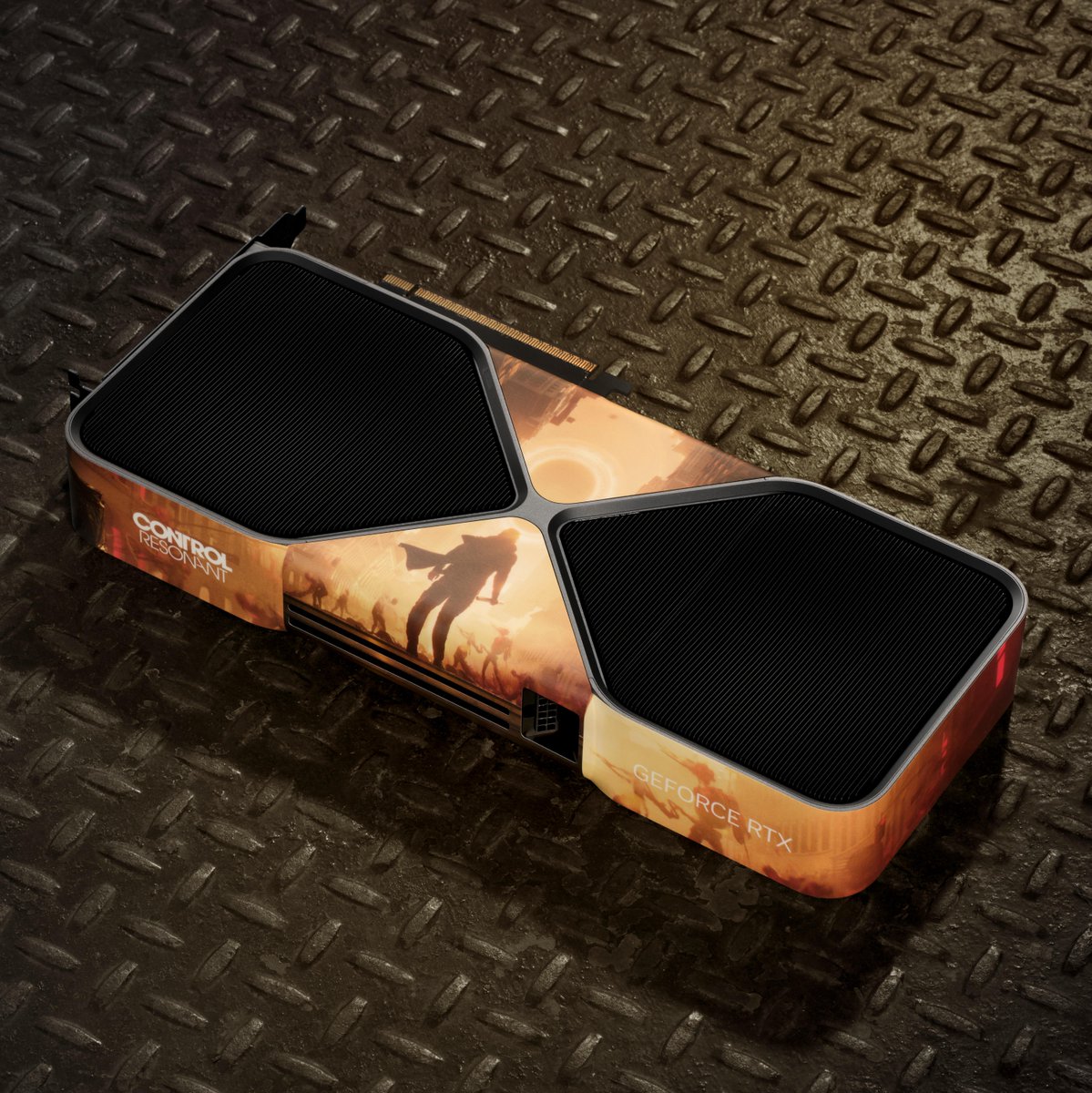
We're giving away a CONTROL Resonant custom wrapped NVIDIA GeForce RTX 5080 to celebrate its official release with #RTXON.
To enter:
🟢 Share this post
🟢 Comment #RTXON
T&Cs: https://t.co/Mbf7w3j1q3
Build your own harness.
This is a seriously good paper from NVIDIA on self-improving agent harnesses.
The paper is called SoL-Pi, out of NVIDIA, NTU and MIT.
Every coding agent runs inside a harness. That's the layer that reads files, runs commands, manages memory and talks to the model. Humans tune it by hand, reading long execution logs and turning what they notice into code changes.
They handed the job to an AI instead.
A research AI watched a coding agent work, proposed changes to the harness, tested them, and kept only what saved tokens without hurting results. It ran about 150 research directions across roughly 500 environments, more than 3,000 runs and over 60,000 agent-environment interactions.
Four fixes survived.
1. The agent edits a file and runs the test in one call instead of two.
2. It compresses its memory when a subtask finishes, and only if that's cheaper than keeping everything.
3. It sends big tool outputs in full twice, then swaps them for a 1KB excerpt with a handle to pull the rest on demand.
4. A cheap model summarizes build and test logs, and a verifier rejects the summary if it drops evidence.
None of that touches the model. It's all in the software around it.
On EdgeBench, a 51-task benchmark, token traffic dropped 44.7 to 49% and API cost fell by about a third against Pi, the harness it was built on. Against the native harnesses it came in 50% cheaper than Codex on GPT-5.6 Sol and 54.3% cheaper than Claude Code on Opus 5. Scores held at roughly 94% of the baseline.
They built all of it on GPT-5.6 Sol, then dropped it onto Opus 5 with zero changes. It still used 44.7% fewer tokens.
The cost conversation so far has been about cheaper models. This paper says a big chunk of the waste sits in the software around the model, and an AI finds it faster than we do.
Their next move is running the search again with the cheaper harness, so a cheaper agent funds the search for an even cheaper one.
This changes everything: Free and OSS self-hosted OTA Updates server for Expo & React-native Apps
I have said this before. Own your infra. This is one less bill to pay and specially for enterprise this is the way to go (security offering included)
https://t.co/To9ktStkXI
Jev is a new type of model that is optimized for making decisions, not generating text
This is the best article I’ve found so far breaking down how it works - required weekend reading imo
@melvindvivas 3 hours after using a reset yesterday. Astra extra high. I have never burned so fast before. Was creating a paymentflow using stripe MCP.
Spotify just published the internal setup their engineers use with Claude Code, the one that cut token usage by 90 percent. Here is how it works.
The observation behind it: most of what a coding assistant does is not thinking. It opens five files to answer a question about one of them. It writes a test that copies the pattern of the twenty tests sitting next to it. Enormous amounts of work, almost no judgment, and all of it billed at top rates.
So they added two cheap assistants. One opens the files and hands back a short summary. The other writes the repetitive code from an example and saves it straight to disk. The expensive model never sees any of it.
The clever part is how they made it stick. First the rules were written down as instructions, and the model ignored them. Now anything over 350 lines gets stopped before it opens and sent to the cheap one instead. Written rules are a suggestion. A block is not.
Two things stayed expensive. Edits still need the real file. And the cheap worker missed a bug the expensive one caught in seconds.
You can do some pretty fun realtime VFX once the depth output is just another (Type)GPU buffer :D
I basically yoinked my old 3D fire sim (that is actually a fluid sim but do not tell anyone) and plugged it into the depth pipeline together with hand tracking
Everything here is built from scratch in TypeGPU, so inference, simulation and rendering can share GPU resources and interleave passes directly. That’s 2 NN inferences, a full 3D fluid sim, relighting and rendering in one command encoder, still under 16 ms with no CPU sync in between
I am for ALL LOCAL, but the HYBRID approach is SOLID as well especially when you want an Orchestrator who is Frontier and that's if you don't have compute to run it locally. I think I will get to a point though where I can run ALL LOCAL. The Current Layout is 75% Local...
📖 How to apply professional design principles in AI app development
✍️ Nicolas Solerieu (our designer)
Here are the eight principles of design:
◆ Contrast
◆ Hierarchy
◆ Alignment
◆ Proximity
◆ Repetition
◆ Balance
◆ White space
◆ Unity
In the blog post you'll learn how to use these principles to steer agents toward unique, balanced, polished designs.
https://t.co/JnZVexfmkM