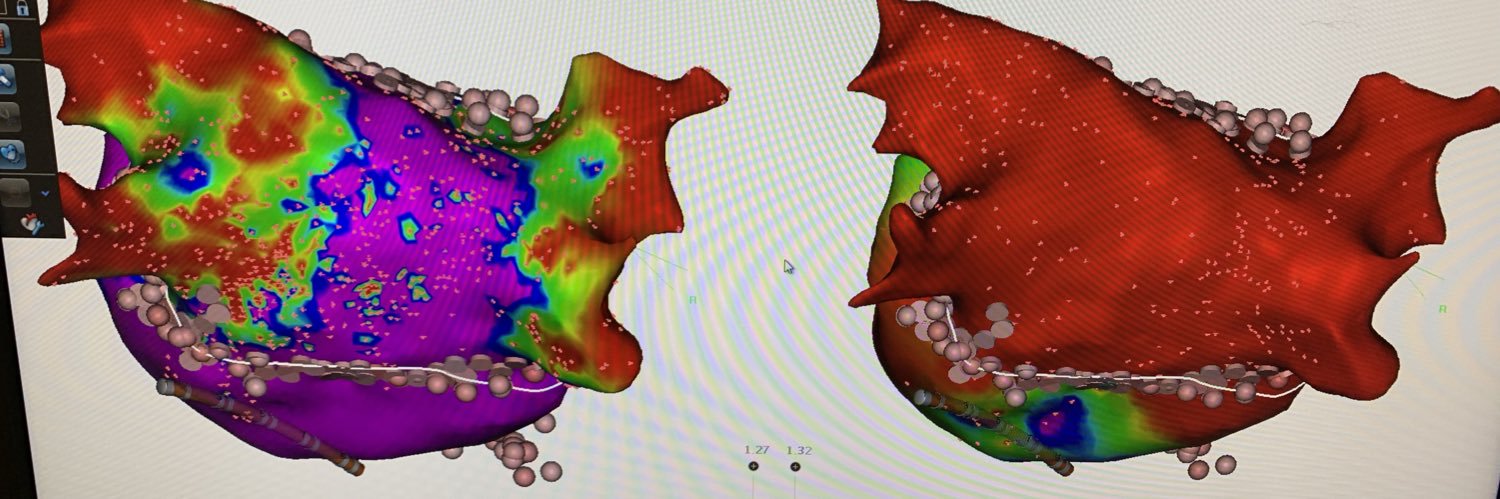
The cardiac autonomic nervous system contributes to the initiation and maintenance of AF through 1) parasympathetic- mediated shortening of action potential duration and the effective refractory period, 2) sympathetic- mediated calcium-loading, and promotion of delayed afterdepolarizations, and 3) sympathoadrenal discharge induced early afterdepolarizations in the PV and atrial myocardium. These effects are facilitated by the intrinsic cardiac ANS, which consists of clusters of autonomic neurons located within the ganglionated plexi, which contain afferent neurons from the atrial myocardium and the central ANS (ie, the extrinsic cardiac ANS), efferent adrenergic and cholinergic neurons, as well as an extensive network of interconnecting neurons.
Previous studies evaluating the neuromodulation effect of PVI postulated that the alterations in GP function following ablation were transient (typically lasting <6 months). However, this was a misconception likely related to historical reliance on intermittent non-invasive assessment performed at limited timepoints on follow-up.
We previously demonstrated that there is a significant decrease in HRV (measured as SDANN), and significant increases in daytime and nighttime heart rates (https://t.co/F8b5PVomkt), changes which are dynamic over the first 3 months following ablation and persist for 3 years or more post- ablation (https://t.co/ss0VEBRgpx). Importantly, patients free of arrhythmia recurrence had significant differences in autonomic parameters.
But the next question, is what happens to the autonomic system when randomised to ablation or AAD therapy (e.g. were the previously described effects related to the transition between AAD to ablation, or is there an independent effect)?
In the EARLY-AF population (RCT of ablation vs. medical therapy with continuous rhythm monitoring) we observed:
1. Patients randomised to ablation experienced a significant increase in DHR and NHR, and a corresponding significant decrease in HRV
2. In contrast, no significant changes in heart rates nor HRV were observed with pharmacologic rhythm control.
3. Patients who crossed over from AAD therapy to catheter cryoablation (eg acted as their own control) exhibited alterations in heart rates and HRV consistent with the treatment received (third image).
PVI results in significant sustained changes in the heart rate parameters related to autonomic function that are consistent with protective antiarrhythmic effects. These changes were not observed in patients treated with AAD therapy (https://t.co/ncJs4Qwo32).
References:
Cryo vs. RF ablation
- 1 year outcomes - https://t.co/BKRWH090t9
- 3 year outcomes - https://t.co/XKzgfSU2pc
Ablation vs Medical Therapy
- https://t.co/L0CVrSvaYl
🔥SVT Quest🔥
For EP beginners, remembering the diagnostic criteria for SVTs like AT, ORT via an AP, and AVNRT can be quite tricky😱
There’s a ton of jargon—terms like V-A-V, V-A-A-V, V-V-A responses, orthodromic His capture, total pacing prematurity, A2-H*-V*, and more—plus countless specific values essential for accurate diagnoses💦
Over the years, electrophysiologists have developed various diagnostic maneuvers, yet even the best methods reveal flaws years after their debut. Consequently, others innovate new techniques, propelling continuous evolution and enhancement in the field🔥
EP University explores the global history of SVT diagnostic criteria, detailing their introduction, significance, and concepts in chronological order.
✅Step 1
differentiating AT from ORT and AVNRT
✅Step 2
differentiating ORT from AVNRT
✅Step 3
diagnosis of concealed nodovantricular/nodofascicular or his-ventricular pathway-related tachycardia.
#EPUniversity
Here is our new JACC-EP publication on “Fluoroless ICE-Guided Concomitant Pulsed Field Ablation and Left Atrial Appendage Occlusion”.
🎥 Here is one of the 14 narrated videos:
Reattaching Core Wire to Watchman Connector Hub
https://t.co/KV1SiCHtSx
In 1958, this man’s heart kept stopping—20 times a day.
Doctors had no solution.
Then his wife demanded an experimental surgery that had only been tested on dogs.
What happened next changed medicine forever. 🧵
Takeaways from #ACC2024. Late breaking trials - take home points @ACCinTouch
1. RELIEVE-HF Trial: In patients with HFrEF and HFpEF, Interatrial Shunt did not show any significant difference in the primary effectiveness endpoint, a composite of all-cause mortality, LVAD/heart transplantation, HF hospitalizations, outpatient worsening HF events.
I adopted this probe 3 years ago and I would not go back. @HRSonline @AttuneMedical #eppes
Atrioesophageal Fistula Rates Before and After Adoption of Active Esop... https://t.co/UBfwO5lV61
The Veenhuyzen paper is an absolute masterpiece concerning SVT differentiation…. I re-read it frequently… are there other papers in EP that are just as good?
@paulzei @nmarrouche @PrashSanders
@EPeeps_Bot @CardioNerds
An outgrowth of postural orthostatic tachycardia syndrome (POTS) from #LongCovid, photos below 0, 2 and 10 minutes after standing
https://t.co/AZqGeS4HYC
Ultrasound guidance for axillary vein access in pacer/ICD implant. Discussion of technique and live demonstration.
6 min video created for HRS, but unpublished until now.
#EPeeps
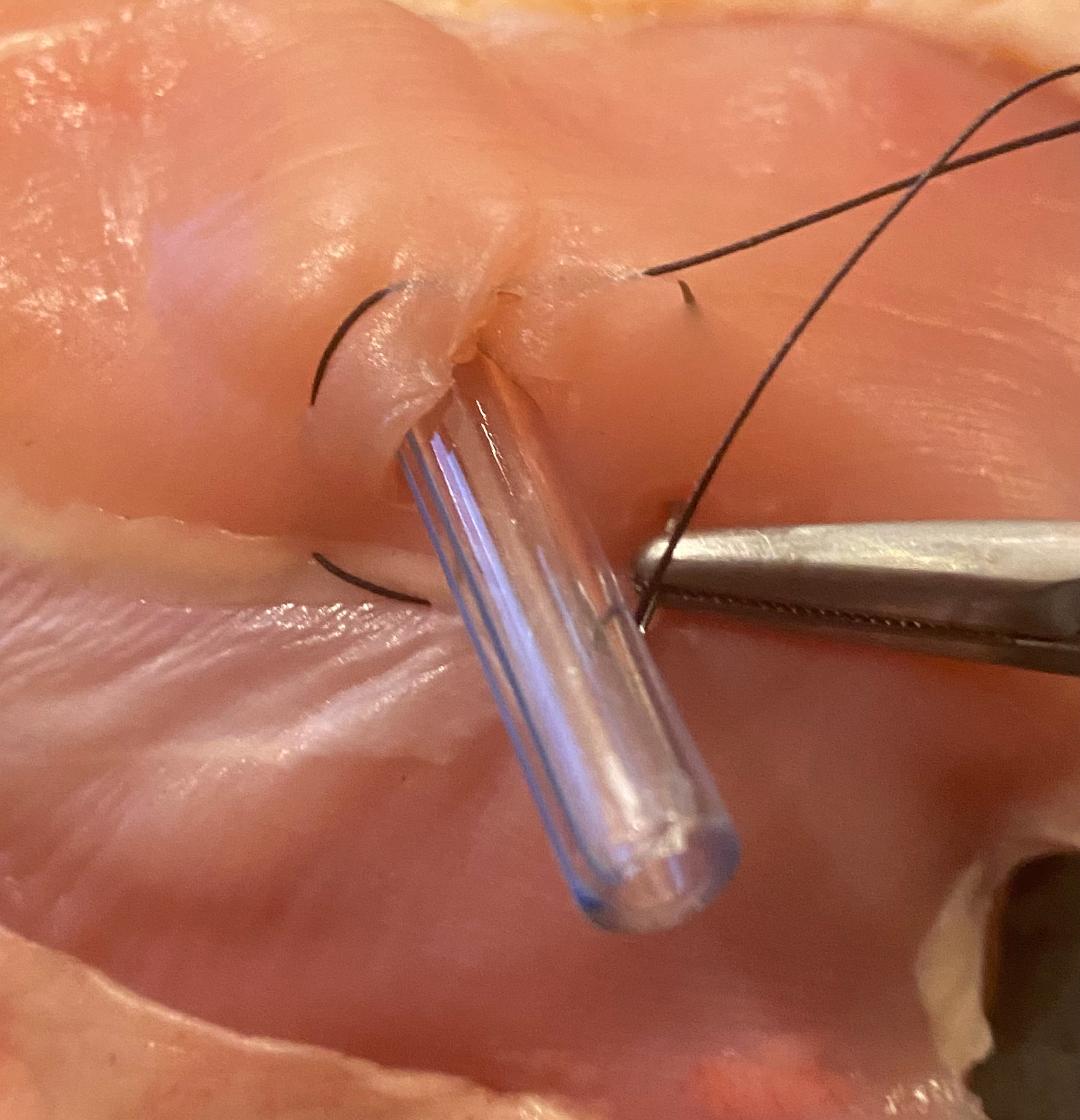
🧵regarding the 'figure-of eight' suture and also the 'pursestring' suture.
We'll go over what they are for, some technical pointers, and errors that can be made while doing them.
(1/ )
Pleased to present to you, in a new SOA 📝, everything you need to know about peri-device leak after LAAO.
📌Incidence & clinical impact
📌Detection methods & pitfalls
📌A mechanistic classification scheme
📌How to prevent & how to treat
https://t.co/BY0n4kHcjg @drpaulfriedman