Director, US Policy @crypto_council, GP @LucrumVC, @dydx @CoryBooker alum | DC sports fan. You can probably find me reading. Crypto//History//Politics//Art
The crypto policy conversation is quickly converging with other technologies including energy and AI: @Rashan@NABSummit.
Thanks to fellow panelists Robin Cook (@coinbase), @Koleyayyc
(@Bitcoin_CBC), & moderator Michael Postupak (@BlockchainAssn) for today's discussion.
Tomorrow, CCI’s Director U.S. Policy and Digital Energy Council Policy Lead, @Rashan joins @NABSummit to discuss crypto’s convergence with AI, new fronts with agentic commerce, and frontier markets.
From Legislation to Implementation: What’s Next for Digital Asset Policy?
Wed, Nov 18 · 10:45 AM CT
See you in Texas.
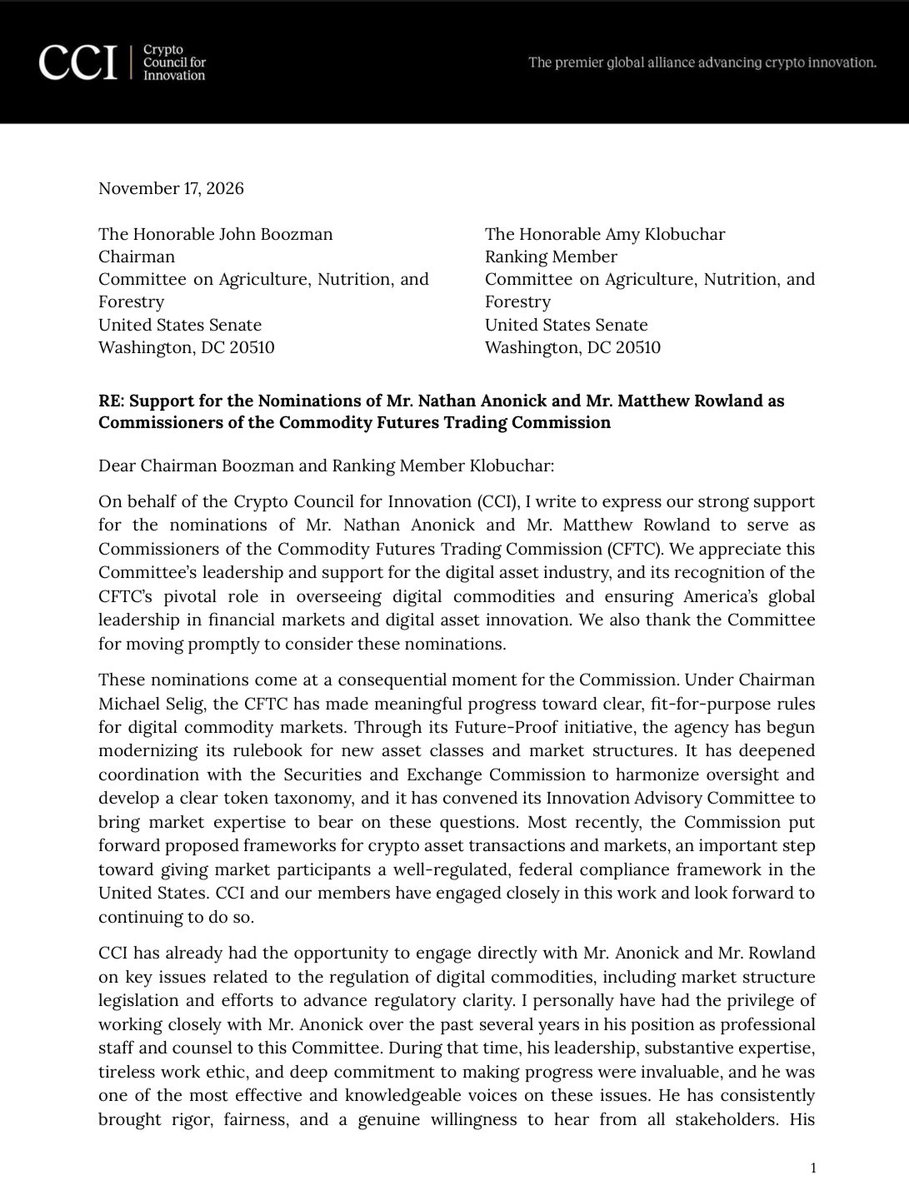
CCI expresses our strong support for the nominations of Mr. Nathan Anonick and Mr. Matthew Rowland to serve as Commissioners of the @CFTC. They are experienced nominees and their appointment would come at a consequential moment for the CFTC.
Mr. Anonick has spent years as professional staff and counsel to Senate Ag, where he was one of the most effective and knowledgeable voices on various critical issues including digital commodity policy. He brings experience across traditional and digital markets, deep understanding of regulations, and a genuine willingness to hear from all stakeholders. Mr. Rowland’s tenure as a career CFTC attorney and work for Senate Ag provide the experience and institutional knowledge critical to the position. He knows the Commission, the legislative process that shapes it, and has demonstrated a thoughtful regulatory approach that balances innovation with market integrity.
CCI commends the Committee for moving promptly on these nominations and urges Members to advance both nominees.
https://t.co/16lZ0dVKAr
New @cbventures market map alert! 🚨
AI agents are moving from talking about markets to trading in them. But as agents get easier to build, where will lasting value accrue?
My new post maps the agentic trading stack through that lens. Here’s where I’m focused:
• Agentic trading harnesses and terminals that turn a user’s goal into an ongoing strategy, with real retention.
• Market reasoning models and data assets that give trading agents a real edge.
• Identity, audit trails, and performance verification infra built for non-human, financial decision makers.
I care less about shiny demos and more about products that get harder to copy as they grow.
If you’re building here, I’d love to hear from you.
Swarm riders and Swarm-native companies
AI-use even among highly AI-native people is power-law distributed.
There seems to be a new class of people — call them “swarm riders” — who are capable of consistently commanding large swarms of agents to productive ends.
This is a new kind of managerial skill, analogous to the skill it takes to manage large organizations of people, but wholly different in nature and of course more technical.
Based on the swarm riders we know (including many at @Tempo and @Paradigm), these people are capable of productive token spend that is 1000x-10000x higher than median software engineers, and 100x higher than top 5% Claude Code users.
The art of swarm riding is different from software engineering and more akin to machine learning, where practitioners grapple with black box systems: defining reward functions and evals, transmuting non-verifiable problems into verifiable problems, running experiments, etc.
Swarm-native companies are a new class of company founded by and populated by swarm riders. These companies are organized around swarms in a way that conventional companies will struggle to replicate, as the cost of internal human coordination is sand in the gears of an effective swarm. Effective swarm-native companies will define the right reward functions and evals, remove functional and bureaucratic barriers, and then let the swarms cook.
We’ve gotten to see a few swarm-native companies up close — reshaping financial rails @Tempo, building a new gaming platform @Spawn, cyber swarms at Cathedral Systems — and it’s clear these teams wield a significant advantage over pre-AI teams.
Some questions I’ve been wondering about:
1) How fast will swarm riding diffuse through the economy? The implications for token spend could be significant.
2) Can swarms be effectively adopted by existing companies or will it generally track the formation of new swarm-native companies?
3) What becomes scarce as swarm capabilities themselves commoditize (through frontier models becoming better at swarming, swarm capabilities built into harnesses, etc)? Cultures and teams that can define reward functions well and otherwise get out of the way?
Congratulations to Nathan Anonick and Matt Rowland on their nominations to the @CFTC, and to Kristin Johnson and Steve Levine on their nominations to the @SECGov. Strong, bipartisan representation is essential to developing durable rules that safeguard markets, protect consumers, and keep the U.S. leading on innovation.
Nathan’s deep expertise across traditional and digital asset markets would make him an outstanding addition to the CFTC. I’ve seen his leadership, substance, and work ethic up close, and I know he will bring the same to the CFTC. He cares deeply about getting policy right, and our markets will benefit from his thoughtful and rigorous approach.
Matt has more than a decade of experience at the CFTC, most recently as a CFTC detailee to the Senate Ag Committee. That institutional knowledge will serve the CFTC well as it implements new rules. I’ve always respected his command of the issues and his willingness to engage directly.
Kristin brings a rare combination of government service and academic depth, including her prior tenure as a CFTC Commissioner. I always appreciated her expertise and transparent approach, and she will bring both to the SEC. Her understanding of innovation and investor protection will serve the SEC well.
Steve brings valuable experience from his prior service at the SEC and as General Counsel of the White House Council of Economic Advisers. His perspective and knowledge will certainly be an asset as the SEC modernizes its rulebook and takes on other important regulatory matters.
Both the CFTC and SEC will continue to play central and consequential roles in our financial markets, and together these nominees bring a wealth of experience and expertise that will help ensure continued American leadership. 🇺🇸
https://t.co/XboYRbT332
Everyone agrees about the vaults that hold most of DeFi’s capital.
If a user supplies assets to a lending protocol with parameters that no one can unilaterally reconfigure, the securities laws aren’t triggered—the user didn’t buy a security, the protocol isn’t an investment company, no one is an adviser, no one is a custodian.
Control is what matters.
The same applies to vaults where a DAO can change parameters through public, timelocked votes. DAO governance that sets rates and collateral parameters is market administration, not managing anyone’s money.
In July, then-Commissioner Peirce asked the people “setting interest rates, deciding which assets to accommodate, setting loan-to-value limits, and establishing liquidation thresholds” to think about whether the securities laws are implicated.
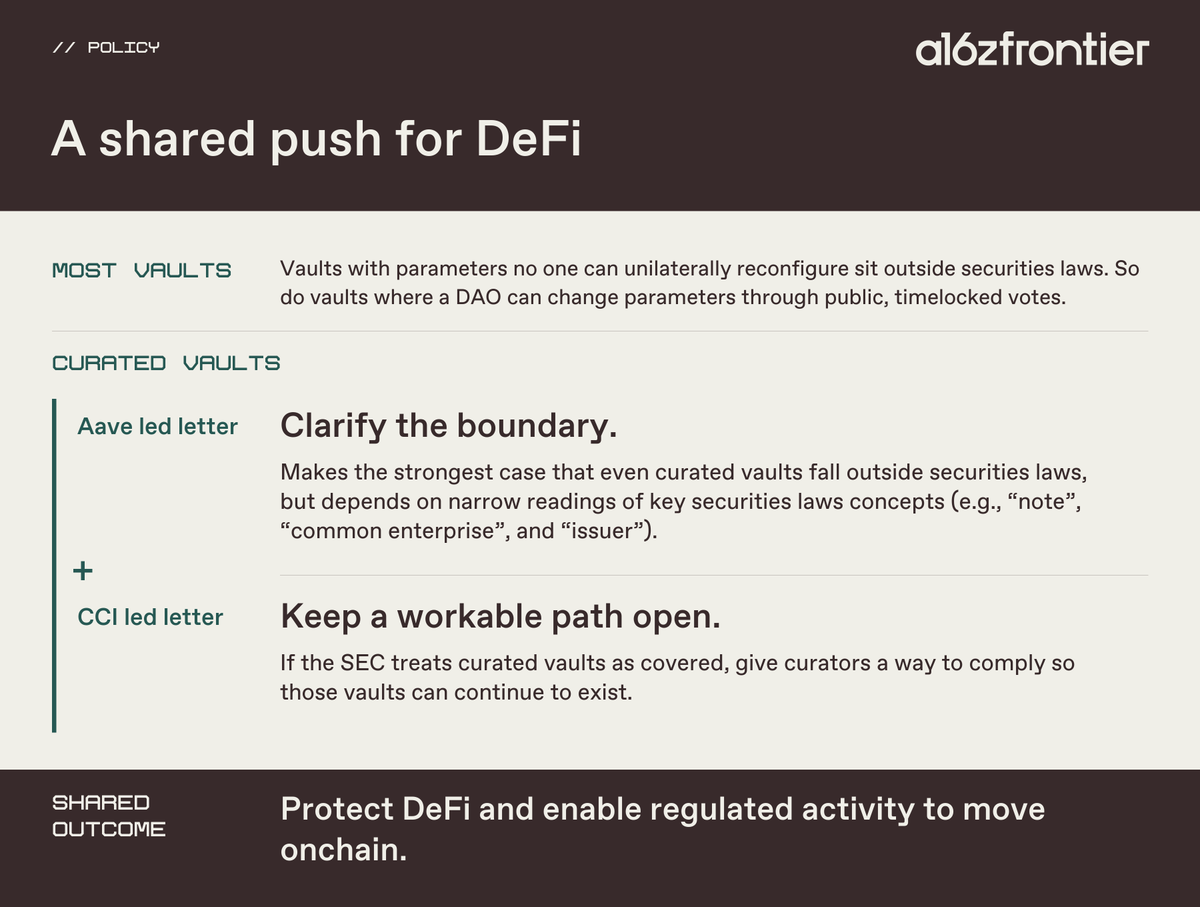
A group led by CCI and a group led by Aave recently submitted compelling answers to that call—securities laws do not reach the vaults that hold most of DeFi’s capital, and the SEC should confirm that this activity sits outside their scope.
But vaults come in many forms, and when you add complexity, the legal arguments get more complex.
Where a vault has a single curator with unbounded discretion over how the vault’s assets are deployed, the argument that it falls outside the securities laws is much more tenuous, because one cannot credibly argue that such a vault is truly autonomous.
Aave’s letter makes the strongest form of the argument that even curated vaults fall outside. But that argument depends on the SEC reading “note” to require a person who promises repayment, “common enterprise” to require a venture that investors finance rather than assets they co-own, and “issuer” to require an entity that owns the vault’s assets. Those are good arguments, but they're not conclusive. The letter also concedes that curators may be subject to the Investment Advisers Act, but does not say how they would comply.
CCI’s letter addresses what happens if the SEC does interpret securities laws to apply to some subset of curated vaults. In that world, curated vaults should still exist! The passages being quoted as “concessions” are CCI stating the adverse facts before the SEC does, which is how the baseline argument keeps its credibility, and it is what lets CCI then argue for a way for curators to comply under authority the SEC already has to tailor compliance.
Ultimately, the two letters work well together.
Both safeguard a broad vision of DeFi, both open the door for regulated financial activity—like investment fund management—to move onchain, and both provide the SEC with a lot to consider, based on how different types of vaults actually work.
*Disclosure: a16z is a member of CCI and commented on drafts of its paper.
Agree with this. Figuring out how to thoughtfully engage with policymakers offering positions somewhere on the spectrum between ratepayer protection, slowdown, and full moratorium on AI will be difficult.
Necessary to get in offices and deliver meaningful counterpoints and nuanced perspectives without creating divisions so big that they won't let us in the door.
Wonderful to see that the CFTC and @ChairmanSelig, with their remarkable speed and diligence, has approved Equity Perpetual Futures under the joint regulatory framework first proposed by American Perpetuals in the Harmonization Committee meeting we led in June.
This framework is a significant step towards enabling a robust 24/7 equity perpetuals market that is fully regulated and onshore. American Perpetuals is excited to work further with regulators to create this reality.
18 years ago, the Bitcoin Whitepaper set out a foundational vision for open, peer-to-peer transactions without intermediaries.
As the financial system continues to evolve, today reminds us of the idea that started it all, and the community that has carried that vision forward by building for the long term.
https://t.co/CZKjbTgC31
The benefits of abundant intelligence will accrue far outside of San Fransisco.
Spent the last year writing about capital, sovereignty, and the coming reordering of economic power.
THE COMMANDING HEIGHTS
https://t.co/d048KdAkbv
As the saying goes, we didn’t have time to write a short paper, so we wrote a long one.
Proud to share @crypto_council vault coalition’s work on a practical framework. Grateful to our members and the @ChapmanCutler team for bringing it together.
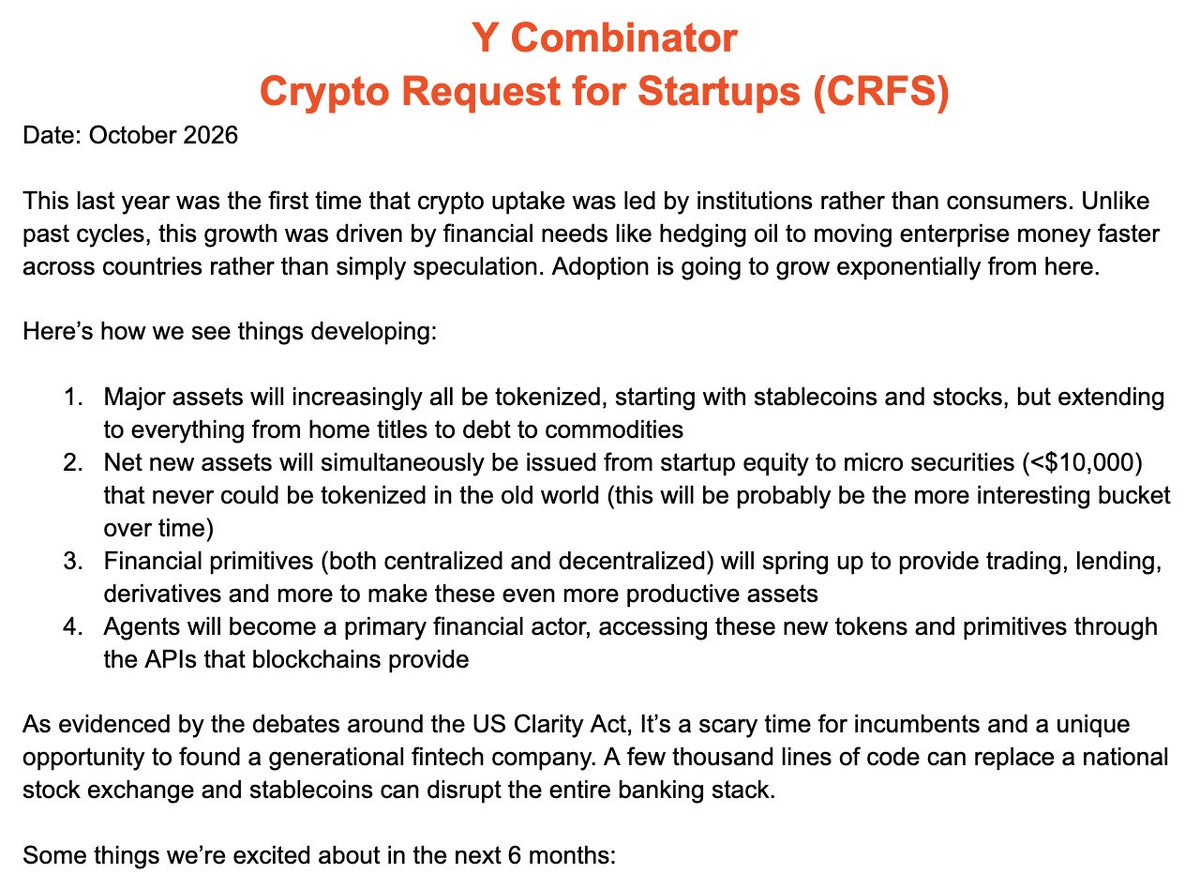
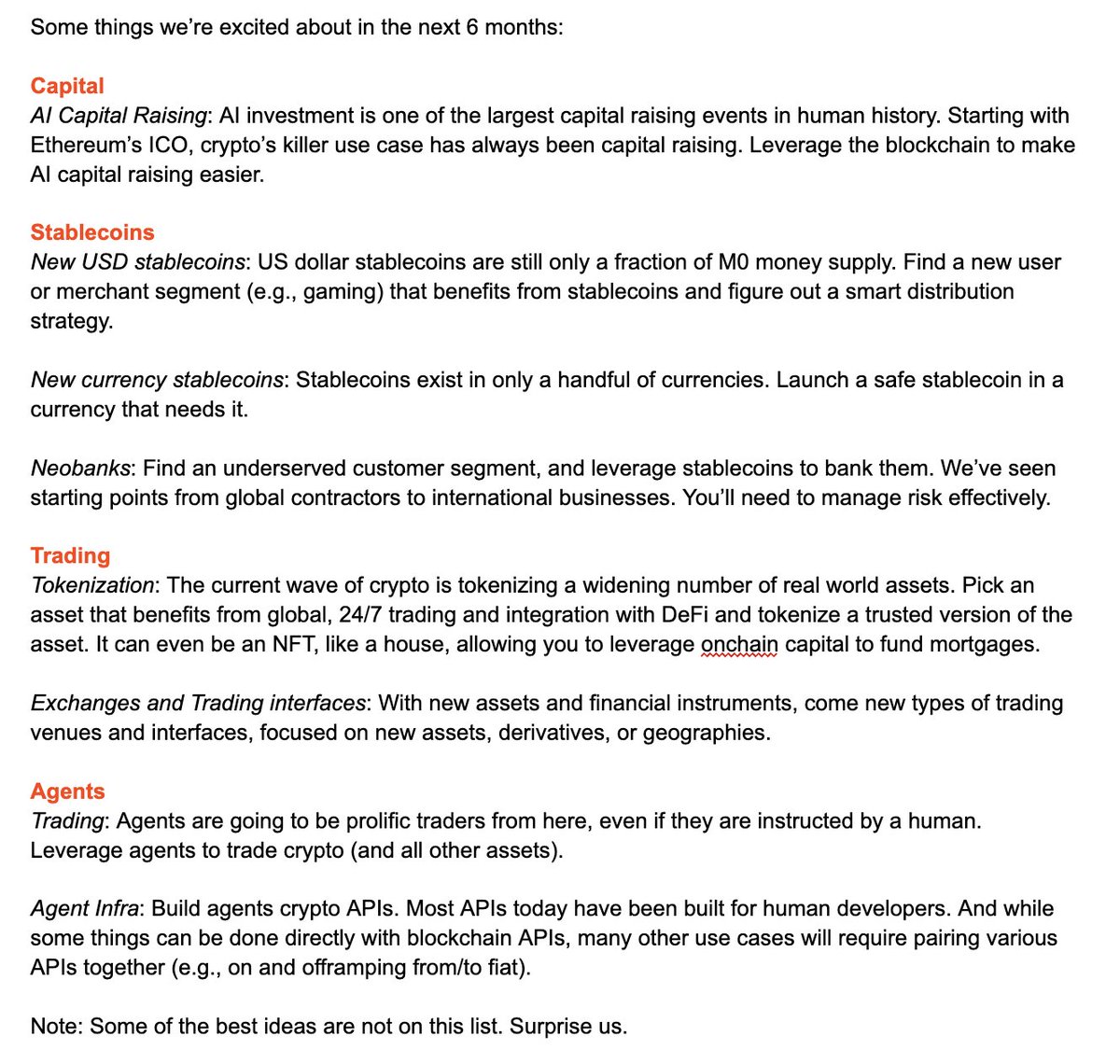
At @ycombinator, we're excited to fund more crypto startups solving financial needs including AI capital raising, stablecoins, trading, and agents.
Here's our latest crypto request for startups. Our next application deadline is Monday.