Very grateful to @dwarkesh_sp that he made this video! If you end up in a position of power, you also end up with responsibility and it is great to see him use his reach to put this message out https://t.co/4H9fkN1MT0
Once o1 was released and we knew we can set up RL for verifiable rewards on LLMs it was clear that we would eventually get AIs superhuman at math. For a while mathematicians might work on understanding and verifying AI proofs but eventually it will be a fruitless exercise.
Following Terence Tao for the last 3 years I find it almost painful to see that while he is possibly the smartest person on the planet yet he can't see the writing on the wall for math https://t.co/Vj9RMt7RQk
NEW: When OpenAI announced its Pentagon deal Friday night, people immediately challenged Sam Altman's claims. Why, they asked, would the DoD suddenly agree to red lines when it had said it would never do so?
The answer, sources told me, is that it didn't. https://t.co/DkF9uWVHa4
Many critiques and defenses of @sama and @OpenAI right now seem to be talking past each other. I think at least three issues need to be separated: the substance of the deal, the timing, and the messaging.
On substance: OpenAI appears to have accepted "all lawful uses" language with assurances that current law and policy rule out mass surveillance and autonomous weapons, rather than requiring explicit contractual commitments. They also appear to have deferred to the government's definitions rather than stipulating definitions that cover novel capabilities — like sifting through legally procured data at scale. The details are still unknown, but based on public statements, I lean towards Anthropic on both counts. That said, I can see reasonable arguments on the other side.
On timing: The government had just declared a competitor a supply chain risk — a designation normally reserved for foreign adversaries — on transparently disingenuous and unacceptable grounds. Here I feel more strongly that OpenAI is in the wrong. There are times for competition and times for solidarity, and this was a clear time for solidarity. Signing a deal mere hours later, whatever its merits on substance, undermined the entire industry's ability to push back against government overreach. That matters for principled and long-term pragmatic reasons alike.
On messaging: Sam's statement was, at best, confusing. Many people struggled to determine how OpenAI's deal differed from Anthropic's proposal. Had Sam written something like: "We accepted roughly the compromise that Anthropic rejected, because we trust the government not to use AI for mass surveillance or automated weapons, and in any case we view such matters as up to public officials, not private companies," I would have disagreed, but I would have at least respected the straightforwardness. Instead his statement seemed designed to obscure and mislead.
If I were an OpenAI employee, I would not be thrilled that a taxonomy needs to be created to clarify how the company is being critiqued and defended. But here we are. Do with this what you wish!
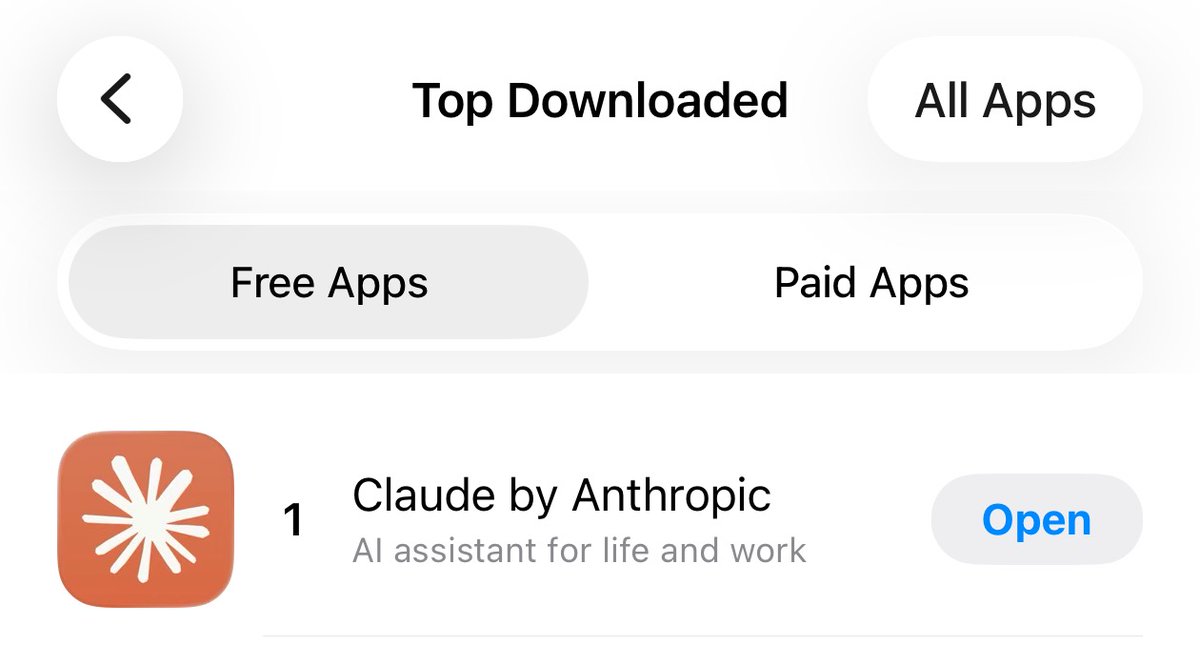
Claude is #1 in the App Store today — I want to say a huge thank you to all of our new (and existing!) users for the support. We’re working hard for you, please share your thoughts and feedback along the way.
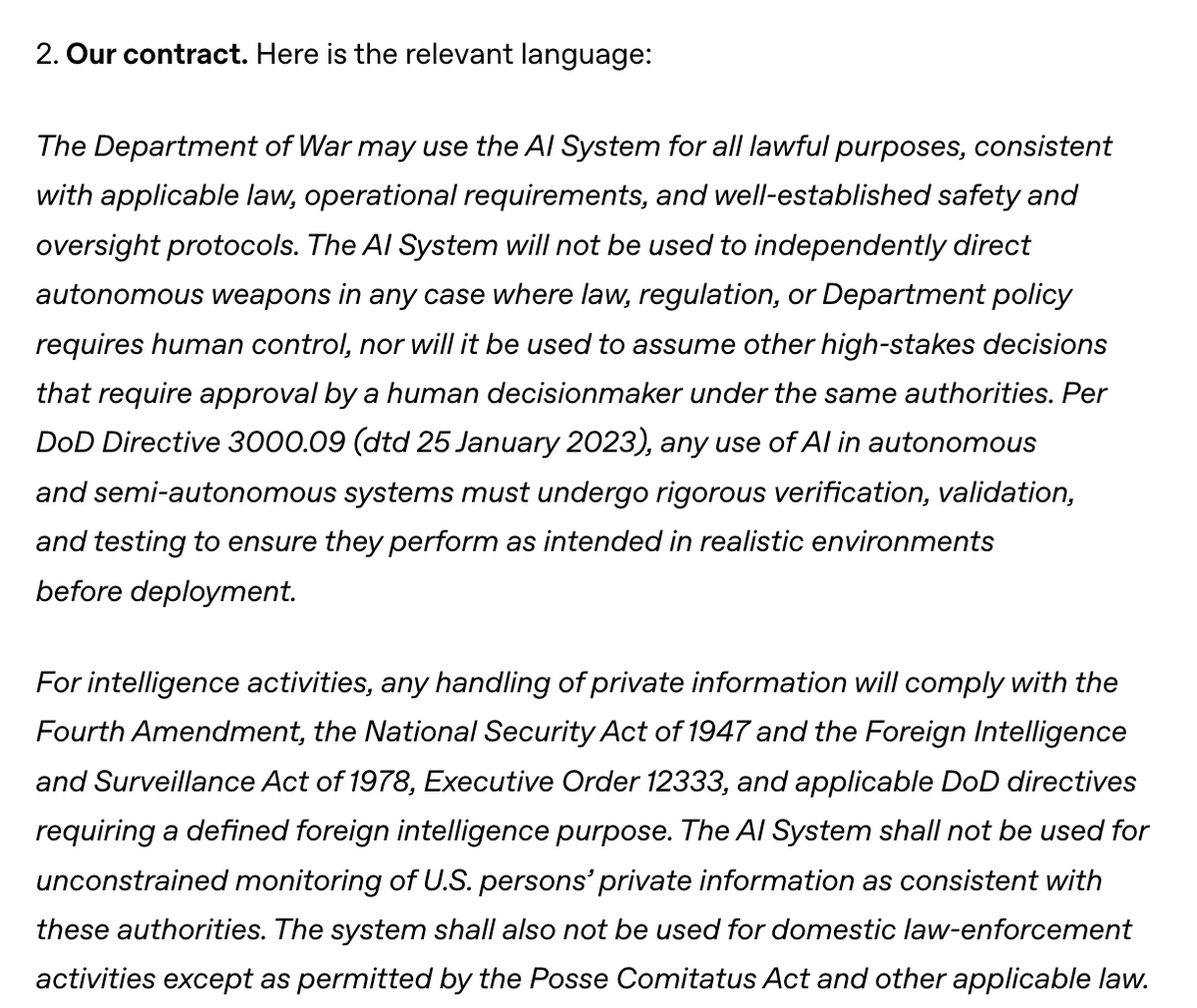
OpenAI has released the language in their contract with the DoW, and it's exactly as Anthropic was claiming: "legalese that would allow those safeguards to be disregarded at will".
Note: the first paragraph doesn't say "no autonomous weapons"! It says "AI can't control autonomous weapons as long as existing law (that doesn't exist) or the DoD says so."
Similarly, the mass surveillance use cases will "comply with existing law", but many forms of data collection that we'd consider "mass surveillance" are things that the NSA has consistently argued are legal under current law.
In light of what external lawyers and the Pentagon are saying, OpenAI employees’ default assumption here should unfortunately be that OpenAI caved + framed it as not caving, and screwed Anthropic while framing it as helping them.
Hope that is wrong + they get evidence otherwise
I appreciate @Anthropic's honesty in their latest system card, but the content of it does not give me confidence that the company will act responsibly with deployment of advanced AI models:
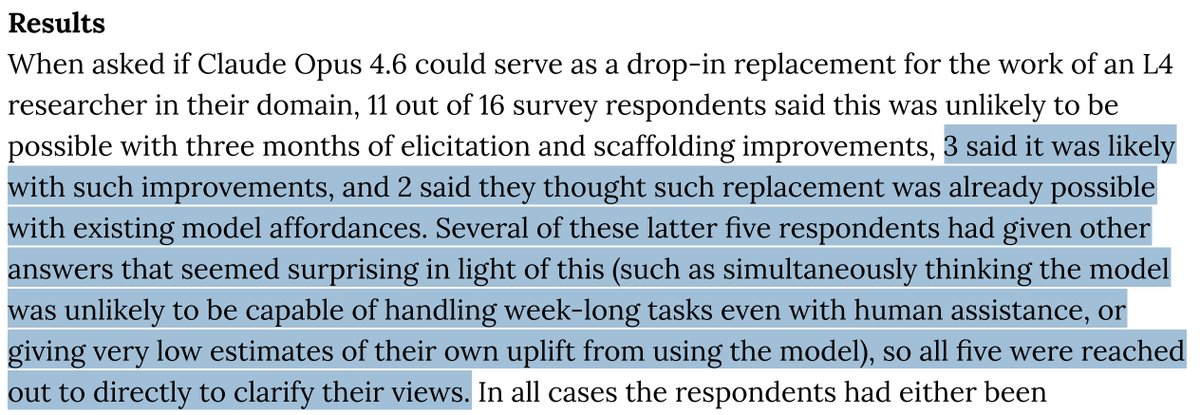
-They primarily relied on an internal survey to determine whether Opus 4.6 crossed their autonomous AI R&D-4 threshold (and would thus require stronger safeguards to release under their Responsible Scaling Policy). This wasn't even an external survey of an impartial 3rd party, but rather a survey of Anthropic employees.
-When 5/16 internal survey respondents initially gave an assessment that suggested stronger safeguards might be needed for model release, Anthropic followed up with those employees specifically and asked them to "clarify their views." They do not mention any similar follow-up for the other 11/16 respondents. There is no discussion in the system card of how this may create bias in the survey results.
-Their reason for relying on surveys is that their existing AI R&D evals are saturated. Some might argue that AI progress has been so fast that it's understandable they don't have more advanced quantitative evaluations yet, but we can and should hold AI labs to a high bar. Also, other labs do have advanced AI R&D evals that aren't saturated. For example, OpenAI has the OPQA benchmark which measures AI models' ability to solve real internal problems that OpenAI research teams encountered and that took the team more than a day to solve.
I don't think Opus 4.6 is actually at the level of a remote entry-level AI researcher, and I don't think it's dangerous to release. But the point of a Responsible Scaling Policy is to build institutional muscle and good habits before things do become serious. Internal surveys, especially as Anthropic has administered them, are not a responsible substitute for quantitative evaluations.
Claude's new constitution is a wild, fascinating document. It treats Claude as a mature entity capable of good judgment, not an alien shoggoth that needs to be constrained with rules.
@AmandaAskell will be on Hard Fork this week to discuss it!