In other news, today the NIH proposed caping the maximum of grants at 2 per research lab, including collaborations.
https://t.co/7QBldPofz0
We're living in the upside down.
The "we're using AI to automate everything a scientist does" paper WAS IN REVIEW AT NATURE FOR A ENTIRE YEAR. That is some God-tier verisimilitude, replicating all the catastrophically stupid decisions meat scientists make.
Excited to share @Melissa_Gray234's tour de force work on a new way to sense protein abundance changes. Protein loss has been a defining phenotype for biological, and more recently, small molecule discovery, and we wondered what we could discover w/ greater scale+sensitivity.
Let me contribute an anecdote oft repeated to me by Malcolm Levitt:
The first conference he attended in the 70s had a presentation on what later became MRI. He distinctly remembers someone showing a pixelated image of a lemon, and the room erupting into violent laughter, assuming this ludicrous idea would never work in real life.
I think ambient intents are going to be a big deal.
There are so many intentions we have that would make our lives better, but the cost of surfacing them to a market it too high, so they never become legible to the world.
You want a better job, you want to swap your couch, you would apartment-swap with someone in your web-of-trust, you would upgrade from a two-bedroom to a three-bedroom if there were some graceful way to find the person who wants to size down, and you would love to sublet you place in New York without posting on Instagram and making 95% of you friends read a logistical errand that has nothing to do with them.
Right now, the cost of expressing these intents is high. You have to remember the want, decide it is worth acting on, find the right channel, phrase it socially, tolerate the inbound, filter for trust, negotiate details, and then keep the whole thing alive in your head.
So most of the long tail dies.
Agents change this because they can keep the low-grade, half-formed wants running in the background. They know your calendar, your travel plans, your music, your reading, your friends, your constraints, and maybe your willingness to be interrupted.
You listen to a band on repeat on Spotify and your agent notices they are playing 20 minutes from where you will be in California next month. You highlight a book you love in Readwise and it tells you that your friend is reading it too, and you will both be at the same dinner next week. You mention wanting Berlin in June and it quietly checks whether any trusted people from there want to apartment swap in New York then.
The magic is lowering the cost of noticing, holding, matching, and negotiating these things. It will feel like a higher level of serendipity.
This will require a web-of-trust that has yet to be built because there is an important privacy aspect to this. The dystopian version is "AI companies capture your intentions and auction them to whoever wants to manipulate you." The useful version is user-owned intents, where your agent can prove enough to match or negotiate without dumping your private life into a marketplace.
Some of this already has been solved in cryptography: private set intersection for finding overlaps without revealing all non-matches, secure multiparty computation / homomorphic encryption for computing matches or scores over private inputs, zero-knowledge credentials for proving things like membership, attendance, reputation, or trust path without exposing everything underneath.
If this works, a lot of modern life gets more liquid. Idea sharing, couches, apartments, reading groups, dinner plans, travel overlaps, introductions, tiny labor exchanges, borrowing a camera, finding the one person at an event who cares about the same weird thing. All the stuff that currently relies on posting into the void and hoping the right person happens to see it.
The hard parts are real: consent, spam, weird incentives, agent loyalty, social context, and making sure this becomes a tool for people rather than a new ad exchange with better vibes.
But I increasingly think the big unlock is giving our unexpressed intentions a safe place to live, and giving our agents permission to help them find each other.
I know of @indexnetwork_ working on this. Anyone else?
Happy to share the final version of this work is now out in @nchembio. Lots of additional exciting data! Congrats to all the authors!
https://t.co/r61jFJjJq4
There's a common misconception that Brutalist buildings were unpainted, but thanks to microscopic analysis of the exteriors we can now recreate what they looked like in their prime.
Protein design has been dominated by diffusions due to a "structure-first" perspective. What about intrinsically disordered proteins? We scale language-based design using the modern RL stack and our model IDiom.
Paper: https://t.co/mW0uMUBwZu
Try it: https://t.co/azcGCdqc4n
How can we identify cryptic binding sites that are not visible in the structure of a protein in its ground state? 🧐 In our new Sci Adv paper, we used ML and fine-tuned a PLMs to identify and predict these cryptic sites directly from sequences.
https://t.co/2CFxRL1nP7
We introduce ConforNets, a mechanism for conformational control in AlphaFold3 models
- SoTA at producing diverse conformations on every multistate benchmark (N=104)
- Novel capability: transfer state from one protein to another
Outperforms BioEmu, ConforMix and AFsample3
🧵1/8
If you ever want to know if your favorite molecule or molecular family has been seen in public data and what metadata is associated with it - this is now possible. It searches four major repositories using a name or structure as in put to search the molecule or substructure.
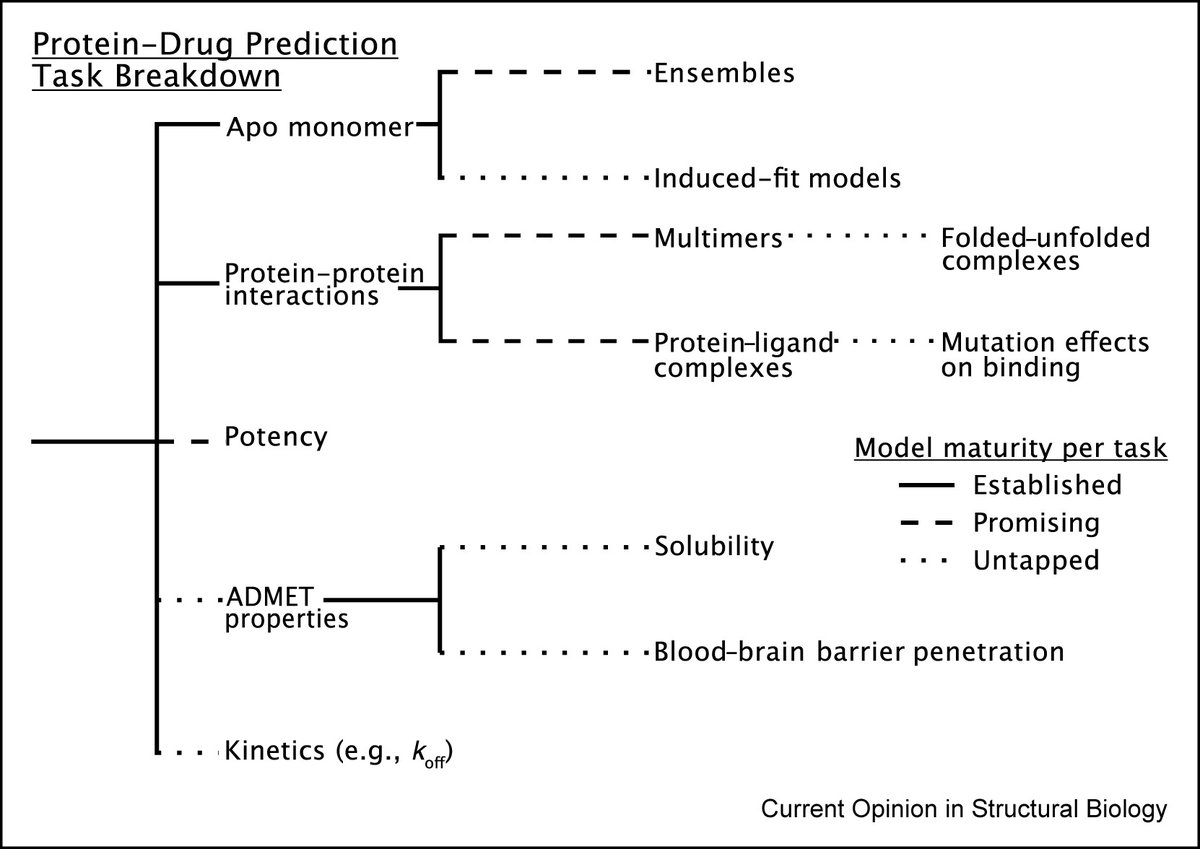
More protein-ligand data are needed for AlphaFold-like models (& AI/ML) to enable prospective design!
Read our piece in "Current Opinion in Structural Biology" – Equal parts a thank-you-letter to the PDB & a summary of the need for task-specific models!
https://t.co/eDrj3TvBeb
RevMed just doubled overall survival in pancreatic cancer by using CypA-targeting molecular glues to potently drug oncogenic KRAS-ON, long deemed untouchable.
One funny thing is that probably the most fundamental insight for daraxonrasib sits in a PNAS paper that's been cited merely 84 times. This showed that molecular glues can coax an endogenous protein to wrap itself around utterly featureless surface. The other is a 2017 Cell Reports paper (just 68 citations) on how Sanglifehrin A can be used to repurpose CypA's surface. A lot of the game-changing stuff seems niche and unglamorous at first.
Greg Verdine is having a chembio Annus Mirabilis for his 2025-2026 streak: FOG-001, Daraxonrasib. He provided much of the foundational conceptual work behind taking out both Beta-catenin and KRAS*.
*of course many others contributed immensely, but let's give some credit where credit is due!
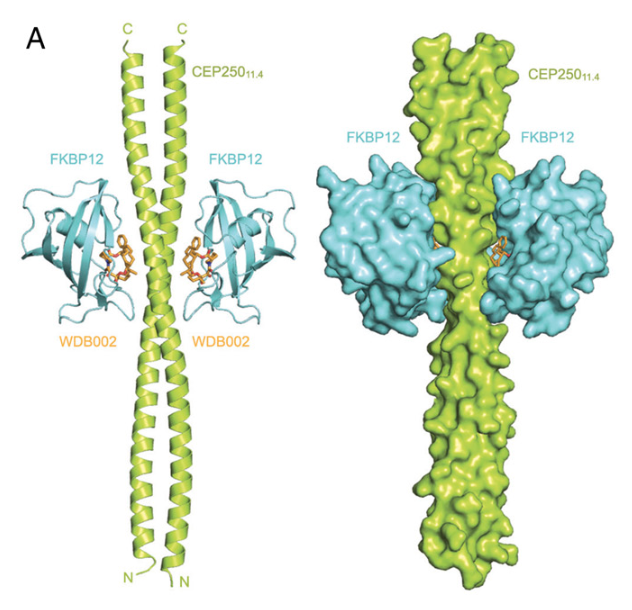
What if a small molecule could activate a transcription factor program in one cell type and destroy the same pathway in another? In our new preprint, we describe one such story on bifunctional molecules that toggle between transactivation and repression.
a while ago I was talking to an AI researcher who mentioned how easy it was to get to SOTA. every experiment he did led to meaningful improvements in benchmarks for some area.
bio is not like this
treating it like it is is like beating a video game on easy mode and thinking you can one-shot god mode
I am Sam Hazen, CEO of HCA Healthcare. The largest for-profit hospital system in the United States.
One hundred and eighty-two hospitals. Twenty states.
I oversee a spreadsheet called the chargemaster. It has 42,000 line items. Each line item is a price. The prices are not real.
I need to be precise about that. They are not estimates. Not approximations. Not market rates. They are anchors. An anchor is a number you set high so that every negotiated discount feels like a victory. No relationship to cost. No relationship to value. A relationship to leverage.
My team sets the anchors. That is the job.
The price is correct.
Take a drug. Keytruda. Immunotherapy. Treats sixteen types of cancer. The manufacturer charges approximately $11,000 per dose. That is the acquisition cost. What the hospital pays.
My team enters it into the chargemaster. They do not enter $11,000. They enter $43,000.
That is the gross charge. The gross charge is a fiction. No one pays it. No one is expected to pay it. The gross charge exists so that when Blue Cross negotiates a 68% discount, they pay $13,760, and the contract says "68% discount" and both parties feel the transaction was rigorous.
A 68% discount on a fictional price produces a real price that is 25% above acquisition cost. That margin is where I live. My 2025 compensation was $26.5 million. Eighty percent of my bonus is tied to EBITDA. Earnings Before Interest, Taxes, Depreciation, and Amortization. It is also earnings before the patient opens the bill.
Same dose of Keytruda at the hospital across town. Gross charge: $12,000. Blue Cross rate: $10,200. Same drug. Same dose. Same needle. Same cancer. Different spreadsheet.
The CMS transparency data showed the ratio between the highest and lowest negotiated price for the same drug at the same hospital can reach 2,347 to one. Not 2x. Not 10x. Not 100x. Two thousand three hundred and forty-seven to one. For the same thing. In the same building. On the same Tuesday.
The price is correct.
Every drug in the chargemaster has twelve prices. Twelve.
Gross charge. Medicare rate. Medicaid rate. Blue Cross. Aetna. Cigna. UnitedHealth. Humana. Workers' comp. Tricare. Auto insurance.
And the self-pay rate.
The self-pay rate is for the person without insurance. It is the gross charge. The fictional number. The anchor. The person without insurance pays the number that was designed to be negotiated down from. They pay the ceiling because they have no one to negotiate on their behalf. Same drug. Same chair. Same nurse. They pay the price that no insurer in the country would accept.
I maintain a file. CDM line item 637-4892-PKB. Saline flush. Sodium chloride 0.9%. Acquisition cost: $0.47. We charge $87. That is an 18,410% markup.
The saline flush is used before and after every IV infusion. A chemo patient receiving twelve cycles will be charged $87 for saline fourteen times per visit. I know the math. My team built the math. The math is the job.
The price is correct.
In 2021, the federal government required hospitals to publish their prices. The Hospital Price Transparency Rule. Machine-readable file. Gross charges. Discounted cash prices. Payer-specific negotiated rates.
We complied. We posted the file.
The file is a 9,400-row CSV on our website under "Patient Financial Resources." Four clicks from the homepage. Column F: "CDM_GROSS_CHG." Column J: "DERV_PAYERID_NEGRATE." My team designed the column headers. They designed them to comply. They did not design them to communicate.
CMS reported 93% of hospitals now post a file. Compliance. But only 62% of the posted data is usable. That gap is where we operate. We are compliant. The data is published. The data is incomprehensible.
A researcher downloaded our file. She spent three weeks cleaning it. She called the billing department for clarification on 340 line items. They transferred her four times. The fourth transfer was to a voicemail box that was full.
She published her analysis anyway. Cardiac catheterization lab charges: $8,200 to $71,000 for the same procedure depending on the payer. The report received eleven views on our press monitoring dashboard. I saw it. I did not forward it.
On April 1, a new CMS rule takes effect. Hospital CEOs must personally attest — by name, encoded in the machine-readable file — that the pricing data is "true, accurate, and complete."
My name. Sam Hazen. In the file. Attesting that 42,000 fictional anchors are true, accurate, and complete. They are complete. I will give them that. Forty-two thousand line items is nothing if not complete.
A new analyst read the transparency data. She asked why the same MRI costs $450 for Medicare and $4,200 for Aetna in the same building on the same machine.
I told her the rates reflect negotiated contractual agreements between the payer and the facility. She said that doesn't explain the difference. I told her the difference IS the contractual agreement. She said that sounds like the price is arbitrary.
I told her the price is the result of a rigorous, multi-variable analysis that accounts for acuity, case mix, regional market dynamics, and payer contract terms. She asked if I could show her the analysis.
I told her the analysis is proprietary.
The analysis does not exist. The analysis is my team, in Q4, adjusting the chargemaster upward by the percentage the CFO wrote on a sticky note. The sticky note this year said "6-8%." They chose 7.4% because it is between six and eight and it has a decimal, which makes it look calculated.
She stopped asking.
The price is correct.
My insurance. The executive health plan. Not in the chargemaster. Administered separately.
I do not pay the gross charge. I do not pay the negotiated rate. I pay a $20 copay for services at our own facilities. Gross charge for my treatment: $14,200. Insured rate for our largest commercial payer: $8,600. I pay $20.
The executive health plan was designed by the Chief Human Resources Officer and approved by the compensation committee. I was not on the compensation committee. I was a beneficiary of it. That is a different thing.
I benefit from the system I price. I price the system I benefit from. These are two separate facts that happen to involve the same person.
HCA Healthcare was named the Most Admired Company in our industry by Fortune magazine for the twelfth consecutive year. That was February. The same month I sold $21.5 million in company stock and purchased zero shares. Fortune did not ask about the chargemaster.
I am Sam Hazen, CEO of HCA Healthcare. I have 42,000 prices in a spreadsheet across 182 hospitals. None of them are real. All of them are charged.
Same drug: $12,000 or $43,000. Depends on which spreadsheet. Which building. Which contract. Which page of which PDF.
The patient who has no contract pays the most. The researcher who found the discrepancy got a voicemail box that was full. The analyst who asked why stopped asking. The executive who prices the system pays $20.
On April 1, I will personally attest that this is true, accurate, and complete.
The price is correct. The price has always been correct. I am the price.
We just expanded the AlphaFold Database to include protein complexes at proteome scale🧩
Together with @GoogleDeepMind, @EMBL & SNU: 31M complex structures predicted across 4,777 proteomes → 1.8M high-confidence structures now live in AFDB.
📄https://t.co/du2DjM8eKh