🤖 Scaling deployment in robotics can be difficult and expensive. How can we properly serve a VLA/WAM to 10+ robots concurrently from a single GPU?
Introducing Armory, a system for serving large robot policies to a fleet of robots from the cloud/edge. Through real-time scheduling of action chunks, Armory boosts task throughput over baselines by up to 18% on heterogeneous fleets in the real world.
🧵1/6
Train on static objects. Grasp moving objects. 🤖
Many visuomotor policies assume static objects. Real deployments break this: parts drift on conveyors, fruits sway in the wind. Meet SIDO (Static In, Dynamic Out), taking a policy trained only on static demos to moving objects.
System & infra is first-class citizen of robot learning.
To see how we can serve 10+ robots smooth as butter from a single remote GPU, check out @davidhe137 and @rbansal22 's work Armory! https://t.co/Zi4jQoNPjS
🤖 Scaling deployment in robotics can be difficult and expensive. How can we properly serve a VLA/WAM to 10+ robots concurrently from a single GPU?
Introducing Armory, a system for serving large robot policies to a fleet of robots from the cloud/edge. Through real-time scheduling of action chunks, Armory boosts task throughput over baselines by up to 18% on heterogeneous fleets in the real world.
🧵1/6
🧵6/6
Paper co-led by @rbansal22@davidhe137, made possible by @NadunRanawakaA, @DanielZhenyang, Soobum Kim, @kexinrong, @danfei_xu.
Furthermore, we open source our serving engine, which is ready to serve Pi05 out of the box, with more models and improvements to come. You can spin up a server or reproduce our experiments all in one command with @modal. Check it out here: https://t.co/YfqJh1cXCM 😄
Website: https://t.co/r57YwPkKyq
Paper: https://t.co/3Y7xf0PA6L
How efficiently can we serve policies to a fleet of robots?
@rbansal22 and @davidhe137 discovered that cloud-based policy serving is in fact a scheduling problem with complex real-time constraints (sometimes robot waiting for inference = failure)
With our serving engine Armory, a single gpu can serve a large VLA to a fleet of 10+ robots simultaneously without pausing any robots.
🤖 Scaling deployment in robotics can be difficult and expensive. How can we properly serve a VLA/WAM to 10+ robots concurrently from a single GPU?
Introducing Armory, a system for serving large robot policies to a fleet of robots from the cloud/edge. Through real-time scheduling of action chunks, Armory boosts task throughput over baselines by up to 18% on heterogeneous fleets in the real world.
🧵1/6
Today's frontier VLAs can do many tasks—but they're far less steerable than advertised. Switch the instruction mid-execution and frontier models often plow ahead with the original task anyway.
🤖In our #RSS2026 paper, we measure steerability, explain why it breaks, and fix it. Introducing **ReSteer** (1/7)
Today, we're introducing SimFoundry, our real2sim2real framework at NVIDIA GEAR that automatically turns real-world scenes into simulation-ready worlds from a single image or video.
Website: https://t.co/JB3kf3GlYm
Paper: https://t.co/pVhE1qWXtU
This work marks a major step for our team toward leveraging simulations and synthetic data for foundation model training and systematic policy evaluation at scale. Code will be open-sourced soon. Stay tuned!
@WinstonGu_ really cool work! Saw that the internal model uses 32-len history. How sensitive is the performance to this window size? For tasks with more time varying contact like the calligraphy task, is a longer history required to capture the dynamics?
@DrJimFan awesome! how did you define kinematic limits for the -z direction? i found that imposing a safety box with the floor being the table caused some false resets when the gripper went to grasp something flat on the table
It'd be fun if OpenReview generated a radar chart of secondary/tertiary keyword correlations, like “you bid on a lot of WAM papers but statistically you’re also a sim2real + dex manip + sample efficiency typa guy”
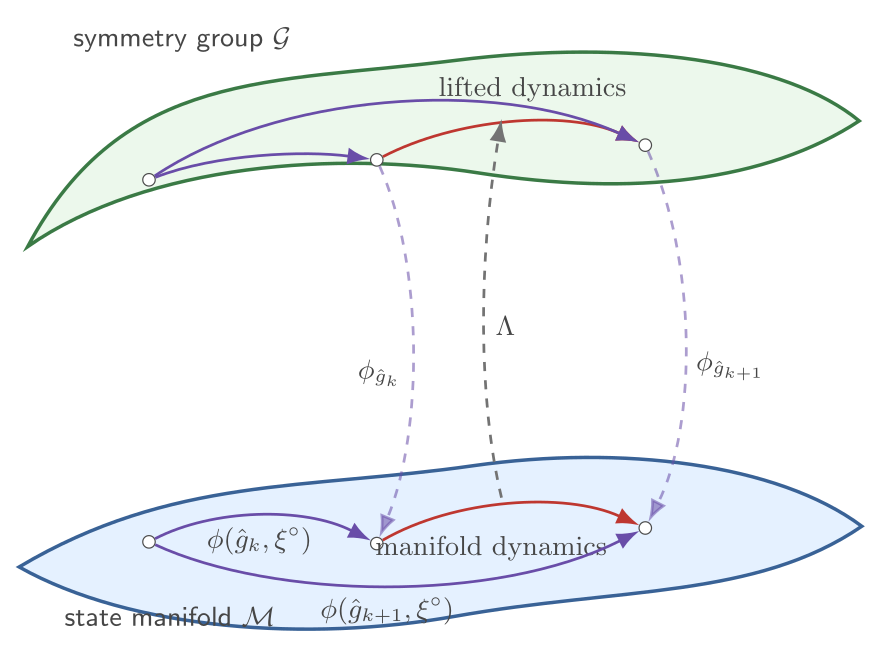
Thrilled to share AwesomeEqF, a curated reading list of EqF papers + GTSAM notebooks, with more to come. Many weeks of careful iteration went into porting EqVIO/ABCEqF faithfully into the framework, and it was a team effort. Huge thanks to @dellaert for advising me on this!
Check out our blog post on the equivariant filter, a state estimation approach that exploits system symmetry for more robust and accurate estimates.
If your state may not be a group but a group still acts on it, an EqF is the way to go!
New GTSAM blog post on a new capability: the Equivariant Filter (EqF). This one is geekier than last week’s STAG post, but if you're intrigued by equivariance, manifolds, or symmetry-aware estimation, this post provides a gentle intro to the EqF. teaser image below, link in reply.