Apply to do a PhD at @sangerinstitute with me on global genomics of Mycobacterium abscessus
https://t.co/HrqEYj0IOq
About the scheme:
https://t.co/1gHbGGK238
“Every language offers a different window onto the world.” 🌍
Irish poet Ailbhe Ní Ghearbhuigh introduces us to 5 beautiful Irish phrases that offer more than just a glimpse into the Irish language. They invite us to see the world a little differently.
Sometimes, discovering a new way of expressing an idea can open up a new way of seeing it. From poetic turns of phrase to feelings that are difficult to capture in English, Irish offers its own unique window onto the world.
🎧 https://t.co/D4UxqdlF9J
"Oh my mama told me. There'll be days like this...."
Relive a famous night for Team Ireland at the European Championships which saw Mark English take home the gold and Rhasidat Adeleke win silver.
1/ My friend spent two years on a project that was broken before he ever touched a pipette.
The transgenic mice arrived. The gene knock-in was supposedly already validated. He just started running experiments on top of it.
New from me:
Young people in Britain are some of the most well-educated in the rich world, but economic stagnation means that breeds not growth but frustration.
In fact, US workers who are functionally illiterate now earn roughly the same per hour as the average British worker.
There has been a slow but seemingly inexorable industrialization of academic science that, while apparently laudable for its “practicality”, risks stamping out that which makes academic science beautiful and precious to begin with.
GSK has been in Stevenage for decades. Now the new CEO wants to flip to Cambridge. Has relocating R&D, "immersing" yourself in one of the big hubs, ever achieved the creative revolution that executives imagine? Or is it just a giant pain in the ass for researchers as the CEO seeks applause for a disruptive organizational move camouflaged as strategy?
https://t.co/gEftlW2eBI
New laws in Afghanistan, introduced by the Taliban, mean that men can now marry girls at any age – there is no limit. Male relatives can arrange this with other men, and it’s only once the girls reach puberty that, in extremely limited circumstances, they can ask a court to dissolve the marriage. What’s happening in that country is horrific, and it begs the question why Amnesty are not putting all of their resources into tackling this latest child abuse atrocity.
“The findings raise questions about one of the most-hyped UK AI developments, and suggest a centrepiece of US-UK AI cooperation was in fact little more than a press release.” https://t.co/9cgziu3anK
This should be treated like a national emergency. The UK infant mortality rate is now around 4.1 deaths per 1,000 live births — higher than France, Germany, Spain, Norway and Italy. A child’s postcode, poverty level and access to early support should not decide whether they survive their first year. Child health is infrastructure. Fund it like it matters.
More children in the UK are dying in their first year of life than in almost all other European coutries. The @RCPCHtweets warns UK must do more to protect children's health:
https://t.co/O54VhPjLdG
Zero days since I found Claude Code made a pretty serious, subtle implementation error in a scientific analysis.
Agentic coding will greatly accelerate science, and is an overall good thing. But it’s essential to invest the new productivity into even more checks and validations.
Announcing Built with Claude: Life Sciences, a global virtual hackathon.
Join us and @GladstoneInst for a week of researching and building with Claude Science and Claude Code, with a prize pool of $100k in credits.
Claude Science is incredible. I gave it some sequencing data, and in 8 hours it did a full analysis, generated figures, wrote a paper, submitted it for publication, got rejected, revised and resubmitted, got rejected again, it is now applying for positions in industry
Big early test on health for @andyburnham Will he snub families from across England wanting a public inquiry to force those who refuse to give evidence to do so? Families tell me they are prepared to take his Govt to court. Ockenden backs an investiagtion of regulatory bodies
Do single-cell foundation models obey scaling laws?
A somewhat thought-provoking new Nature Methods study by the Crawford lab suggests that, for current single-cell foundation models, the answer may be “not really.” Across a broad range of architectures and downstream tasks, increasing pretraining data from hundreds of thousands to tens of millions of cells yielded surprisingly limited gains, with performance often saturating much earlier than expected.
This is interesting and provides exactly the kind of rigorous benchmarking our field needs. As Felix Fischer and I commented in the accompanying Research Briefing, such studies help move the discussion beyond model size and computational budgets toward actual scientific utility.
At the same time, I am not convinced the key conclusion is that scaling does not work in biology. Rather, it may be that current objectives are not extracting enough information from additional data.
Interestingly, in our recent scConcept work, we observe a markedly different scaling behavior, with continued gains as training data grows toward hundreds of millions of cells. The key difference may be the training objective itself: instead of reconstruction-based masked modeling, scConcept uses a contrastive objective that directly optimizes biologically meaningful cell representations.
https://t.co/CR8DSUmHi3
This raises an interesting question for the field: Have we reached the limits of data scaling, or only the limits of current objectives?
-> My guess is that the next generation of biological foundation models will depend less on simply collecting more cells and more on finding the right representation learning principles for biology.
Nature Methods paper:
https://t.co/ArtUo1fcPE
Research Briefing:
https://t.co/5er4vGJiAJ
#SingleCell #FoundationModels #AIforBiology
No scaling laws for single-cell foundation models: when bigger atlases stop teaching the model anything
In language and vision, the recipe has been simple: more data, bigger models, better performance. Single-cell biology borrowed that playbook. Foundation models for transcriptomics jumped from 1 million cells to atlases of over 100 million, on the assumption that scale would unlock the same gains. Alan DenAdel and coauthors put that assumption to the test, and the result is sobering.
Working from a 22.2-million-cell corpus, they pretrained 400 models across five architectures (from PCA and a variational autoencoder up to the Geneformer transformer) and ran 6,400 evaluation experiments. They varied not just dataset size (1% to 75%) but also diversity, using cell-type re-weighting and geometric sketching to deliberately enrich rare cell types and transcriptional states.
The finding: performance saturates almost immediately. On cell-type classification, batch integration, and perturbation prediction, most models hit their ceiling at roughly 1% of the corpus, about 200,000 cells. Beyond that, adding millions more cells changed essentially nothing. More diversity didn't help. Even spiking in genome-scale Perturb-seq data, to give the models perturbed phenotypes rather than just healthy ones, failed to move the needle. Larger models did score better overall, but they too plateaued early on data.
Two points stood out. Simple baselines (PCA, logistic regression) often matched or beat the transformers. And the strongest model, SCimilarity, won not because of size but because its contrastive training objective is aligned with the downstream task. For single-cell data, what you train on and how you frame the objective matters far more than how much you collect.
This reframes a quiet but expensive habit. In drug discovery, biotech, and any pipeline leaning on cell atlases, the instinct to keep scaling pretraining corpora may be burning compute for no return. The real leverage sits elsewhere: curating high-quality, task-relevant data and matching the training objective to the actual question you're trying to answer.
Paper: DenAdel et al., journal license | https://t.co/X7GxoxF5U5
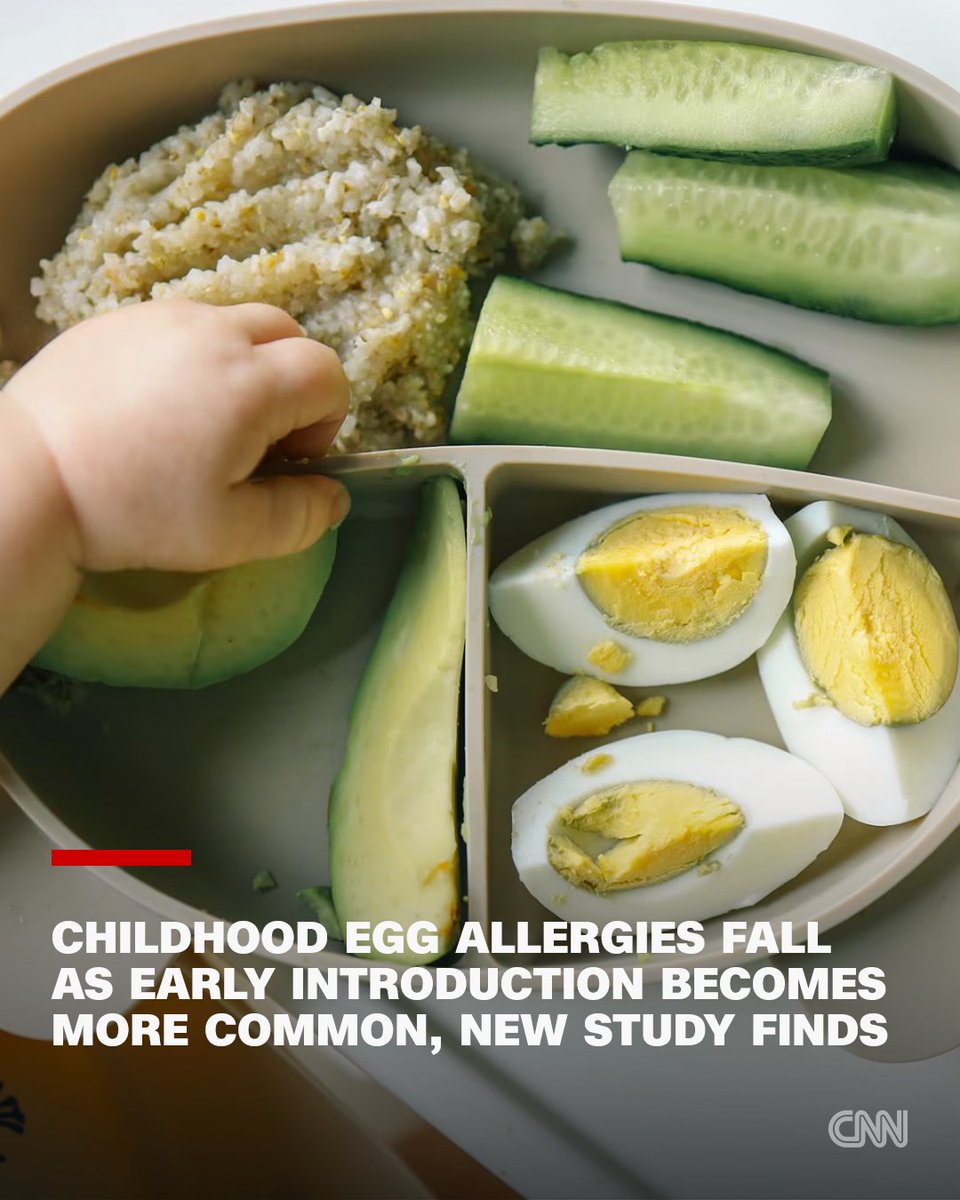
After the drastic change in guidance to no longer keep allergenic foods away from babies until 1 to 3 years of age and instead introduce them by 6 months of age, the prevalence of egg allergy among children fell by more than 17% in a new study published Monday in the journal JAMA Pediatrics. https://t.co/DAYqlFom8N
Exciting breakthrough technology from the lab, now live in @CellCellPress ! Instead of cutting the genome where proteins bind (e.g., Cut&Tag), D&D-seq scars the DNA with a deaminase, allowing single cell genome mapping of TFs and chromatin remodellers!
Between 1985--2023, MIT's faculty grew 9%. Administrative staff grew 189%. 📈 Why? In new @PNASNews paper, we use dynamical system model to show administrative bloat can emerge without empire-building--just from well-intentioned problem-solving gone awry https://t.co/MZgGkxilZ2