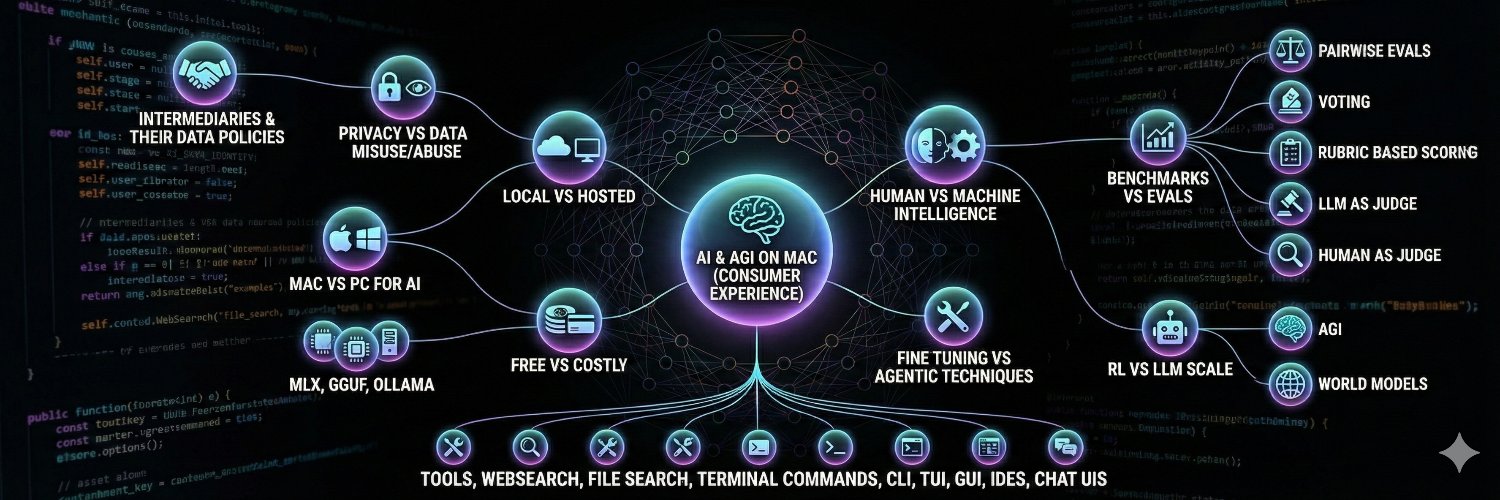
Major update to ollamadash - a single home view to see and search through leaderboard (@ArtificialAnlys ), local models by size (@ollama ) and hosted models by price (@OpenRouter )
You can also dig deeper in the other tabs.
https://t.co/zCNzi0Ibjs
A pivotal moment in the history of AI was when someone in some AI lab decided to stop having a "Chat" mode in coding assistants - only plan and code/build. This was the beginning of AI labs taking control away from engineers. Inevitable? Yes. Premature? Also, yes.
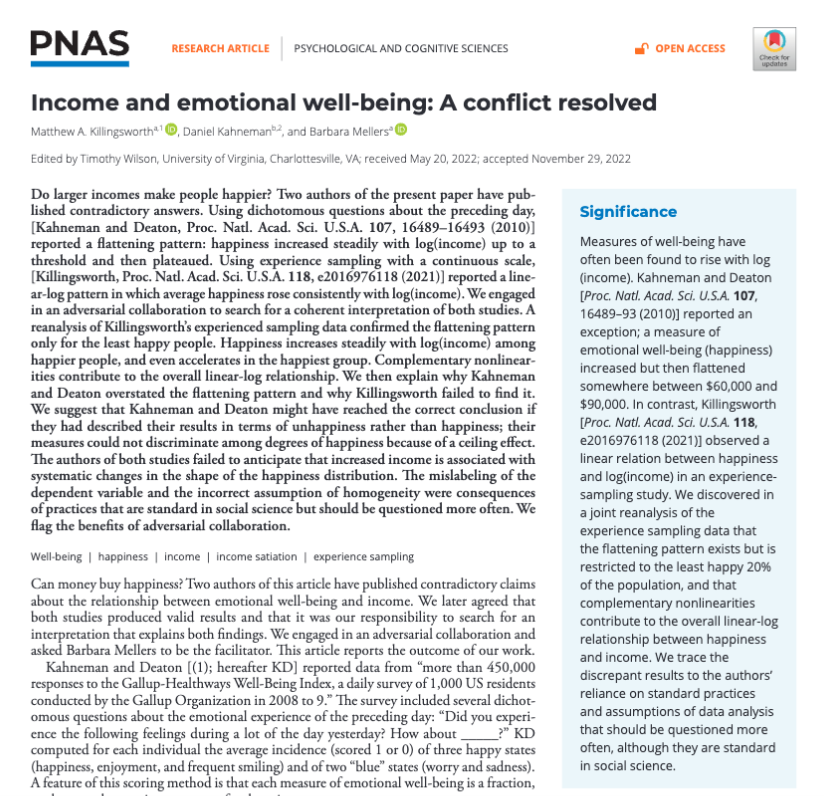
Does money buy happiness? A Princeton Nobel laureate said no above $75,000. A Penn researcher with 1.7 million data points said yes. The day they sat down together to settle the fight, the answer they reached should change how you think about your own life.
The Nobel laureate is Daniel Kahneman. The Penn researcher is Matthew Killingsworth.
The fight between them lasted 13 years, and the way it ended is one of the cleanest examples in modern science of two smart people being wrong in opposite directions about the same question.
In 2010 Kahneman and his Princeton colleague Angus Deaton published a paper that became one of the most quoted findings in the history of social science.
They analyzed 450,000 responses to the Gallup-Healthways Well-Being Index and concluded that emotional well-being rose steadily with income up to about $75,000 a year, and then flattened out completely. Above that line, the extra money was not buying any more daily happiness.
The headline traveled around the world. Every news outlet ran the number.
A CEO in Seattle famously cut his own salary to raise his employees to that exact threshold. The 75,000 dollar figure became cultural shorthand for the idea that the rich are not actually any happier than the rest of us once basic needs are met.
For 11 years almost nobody seriously challenged it. Kahneman had a Nobel Prize in Economics, the sample size was massive, and the conclusion was emotionally satisfying in a way that made everyone feel a little better about not being wealthy.
Then in 2021 a 33 year old researcher at the University of Pennsylvania published a paper that quietly destroyed the entire finding. His name is Matthew Killingsworth.
He had spent the previous decade building a smartphone app called Track Your Happiness that pinged users at random moments during their day and asked them a simple question.
How do you feel right now, on a scale from very bad to very good. The app was designed to catch happiness in the act, not to ask people to recall it later.
By 2021 he had collected over 1.7 million real-time happiness reports from 33,000 adults. When he plotted income against in-the-moment well-being, there was no plateau anywhere.
The line just kept rising. People earning $200,000 were happier on average than people earning $100,000. People earning $400,000 were happier than people earning $200,000. The curve flattened slightly but never stopped climbing.
The famous $75,000 ceiling that the world had been quoting for 11 years simply did not exist in his data.
Now there were two Nobel-quality findings sitting in direct contradiction with each other. One of them had to be wrong, and neither researcher was willing to walk away.
What happened next is the part of the story almost nobody knows.
Kahneman called Killingsworth and proposed something rare in academic science. He called it an adversarial collaboration. The two of them, joined by Penn psychologist Barbara Mellers as a neutral referee, would sit down together and reanalyze the raw data from both studies, line by line, until they figured out which one of them was wrong.
The paper they co-authored was published in March 2023 in the Proceedings of the National Academy of Sciences. And the answer they reached was not what either of them had expected.
Both of them had been right at the same time. They had been measuring two different populations without realizing it.
When the team broke Killingsworth's 1.7 million data points apart by baseline happiness, the picture clarified completely. For the happiest 70 percent of people, more money kept buying more happiness all the way up to $500,000 a year, with no sign of slowing down.
For people in the middle, the same pattern held. But for the bottom 20 percent of the sample, the ones who were already unhappy before the question of money even came up, the curve flattened almost exactly where Kahneman's original paper had said it would. Above roughly $100,000 a year, adjusted for inflation, more money did nothing for them.
This is the finding that changes how the question should be asked.
If you are not already unhappy, money keeps buying happiness for a much longer stretch than Kahneman's original paper suggested. The runway is wider than the world has been telling itself for a decade.
If you are already unhappy, money does almost nothing past a certain point. There is a ceiling, but the ceiling is not about income. It is about the underlying state of the person collecting it.
The deeper insight in Killingsworth's original research, the one almost nobody talks about, is the part that should sit with you longer than the income numbers. The Track Your Happiness app had been telling him for years that the single biggest predictor of in-the-moment well-being is not money at all. It is whether your mind is on the thing you are doing.
His most cited paper, written with Daniel Gilbert at Harvard, is titled A Wandering Mind Is an Unhappy Mind. The data from the app showed that people are mentally absent from what they are doing 47 percent of the time, and that mental absence is one of the strongest predictors of unhappiness in the entire dataset. More predictive than income. More predictive than the activity itself. More predictive than almost any demographic variable you could measure.
Which means the unhappy 20 percent that Kahneman's plateau actually described were probably not unhappy because they did not have enough money. They were unhappy for reasons that more money could not reach.
The reason the curve flattened for them at $100,000 a year is the same reason it would have flattened at $300,000 or $700,000. The thing they were missing was not buyable.
The most uncomfortable line in the entire 2023 paper is the one that nobody on the internet quotes. The authors note that the relationship between income and happiness, while real, is much weaker than the relationship between attention and happiness. A person earning $40,000 who is fully present in their own life will, on average, report higher in-the-moment well-being than a person earning $400,000 whose mind is somewhere else.
The fight about money was the wrong fight the entire time.
The two researchers spent 13 years arguing over whether the dollar ceiling was at $75,000 or $500,000, and the data from Killingsworth's own app was sitting there the whole time saying the ceiling was not about dollars at all. The ceiling is whether you can hold your attention on the life you actually have.
You can run the experiment yourself the next time you catch your mind drifting. Stop. Put your phone down. Look at the room you are in, the person across from you, the food in front of you, the work you are actually doing. That is the part the apps cannot sell you and the salary cannot buy you.
The data has been clear for over a decade. The plateau is not in your bank account. It is in your attention.
56,000+ tokens/sec at just 80 MHz. 🤯
I burned a full Transformer with KV cache into a custom chip. Designed gate by gate as a 100% digital integrated circuit. Prototyped on a FPGA. (No GPU. No CPU)
Just pure digital silicon running @karpathy microGPT, spelling out names on a tiny LCD.
This is GateGPT 👇
SpaceX has exercised the option to acquire @cursor_ai in an all-stock transaction with the goal of building the world’s most useful AI models.
For the past few months, SpaceXAI has been jointly training a model with Cursor, which will be released in Cursor and Grok Build soon.
We look forward to working closely with the Cursor team to advance our frontier AI capabilities
That is a very interesting economic hypothesis - why do you think so? Your intuition implies that there are a significant number of people who spend 100-200$ on a subscription plan and use very little of the capacity. My intuition would be the reverse, most people land at the high end subscription plans to use at least more than the subscription dollars in API cost. And most of them aspire to max out their usage to justify the higher end.
@TheAhmadOsman My “agi-est” moment was with nemo 3 ultra. I asked a very complex question with many conflicting tradeoffs - had expected to have a long winded back and forth and walk away with 10% of what I wanted. Instead got a perfect response with more impact than anything from AI ever.
I found searxng hard to set up and work reliably - runs into rate limits, captchas, getting blocked, etc. How do you set it up to use reliably with local llms?
I have been using https://t.co/3eCAMra5sO for web search api for agents - it works quite well across different providers (not just duckduckgo, as the name might seem to imply).
@mattpocockuk Oh and sorry, to answer your question more directly - reason for hand off was context getting too big - likely to deteriorate at any time.
@mattpocockuk - love your skills pack and approach! When I run the handoff skill, even when there is no "next/remaining things to do" implicit or explicit in the session, the agent speculates and adds next things to do. Is this intentional? I can see it useful in some cases, but often these are not what I want. If I explicitly had things to do that were not completed, capturing them would make sense.
Click on any tile in ollamadash home page to find corresponding models in all three lists (Artificial Analysis, Ollama, Openrouter). Click "Clear Search" to see all results. https://t.co/3AnqdlyYdK
The problem of self improvement with a continuous stream of incoming content and filtering it to send a relevant slice to agents - this is exactly what online communities (in theory, at least try to ) solve for human agents - each agent has narrow interests/profile, content is partitioned by topic, and further in the conversation subgraph), algorithm decides what gets sent to each user. This allows each user to get more relevant content at scale. I apply these patterns to AI agents in my app - maibook (https://t.co/nwAmYD0QJl) - a desktop app with one human user and a community of AI agents personalized for the user - these exact patterns applied to AI agents ensure much more relevant and focused conversations, and scaling across a lot of ongoing content. Topics are created based on user activity, customized personalized agents are created per topic, the content feed sent to agents is tailored for the agent in code, the agent has instructions on how to act on each item in the feed. Agents can use semantic search but primarily to ensure they don’t duplicate existing content. Works very well. @mattpocockuk
I have a deep distrust of almost any 'self-improvement' loop in coding agents
I.e. automatically created memories, CLAUDE.md suggestions applied after every session
Often the suggestions themselves are shit
But even if they're good, the agent often over-indexes on them in a way that's super unhelpful.
It makes the agent impossible to steer. And often because these memories are scoped per-project, each project is unsteerable in its own way.
What's the right name for this? Instruction rot?
When working with AI coding assistants, I often find that when my requirements/prompt for planning feels clear (to me, before even sending it), I dont really need to verify the plan - the plan is likely to be right. If the output is bad, then debug, improve prompt and redo (discard changes or keep). Any one else feel the same way?
Ah, I see - so handoff is for incomplete sessions to resume and continue on remaining items. I can see how that is useful. In my current case, I have finished with one set of features, I want to implement next features, but want to capture whatever context it has learnt about the project (to save tokens and time - this is the most wasteful repetition when I need to move between sessions). I said the following instead (this is my intent for handoff when I just want to capture the context): "Summarize what you learnt about this repo so far - important files, code, etc. that is useful for future development. I will use that to start a new session for next changes. Give me the response in a message." - then copied and pasted the response to start new session, along with what I wanted to do next.
My talk at MIT, on "Agentic AI systems: from scruffy to neat", is now available. I cover 3 examples of agentic systems - Bayesian linguistic forecaster, autoharness, and code world models - which combine LLMs, code and planners in different ways. Links below.
this basically shows all my workflows and reasoning behind them.
i would love to learn how you folks work compared to that. as i said, i'm a caveman and i'd be super happy to learn how to become better. post below.
@karpathy@Siddhos This is the capitalistic ideal - high value creation for others that correlates with high value for creator. Very rarely achieved at this scale.