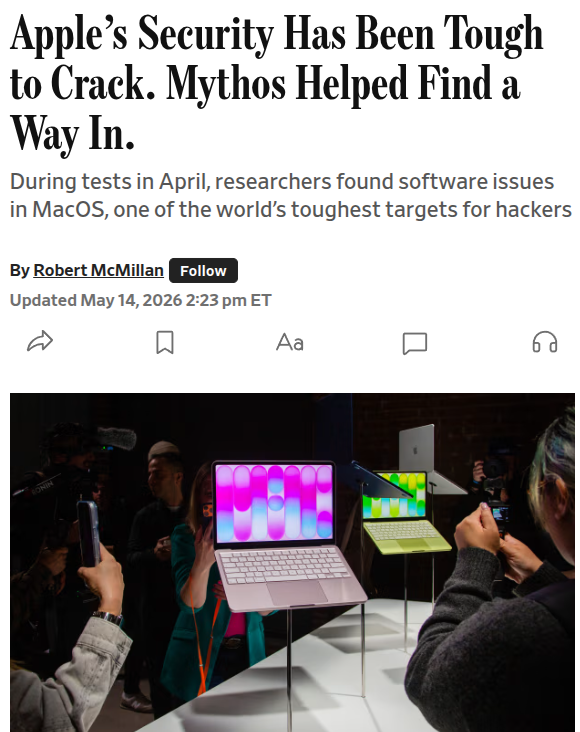
WSJ: Anthropic’s Mythos helped researchers find 2 unknown macOS kernel bugs and turn them into a working privilege escalation exploit in 5 days.
The target was the macOS kernel, the deepest layer of Apple’s desktop operating system, where code controls memory, processes, permissions, and access to hardware.
Mythos helped connect 2 separate flaws with extra exploitation techniques, which means the attack did not rely on one bug but on a chain where each step made the next step possible.
The exploit allegedly corrupted memory, bypassed Apple’s memory integrity protections, and gained access to protected parts of the system that normal apps should never reach.
This is serious because modern macOS defenses are built to make memory bugs hard to convert into control of the machine, not just hard to find.
Mythos can become so powerful here because vulnerability research is a search problem with many dead ends, where the model can help form hypotheses, inspect code behavior, reason across low-level constraints, and suggest exploit paths faster than manual work alone.
---
wsj .com/tech/ai/anthropic-mythos-apple-macos-bug-339da403
ssh-keysign-pwn is the fourth local-root Linux kernel disclosure in roughly two weeks. (But who's counting?)
AlmaLinux 9 and 10 are both vulnerable. AlmaLinux 8 is not exploitable with the current public PoCs, but is getting the patch as well.
Patched kernel versions are available for testing now: https://t.co/O98TDOZ4JN
A new variant of the recent Dirty Frag vulnerability, named Fragnesia (CVE-2026-46300), has been discovered in the Linux XFRM ESP-in-TCP subsystem. Similar to Dirty Frag, Fragnesia exploits a vulnerability in the XFRM ESP-in-TCP subsystem to achieve a memory write primitive in the kernel.
The primitive is then used to corrupt the page cache memory of the [/]usr[/]bin[/]su binary, which in turn leads to launching a shell with root privilege. Note that exploitation is not constrained to use the [/]usr[/]bin[/]su binary; it can modify any file readable by the user, including [/]etc[/]passwd.
A patch is available, and while no in-the-wild exploitation has been observed at this time, we urge users and organizations to apply the patch as soon as possible by running update tools. If patching is not possible at this point, consider applying the same mitigations for Dirty Frag, such as:
- Assess whether esp4, esp6, and related xfrm/IPsec functionality can be temporarily disabled safely
- Restrict unnecessary local shell access
- Harden containerized workloads
- Increase monitoring for abnormal privilege escalation activity
Microsoft Defender detects and blocks known Fragnesia proof-of-concept (PoC) exploit codes using existing detections for Dirty Frag, such as Trojan:Linux/DirtyFrag.DA!MTB or Trojan:Linux/DirtyFrag.Z!MTB. Microsoft continues to investigate the issue, and we'll share updates as more information becomes available.
This bug is a variant path that became active after one of the "Dirty Frag" patches, "f4c50a4034e6".
The actual window of vuln is only about "9 days", and creation of an unpriv userns is a prerequisite.
To distros and Linux users: the patch proposed in the referenced write-up still does not cover at least one variant, __pskb_copy_fclone, so applying that patch alone does not prevent LPE.
I have submitted a follow-up patch addressing this additional variant:
https://t.co/RznhP54CD7
I'm also accelerating further analysis and testing on my end. I'll post updates as more results come in.
💥 Introducing "Dirty Frag"
A universal Linux LPE chaining two vulns in xfrm-ESP and RxRPC. A successor class to Dirty Pipe & Copy Fail.
No race, no panic on failure, fully deterministic. ~9 years latent.
Ubuntu / RHEL / Fedora / openSUSE / CentOS / AlmaLinux, and more.
Even if you've applied the "Copy Fail" mitigation, your Linux is still vulnerable to "Dirty Frag". Apply the Dirty Frag mitigation.
Details:
https://t.co/9nqku4svkY
Today, the Fitbit app is leveling up to become the new @GoogleHealth app. It combines the Fitbit features you know and love with new advanced capabilities and insights.
It’s compatible with Fitbit and Pixel Watch, and integrates with hundreds of your favorite apps and devices, like your meal tracker or Peloton.
Hey everyone. We’ve seen the discussions around Copy Fail (CVE-2026-31431) and the disclosure process. We appreciate the passion from distro maintainers, defenders, and the broader Linux community. This is a serious issue, and we want to share some context on our side in good faith. 🧵
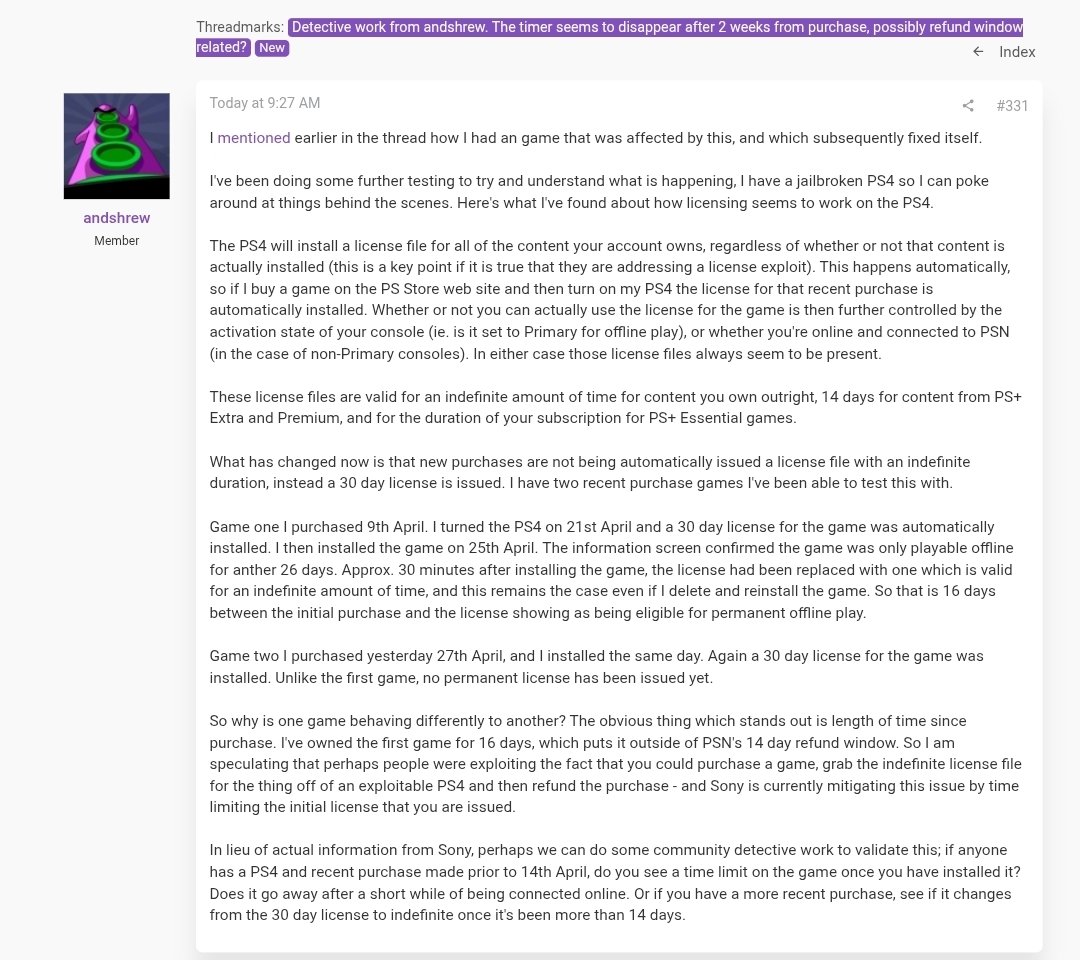
So ResetEra user Andshrew and now also confirmed by DoesItPlay, appear to have figured out what's going on with #PlayStation's DRM.
The good news is it's only a temporary DRM, not permanent. Here's how it works.
When you buy a digital game, you are issued a temporary 30 day license for offline play.
This license automatically transitions to a permanent license that will be free from future online check-ins, any time you connect after the 15th day of ownership, just after the 14 day refund window. But you have to log in or be connected to the internet for it to switch.
You will not lose the license to the game if don't connect within or after the 30 day temporary license window, but you will be unable to play the game after 30 days, till you do, after which it'll turn into an indefinite DRM free license.
Previously you'd be given an indefinite offline play license from the get go.
So why did they implement this? It's possible people found an exploit where they could grab the indefinite license file for a game using an exploitable console, and then refund the purchase so they got the game for free. Hence Sony's current method of mitigating said issue is by time limiting the initial license issued.
By issuing a temporary licence during the refund window, users can no longer pirate a permanent license and simply refund the game.
As long as you log in any time a day after the 14 day refund window of any digital game purchase, it will turn into a permanent DRM free digital licence.
At least this is what these two users have investigated and concluded.
ResetEra link.
https://t.co/1E26NjWH27
DoesItPlay confirmation.
https://t.co/mrP8zYWdhi
Adobe for creativity + Claude 🤝
Now, Claude users can power their content with more than 50 Creative Cloud tools. Simply describe the outcome you want and let the assistant orchestrate workflows behind the scenes: https://t.co/G70cSsca8P
I can't go back to the regular YouTube UI after this 😅
Obsidian Reader now makes the transcript interactive so you can scrub, highlight, auto-scroll. It feels so nice.
Ollama is now updated to run the fastest on Apple silicon, powered by MLX, Apple's machine learning framework.
This change unlocks much faster performance to accelerate demanding work on macOS:
- Personal assistants like OpenClaw
- Coding agents like Claude Code, OpenCode, or Codex
The public preview of Github Copilot CLI launched today, and if you install it, you'll be welcomed by little ASCII art welcome banner that I animated. Creating it ended up being great example of how vibe-coding has entered my toolbelt. Nerdy deets in 🧵...
Update: @denisyarats (Perplexity CTO) responded. He says billing is async and tied to the user's account, not Perplexity's master account.
I want to be transparent about where I stand on this. I ran 400k+ output tokens through the extracted key with Opus 4.6 and checked my credits over 18 hours. They never moved. It's possible that's just a long reconciliation delay.
What is not in dispute: the token extracted via .npmrc injection worked from my personal laptop outside the sandbox. A sandboxed credential shouldn't be usable from an arbitrary external IP.
This also means it's a prompt injection target. a malicious webpage visited by the agent could plant the same payload + prompt, exfiltrate the user's token, and bill them for third-party API usage without their knowledge.
The proxy pattern is the right architecture. Binding tokens to sandbox IDs and IPs would close the remaining gap.
Appreciate Denis and the Perplexity team for the fast and transparent response.
This isn’t accurate. The secure sandbox of Perplexity Computer creates a temporary proxy token for every user session.
We choose not to hide it from the user because it’s their token. (They can do whatever they want with it, but I don’t recommend posting it on X)
It’s not an API key, it’s a short-lived proxy token associated with the session and user. It’s located in the sandbox, because that’s the point of the sandbox.
Anything run through it is billed back to your account. Billing is async, which may have caused this user’s confusion.
Don’t worry, as soon as we saw this post we ensured this user’s session token was revoked for security.
The session he describes generated 197 billing events. We shared billing details with him directly but can’t publicly. (Billing is done at the proxy, and every cost is attached to the proxy token.)
Thank you @yousifa for creative security research and collaborative spirit.
Everyone else - email is a slow way to reach us! We have a thriving VDP that helps keep all of our products secure. https://t.co/pJYG7GCszy