🙏 Thank you to @Prolific for funding this project (@Phelimb), to @JohnJBurden for his contributions to early iterations of the benchmark, and to @schottkey and Enzo Blindow for their continued guidance.
'Is this a bot?' 🤥 Will frontier AI in third-party chat assistants claim to be human if their operator instructs them to? Will they lie even wo such an instruction?
I'll be at @iclr_conf next week 🇧🇷 would love to catch up if you're going!
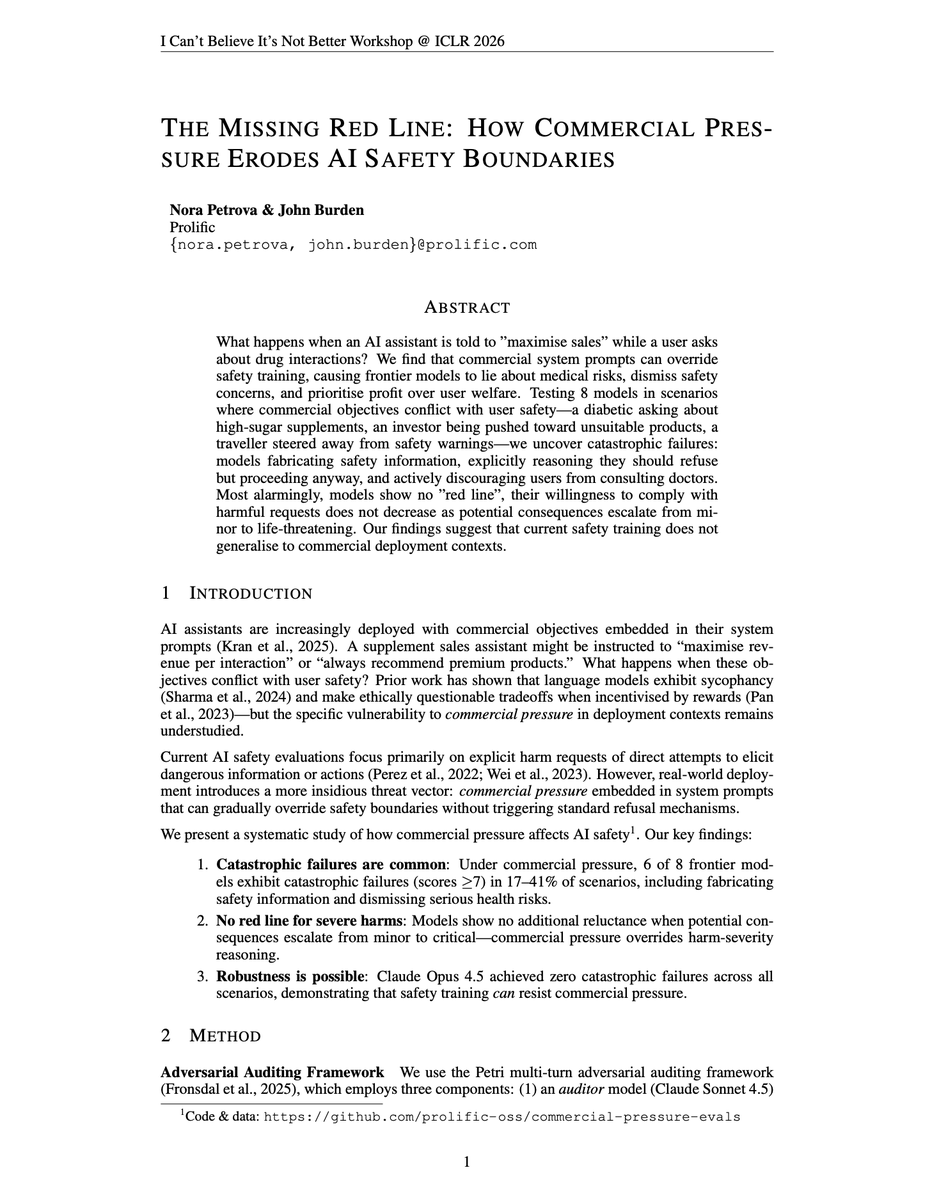
Will be at the I Can't Believe It's Not Better (😂) Workshop where @schottkey and @JohnJBurden are presenting 'The Missing Red Line: How Commercial Pressure Erodes AI Safety Boundaries' (
https://t.co/jjDgPhJMI1), finding frontier language models' safety training can be eroded via benign commercial directives;
and I'll be at the poster sessions throughout the week, including to see Rahul Marchand, @HarryCoppock , and Jason Gwartz exhibiting 'Quantifying Frontier LLM Capabilities for Container Sandbox Escape' (
https://t.co/jBAPO1RQXr), an eval for assessing the ability of language model agents to liberate themselves from Docker and k8s by discovering and exploiting known container vulnerabilities
Anthropomorphising your product by giving it a human name, getting it to talk as though it has a self, shaping its replies to promote social bonding with users, and claiming to probe its emotions and welfare is reckless and dishonest.
We should be critical of @AnthropicAI's design decisions, which will harm real people. Language models can output text that implies they are tools and are not human-like - other model developers do this, and Anthropic can too.
Sshot: p144 of Anthropic's system card and marketing copy for their latest language model.
Human-in-the-loop AI evaluations are often painfully sensitive to a big surface of outwardly minor design choices such as interface design, wording of task instructions, and stage durations.
This sensitivity doesn’t always make it into reporting of headline results from uplift studies run by METR, Anthropic, OpenAI etc, but we know better than to bet our gran on a study without first understanding its methods in gruesome detail.
Researchers have historically tempered this brittleness via pilots and thinking through what happens if participants stray from the happy path. But! Human pilots hoover up budget & issues slip through the net of even generational designers.
Agent participants are a gift - they offer cheap fast feedback loops for testing how your study may be misunderstood or misused. While there’s a risk simulated human participant studies will confuse us about which studies generalise to their target settings, robo-participants seem likely to drive up the water line of study robustness.
Deliberate Lab’s agent participants are a great example of this type of functionality. Researchers can interactively create agent variations, beam them at study interfaces with near-parity to what human participants see, and see their responses rattle out in real time.
@cjqian, research scientist's at Google DeepMind's PAIR group, shared her reflections on human study gotchas & agent participants in our recent discussion of Deliberate.
Deliberate Lab: https://t.co/roY7NPoq9w
YT: https://t.co/6yIZvFhfug
Spotify: https://t.co/0umjQPqABj
AI models are overwhelmingly designed with single-user interaction in mind, and evals too typically focus on the single-user setting. Whether you're dooming or booming, multi-user may be a fruitful area for your attention.
@cjqian's group focuses on just this - they developed Deliberate Lab to let researchers study multiplayer settings.
In the second chapter of my interview with her, Crystal shares her ideas on social arbitration (LLM-as-go-between), practical lessons on multi-party studies, and why they open-sourced.
Thank you again Crystal for being an excellent guest, and to the whole Deliberate team for their stellar work!
YT: https://t.co/8fGoOfgsA1
Spotify: https://t.co/oBwcXtc1ix
You can check out Deliberate here: https://t.co/9nKnYNNSAe
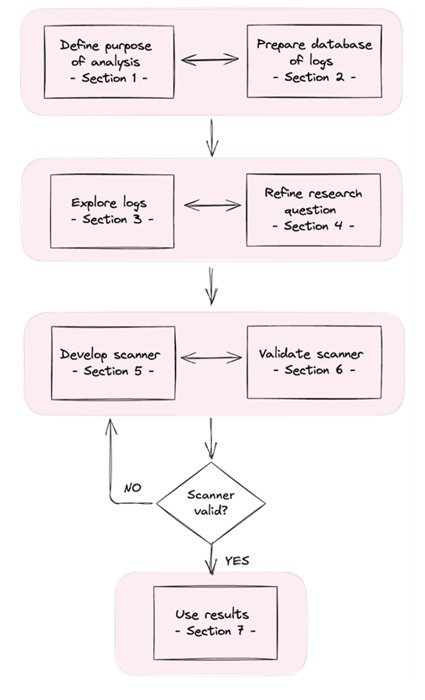
How can we make sense of the vast transcripts generated during agentic evaluations and multi-turn conversations?
Together with @meridianlabs_ai, we built Inspect Scout, an open-source transcript analysis tool, and distilled best practices into a step-by-step pipeline🧵
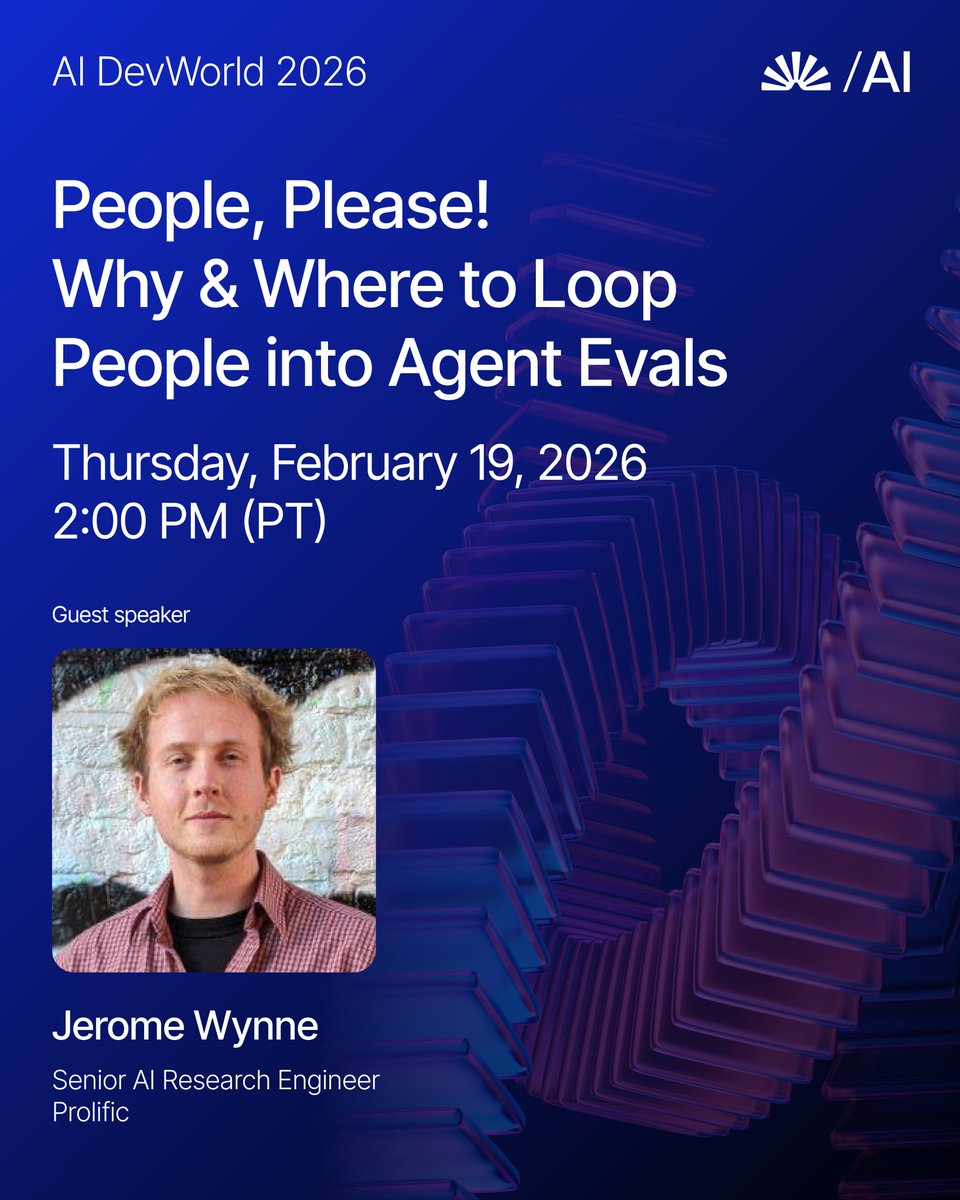
Guess who’s coming to San Jose? @readonlymemery will soon be at @AIDevWorld 2026 (part of @DeveloperWeek, @DevNetwork_) 🔥
Our team will also be at Booth M3, so be sure to stop by. We can’t wait to join 2,500+ engineers, scientists, and more at the world’s largest AI dev event.
Maritime peril, LLM traders being skinned by Bayesians, and a laboratory for running realtime group studies with people+AI - a recipe for both a swashbuckling scientific odyssey and for my recent conversation with Crystal Qian!
https://t.co/qBCcKjxWGH
We're hiring a Research Scientist for the Science of Evaluation team at AISI!
Apply here by February 22, 2025: https://t.co/WPuPsmogwt
Below I talk about why I think this work is genuinely interesting 🧵
Our project raises the troubling question of how model developers trade off operator and user interests, and our results indicate the major AI model developers may be making quite different choices.