The FIFA FFE feels less like the reform Infantino called it and more like a corporate takeover. Football risks becoming what the Grammys became for music: business first, merit second - where one thing is obvious, but another is announced.
We can expect more controversial hosting decisions, less consideration for regions that don’t bring as much commercial value, and F1-style fan monetization like we saw with the last World Cup ticket pricing.
The regions that stand to lose the most are the disadvantaged ones, especially Africa, because they simply won’t generate the same commercial returns.
We're thrilled to partner with @Google on something we've been building with them - Googlebook.
Premium, powerful devices designed for Intelligence. We can't wait to get it into your hands this fall.
Learn more at https://t.co/KEF9BpwmLl
#Googlebook#NEXT#Intel
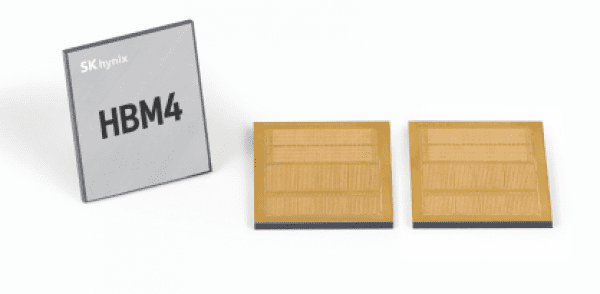
SK Hynix Pursues 2.5D Packaging Collaboration with Intel, Signaling Shifts in AI Chip Supply Chain
SK Hynix is drawing attention as it pursues collaboration with Intel in advanced packaging. The company is currently understood to be conducting tests that adopt Intel's 2.5D packaging technology to integrate High Bandwidth Memory (HBM) with logic chips.
With Taiwan's TSMC—the leader in 2.5D packaging—recently grappling with a severe supply crunch, expectations are growing that the 2.5D packaging supply chain for AI accelerators could diversify.
According to industry sources on the 11th, SK Hynix is conducting joint R&D with Intel on 2.5D packaging technology.
2.5D packaging is a technique that inserts a thin film-like interposer between the chip and substrate to enhance chip performance. Representative applications include the AI accelerators being developed by global big tech firms such as NVIDIA and AMD. AI accelerators are built by combining high-performance logic chips—such as GPUs—with HBM through 2.5D packaging.
At present, the global 2.5D packaging supply chain for big tech is effectively monopolized by TSMC, Taiwan's leading foundry. SK Hynix has also maintained a close partnership with TSMC, conducting joint R&D on HBM and 2.5D packaging.
Beyond this, SK Hynix is reviewing the adoption of Intel's 2.5D packaging technology, "Embedded Multi-die Interconnect Bridge" (EMIB). The company is understood to be testing the integration of HBM and logic chips using EMIB-embedded substrates supplied by Intel.
A source familiar with the matter said, "While it is still at an early R&D stage, SK Hynix is actively conducting tests to implement 2.5D packaging using Intel's EMIB," adding that "the company is also scouting candidate materials and components that would be required for actual volume production."
The discussions between SK Hynix and Intel are seen as well aligned in terms of mutual interests.
TSMC's 2.5D packaging technology, "Chip-on-Wafer-on-Substrate" (CoWoS), has been suffering from acute supply shortages amid the recent AI semiconductor boom. As a result, several big tech firms have turned their attention to Intel's EMIB as a promising alternative to CoWoS.
From SK Hynix's perspective, preemptive R&D on Intel's EMIB is also necessary. While SK Hynix does not manufacture 2.5D packaging itself, developing HBM with the structure and characteristics of 2.5D packaging in mind is advantageous for improving yield and reliability. In fact, SK Hynix operates a small-scale line domestically dedicated to 2.5D packaging R&D.
Furthermore, the collaboration is expected to allow Intel to significantly expand its advanced packaging business. Intel's EMIB uses small silicon bridges to connect chips, rather than a broad interposer. Because bridges only need to be placed where chip-to-chip connections are required, chips can be arranged more flexibly and efficiently.
An industry source explained, "Intel is currently promoting its EMIB technology aggressively to SK Hynix and major OSATs," and "over the medium to long term, Intel's EMIB is expected to be added to the 2.5D packaging supply chain for AI accelerators."
$INTC
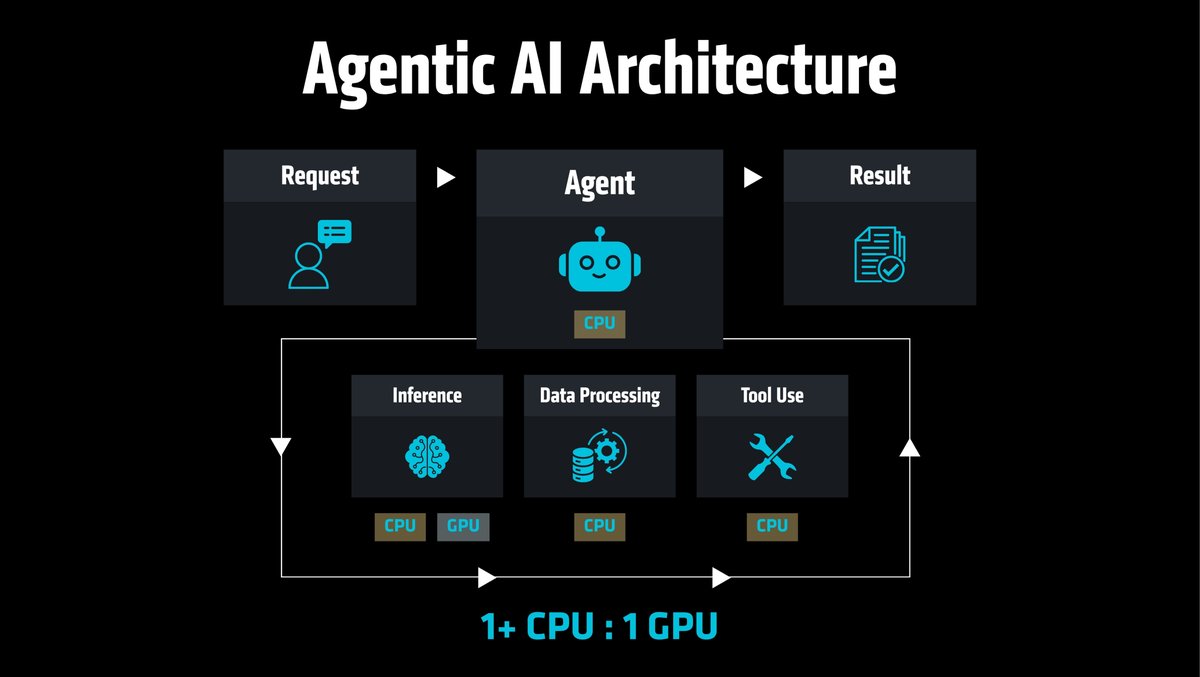
Agentic AI is changing the infrastructure equation. As AI moves from simple responses to planning and workflow execution, the CPU-to-GPU ratio is shifting from 1:8 or 1:4 toward 1:1. Enterprises need new CPU compute layers alongside GPU infrastructure to handle the orchestration and tool execution that agents demand.
See how AMD EPYC is built for the shift: https://t.co/VikuaYIAxz
A lot of people don’t realize how ambitious it is to put the Intel high–NA EUV 14A node, HBM, and advanced packaging all under one roof, especially at the scale Terafab is currently aiming for. This should easily produce 100–200 billion chips annually from that single integrated operation. I’m trying to wrap my head around the efficiency, but the bigger win might even be what happens when you remove the delays, handoffs, logistics overhead, and coordination friction between every stage of development and manufacturing caused by having them under different roofs. Those bottlenecks are what normally slow the pace of innovation and volume of production.
When I hire professionals and receive their advice in some areas of my life, we often end up revising their suggestions to address my specific situation after a series of questions, requests for data, and detailed analysis. Most of them eventually get fired for being either defensive or lazy. One lesson I learned early in life is to never compare myself with people, or stats of people, who have generations of support systems behind them.
Most of the truly driven people I’ve met look completely ordinary or just simple. No flashy routines, no obvious signs. Real ambition hides in plain sight… until it doesn’t.
Jensen is one the smartest and most far seeing folks the world.
"If an AI scientist warns people that AI is going to permeate across radiology and radiologists are going to get wiped out, it might seem helpful but it's hurtful. If we convince everybody not to be radiologists and we now need radiologists, that actually is hurtful to society.
"It is hurtful to convince all the young college graduates not to study software engineering because we are going to need more software engineers than ever.
That's hurtful."
"Scaring people with nonsensical things, which are not going to happen, that this is an existential threat, there's a 20% chance that is is existential, that's ridiculous.
"That it's going to wipe out 50% of college level jobs.
"That is it going to completely destroy democracy.
"These kinds of comments are not helpful. They are made by...CEOS. And you become a CEO, maybe you adopt a God complex and somehow you know everything."
Brutal.
And right.
Either there is a memo going round among these CEOs to reshape the public perception on AI after years of indirectly threatening them that they will no longer have jobs as AI replaces them. First it was Jensen, now Sam. This is the direction Acemoglu had clamoured for since this wave started.
Today’s OpenAI revenue miss has the market spooked, but the real story might be the Helium crisis in the Middle East. If TSMC and Samsung can’t get gas to cool their fabs, global chip production will see some bumpy road.