I talk to young dads regularly in various men's groups. I can confidently say this is one of two things you should be fiercely committed to as a father. The dinner table is where its at. Too busy? Circle up for ice cream sandwiches then at days end. Family dinner fixes it all.
imagine being a child filled with love and wonder and your parents, your one true source of affection and guidance, are addicted to little blinking lights
i understand there's a guy inside me who wants to lay in bed, smoke weed all day, and play old school runescape. my whole life is a series of stratagems to avoid, and outwit, that guy
This is a deeply sad instantiation of a correct ethic.
I don't want to die with $10M, but not because I spent it on a jet to Paris or other frivolous consumption.
I want to die with nothing because I planted forests of chestnut trees, cleaned the Chesapeake Bay, paid for my grandchildren's homes, built a local sawmill, food processing hub, and extensive tool library, funded a scholarship endowment for talented kids in Frederick County, helped start the Buffalo Commons, and many other projects that pay it forward to future generations by stewarding and improving my community and country.
There is so much more to life than consumption. We need to mature in our responsibility as stewards who develop, implement, and truly live an autopoietic agape to our world and descendants.
"Real generosity toward the future lies in giving all to the present." - Albert Camus
The most successful people I know (finances, fitness, family) all treat 30 minutes like its an extended vacation (because it is). Every broke finger pointing doomer treats 30 minutes like it’s 15 seconds. god the power of a half hour. I wish you could see. That 30 minutes per day is more than enough time to completely change the course of your life. 30 minutes in the gym, 30 minutes building a business, 30 minutes learning about your kids hobby. So much damn time. An eternity in this life. In many cases, as much time as you’ll ever get. What a waste to not take advantage of it.
My wife mentioned a nice private school over dinner this week
She said the campus was beautiful
I asked what's the tuition
She said we should look at it as an investment in him not a cost
I made a note
She said don't make a note
I said I always make notes
She said this isn't a deal
I said everything is a deal
She closed her eyes
She said we'd discuss it Saturday
I agreed
Saturday 7:02am
She came downstairs in her Saturday robe
Coffee in hand
I had my cargo shorts on
The dining room had been cleared
The projector was on
The analyst was at the head of the table
Quarter zip on, three iced coffees, a legal pad, and two laptops
He had been there since 6:44am
I texted him at 11:14pm Friday
The text said dining room 6:45am bring the model
He sent a thumbs up
My wife stopped in the doorway
She said what is this
I said you said you wanted to discuss it
She said this is not a discussion
I did not respond
She sat down anyway
The analyst stood
He said good morning ma'am
She did not respond
He sat back down
A printed deck in front of each seat
A fourth copy in case
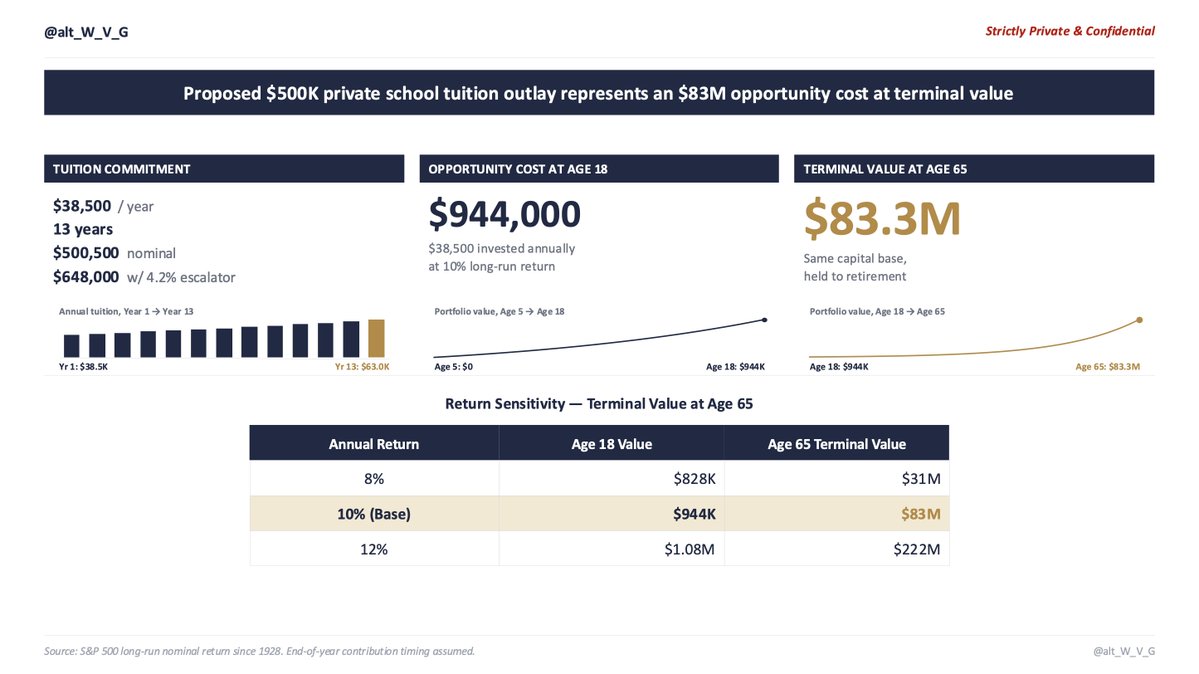
Slide 1 Tuition Schedule
$38,500 per year
Thirteen years
$500,500 nominal
Before escalators
The school has raised tuition 4.2% per year for a decade
With escalators $648,000
My wife said okay
I said I'm not done
Slide 2 Opportunity Cost
Even before escalators
$38,500 invested annually
10% nominal return
S&P long-run average since 1928
By his eighteenth birthday $944,000
My wife said we can afford it
I said I know that's not the slide
Slide 3 Terminal Value at Age 65
$83 million
She was quiet
The analyst slid the sensitivity tables across the table
8% return $31 million
10% return $83 million
12% return $222 million
She did not look
She said this isn't about money
I said it's always about money
She said no it isn't
I said then what is it about
She did not answer
She said you can't put a dollar value on his teachers his classmates his environment
I said I can the analyst already did slide 6
He flipped to slide 6
She did not look
She said the school is the best in the city
I said best is a feeling
She said it produces the best students
I said the students were already the best before they got there
She said our son deserves it
I said our son deserves $83 million
My son walked in
He is five
Dinosaur pajamas
He looked at the projector
He looked at the open deck on the table
He looked at slide 3
He said are we modeling pre-tax or after-tax
The analyst opened a new tab
My wife looked at the ceiling
He said what's the discount rate
The analyst set down his pen
She closed her eyes
He said is this the same return assumption from the 529 conversation
The analyst stopped typing
He looked at me
I did not say anything
She stood up
Sat back down
He said dad can I help
I said yes
He pulled up a chair
The analyst handed him a printout
He started reading
My wife watched him read
She watched him for a long time
She said his name
He looked up
She said do you like school
He said the work is too easy and the kids don't ask questions
She did not respond
She looked at the ceiling
She walked out of the room
The analyst started packing up
He said should I follow up Monday sir
I said no follow up needed
He'll be fine
Sent from my iPhone
part of the anthroposophical model of early childhood (what waldorf is based on), is that the child begins life in a kind of magic bubble, and that the time spent in this state is essential for their long term spiritual development.
you can accidentally rush them out of this stage.
the child goes through a process of recapitulating the stages of civilization itself: they eventually go through an egyptian stage, and become fascinated with writing, symbols, and what we think of as the hallmarks of that civilization. later, they go through an antiquity / roman stage, and become fascinated by building, laws (rules), and the things we think of humanity as generally acquiring during that time. later, the medieval, and so on.
but at the start, the child is in magic world. this is occasionally referred to as “the garden”, as in the garden of eden, but i just think of it as fairy world, where the boundary between myth, story, imagination, and reality is completely fluid.
taking this view puts you at odds with modern parenting in ways that you would not expect. a lot of parenting discussion online is about nutrition, discipline in general, appropriate punishments, homeschooling, giving them tablets - there’s a clear set of basic controversial topics.
taking a concern about rushing the child out of this initial state and into the next one too quickly puts you at odds with other less obvious aspects of parenting style. the one i find most interesting is the conception of early childhood and learning itself that i see as flowing downstream from the modern scientific worldview.
recently, i was at an aquarium. they have this large cylinder tank that you can walk around and look into. the walls are glass. in the center, there’s a (real) fish that’s huge - easily the biggest fish i’ve ever seen.
a girl runs up and says, “wow, that’s a huge fish”. the mom says: “yes, it is a large fish, but just keep in mind that the glass is convex. when glass is bent this way, it makes things inside look bigger. but it is a big fish”.
now, the kid asks, “so, it’s not a big fish?”, and the mom says, “well, yes, it is a big fish, but…” and reiterates the explanation about what convex glass is and what it does to your perception.
in the modern scientific worldview, part of “becoming wise” is accumulating facts and that are not intuitive, and that undercut empirical perception. becoming educated means knowing these facts and having them at hand to make sure you’re perceiving things accurately - unlike someone uneducated, who wouldn’t know about glass distorting perception, and the finer mechanics of how and why that happens.
this means that “passing on wisdom” and being “the wise elder” often amounts to passing on and dispensing these facts. here, the kid is looking at something - but has to be told: “don’t get the wrong idea. i, the wise elder, know something you don’t, and i’ll let you in on the secret.”
there’s nothing wrong with this in and of itself, but it’s completely at odds with the world the child is presently inhabiting (in my opinion). the child is just in awe of a large fish. this is a total, magical, all encompassing spiritual experience - but the adult has to step in and take them out of it, to ensure that they’re giving primacy to a scientific perception.
the adult, due to their model of what knowledge is, is constantly stepping in to jet pack the child out of their direct perception, into abstractions that have nothing to do with their inner world.
once you notice this, you really see it all the time. i’m at the park, and a kid is hitting a log with a stick. it’s making a cool sound. he says, “dad, look at this”, and the dad starts explaining that sound is really vibrations, what vibrations are - bam: smash the eject button. the kid can’t just hear the sound: an adult has to step in and make sure that the experience of hearing the sound is being filtered through this paradigm’s conception of what knowledge, and life, “really” is.
K-shaped white collar crisis in full effect.
At the upper leg you have people who are gainfully employed but are being worked to the bone and know that any day might be their last. So they are holding on for as long as possible and have little time to invest in the next move/next pivot/next phase.
At the lower leg are genuinely talented and experienced people who have been without full time work for a year, two years maybe, and have been freelancing or taking projects to get by. Some will start their own indie shops, but most feel adrift and would rather have a reliable W2 income. And they know that with every major layoff wave there will be more freelance competition in the market.
Some will pivot to new industries (and potentially take less pay), some will become content creators, some will become entrepreneurs. Many will prematurely cash out on retirement accounts to maintain a semblance of day to day normalcy for their families. But the vast majority of career W2 workers doesn’t want any of that. They want the stability that affords them the ability to contribute to a solid, middle/upper middle class lifestyle. Pay taxes, send their kids to decent schools, do work that they can be proud of.
So the question is how to survive what is looking to be a decade of white collar disruption with a plan to get back on the horse when the next opportunity comes around. Or do you opt out and leave it all behind (… and for what?)
Hey Derek, donation below. As a follow-up to above, I just moved from CHI to a beachy suburb of San Diego. While I appreciate the weather upgrade, I am missing the ability to dress more formally in the way more biz cas environment out here (especially when I walk by all the super cool, casual surfers!). As an example, I used to always wear a sports jacket to the CHI office, but feel way more out of place when my boss wears a trucker hat with a dress shirt haha. How would you tweak your business casual recs for beach towns like this in terms of fabric and color?