🧵 PRESENCE IS THE RAWEST FORM OF LOVE
We think love is a feeling.
We think it’s affection, passion, butterflies.
But before love becomes a feeling—
Before it becomes words, touch, or poetry—
It begins as something far more silent:
Presence.
.
To be fully here with someone or something—
No judgment. No distraction. No agenda.
Just awareness.
That is love in its original state.
Not the love that needs to hold, fix, or possess.
But the kind that simply sees and allows.
.
A mother watching her child sleep.
A friend listening without trying to advise.
You sitting with your own pain, not running from it.
That stillness is love.
Because presence is pure acceptance—
And acceptance is the foundation of love.
.
Every form of love begins here:
Presence → Awareness → Compassion → Love → Life
Presence sees things as they are.
Awareness feels their truth.
Compassion softens the heart.
Love flows as connection.
Life blossoms through it.
.
This is why:
Meditation heals.
Prayer in silence feels sacred.
Eye contact can feel overwhelming.
Time slows down when we love someone deeply.
Because where presence goes, love appears.
.
Maybe love is not something we “give.”
Maybe love is what remains when we fully arrive.
So the real question is not
“Who should I love?”
But
“Where am I not present?”
.
Presence is the raw form of love.
Because to be here—truly here—
Is to say, without words:
“You are safe with me. This moment is enough.”
I SEE YOU!
Anthropic engineer just released a 2-hour workshop on "Graph Engineering" for agentic systems:
“80% of our engineers are using self-improving loops. Now everyone is building agentic graphs.”
• 00:00 - Introduction to RAG & Graphs
• 06:39 - Core of "Graph Engineering" (state, nodes)
• 14:29 - 3 feedback loops of Graph agents
• 23:06 - Agent evaluation with Graphs
• 36:29 - Agent cycles in graphs
• 1:15:22 - Agentic RAG & agent context
• 1:41:20 - Evaluation datasets based on Graphs
This 2-hour workshop will replace 10 paid courses on agentic engineering.
Watch it today, then learn how to become a Graph Engineer in the article below.
Dario Amodei, CEO of Anthropic:
"Software is going to become cheap. Maybe essentially free.
there are whole jobs, whole careers that we built for decades that may not be present. I don't think there's an awareness at all of what is coming."
in a 32-min Davos interview, the Anthropic CEO says what the tool being free actually does to the work
when the software costs nothing, the person who can run it is the entire value
the ones who learn that early are the ones this pays
watch it, save it, then see the skill in the article below ↓
Probability quantifies likelihood from 0 (impossible) to 1 (certain).
P(event) = favourable ÷ total outcomes. Diagrams show A ∪ B, A ∩ B, A' with P(not A)=1−P(A), A only=A∩B'. Mutually exclusive: A∩B=∅. Addition: P(A∪B)=P(A)+P(B)−P(A∩B). Independent: P(A∩B)=P(A)×P(B).
Theoretical die P(5)=1/6≈0.1667; experimental from trials. Expected=P×trials. Sample space e.g. {1,2,3,4,5,6}. Stats: range=max−min, IQR=Q3−Q1 (middle 50%), mode most common, mean average, median middle, outliers distant.
Actuaries set insurance premiums using claim probabilities from past data.
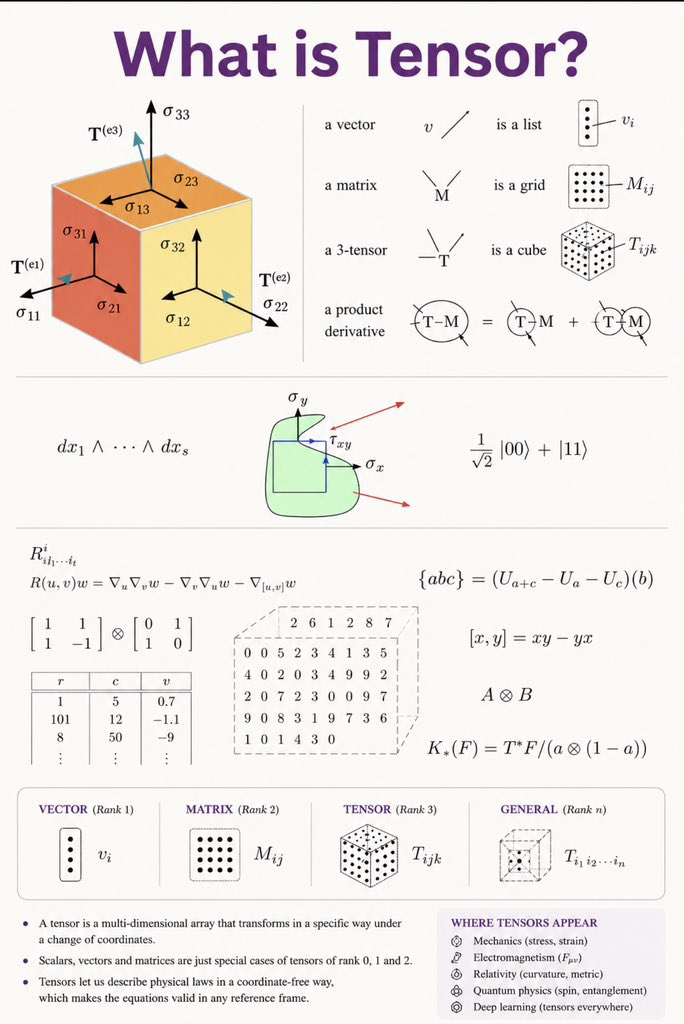
people often think tensors are just bigger matrices.
they’re not.
a matrix is one kind of tensor, just as a vector is another. tensors are the broader idea. they’re mathematical objects that represent relationships across multiple dimensions while preserving those relationships even when you change your coordinate system. that’s why physicists care much more about how a tensor transforms than how it’s stored in memory. the array of numbers is just one representation. the underlying object is independent of your choice of coordinates.
this is what makes tensors so powerful. the stress inside a bridge, the curvature of spacetime, the electromagnetic field, the inertia of a robot arm, and the activations inside a neural network can all be described using tensors. at first glance these seem like completely unrelated problems. mathematically, they’re variations of the same language. tensors let you describe quantities that have direction, interaction, and structure in a way that remains consistent regardless of your point of view.
the deeper lesson is that mathematics evolves by abstraction. numbers describe single values. vectors describe direction. matrices describe transformations. tensors describe relationships in arbitrarily many dimensions. each step isn’t about making mathematics more complicated. it’s about building a language capable of describing a richer reality. that’s why once you understand tensors, you start seeing the same mathematical structure hiding underneath robotics, computer vision, quantum mechanics, relativity, continuum mechanics, and deep learning.
Gilbert Strang, MIT mathematics professor:
"MIT paid me $600K to teach linear algebra. Sixty years boiled down to one lesson: understanding isn't harder problems - it's the right picture. Most students walk past the answer because it looks too simple to be it."
in the first ten minutes of the most-watched math course ever, Strang gives one simple idea that makes all of linear algebra click. most students walk right past it because it looks too easy.
he draws the same equations two ways. first the row picture: lines crossing, the way you learned in school. then he flips it - the column picture. "this is called a linear combination, and it's the most fundamental operation in the whole course."
the question changes completely. not "where do the lines cross?" but "what mix of these vectors reaches the target?" same numbers, new way of seeing - and suddenly the whole subject makes sense.
you don't understand math by solving harder problems. you understand it by finding the right picture.
Anthropic engineer:
“70% of our engineers are using self‑improving loops. Now everyone is building agentic Graphs"
in 3-6 months, we’ll all be building graphs to orchestrate self‑improving agents. No more prompting.”
in 30-minute lecture, Anthropic engineer shows how to build a self-improving agentic workflow from scratch.
Worth more than a $500 agentic course.
Watch this video, then read the article below on how to become a graph architect.
Sam Altman, CEO of OpenAI:
"the models are now so smart that for most of the things most people want to do, they're good enough.
embrace this with caution, but not fear. or we will get run by other people who use AI to be better."
in a 47-min TED conversation, the OpenAI CEO puts the bar exactly where most people refuse to believe it is
the tool is already good enough. what's left is who actually runs it
the people ahead are the ones who started
watch it, then save the skill in the article below ↓
study geometry.
it’s one of the best ways to train your intuition.
geometry teaches you to think in space.
you stop seeing symbols.
you start seeing structure.
what it teaches you:
• visualization instead of memorization
• proofs instead of assumptions
• symmetry, proportion and invariance
• transforming problems instead of brute forcing them
• how local relationships create global structure
geometry shows up everywhere.
• robotics → coordinate frames, transformations, kinematics
• computer graphics → projections, meshes, rendering
• computer vision → epipolar geometry, camera models
• cad → constraints, surfaces, tolerances
• physics → spacetime, fields, tensors, manifolds
• architecture → form, stability, optimization
if algebra teaches you how to manipulate symbols, geometry teaches you how to think.
that’s why so many breakthroughs in mathematics, physics and engineering began with someone drawing a picture.
The curve of e⁻ˣ² spans the real line with total area exactly √π.
Square the integral I = ∫₋∞⁺∞ e⁻ˣ² dx to obtain the double integral of e⁻⁽ˣ²⁺ʸ²⁾ over the plane. Switch to polar coordinates (x = r cos θ, y = r sin θ, dx dy = r dr dθ), integrate θ from 0 to 2π and r from 0 to ∞, then substitute u = r² to reduce I² to π. The positive root is therefore √π.
This constant normalizes the probability density of the normal distribution that models measurement error in experimental physics.
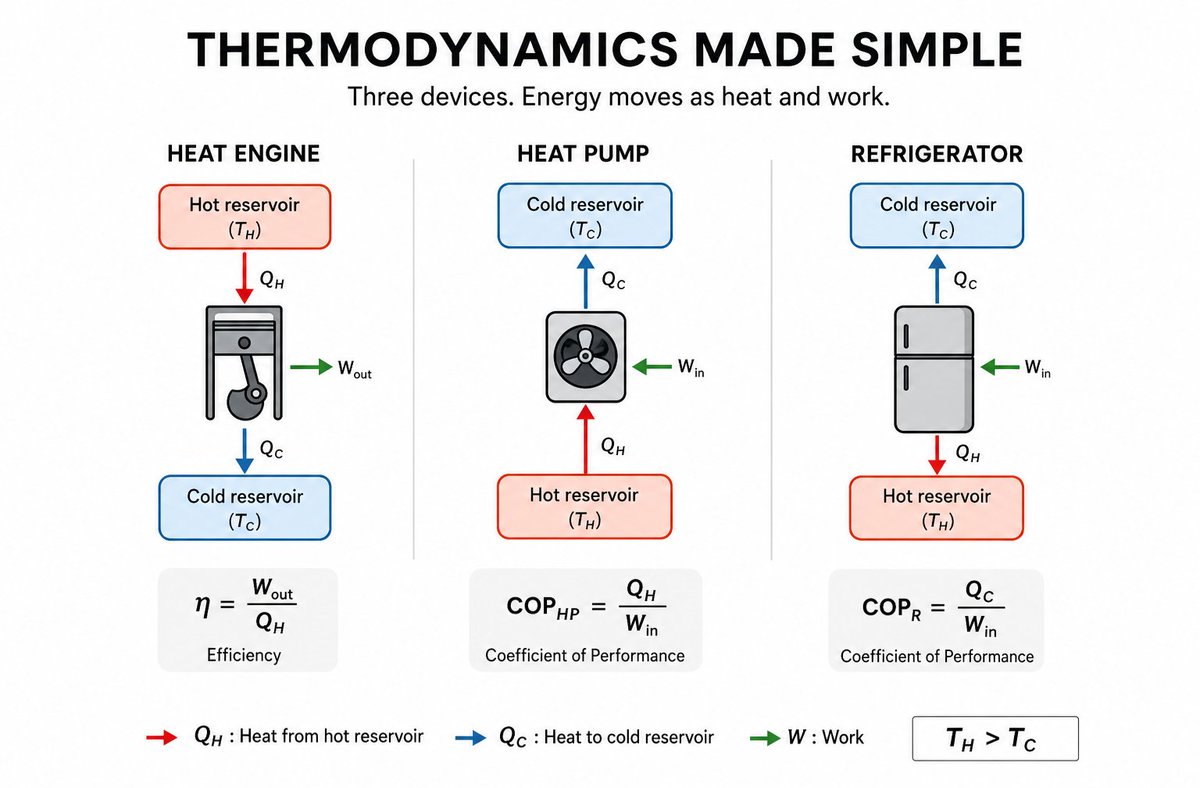
Thermodynamics explains how heat and energy move through every machine around us.
• Heat Engine: Converts heat into useful work while releasing some heat to a colder reservoir.
• Heat Pump: Uses external work to transfer heat from a colder place to a warmer place for heating.
• Refrigerator: Uses external work to remove heat from a cold space and reject it to a warmer surrounding.
Understanding the direction of heat flow and the role of work is the key to telling these three devices apart. Once that concept is clear, their efficiency and performance formulas become much easier to understand.
Met a guy making $1.6 million/year as an LLM engineer.
I asked him how he learned LLMs from scratch.
He sent me the exact video that got him in. A 1 hour course on how LLMs actually work.
He shows how transformers inside LLMs like ChatGPT & Claude are actually built.
I watched it last night.
Halfway through, I realized LLM architecture is way simpler than they make it look.
Bookmark this and read the article below.
• 00:00 - LLM foundations
• 04:21 - LLM tokenization
• 05:43 - LLMs vector embeddings
• 22:16 - attention mechanism of LLM
• 43:42 - LLM multi head attention
The computer of the future began with ideas from a century ago.
Quantum computing is the result of decades of scientific breakthroughs, starting with quantum mechanics in the 1920s and growing through the work of Heisenberg, Schrödinger, Dirac, Feynman, Deutsch, Shor, Grover, and many others.
This timeline shows the discoveries that turned a theoretical idea into one of the most exciting fields in modern science.
Andrew Ng:
"100% of my tasks are done by AI agents - hype has exceeded my expectations. Graphs are the next step.
In 3-6 months, everyone will be building Graphs for our multi-agent systems. No more prompting."
In 15-minute talk at dev conf, Andrew Ng reveals how to build self-learning agents from scratch.
Worth more than a $500 agentic course.W
Watch it today, then read how hedge funds are using graph engineering in the article below.
most people think mathematics is about being good with numbers. it isn’t.
mathematics is the discipline of seeing patterns.
• patterns in change.
• patterns in structure.
• patterns in logic.
• patterns in uncertainty.
build a mathematical mind by Albert rutherford argues that mathematical thinking is a skill, not a talent.
you develop it by asking:
• what stays the same?
• what changes?
• what repeats?
• what constrains the system?
• what is the simplest rule that explains this?
that is why mathematics reaches so far beyond the classroom.
the same pattern-recognition machinery powers engineering, programming, physics, finance, and science.
a mathematical mind doesn’t memorize formulas.
it learns to compress complexity into structure.
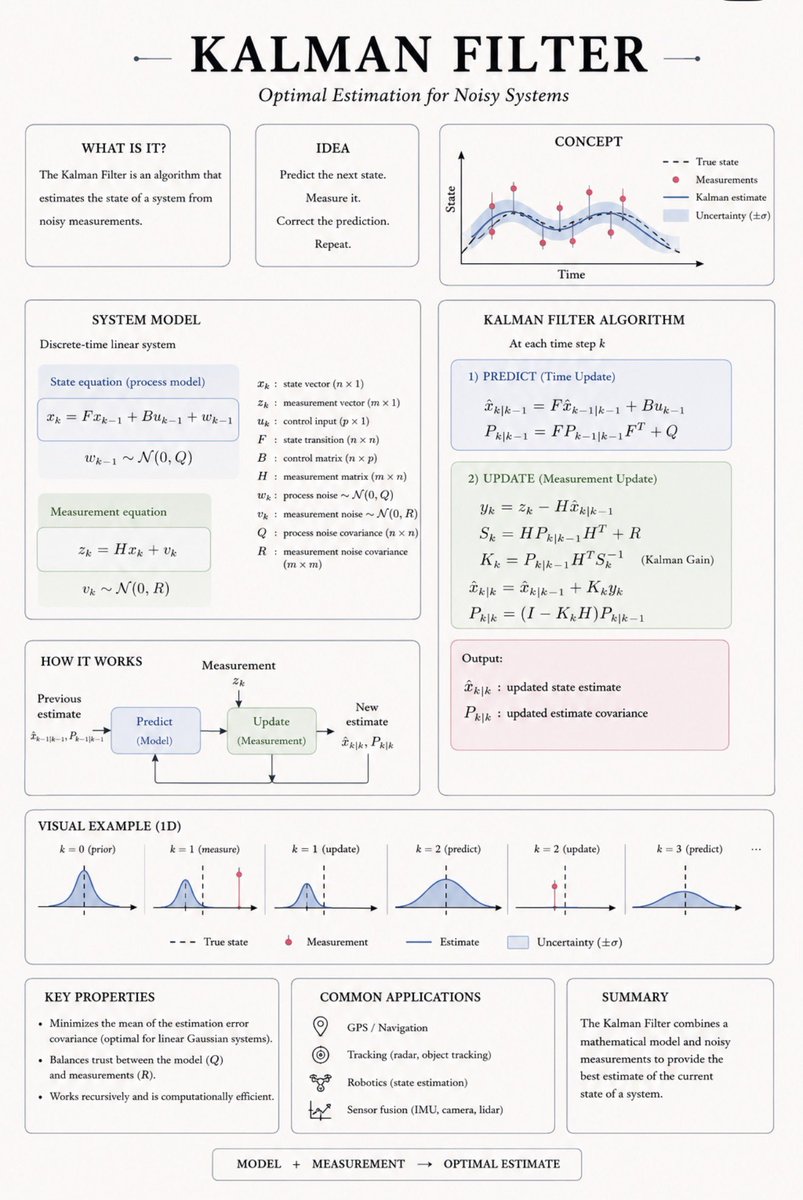
the kalman filter solves a problem that every robot eventually runs into: sensors are noisy, and models are imperfect. if you trust only your sensors, your estimate jumps around. if you trust only your model, errors accumulate over time. the kalman filter does neither. it continuously balances prediction with measurement, producing the best estimate of the system’s current state from both sources of information.
every iteration follows the same loop. first, predict where the system should be using the mathematical model. then take a measurement from the real world. compare the prediction with the measurement, calculate how much to trust each one, and update the estimate. then repeat. prediction → measurement → correction. this simple recursive idea is why a kalman filter can track a moving car, estimate a drone’s position, stabilize a rocket, or fuse data from a camera, imu, gps, and lidar into a single coherent estimate.
what i find beautiful is that the kalman filter isn’t trying to eliminate uncertainty. it embraces it. every estimate comes with a measure of confidence, and every new observation changes that confidence. that’s a much deeper engineering principle. reality is noisy, models are incomplete, and measurements are never perfect. the goal isn’t certainty. it’s making the best possible decision with the information you have right now.