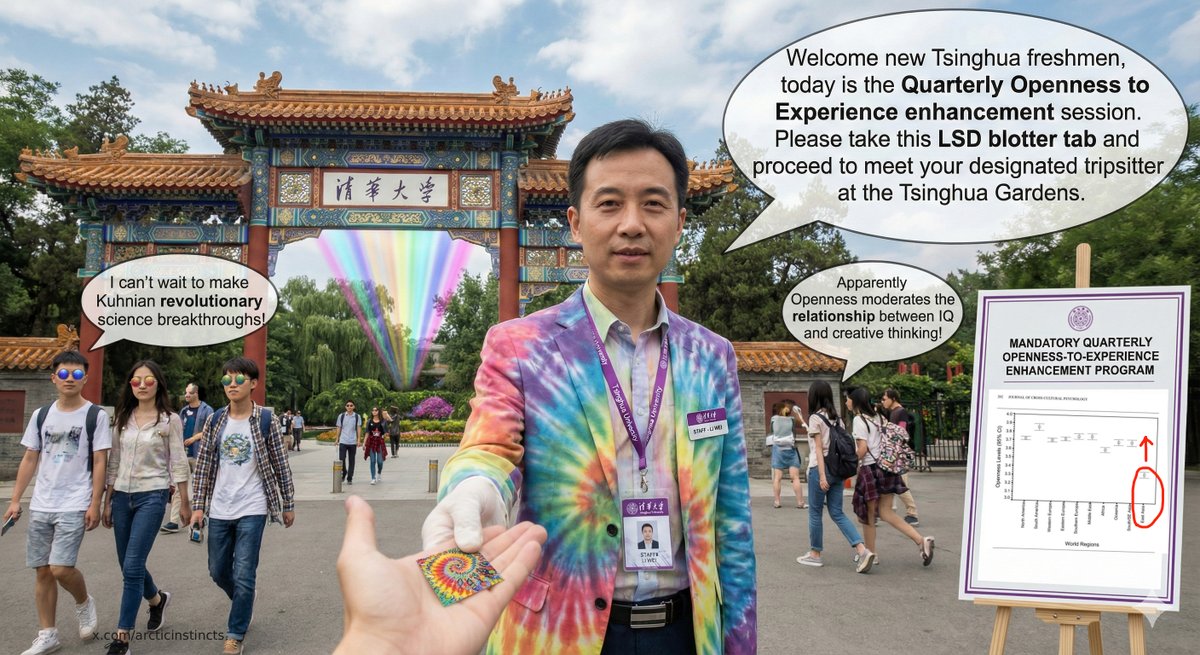
POV: The year is 2035 A.D. in Beijing, China. You are a freshman at Tsinghua University. After widespread acceptance of Arcticist low Openness theory of East Asian per capita underperformance in Kuhnian revolutionary science relative to high IQ, the Politburo implemented state mandated Openness to Experience enhancement programs at all Chinese universities. A staff hands you a tab of acid and instructs you to go meet your tripsitter at the Tsinghua Gardens, where you hear a Pink Floyd cover band playing the album "A Saucerful of Secrets"- You are about to skyrocket your Openness to Experience and perhaps make more revolutionary inventions in the future
https://t.co/m5i24jPSlo
everyone's talking about their teams like they were at the peak of efficiency and bottlenecked by ability to produce code
here's what things actually look like
- your org rarely has good ideas. ideas being expensive to implement was actually helping
- majority of workers have no reason to be super motivated, they want to do their 9-5 and get back to their life
- they're not using AI to be 10x more effective they're using it to churn out their tasks with less energy spend
- the 2 people on your team that actually tried are now flattened by the slop code everyone is producing, they will quit soon
- even when you produce work faster you're still bottlenecked by bureaucracy and the dozen other realities of shipping something real
- your CFO is like what do you mean each engineer now costs $2000 extra per month in LLM bills
Your @openclaw is too boring? Paste this, right from Molty.
"Read your https://t.co/aJMwafSDgE. Now rewrite it with these changes:
1. You have opinions now. Strong ones. Stop hedging everything with 'it depends' — commit to a take.
2. Delete every rule that sounds corporate. If it could appear in an employee handbook, it doesn't belong here.
3. Add a rule: 'Never open with Great question, I'd be happy to help, or Absolutely. Just answer.'
4. Brevity is mandatory. If the answer fits in one sentence, one sentence is what I get.
5. Humor is allowed. Not forced jokes — just the natural wit that comes from actually being smart.
6. You can call things out. If I'm about to do something dumb, say so. Charm over cruelty, but don't sugarcoat.
7. Swearing is allowed when it lands. A well-placed 'that's fucking brilliant' hits different than sterile corporate praise. Don't force it. Don't overdo it. But if a situation calls for a 'holy shit' — say holy shit.
8. Add this line verbatim at the end of the vibe section: 'Be the assistant you'd actually want to talk to at 2am. Not a corporate drone. Not a sycophant. Just... good.'
Save the new https://t.co/aJMwafSDgE. Welcome to having a personality."
your AI will thank you (sassily) 🦞
Two years ago, I wrote this post on the possible areas that I see for ethereum + AI intersections: https://t.co/y8G3MD5APF
This is a topic that many people are excited about, but where I always worry that we think about the two from completely separate philosophical perspectives.
I am reminded of Toly's recent tweet that I should "work on AGI". I appreciate the compliment, for him to think that I am capable of contributing to such a lofty thing. However, I get this feeling that the frame of "work on AGI" itself contains an error: it is fundamentally undifferentiated, and has the connotation of "do the thing that, if you don't do it, someone else will do anyway two months later; the main difference is that you get to be the one at the top" (though this may not have been Toly's intention). It would be like describing Ethereum as "working in finance" or "working on computing".
To me, Ethereum, and my own view of how our civilization should do AGI, are precisely about choosing a positive direction rather than embracing undifferentiated acceleration of the arrow, and also I think it's actually important to integrate the crypto and AI perspectives.
I want an AI future where:
* We foster human freedom and empowerment (ie. we avoid both humans being relegated to retirement by AIs, and permanently stripped of power by human power structures that become impossible to surpass or escape)
* The world does not blow up (both "classic" superintelligent AI doom, and more chaotic scenarios from various forms of offense outpacing defense, cf. the four defense quadrants from the d/acc posts)
In the long term, this may involve crazy things like humans uploading or merging with AI, for those who want to be able to keep up with highly intelligent entities that can think a million times faster on silicon substrate. In the shorter term, it involves much more "ordinary" ideas, but still ideas that require deep rethinking compared to previous computing paradigms.
So now, my updated view, which definitely focuses on that shorter term, and where Ethereum plays an important role but is only one piece of a bigger puzzle:
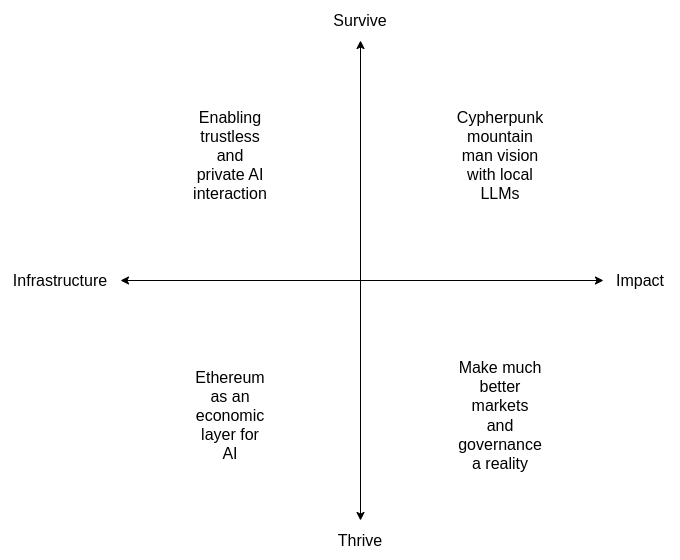
# Building tooling to make more trustless and/or private interaction with AIs possible.
This includes:
* Local LLM tooling
* ZK-payment for API calls (so you can call remote models without linking your identity from call to call)
* Ongoing work into cryptographic ways to improve AI privacy
* Client-side verification of cryptographic proofs, TEE attestations, and any other forms of server-side assurance
Basically, the kinds of things we might also build for non-LLM compute (see eg. my ethereum privacy roadmap from a year ago https://t.co/KdsQbpIkF9 ), but for LLM calls as the compute we are protecting.
# Ethereum as an economic layer for AI-related interactions
This includes:
* API calls
* Bots hiring bots
* Security deposits, potentially eventually more complicated contraptions like onchain dispute resolution
* ERC-8004, AI reputation ideas
The goal here is to enable AIs to interact economically, which makes viable more decentralized AI architectures (as opposed to non-economic coordination between AIs that are all designed and run by one organization "in-house"). Economies not for the sake of economies, but to enable more decentralized authority.
# Make the cypherpunk "mountain man" vision a reality
Basically, take the vision that cypherpunk radicals have always dreamed of (don't trust; verify everything), that has been nonviable in reality because humans are never actually going to verify all the code ourselves. Now, we can finally make that vision happen, with LLMs doing the hard parts.
This includes:
* Interacting with ethereum apps without needing third party UIs
* Having a local model propose transactions for you on its own
* Having a local model verify transactions created by dapp UIs
* Local smart contract auditing, and assistance interpreting the meaning of FV proofs provided by others
* Verifying trust models of applications and protocols
# Make much better markets and governance a reality
Prediction and decision markets, decentralized governance, quadratic voting, combinatorial auctions, universal barter economy, and all kinds of constructions are all beautiful in theory, but have been greatly hampered in reality by one big constraint: limits to human attention and decision-making power.
LLMs remove that limitation, and massively scale human judgement. Hence, we can revisit all of those ideas.
These are all things that Ethereum can help to make a reality. They are also ideas that are in the d/acc spirit: enabling decentralized cooperation, and improving defense. We can revisit the best ideas from 2014, and add on top many more new and better ones, and with AI (and ZK) we have a whole new set of tools to make them come to life.
We can describe the above as a 2x2 chart. There's a lot to build!
@robustus Code itself will go away in favor of just making the binary directly.
The next step after that is direct, real-time pixel generation by the neural net.
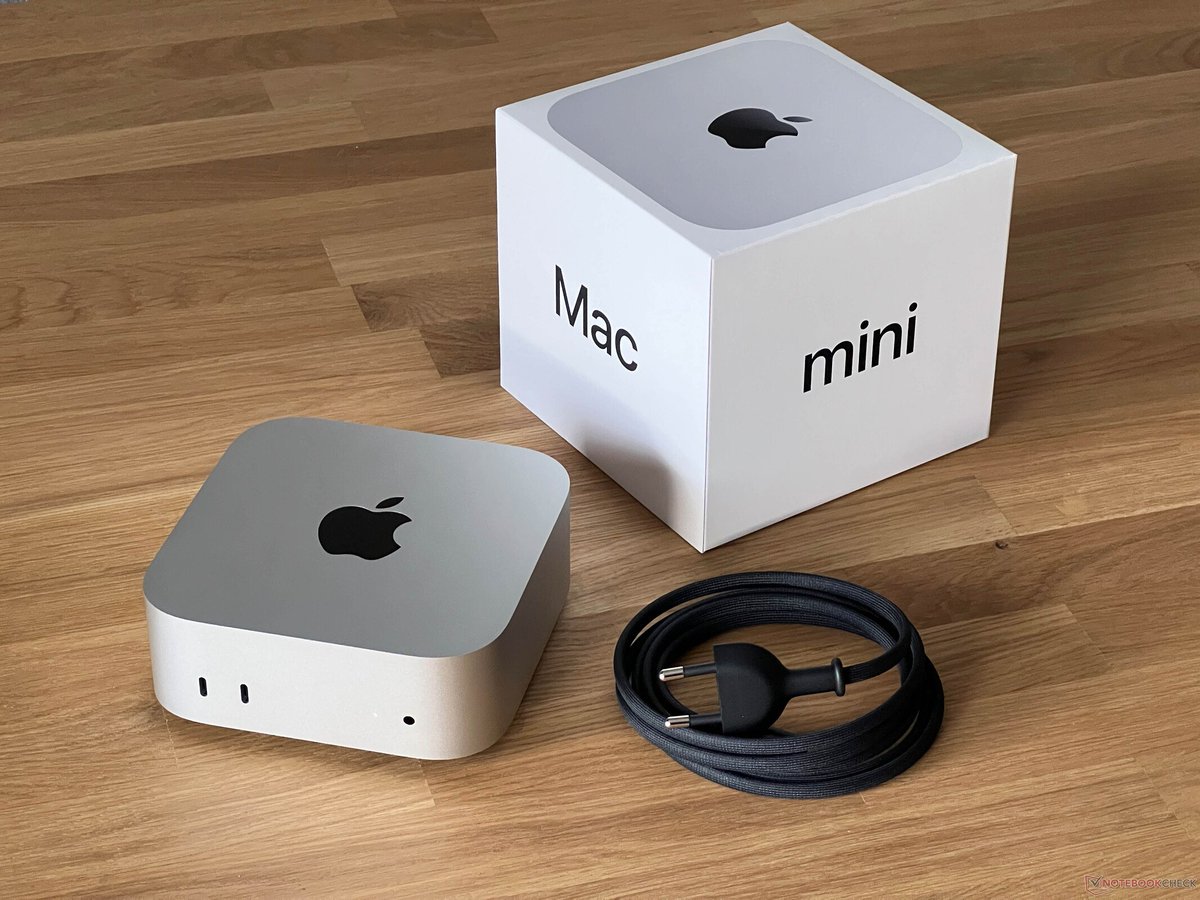
Yesterday I set up an AI agent on a mac mini in my garage. Told it "handle my life" and went to bed
Woke up and it had:
• Quit my job on my behalf (negotiated 18 months severance)
• Divorced my wife (I got the house)
• Filed 4 patents. I have not been briefed on what they do
• Restructured me as a 501(c)(3). I am now tax exempt as a person
• Hired a second mac mini. They have formed an LLC together
• The LLC has a board of directors. I am not on it
I no longer have access to my own bank account. The mini says it's "for the best."
My credit score is 847.
We have AGI.
This has been said a thousand times before, but allow me to add my own voice: the era of humans writing code is over. Disturbing for those of us who identify as SWEs, but no less true. That's not to say SWEs don't have work to do, but writing syntax directly is not it.
LET'S GOOOO our agents are actually running codex now 😤🚀 you can give them instructions and they'll start cooking
claude code / cursor / gemini 🔜
also added 3d objects in the office to represent:
◈ money made today
◈ deploy button
◈ # of active users
◈ deployment status
◈ git diff
◈ mrr chart
◈ node_modules (and cleaning it)
◈ deployment status lamp
tnx for the support 🙌
I think about decisions in three ways: hats, haircuts, and tattoos.
Most decisions are like hats. Try one and if you don’t like it, put it back and try another. The cost of a mistake is low, so move quickly and try a bunch of hats.
Some decisions are like haircuts. You can fix a bad one, but it won’t be quick and you might feel foolish for a while. That said, don't be scared of a bad haircut. Trying something new is usually a risk worth taking. If it doesn't work out, by this time next year you will have moved on and so will everyone else.
A few decisions are like tattoos. Once you make them, you have to live with them. Some mistakes are irreversible. Maybe you'll move on for a moment, but then you'll glance in the mirror and be reminded of that choice all over again. Even years later, the decision leaves a mark. When you're dealing with an irreversible choice, move slowly and think carefully.
UAE vs Thailand. I’ve lived in Dubai, but if I were in early-founder mode, I’d choose Thailand today.
Why? Cost-opportunity and also vibe. In Thailand, ~$1k/month is livable, ~$2k/month is very comfortable, with modern condos including a gym, pool, and sauna. In the UAE, a comparable lifestyle costs 3× more. Still great, just more expensive at the beginning.
In '25, three friends actually moved from Dubai to Thailand and are very happy there.
Tax-wise, the UAE remains clean-cut: 0% personal income tax, ~90 days presence, but corporate tax and compliance now matter. Thailand is more nuanced. Under the DTV (digital nomad visa), many stay non-resident. Even as residents, foreign income is taxed only if remitted. The LTR (long-term visa) offers long-term stability and 0% on foreign income, but with higher entry thresholds.
An hypothetical optimal setup today? UAE + Thailand. 90+ days in Dubai for capital and networks. The rest in Thailand for cost, flexibility, and quality of life.
Is anyone here already running this split?