The World Cup begins tomorrow, and many will watch the matches. Soccer reminds us of something we must not forget: life is not a race to show off on our own, but a path we learn to walk together. Anyone who does not know how to pass the ball, even if they have talent, has not yet understood the game. Anyone who does not know how to live with and for others has not yet understood life. #ApostolicJourney
Today, @weweb_io launched on @ProductHunt... the same day as Google Antigravity.
David vs Goliath.
And right now, we're on the podium with Google, only 9 upvotes behind them.
If you have a Product Hunt account and want to support a small team go head-to-head with one of the biggest companies in the world, take 10 seconds to show your support for WeWeb here 👇
https://t.co/dQJmO9cIQs
This one would be huge for us. 🔥
Big day today, @weweb_io is live on Product Hunt!
We built advanced AI capabilities into a powerful no-code web app builder. The result? The best tool for non-technical users to build their apps.
Check out the launch below. We’d love to get your support ❤️
And yes, there’s a special launch offer for the PH community: 20% off any plan 🤗
https://t.co/RiqBjv4p6B
We’re hosting a live AMA with @raphgoldz, WeWeb CEO & co-founder, so bring your questions!
✅Ask us anything
✅ Share feedback and ideas directly
✅ Hear what’s coming next for WeWeb
📆 May 21st at 4 PM UTC
Set a reminder and join us live 👇
(link in comments)
Introducing WeWeb Unify: a brand new, full-stack version of WeWeb ✨
With WeWeb Unify, you can now combine AI & a drag-and-drop editor to design your interface, manage data, build backend logic, and publish production apps. All in one platform.
We'd love to hear what you think 👇
UI/UX Designers, this might be one of the cleanest color palette generators I’ve seen lately.
Kigen is a color generator that helps you quickly create beautiful palettes for your UI projects, making it easier to pick colors that actually work well together instead of guessing.
Bookmark it for later 💜
One of the greatest cheat codes in life is to never get offended. Train yourself to have a thick skin. Don't take things personally. Let others disagree with you. Being easily offended means you're easily manipulated. Want more peace? Avoid getting offended.
This is fascinating... the HEIGHT of the ceiling in the room you're working in has a DIRECT impact on how creative you are
It's called the Cathedral Effect
How it works: Your brain borrows metaphors from the physical world (space is one of the strongest)
When a room feels tall and open, your mind unconsciously associates that with freedom and possibility - you zoom OUT
When a room feels tight or enclosed, your mind goes into precision mode… attention narrows. You notice typos, spot mistakes, and hone in on details - you zoom IN
Researchers found that people in high-ceiling rooms perform better on creativity. People in low-ceiling rooms perform better on detail orientation and error detection
Churches and museums have soaring ceilings - meant to inspire awe. Libraries and war rooms are tighter - meant for concentration
Startup brainstorms love lofts, and accounting teams love small rooms with doors
Even coffee shops do this. The ones designed for deep work tend to be lower and quieter. The ones designed for conversation tend to feel more open
So if you’re doing creative stuff - writing, designing, brainstorming - do it in a LARGE room with high ceilings. Then move to a smaller room to edit and proofread.
the lessons I've learned scaling my startups:
> 90%+ of users pick google sign in. just make it the default.
> strip all formatting from your emails. send from a real name, not "company team." watch your open rates jump.
> add "how did you hear about us?" to onboarding. makes marketing 10x easier.
> 99% of people sliding into your dms with "opportunities" are wasting your time. protect your calendar.
> creator sponsorships cost less than ads but eat more time. pick based on what you have more of.
> building a good product is just relentlessly asking "what does my user actually want" and doing that.
> copycats show up the moment you get traction. they'll clone everything. they still won't catch you.
> i couldn't build something good if i wasn't using it daily.
> always check logs right after pushing updates.
> bugs are fine. slow fixes aren't.
> people notice good ui/ux design even if they can't explain why.
> first 10 paying customers are harder than the next 100.
> always refund people who ask. not worth the energy or the bad review. give them 2 months free too.
> marketing is just running experiments fast. steal from what works for similar products.
> cheap accountants cost more in the long run.
> users will hop on calls way more than you'd expect. these conversations are cheat codes.
> strong testimonials let customers sell for you.
> you won't have a "pmf moment." only way to know is when people tell their friends about your product (word of mouth)
> even when things are going well you'll have days where you think it's all falling apart. it's not. keep building.
AI is transforming how we build web-applications. It’s faster, easier, and more accessible than ever.
But for non-coders, AI alone isn’t enough.
Even if AI gets non-coders 95% of the way, visual interfaces are still needed for them to understand what was built, validate it, and confidently adjust the last 5%.
Also, in many cases, it’s actually faster to make the adjustments manually than to ask an AI to do it.
At @weweb_io , we put a lot of effort into making sure AI works in harmony with our visual builder.
I dive deeper into this in our latest article, including how we see AI and visual development evolving together. Link in comment!
harsh truths about building startups that nobody tells you:
> offer Google login. most users won't create accounts otherwise.
> forget free trials, charge from day one. paid users are serious users.
> after launch: 80% marketing, 20% building. launching is just the beginning.
> talk about your product everywhere, even where it feels uncomfortable (market shamelessly)
> unsubscribers give you the most honest feedback. respect them always, and even in the early stages, give them a few months free
> use your own product daily (build based off of the problems you face)
>70% of revenue comes from existing users. retention beats acquisition so keep churn low
> MVP = ONE CORE FEATURE only. once it solves the problem you're fixing, ship it asap
> if competitors charge $100, don't settle for $10. value your work. undercut SLIGHTLY
> no revenue after 6 months? time to pivot or change ideas (your problem isn't present enough)
> landing page formula: navbar, clear hero, problem you're solving, features bento card, pricing, cta, footer. nothing else.
> email your users regularly. best features come from conversations. ask for brutal feedback.
> price based on results, never features.
> add a clear way to contact the founder, and send a welcome email after someone signs up (even if they didn't buy) for forwarded questions
> ugly product that works > beautiful product that doesn't.
the brutal reality:
90% quit within 2 years.
the 10% who stay own the market.
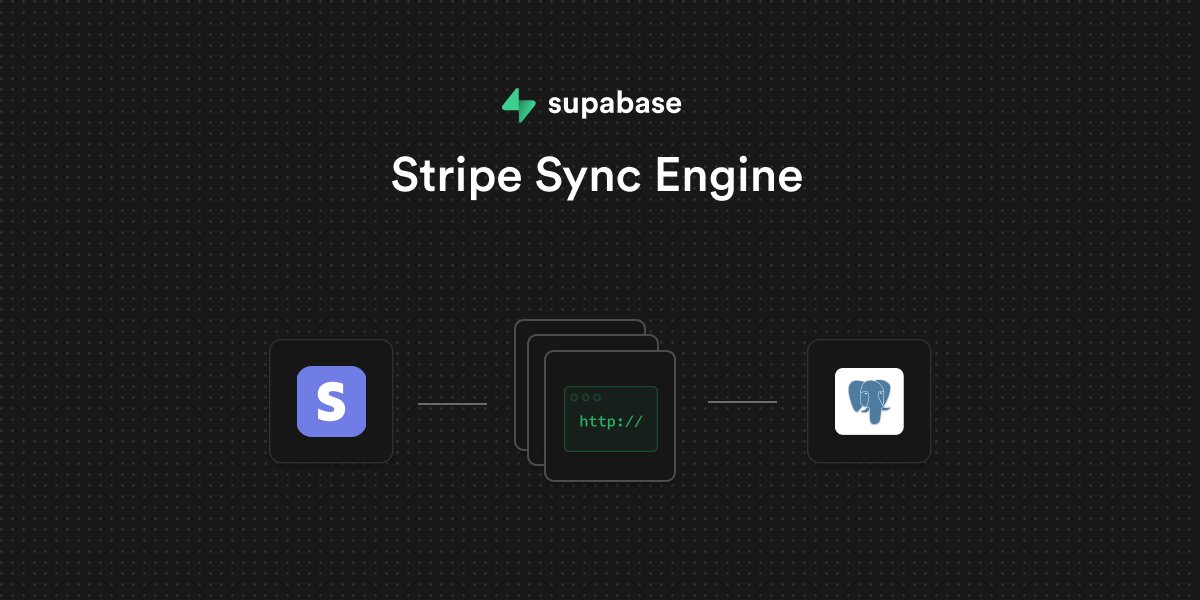
Supabase now has a Stripe Sync Engine integration!
It automatically syncs Stripe data, such as customers, payments, and subscriptions, into your Postgres database!
You can enable it from your Supabase dashboard under integrations!