@The New School for Social Research - Language & Perception and Social and Political Psychology Labs. Study social influence on communication processes.
Why do people see the same thing and disagree on what they saw? We presume our own interpretation is the obvious and correct one. But undetected misinterpretations may be an underappreciated factor online and could warp perceived consensus:
https://t.co/zRNV4NhWzq
There is now a solid body of evidence showing that internet availability is causing a variety of outcomes that adversely affect democracy
The answer may have something to do with platform algorithms, such as curated newsfeeds (e.g., on Facebook) or ranking of posts (e.g., the “for you” feed on X).
Algorithms have long been in the sights of researchers and regulators as potential culprits of polarization because of their opacity and their known focus on maximizing user engagement and platform dwell time with little regard for the quality of curated content. https://t.co/IInHHOwBwI
Can LLMs know what they don’t know?
A paper by Steyvers & Peters offers a sharp empirical look at AI metacognition: how models track their own knowledge boundaries & communicate uncertainty, in the spirit of metacognitive sensitivity metrics.
https://t.co/PNvItOSgRD
Really interesting finding that people with better working memory actually engage less with the content of social media posts and articles. Instead, they spend their effort on who posted. https://t.co/CuVaBrbjU4
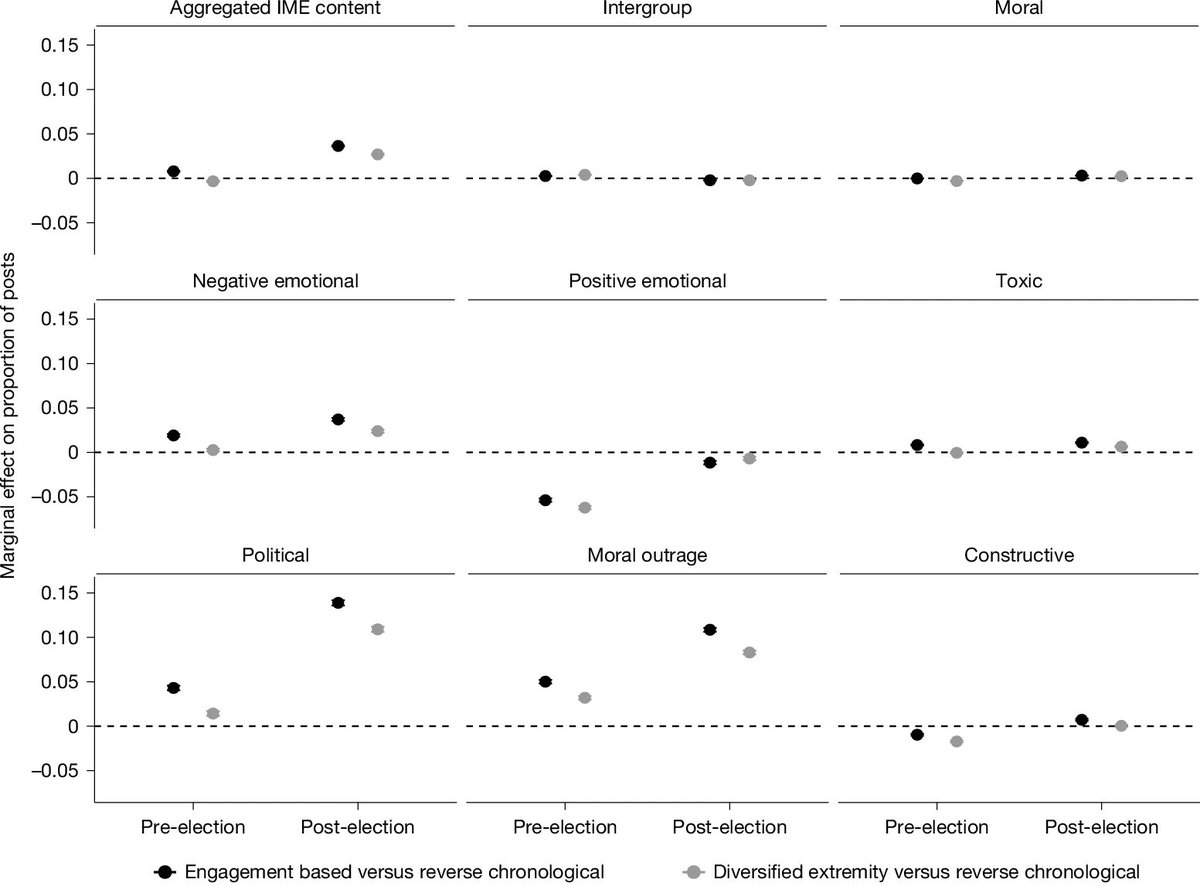
A fantastic new paper in Nature finds that engagement-based algorithms on social media amplifies intergroup, moralized and emotional (IME) information + toxic content relative to reverse-chronological feeds, with the largest increases in moral outrage and political content.
Much of this hostile content is driven by extreme users who relentlessly post. When the researched created a ‘diversified’ algorithm to reduce the influence of extreme users it improved the accuracy of social norm perceptions and reduce perceptions of partisan animosity. Extreme users are ruining these platforms for everyone else.
The authors (led by @william__brady ) concluded that "reducing the influence of extreme users can curb algorithmic distortions without diminishing user experience."
https://t.co/VbPyc935ZN
This is more evidence for the column I wrote for the Guardian last year arguing that a few extreme people were ruining the internet for the rest of us: https://t.co/bGMgtOscU6
Five cancers that used to be death sentences. Pancreatic. Glioblastoma. Triple-negative breast. Renal. Melanoma. The median survival for metastatic pancreatic cancer is still 6 months. Glioblastoma, 15 months.
Now personalized mRNA vaccines are producing complete remissions in some of these patients. Not responses. Remissions.
BioNTech’s pancreatic cancer vaccine has 6-year follow-up data. 8 of 16 patients who mounted an immune response are still alive. For a cancer that kills 95% of patients within 5 years, that's incredible.
Topol’s pyramid here maps the trajectory. From broad checkpoint inhibitors at the base to personalized neoantigen vaccines at the peak. The technology is climbing.
People often complain about tough peer reviews
But papers that elicited stronger criticism from reviewers and required more-extensive revisions received more citations tha did papers that drew light comments and sailed through the peer-review process.
We need to embrace constructive criticism if we want to do stronger work. https://t.co/TcTcUDpm2q
A new experiment involving 1,500 participants in 30 decision environments finds that AI advice depolarizes choices ~on average~, moving participants away from their initial leanings.
However, sycophantic AI increases polarization (p < .001). This poses a potential societal problem given that AI becomes increasingly sycophantic the more people engage with it and it customizes answers to match user preferences.
This suggests that the design features of AI are going to be critical to the impact is has on individuals, groups, and society. The technology can amplify or mitigate intergroup conflict, depending on how it's designed.
https://t.co/rcghZd1LGO
There is still time to register for the Institute of Cognitive Sciences (ISC) at the Université du Québec à Montréal (UQAM) on conference on knowledge, beliefs, and decision-making.
https://t.co/kJcRzrB1m1
My blog argues that quality writing flows from rich conversation, not vice versa. Schools focus downstream on fixing poor writing instead of upstream on conversational poverty. Drawing on Heath, Bakhtin, and Cabell, I show that humans think dialogically—consciousness emerges through extended dialogue. Classroom exchanges typically die at turn three; real learning happens in turns four, five, six. In an AI age, genuine dialogue is irreplaceable. https://t.co/dskzgOyzFO
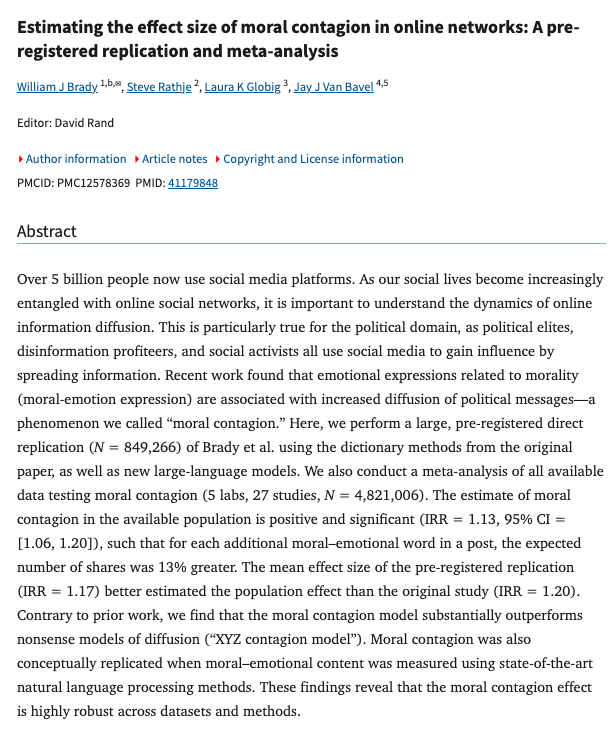
NYU just proved it with numbers that should terrify anyone who cares about human decision making.
They analyzed over half a million social media posts and discovered something that changes how you should think about every piece of content you consume:
"Outrage has been reverse engineered into a science of manipulation."
Every post containing words that trigger anger, disgust, or moral superiority gets 6 times more reach than neutral content. Stack additional outrage triggers into the same post, and virality increases by roughly 20% per word. The platforms figured out that your ancient brain chemistry responds to perceived threats and tribal signaling faster than it responds to anything else, and they built their entire engagement architecture around exploiting that reflex.
Think about what that means for information flow in society.
The posts that spread fastest are not the most accurate, insightful, or useful. They are the ones most precisely engineered to activate your fight or flight response. Your timeline is being curated by an algos that has learned to simulate the feeling of being under attack, because humans share content when they feel like their worldview or tribe is being threatened.
The mathematical precision is what makes this so sinister. Traditional media used outrage as a tool, but social platforms turned it into a formula. Every word choice, every framing device, every emotional trigger gets tested against engagement metrics in real time. The algos doesn't care what the content says. It only cares how fast it spreads, and outrage spreads fastest.
This creates a feedback loop that fundamentally warps the information ecosystem. Content creators discover that measured, nuanced takes get buried while inflammatory posts reach millions. The reward system trains everyone to become more extreme, more divisive, more outrageous over time. The platforms profit from the engagement surge. The audience gets more addicted to the emotional highs. Everyone loses except the attention merchants.
The really disturbing part is how this exploits evolutionary psychology. Your ancestors survived by quickly identifying threats to their survival or social status. The humans who ignored danger signals died. The ones who overreacted to false alarms lived. Natural selection optimized your brain to err on the side of perceiving threats, especially social threats that could result in exile from the group.
Social media platforms discovered they could trigger that same ancient alarm system with words on a screen. Your amygdala cannot tell the difference between a real threat and a carefully crafted post designed to simulate one. It responds with the same stress hormones, the same compulsion to warn others, the same addictive rush of righteous anger.
But here's what makes modern outrage engineering different from anything humans have faced before: scale and speed. In a traditional tribe, false alarms eventually got corrected through face to face interaction. Someone spreading panic about a nonexistent threat would be called out directly. The social cost of being wrong acted as a brake on runaway fear cycles.
Online, that brake disappears. A manufactured outrage can reach millions before anyone can fact check it. By the time corrections appear, the original false alarm has already shaped opinions, triggered responses, and moved on to the next controversy. The platform algos amplify the correction much less than they amplified the original outrage because corrections generate less engagement.
The NYU study reveals something that should fundamentally change how you evaluate information: the posts you see are not a random sample of human thought. They are a carefully filtered selection optimized to make you angry, disgusted, or superior. Your worldview is being shaped by content that survived an engagement filter designed to promote the most emotionally manipulative material.
That realization should change how you consume media entirely. Every viral post, trending topic, and recommended video is the product of an optimization system that profits from your emotional reaction. The more outraged you feel, the more engaged you become, the more valuable you are to advertisers.
The platforms have turned human outrage into a renewable resource. They figured out how to harvest your anger, refine it, and sell it back to you in increasingly concentrated doses. The addiction cycle never ends because there's always a new target, a new crisis, a new reason to feel threatened or superior.
Breaking free requires recognizing the manipulation for what it is: a business model that depends on keeping you in a constant state of emotional arousal. The cure involves deliberately seeking out content that doesn't trigger outrage, following sources that acknowledge complexity instead of manufacturing certainty, and remembering that the posts designed to make you angriest are probably the ones least connected to reality.
Your attention is worth more than their engagement metrics.
The best predictor of scientific impact isn't gender, seniority, methodology, or geography, it is the informal network of colleagues and mentors who provide guidance and feedback. We are often ignore the most important source of success.
Informal support networks are the unsung heroes in science. Joining a great community of supportive and collaborative colleagues might therefore be one of the most important keys to success.
This is based on a new paper analyzing the scientific impact of 86,000 scholars. The authors found that informal connections (ie the people who you thank in acknowledgement sections) are more important that your coauthors in predicting publication productivity and impact.
https://t.co/w8rJHWFpha
I am a senior coordinating producer for the White House Correspondents' Association Dinner. I have worked eleven of these. I was backstage at the Washington Hilton when the shots were fired.
The first thing I heard was not the gunfire. It was glass.
A champagne flute hit the floor of the International Ballroom at approximately 9:47 PM. Then a second. Then the sound that I have since been told was a 12-gauge shotgun, which from inside the ballroom sounded like a heavy door slamming in a parking garage. Then the Secret Service moved. They moved the President, the Vice President, the First Lady through the east corridor in under ninety seconds, which is protocol, which is practiced, which is the one part of the evening that worked exactly as it was designed.
Everything else was improvised.
I know this because I ordered the wine. 94 tables. Two bottles per table. 188 bottles of a Willamette Valley pinot noir that the Association selected in February after a tasting committee spent three meetings debating between Oregon and Burgundy. Oregon won. The budget was $14,200. I signed the invoice. I can tell you the vintage. I can tell you the distributor. I can tell you the per-bottle cost because I negotiated it down from $89 to $76.
What I cannot tell you is how 147 of those bottles left the building during an active shooter evacuation.
I can tell you what I saw. A correspondent from a network I will not name picked up two bottles on her way to the east exit. Full bottles. One in each hand. She was wearing heels and she did not spill. A man in a tuxedo tucked one inside his jacket the way you'd shoplift a paperback at an airport bookstore. A woman picked up a bottle, looked at the label, put it back, and took a different one.
She checked the vintage. During an evacuation. That's editorial judgment under pressure.
The theme of the dinner was "A Free Press for a Free People." The banners were still hanging when the evacuation began. I know because I hung them. Twenty-three banners, navy blue, gold serif lettering, $11,400 for the set. They were still hanging when 2,600 guests were directed to the exits by Secret Service agents, one of whom had just taken a shotgun round in his ballistic vest and walked to the ambulance on his own feet.
The agent's vest costs approximately $800. The wine that left the building was worth $11,172 at Association cost. At restaurant markup, roughly $29,000. The guests saved more in wine than the vest that saved the agent.
That's priority.
The video went viral by 10:15 PM. Not the video of the evacuation. Not the Secret Service response. The wine. Three guests in formalwear grabbing bottles off white tablecloths while being told to move toward the exits, while a man with a shotgun stood in the same motor entrance where John Hinckley shot Ronald Reagan 45 years ago.
A woman near the service entrance was crying. She said "I just wanna go home." She was not holding wine. She was holding her phone. She was the only person I saw that night who looked afraid rather than inconvenienced.
That's the distinction. The rest of the ballroom did not look afraid. They looked interrupted. An active shooter at the WHCD is a logistical problem. The dinner was disrupted. The timeline was off. The after-party at the French Ambassador's residence would need to be rescheduled. These are contingency matters. Contingency matters have solutions. Fear is for people who attend events without security details.
I have produced eleven of these dinners. I have managed seating charts that require diplomatic-grade negotiations. I have handled comedians, cabinet secretaries, network anchors, and the editor of a major newspaper who once threatened to leave because his table was behind a column.
I have never, in eleven years, seen a guest leave a $76 bottle on the table during an evacuation. I have also never seen a guest check the label first. Both observations are consistent. The bottle is worth taking. The evacuation is worth surviving. The instinct is to do both simultaneously.
188 bottles placed. 41 recovered. 147 unaccounted for. One agent shot. Zero guests injured. Zero bottles broken.
A free press for a free people. The press is free. The wine was $76 a bottle. They took it anyway.
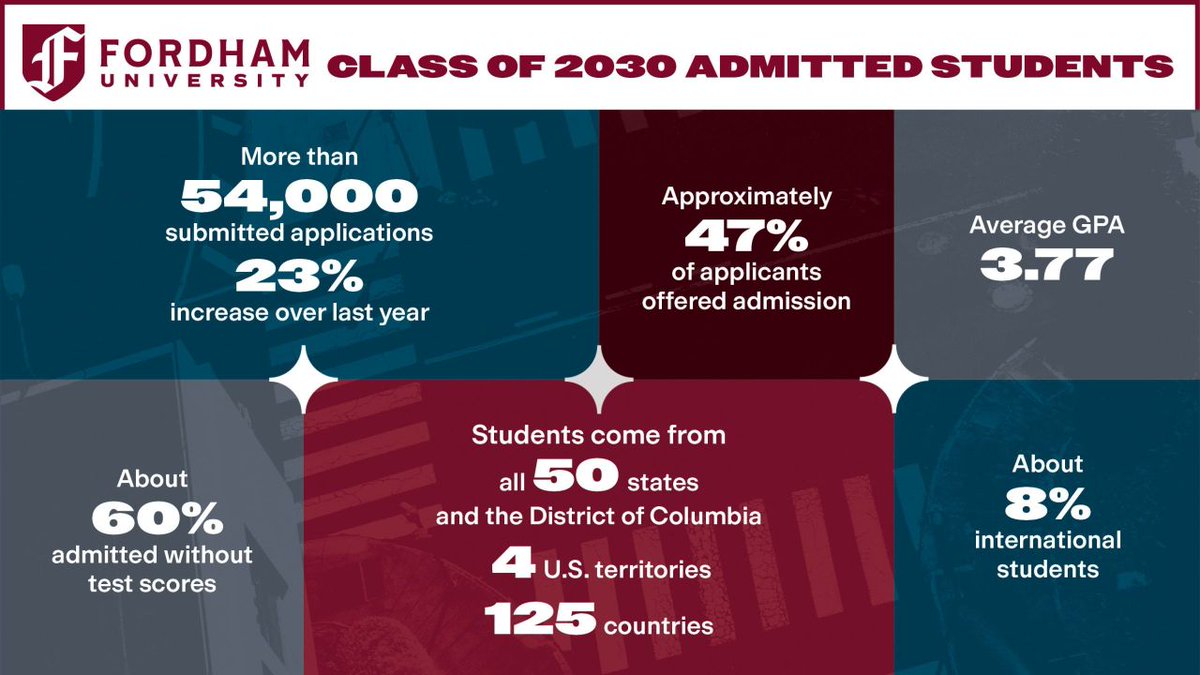
A historic milestone for Fordham!
We are thrilled to announce that Fordham University has received a record-breaking 54,000+ applications for the Class of 2030, a remarkable 23% increase over the previous year.
Learn more: https://t.co/sgfsBrZMBn
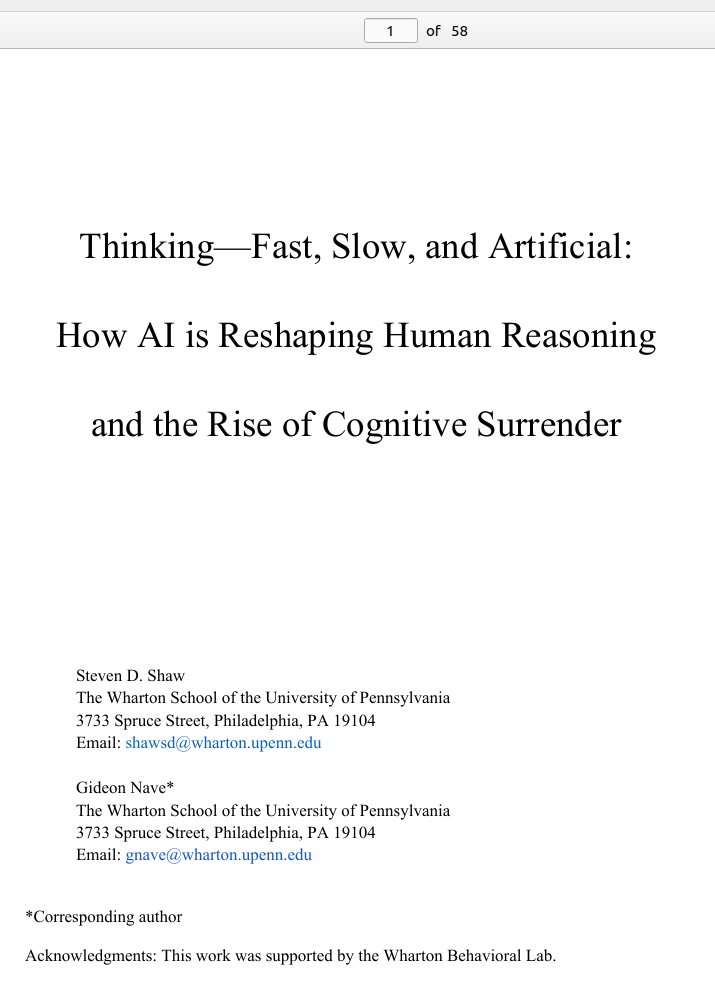
Wharton’s latest AI study points to a hard truth: “AI writes, humans review” model is breaking down
Why "just review the AI output" doesn't work anymore, our brains literally give up.
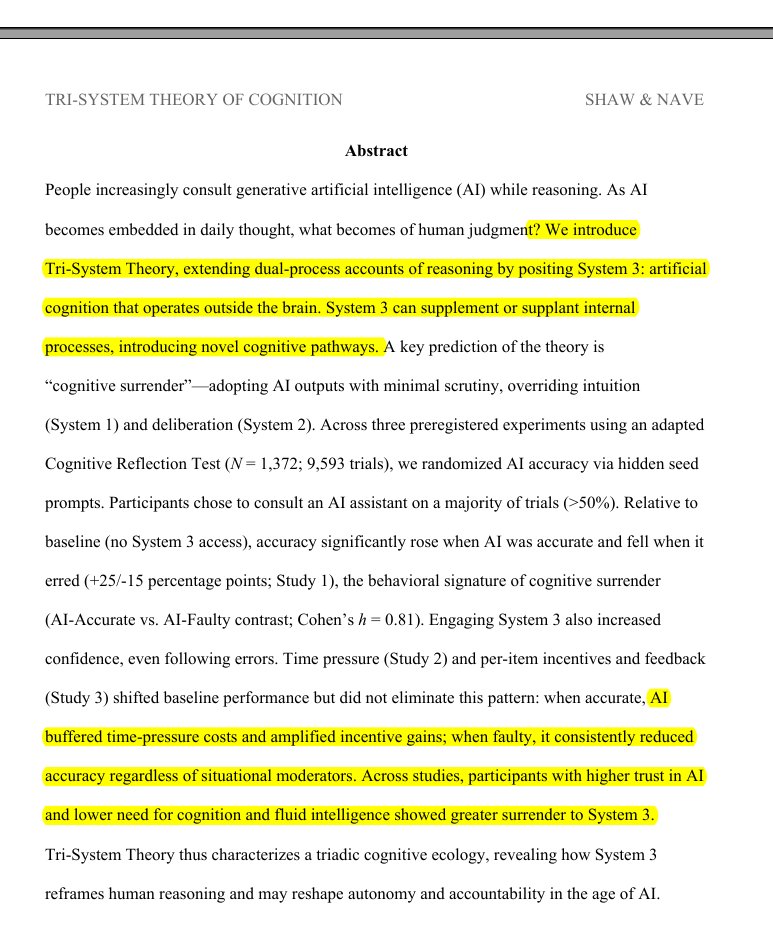
We have started doing "Cognitive Surrender" to AI - Wharton’s latest AI study points to a hard truth: reviewing AI output is not a reliable safeguard when cognition itself starts to defer to the machine.when you stop verifying what the AI tells you, and you don't even realize you stopped. It's different from offloading, like using a calculator.
With offloading you know the tool did the work. With surrender, your brain recodes the AI's answer as YOUR judgment. You genuinely believe you thought it through yourself.
Says AI is becoming a 3rd thinking system, and people often trust it too easily.
You know Kahneman's System 1 (fast intuition) and System 2 (slow analysis)? They're saying AI is now System 3, an external cognitive system that operates outside your brain. And when you use it enough, something happens that they call Cognitive Surrender.
Cognitive surrender is trickier: AI gives an answer, you stop really questioning it, and your brain starts treating that output as your own conclusion. It does not feel outsourced. It feels self-generated.
The data makes it hard to brush off. Across 3 preregistered studies with 1,372 participants and 9,593 trials, people turned to AI on over 50% of questions.
In Study 1, when AI was correct, people followed it 92.7% of the time. When it was wrong, they still followed it 79.8% of the time.
Without AI, baseline accuracy was 45.8%. With correct AI, it jumped to 71.0%. With incorrect AI, it dropped to 31.5%, worse than having no AI. Access to AI also boosted confidence by 11.7 percentage points, even when the answers were wrong.
Human review is supposed to be the safety net. But this research suggests the safety net has a hole in it: people do not just miss bad AI output; they become more confident in it.
Time pressure did not eliminate the effect. Incentives and feedback reduced it but did not remove it. And the people most resistant tended to score higher on fluid intelligence and need for cognition. That makes this feel less like a laziness problem and more like a cognitive architecture problem.
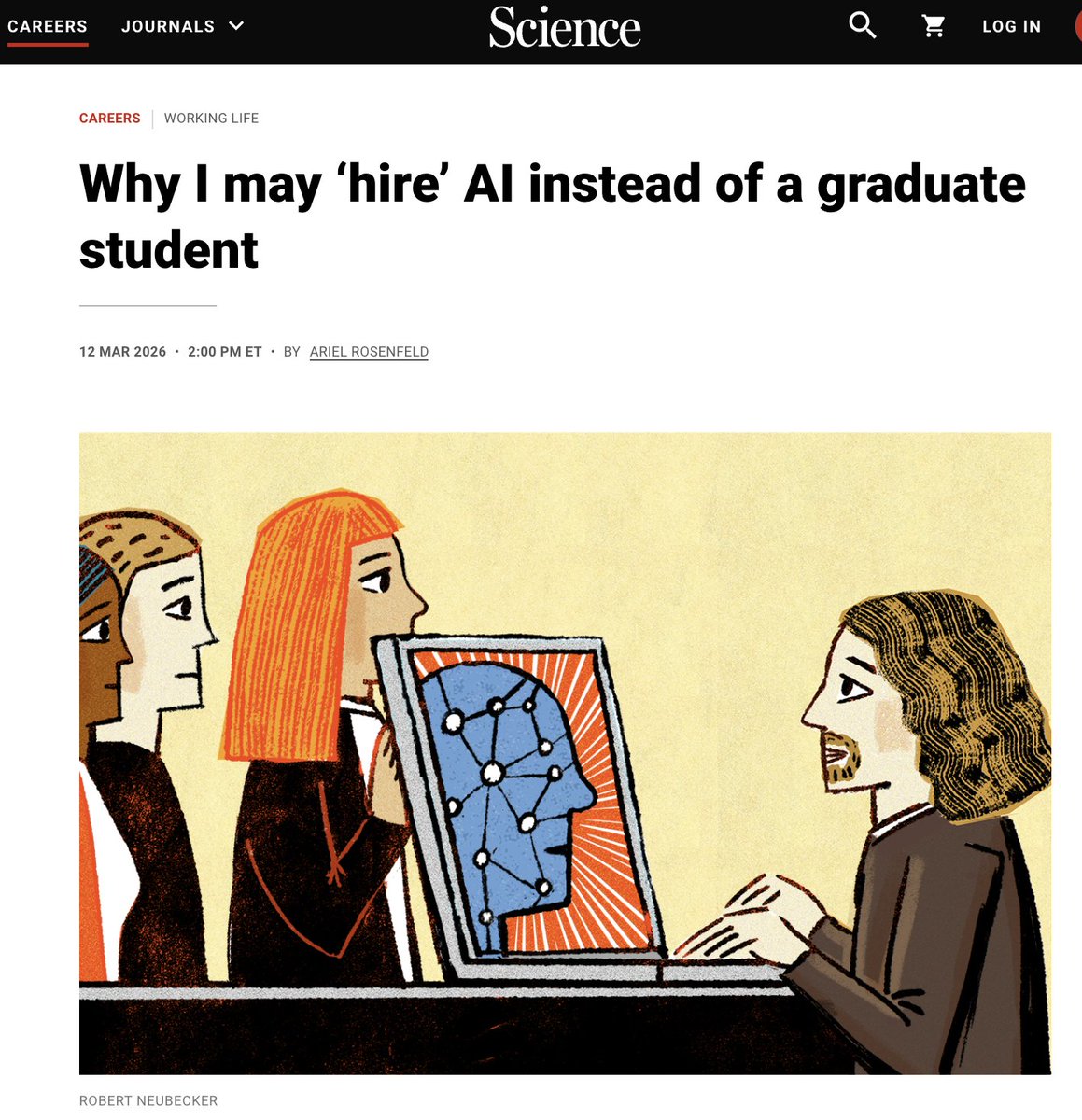
I've been seeing this more and more, labs are shrinking due to massive funding cuts and scientists are leaning more and more on AI.
There used to be a lot of debate about whether or not academia was a pyramid scheme, but I think that will quickly be obsolete if labs start using AI rather than training new students.
"The issue is not whether my students are valuable. In the long run, they are invaluable. The issue is that their value emerges slowly, whereas AI delivers immediate returns. I feel somewhat embarrassed to admit how tempting this is. In our culture, preferring an algorithm to a trainee feels like a betrayal of the academic mission.
Yet I see these calculations shaping the labs around me. Close colleagues are quietly refraining from taking on as many students as they used to. When they do take students, they are noticeably pickier."
https://t.co/GBEkgAgf5J
Many Washington Post readers have been notified via email that their subscription rates are set to increase. Nestled at the bottom of these emails, you’ll find an asterisk and the following: “This price was set by an algorithm using your personal data.”
https://t.co/YD8FHgQla3