Private Capital Snapshot
• PE exits ↓ 6% YoY
• $306.8B raised globally in H1
• 70% of capital flowed into buyout funds
Capital is becoming more selective.
Firms that can turn institutional knowledge into faster, better decisions will have the edge.
Generative AI is making information abundant.
That makes context the scarce asset.
The firms that outperform won’t simply have access to more data.
They’ll remember why decisions were made and use that context to make better ones.
We’re moving from the era of AI assistants to the era of AI with memory.
Institutional memory may soon become as valuable as institutional capital.
The firms that build for that shift today will define how private markets operate tomorrow.
Generative AI is making information abundant.
That makes context the scarce asset.
The firms that outperform won’t simply have access to more data.
They’ll remember why decisions were made and use that context to make better ones.
These aren’t isolated documents.
They’re a compounding dataset of judgment.
Yet most firms still lose this context across Slack, email, meeting notes, CRMs, and employee turnover.
Knowledge is created every day but rarely compounds.
A new moat is emerging:
The ability to retain, connect, and reuse institutional memory.
Every founder meeting.
Every IC debate.
Every diligence memo.
Every portfolio review.
Even every investment that never happened.
Historically, firms won through:
→ Proprietary deal flow
→ Strong networks
→ Sector expertise
Those still matter.
But as AI becomes ubiquitous, they’re no longer enough to stand out.
The data tells the story:
• Global VC funding reached $227.4B in Q2 2026, one of the strongest quarters on record.
• Capital is concentrating into fewer, higher-conviction investments.
• PE firms are shifting AI spend from experimentation to operational infrastructure.
Everyone is measuring AI adoption.
Very few are measuring what AI is changing inside investment firms.
The latest market signals suggest we’re entering a new era, where the competitive advantage isn’t just intelligence.
It’s institutional memory.
Everyone is measuring AI adoption.
Very few are measuring what AI is changing inside investment firms.
The latest market signals suggest we’re entering a new era where the competitive advantage isn’t just intelligence.
It’s institutional memory.
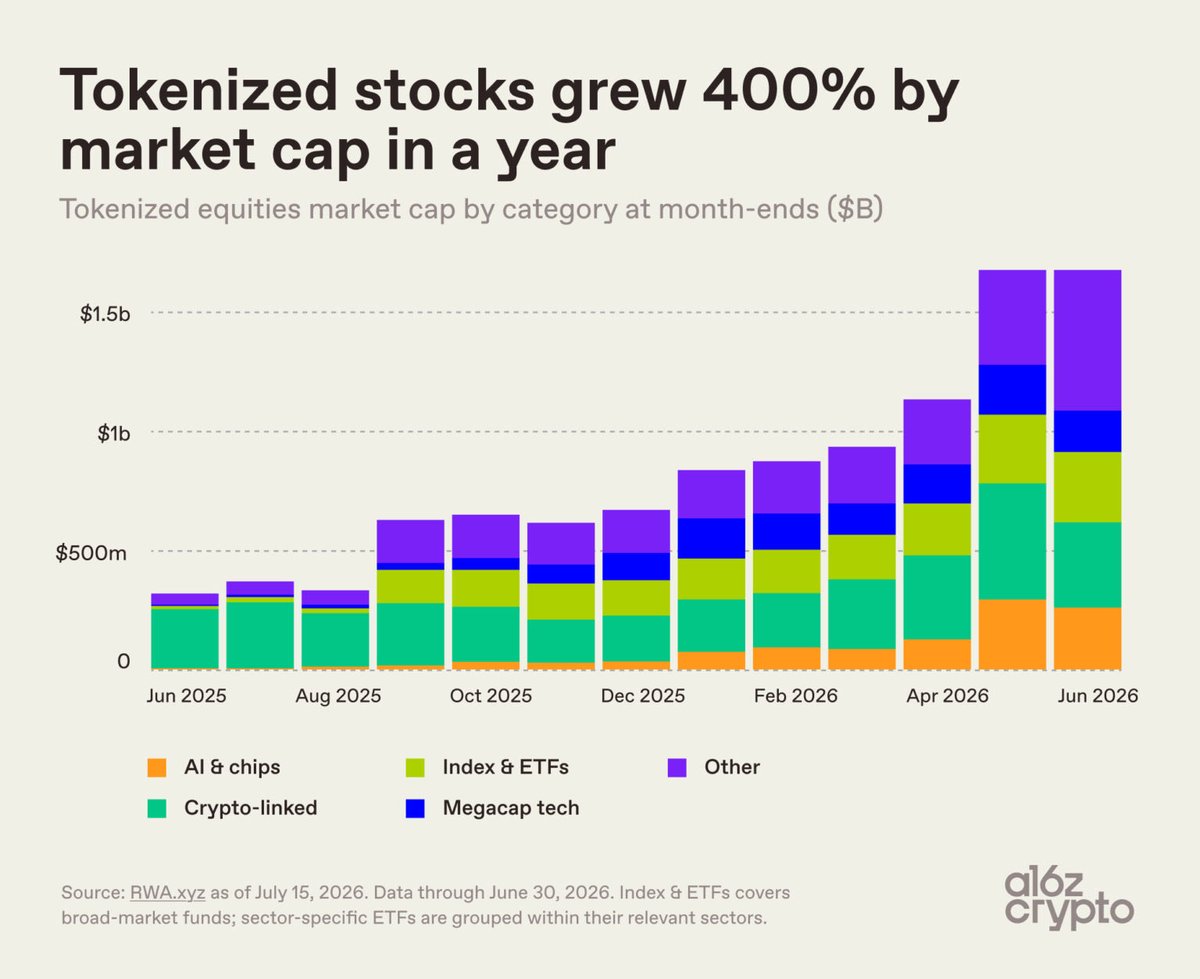
The market cap of tokenized stocks reached about $1.7 billion at the end of June, up from $329 million a year earlier — more than 5x growth. This makes tokenized stocks one of the fastest-growing categories of tokenized assets (which some refer to as real world assets).
Unlike stablecoins, whose circulating supply is a direct proxy for demand — one token, one dollar — tokenized stocks move with their underlying equities, so “market cap” does not cleanly separate the effects of new tokens minted and existing tokens repricing.
The evidence points to issuance though. More than half of today's market cap sits in assets that weren't onchain a year ago. And most of the remaining balances arrived mid-year — after much of the period's price movement in the underlying stocks had already occurred.
Venture capital has always been a pattern recognition business.
As AI concentrates returns, it becomes a memory business too.
The firms that win won’t just remember what they invested in.
They’ll remember why.
Information is abundant.
Investment context isn’t.
In a market where a handful of companies can define fund returns, institutional memory becomes part of a firm’s intellectual capital.
Every fund has a graveyard of almost-investments.
Companies that reached the final IC.
Businesses everyone loved until one meeting changed the outcome.
Those decisions quietly become some of the firm’s most valuable intellectual property.
Oddly enough, they’re also the hardest to revisit.
@partnersgroup brought in $16B in new client commitments in the first half of 2026, taking AUM to $186B
Private capital continues to scale.
And as firms grow, so does the volume of decisions, relationships, and institutional knowledge they need to carry forward.
Capital compounds.
The context behind every decision should too.
Because a firm’s advantage isn’t only what it knows—
it’s what it can remember, connect, and carry forward.
A PE firm’s most valuable knowledge might not be in its CRM.
It might be sitting in someone’s head.
@BCG estimates better knowledge management could generate $20–30M in annual net impact for a representative $20B AUM PE firm.
Because firms rarely lose data.
They lose the thinking behind it.
Why did we pass?
What concerned the partners?
What would make us reconsider?
When the same company returns years later, the files are still there.
The context often isn’t.
And teams end up repeating research, revisiting old debates, and relying on whoever still remembers.
The real advantage isn’t storing more information.
It’s making sure every decision builds on what the firm has already learned.