Very happy to announce that @RConsortium has awarded us a grant to develop the RECON COVID19 challenge to centralise #rstats analytics needs to respond to the pandemic.
https://t.co/2KPtjtC86N
pins 1.0.0 is out now: https://t.co/HtfCoZARWf — pins publishes data, models, and other R objects, making it easier to share them across projects and with your colleagues. pins 1.0.0 includes a major update to the interface. #rstats
Hey folks! The deadline to apply as a community to host a (fully paid for) open science + open source intern is September 17 - I want to see more communities applying!
Pls dm me if you have qs, or email y.yehudi at wellcome dot org
👇👇👇
It’s appalling that rich countries, having bought and hoarded their way to the front of the COVID vaccine queue, are now talking about autumn boosters rather than going all out to get doses to the places that really need them. https://t.co/FZoXAmcwrd
2/2 Learn how to make many kinds of epidemic curves using ggplot2, incidence2, cowplot and other R packages at https://t.co/vpe4pWBvkD
@MSFsci@AFENETAfrica @GHDEMPHNET #FETP
1/2 The Epi R Handbook is updated to R v4.1! Written by and for applied epidemiologists - check out https://t.co/54v72WHIzX!
Also, our page on epidemic curves now reflects v1.1 updates to the incidence2 package (developed by @RECONEPI)
#rstats#epitwitter@tephinet@WHOGOARN
Are you interested in learning how to use R?
Written by and for epidemiologists, the Epidemiologist R Handbook is a free, open-access resource serving as a reference manual for R and is available in an offline version.
Check out the latest updates: https://t.co/hCioTgvNgd
Many thanks to @RConsortium for their support and to Matthieu Rolland and Ben Ortiz Ulloa for getting this off the ground! #rstats skills can help inform #epidemic response - all help is welcome!
Your R programming skills can help fight COVID-19! Find out how you can contribute to improve free and open source R tools as part of the COVID-19 Challenge - from the R Epidemics Consortium @RECONEPI@TeebzR#rstats#covid#datascience https://t.co/ReUMROBjhe
How do we adapt #COVID19 transmission models to local settings & why is that important? 🤔
@rozeggo & colleagues explain in @nresearchnews, outlining the challenges of incorporating setting-specific intricacies.
⬇️ https://t.co/hYOUl81SxZ @AdamJKucharski@JayDawa@ZulmaCucunuba
@cap1024@WHOGOARN My experience has been basics done well will address many issues, but will also pave the way for more advanced analyses. Part of the reasons why @RECONEPI has devoted time to both - examples follow.
@cap1024@WHOGOARN@RECONEPI @_TimTaylor_ How basic tools lead to more advanced things:
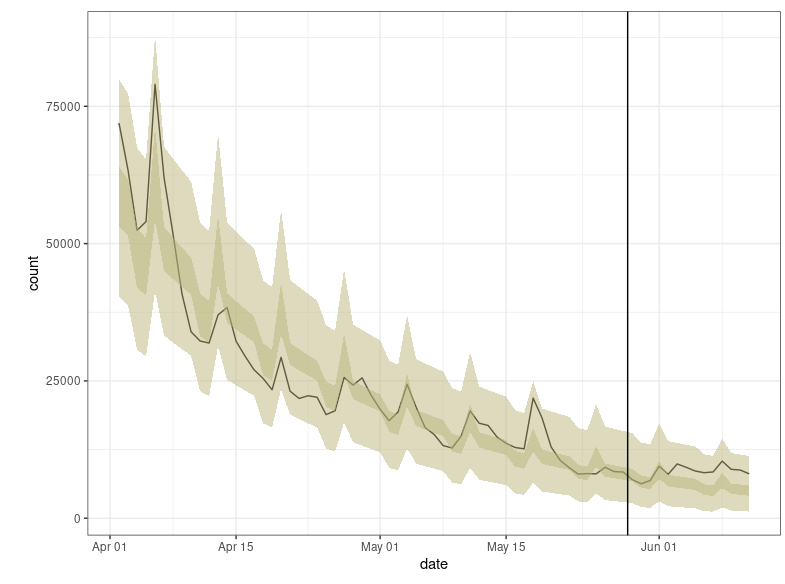
see #rstats trending and trendeval for automated model selection:
https://t.co/5vrFOO6rFs
itself used for fitting epidemic trends in i2extras:
https://t.co/PRfC2DQUxu
Is the new variant of SARS-CoV-2 more transmissible than others and if yes by how much? We @cmmid_lshtm are currently looking at this by comparing reproduction numbers between local areas in England (w/ @seabbs). WORK IN PROGRESS, NOT PEER REVIEWED. 1/10
https://t.co/7KjNmJUb0l
2 RA or Postdoc (London, United Kingdom)
Modelling Vaccine Impact in the Vaccine Impact Modelling Consortium
with @mathModInf
at @vaccineimpact@MRC_Outbreak @Imperial_JIDEA @Imperial_IDE
More details: https://t.co/kdJhzH4udP